


 Download Free Sample
 Buy Now
Market Size
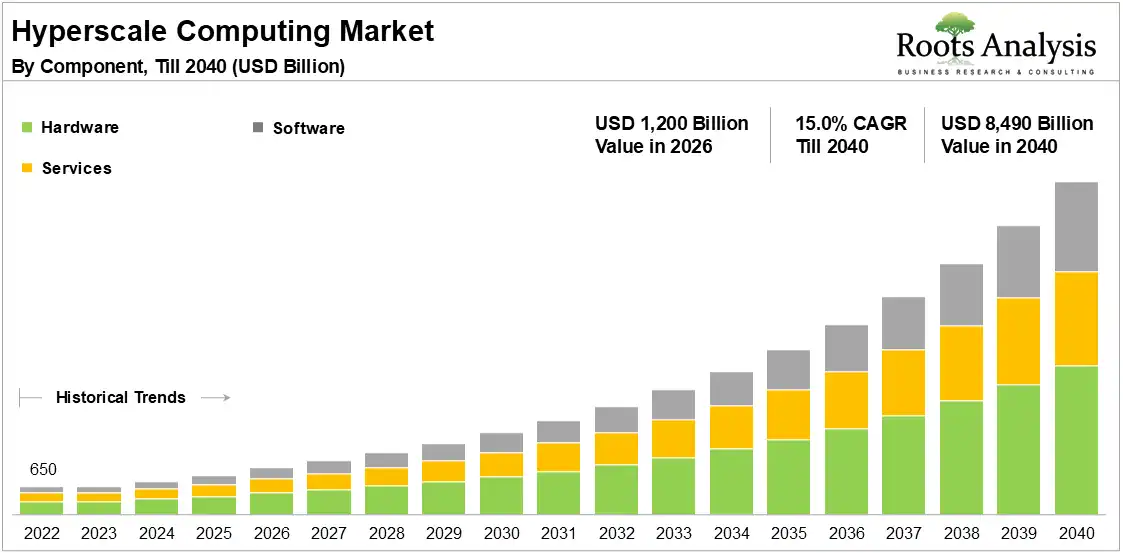
The hyperscale computing market is projected to reach USD 1,200 billion in 2026 and USD 8,490 billion by 2040, representing a compounded annual growth rate (CAGR) of 15.0% during the forecast period 2026 to 2040.
See What’s in the Full Report - Request Your Complimentary Insights!
Market Overview
Hyperscale computing refers to highly scalable and distributed architecture designed to manage massive data volumes and dynamic workloads efficiently. The market encompasses specialized hardware, including servers and networking gear optimized for large-scale deployments, and software-defined infrastructure (SDI) necessary for orchestration and automation. Value is derived from supporting high-performance computing, large-scale data analytics, cloud computing, and robust services for enterprise clients across various sectors.
Market expansion is primarily fueled by the accelerating adoption of generative AI and machine learning models, which necessitate immense processing power and scalable infrastructure. Hyperscale cloud providers market dominance plays a crucial role in enabling this growth, as enterprises increasingly rely on hyperscale platforms for scalable, AI-ready cloud solutions. Additional drivers include proliferation with internet of things (IoT) security becoming a core priority, generating large data sets, and ongoing enterprise digital transformation initiatives requiring robust cloud-based infrastructure. Major applications include high-performance computing (HPC) simulations, large-scale data analytics, and real-time inference across diverse industries like healthcare and finance. For instance, in 2024, major cloud service providers announced significant capital expenditures specifically dedicated to expanding data center capacity to meet surging demand for AI workloads.
Innovation is centered on enhancing energy efficiency and managing high thermal densities associated with advanced processing chips. Key trends include the integration of liquid cooling technologies and renewable energy sources to address rising operational costs and meet increasing sustainability targets. Looking ahead, hyperscale providers are investing in optimizing network architecture to support edge computing requirements and hybrid deployments. The market outlook remains robust, driven by continued investment in AI infrastructure and enterprise migration to multi-cloud environments.
Market Report: Key Takeaways
- Leading Players Competitive Footprint: Dominant players like Amazon Web Services, AMD, Apple, Cirrascale, Cisco Systems, Dell Technologies, Digital Realty, Enfabrica, Equinix, Exaion, Google Cloud, Hadean, Huawei, IBM, Intel, Lambda, Meta, Microsoft Azure, NVIDIA, Oracle hold strong market positions with extensive geographic presence in various regions.
- Startup Ecosystem and Innovation Hotspots: Early-stage companies are focusing on catering to the increasing demand for energy efficiency, sustainability, and AI-optimized infrastructure to address massive data center demands. Companies are making advancements such as advanced liquid/immersion cooling, low-carbon power integration, and efficient hardware for hyperscale AI clusters. The liquid cooling market for hyperscale computing is rapidly emerging as a defining factor in infrastructure scalability, supporting direct-to-chip cooling for higher graphic processor unit (GPU) density and closed-loop systems that reduce water and energy use.
- Regional Penetration and Adoption Trend: Driven by AI-native workloads, North America’s hyperscale market is rapidly expanding through gigawatt-scale campuses. Adapting to extreme thermal and high-density power demands via modular designs addresses critical unmet needs, empowering informed decision-making for stakeholders financing next-generation infrastructure.
- IT & Telecommunications holds Highest Market Segment: In terms of hyperscale computing market share by end use industry, IT & telecommunications sector dominates the market, accounting for 28.65% share in 2026. The growth is derived from fueling demand for scalable infrastructure to handle massive data processing and connectivity needs.
- Opportunities and Unmet Market Needs: Hyperscale computing presents massive opportunities in AI infrastructure and edge-hybrid deployments. Healthcare leads non-IT growth at a 23.64% CAGR, driven by AI diagnostics. Addressing these critical unmet needs empowers informed decision-making for stakeholders financing next-generation digital health platforms.
- Funding and Investment Momentum: Driven by private equity and government grants, hyperscale investments heavily target compiler ecosystems and sustainable AI infrastructure. Addressing critical unmet needs in computer efficiency empowers informed decision-making for stakeholders funding next-generation, high-throughput data centers.
Recent Industry Developments
- October 2025: Hyperscale Data announced an on-demand NVIDIA graphics processing cloud service featuring H100, B200, and B300 models. The service will launch in early 2026 through Alliance Cloud Services.
- September 2025: Alliance Cloud Services collaboration with a Silicon Valley provider after deploying NVIDIA GPUs, scaling AI/HPC infrastructure.
- July 2025: Acumera acquired Scale Computing to bolster AI edge capabilities for distributed sites. This enables organizations for decision-making, low-latency processing, and operational simplicity.
- May 2025: Nutanix and Pure Storage formed a strategic alliance for integrated solutions in mission-critical deployments and manage virtual workloads on a scalable modern infrastructure.
- February 2025: IBM completed $6.4 billion acquisition of HashiCorp for end-to-end hybrid cloud automation & generative AI in hyperscale environments.
Pay Only for What You Need – The Best Way to Optimize
Market Dynamics
Key Hyperscale Computing Market Drivers
- Generative AI and HPC Acceleration: The surging demand for high-performance computing (HPC) and generative AI model training requires specialized hardware (like GPUs and TPUs) that only hyperscale cloud providers can acquire and deploy effectively on a scale. This new wave of compute-intensive workloads drives significant revenue growth for hyperscale infrastructure providers.
- Data Proliferation from IoT and Connected Services: The exponential growth of data generated by a variety of sources, including IoT devices, connected applications, and real-time analytics, necessitates massively scalable storage and processing capabilities. Hyperscale infrastructure provides the only viable solution for managing this volume and velocity of data, driving continuous demand for computers, storage, and networking resources.
- Ecosystem Integration and Network Effects: Hyperscale providers offer a robust, integrated ecosystem of managed services, including databases, analytics tools, serverless functions, and development platforms (PaaS). The impact of 5G adoption on hyperscale infrastructure growth further amplifies the value of these comprehensive service portfolios, creating strong network effects that increase stickiness and encourage enterprises to expand their usage on a single hyperscale platform rather than managing disparate on-premisess systems.
- Supply Chain Efficiency and Economies of Scale: The large-scale purchasing power of hyperscale providers allows them to negotiate favorable terms for hardware components (servers, chips, networking gear) and efficiently manage resource utilization through virtualization. This results in significant economies of scale, making hyperscale services more cost-effective than building or maintaining private data centers.
Market Restraints
- Cloud Cost Management Complexity: While initial migration promises cost savings, managing cloud spending effectively on a scale is challenging due to the complexity of pricing structures and dynamic resource consumption.
- Vendor Lock-in and Multi-Cloud Complexity: The proprietary nature of specific PaaS offerings from major hyperscale providers creates significant friction and cost for enterprises attempting to migrate between cloud platforms or adopt multi-cloud strategies. While enterprises desire flexibility, the high cost of data increases and re-platforming acts as a powerful deterrent.
- Talent Shortage in Cloud Engineering and Security: There is a significant and persistent shortage of skilled professionals in cloud architecture, DevOps, and specialized security (DevSecOps) roles required to effectively implement and manage large-scale hyperscale environments, including expertise in software-defined networking (SDN) for hyperscale deployments. This skills gap acts as a critical bottleneck for organizations seeking to design, operate, and optimize SDN-driven hyperscale infrastructures, slowing new implementations and optimization initiatives.
- Legacy System Integration and Interoperability Issues: Many enterprises still rely on legacy systems and applications (mainframes, on-premisess databases) that are difficult or cost-prohibitive to migrate to a public cloud environment. The challenge of integrating these older systems with modern hyperscale infrastructure slows down complete cloud adoption and necessitates complex hybrid solutions.
Market Share Insights
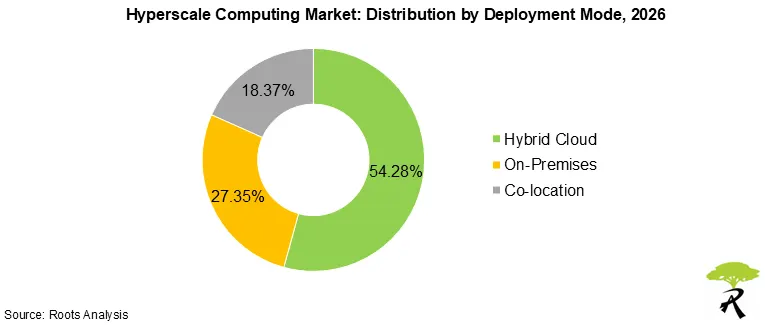
Market Share by Deployment Mode: Cloud Deployment Leads, Powered by AI & Hybrid Strategies
- According to our 2026 hyperscale computing market analysis, cloud-based deployment holds the largest market share, driven by the exponential demand for scalable AI model training and inference. However, growth is increasingly supported by hybrid cloud strategies (integrating public cloud with private infrastructure), which are projected to expand rapidly. This shift is fueled by the need to balance massive scalability with data sovereignty in high-stakes environments.
- There is a surging industrial demand for specialized infrastructure capable of handling high-density AI workloads. While public cloud leads, large enterprises are heavily investing in co-location and private cloud segments to manage latency-sensitive workloads, such as algorithmic trading and immersive media. This ensures high availability and precise control while mitigating the risks of public multi-tenant environments.
- The forecast indicates that deployment strategies are being reshaped by data sovereignty requirements. Organizations are leveraging hybrid architectures to retain sensitive data within controlled environments to meet rigorous standards like GDPR and HIPAA, while still bursting less sensitive processing tasks to the public cloud. This approach minimizes vendor lock-in and optimizes cost-performance ratios for compliance-heavy sectors.
- A prime example of this infrastructure evolution is CoreWeave’s strategic acquisition of Core Scientific’s assets. Rather than traditional on-premises models, the acquisition highlights the trend of vertical integration in the GPU cloud market. By securing 32 facilities with approximately 250,000 GPUs, CoreWeave is retrofitting high-power colocation sites to support liquid-cooled, high-density AI clusters. This addresses the critical shortage of power-ready infrastructure for AI-native tenants, validating the shift toward specialized, high-performance data center operations.
Market Share by Geographical Regions: North America to Dominate the Industry While Asia-Pacific to Grow Rapidly Through 2040
- The regional analysis suggests that North America is expected to hold the largest hyperscale computing market share of 42.36% while Asia-Pacific is expected to witness the fastest CAGR.
- The North America dominance is due to enterprise cloud offload and its unmatched concentration of hyperscale’s such as AWS, Microsoft Azure, and Google Cloud which tends to operate vast data center networks supporting global AI and cloud demands.
- In the Asia-Pacific region, the hyperscale computing market is experiencing the fastest growth, with a CAGR of 26.60%, driven by explosive demand across end-use sectors such as IT, BFSI, and healthcare. This expansion is further supported by government investments and favorable regulatory tailwinds aimed at strengthening digital infrastructure.
Want Information on Specific Region / Segment?
Market Ecosystem Insights
Leading Players Competitive Footprint
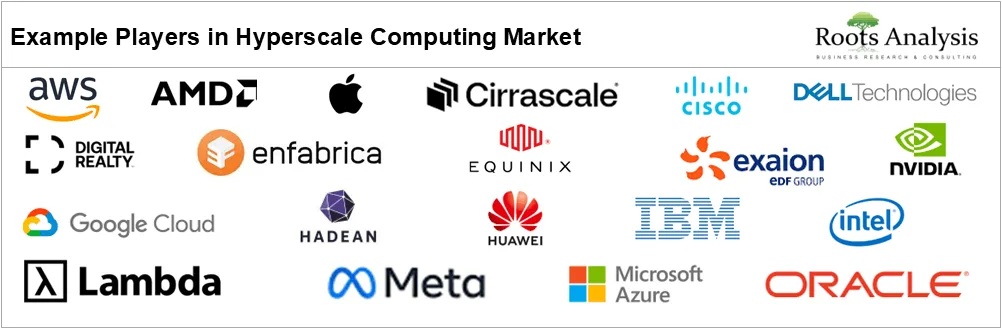
Leading players in the hyperscale computing market domain include industry giants such as Amazon Web Services, AMD, Apple, Cirrascale, Cisco Systems, Dell Technologies, Digital Realty, Enfabrica, Equinix, Exaion, Google Cloud, Hadean, Huawei, IBM, Intel, Lambda, Meta, Microsoft Azure, NVIDIA, Oracle which hold strong market positions through their extensive product portfolios and global reach.
Collaborations and expansions remain key growth strategies, with players accelerating innovation, market penetration, and scalability. For instance, Microsoft partnered with G42 to invest heavily in developing large-scale AI infrastructure in the UAE, expanding its presence in the hyperscale computing market.
Similarly, Nvidia and Microsoft announced a collaboration to build one of the world's most powerful AI supercomputers, utilizing Nvidia's advanced technologies within Microsoft Azure's infrastructure. These "Fairwater" superfactories leverage advanced liquid cooling to support massive-scale AI reasoning, providing unparalleled performance for commercial and research applications.
Startup Activity and Innovation Hotspots
Startup activity within the hyperscale landscape is evolving rapidly, with early-stage companies disrupting traditional models through sustainable, high-performance edge solutions. These innovators focus on physical AI and liquid-cooled infrastructure to resolve the critical compute shortages currently stalling large-scale training. Below outlined are recent strategic moves undertaken by the innovators in this industry:
- Enfabrica Networking Breakthroughs: Addressing data flow bottlenecks, Enfabrica released its ACF SuperNIC and EMFASYS memory fabric in 2025. This technology allows clusters of up to 500,000 GPUs to communicate with unparalleled efficiency, drastically reducing the cost-per-token for generative AI tenants.
- Cirrascale’s Specialized Inference Cloud: Leading the shift toward AI reasoning, Cirrascale deployed the NVIDIA HGX B300 (Blackwell Ultra) in late 2025. Their specialized cloud environment bypasses traditional hyperscale virtualization, offering bare-metal performance tailored for high-token-throughput applications like real-time video generation and autonomous agents.
- Edge-Native Infrastructure Hotspots: Startups are increasingly deploying micro-edge racks in industrial hubs to meet new regulatory mandates for local data processing. These energy-efficient, liquid-cooled platforms enable predictive maintenance and autonomous robotics at the source, reducing reliance on centralized cloud cycles.
Funding and Investment Trends
The hyperscale market is currently fueled by a historic investment super cycle, as capital shifts from general cloud services to specialized AI and edge infrastructure. Massive inflows from venture capital, private equity, and sovereign wealth funds are enabling operators to secure the high-density power and specialized cooling required for 2026-era workloads. Below outlined are recent instances of funding and investments secured by companies active in this industry:
- Microsoft’s European AI Expansion: Microsoft has committed €4 billion to France, marking its largest local investment. This initiative focuses on expanding data center campuses near Paris and Marseille while deploying 25,000 next-generation GPUs to support high-performance AI training and cloud services across the region.
- BlackRock and GIP Infrastructure Bet: In a landmark $12.5 billion transaction, BlackRock acquired Global Infrastructure Partners to dominate large-scale digital assets. The move targets the rising demand for the resilient, high-capacity physical infrastructure essential for supporting global hyperscale and energy-intensive data centers.
- Distributed Cloud and Edge Funding: Emerging startups like Hadean, backed by Adit Ventures, are securing capital to scale distributed simulation and spatial computing platforms. These investments prioritize edge AI innovation, allowing for real-time processing and low-latency applications that bypass traditional centralized cloud bottlenecks. Microsoft's AI Investment in France.
Your Business is Unique – Why Shouldn’t Your Report Be?
Hyperscale Computing Market: Scope of the Report
| Key Report Attributes | Details | |
| Historical Trend | Since 2022 | |
| Forecast Period | Till 2040 | |
| Market Size 2026 | $ 1,200 Billion | |
| Market Size 2040 | $ 8,490 Billion | |
| CAGR (Till 2040) | 15.0% | |
| Segments Covered |
|
|
Market Segmentation
Based on research, we have segmented the hyperscale computing market into component, deployment mode, end use industry, application, geographical regions, and key players.
Market Share by Component
- Hardware
- Software
- Services
Market Share by Deployment Mode
- Co-location
- Hybrid Cloud
- On-premises
Market Share by End Use Industry
- BFSI
- Government & Public Sector
- Healthcare
- IT & Telecommunications
- Manufacturing
- Retail & E-commerce
Market Share by Application
- AI / Machine Learning
- Big Data Analytics
- Cloud-Based Storage
- High-Performance Computing (HPC)
- Internet of Things (IoT)
Market Share by Geographical Regions
- North America
- US
- Canada
- Mexico
- Rest of North America
- Europe
- Austria
- Belgium
- Denmark
- France
- Germany
- Ireland
- Italy
- Netherlands
- Norway
- Russia
- Spain
- Sweden
- Switzerland
- UK
- Rest of Europe
- Asia-Pacific
- Australia
- China
- India
- Japan
- New-Zeeland
- Singapore
- South Korea
- Rest of Asia-Pacific
- Latin America
- Brazil
- Chile
- Colombia
- Venezuela
- Rest of Latin America
- Middle East and Africa (MEA)
- Egypt
- Iran
- Iraq
- Israel
- Kuwait
- Saudi Arabia
- UAE
- Rest of MEA


