


 Download Free Sample
 Buy Now
Immersive Media Market Size
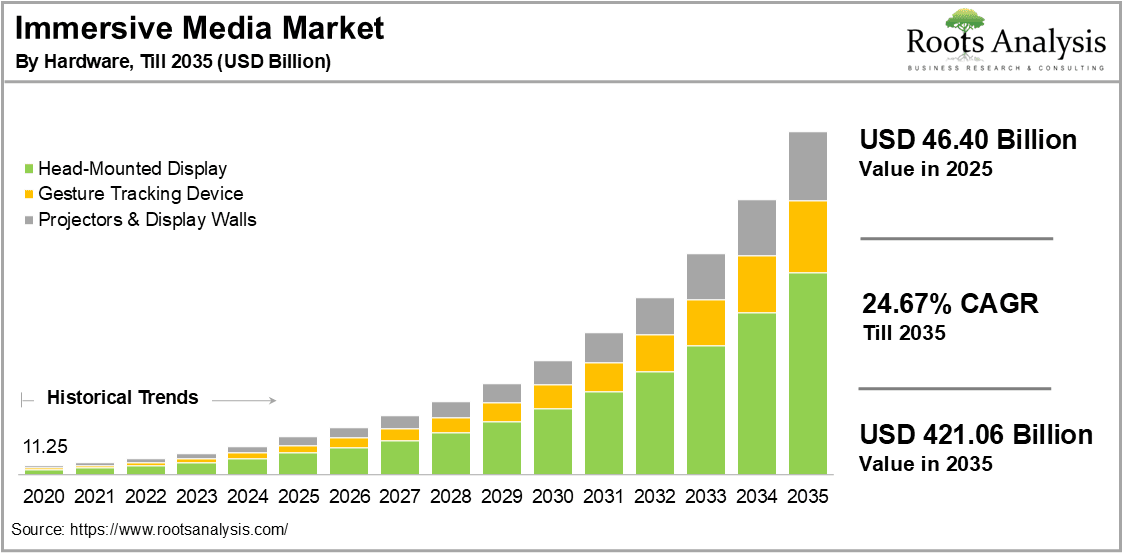
The global immersive media market, valued at USD 46 billion in 2025, is projected to reach USD 174 billion in 2030 and USD 421 billion by 2035, with a CAGR of 24.67% during the forecast period 2025 to 2035.
See What’s in the Full Report–Request Your Complimentary Insights!
Immersive media encompasses a transformative class of digital experiences that fully engage users by blending physical and virtual worlds, thereby creating multi-sensory environments that feel lifelike and interactive. Unlike traditional media (which engages sight and sound in a linear fashion), immersive media leverages virtual reality, augmented reality, and mixed reality to enable users to interact naturally with content, often influencing the narrative or environment in real-time.
This innovative technology is reshaping how individuals learn, work, and connect. For instance, through immersive simulations and use of augmented reality in education, learners and professionals can safely practice complex tasks, while brands leverage immersive storytelling to create memorable, personalized customer interactions that foster loyalty and influence purchasing behavior.
Industry experts emphasize immersive media’s transformative potential across multiple sectors. Assessing the impact of immersive media in architecture, Jeffrey Powers, Co-founder and CEO of Occipital, notes “Immersive media allows professionals to iterate on city plans, homes, and construction worksites multiple times virtually before beginning physical work, leading to significant capital savings and better designs.”
This direct, embodied experience facilitates users to walk, fly, and interact with their virtual surroundings, which not only enhances accuracy but also fosters more creative and effective outcomes. Beyond practical applications, immersive media opens new frontiers in narrative design and user experience. As technology matures, these interactive environments are evolving into rich social spaces and virtual worlds, signaling a profound shift in digital culture and communication.
Recent Developments in the Immersive Media Market
- In July 2025, Naver announced the expansion of immersive media with the launch of AI video and XR content in late 2025.
- In May 2025, VUZ secured $12 million from IFC to fuel global immersive media expansion.
- In April 2025, Tribeca Festival launched an immersive technology exhibit ‘In Search of Us’ in partnership with Onassis ONX and Agog: The Immersive Media Institute. The exhibit will highlight futurism, activism, video games, XR and music.
- In March 2025, Apple unveiled an immersive concert experience with Metallica on Apple Vision Pro (an Apple VR and augmented reality headset, emphasizing spatial computing).
- In January 2025, Fourth Star launched an immersive media streaming platform, enabling users to seamlessly watch standard 2D, 180 and 360 immersive media content and movies.
Immersive Media Market Dynamics
Key Drivers Fueling Demand for Immersive Media
- Rapid Technological Advancements in AR, VR, and MR: AR VR market insights suggest that these advanced technologies are revolutionizing media delivery, making digital content more interactive and life-like. Leading companies, such as Meta, Sony, and Microsoft are heavily investing in improved hardware and software ecosystems to enhance user experience, catalyzing wider adoption across sectors.
- Expanding Applications Across Multiple Industries: Immersive media is being rapidly integrated into entertainment, gaming, education, healthcare, training, manufacturing, and e-commerce, offering solutions like virtual classrooms, realistic healthcare simulations, and immersive shopping.
- Increasing Consumer Demand for Interactive and Personalized Experiences: Audiences seek deeper, more engaging interactions with content, fueling demand for personalized and participatory experiences such as social VR, interactive events, and gamified learning. Consumer appetite is reflected in strong sales growth for AR / VR devices and significant rises in e-sports and live-streaming platform engagement.
Key Market Challenges
- High Content Development Costs and Technical Complexity: Delivering high-quality immersive experiences requires significant investment in technology, creative talent, and iterative testing. These costs can be prohibitive for small and mid-sized enterprises, limiting content diversity and innovation in the market.
- Privacy and Data Security Concerns: Immersive platforms often collect sensitive user data (biometrics, behavior patterns), leading to growing concerns regarding data privacy, user consent, and security. As regulations tighten, compliance costs and potential reputational risks may impede growth, especially in consumer-facing applications.
- Fragmented Hardware and Platform Ecosystem: Numerous competing devices, operating systems, and development frameworks hinder seamless interoperability and content distribution. This fragmentation creates user friction, additional porting costs for developers, and slower overall market convergence.
Have Questions? Let’s Get Them Answered.
Market Share Insights
Hardware Sub-segment Dominates the Immersive Media Industry
Among the different components, the augmented reality hardware is leading the current global market, holding maximum share of 51.93%. This is due to the fact that hardware forms the tangible interface that users interact with, making it the fundamental enabler for immersive media.
Physical devices, such as VR and augmented reality headsets, AR glasses, haptic gloves, motion sensors, and display panels are essential to deliver immersive experiences. Further, the demand for such devices is driven strongly by gaming, entertainment, and professional training applications where high-quality devices improve user engagement and realism.
In contrast, the service segment is growing the fastest due to the evolving needs of users for customized experiences, scalability, and ongoing content development, critical for sustaining user interest and enterprise adoption. The push toward cloud deployment and managed services further accelerates this growth.
Virtual Reality Technology to Shape the Future of Immersive Multimedia
The virtual reality sub-segment dominates the industry, holding a significant share (46.20%) within the current global market. Virtual reality adoption in media aids in applications across multiple sectors, such as gaming, entertainment, healthcare, and education due to its ability to deliver fully immersive, realistic simulations and interactive experiences.
The mixed reality market opportunity estimates suggest that it is poised to have the fastest growth (relatively high CAGR) within the immersive media industry through 2035. This is due to the fact that MR combines the real and digital worlds to allow more interactive and context-rich experiences, gaining traction across multiple entertainment and gaming applications.
Cloud Deployment to Drive the Market Growth Through 2035
Among the types of deployment mode in the immersive media solutions market, cloud-based deployment is expected to experience the fastest growth rate during the forecast period 2025 to 2035. Notably, benefits of cloud deployment, such as lower upfront costs, easier updates, and distributed user connectivity, accelerates its adoption in education, retail, and media sectors.
Cloud deployment is emerging as the most preferred mode of deployment due to the improvements in cloud computing, 5G wireless networks, and demand for scalable, remote-access immersive applications. While the on-premises deployment dominates the current virtual reality industry. This is due to security, privacy, and latency concerns of organizations running sensitive operations, particularly in enterprise, defense, and healthcare verticals to meet compliance and ensure reliability.
Training and Learning Application to Hold Lucrative Market Share
Currently, the training & learning sub-segment dominates the immersive media industry by capturing the maximum share of 39.17%. Adoption of AR and VR platforms in immersive media for enterprise training effectively enhance skill acquisition across various sectors, including corporate firms, healthcare, emergency services, and military exercises.
The sales and marketing segment is projected to grow with a faster CAGR during the forecast period as brands adopt AR VR technologies for virtual product showcases, interactive ads, and immersive brand experiences. This segment benefits from digital transformation and consumer demand for engaging, personalized shopping and brand interaction.
AR and VR Games Fuel Immersive Media Expansion
Among various end use industries leveraging AR and VR technology, the gaming industry (holding maximum share) drives the current immersive media market growth. This is due to the elevated user engagement with highly interactive and realistic experiences. Further, growing virtual reality adoption in media and game titles, the expansion of esports, and innovations in standalone VR headsets have made immersive gaming accessible to wide demographics, propelling market growth.
Immersive media for healthcare sector is projected to exhibit the highest CAGR over the forecast period. This growth is driven by the rising adoption of immersive technologies, such as VR and AR to revolutionize market patient care, improve medical training, and facilitate remote consultations.
Regional Outlook: North America Dominates Market, Asia-Pacific Experiences Rapid Growth
According to our regional growth forecast for immersive media market, North America is likely to hold the largest share. The rapid growth of the North American region is supported by advanced technological infrastructure in the US and Canada. Further, early adoption of cutting-edge technologies and high demand for real-time and virtual experiences are key growth drivers.
Currently, North America captures about 42.48% of the global market share, underscoring its dominance. In contrast, the Asia-Pacific market is expected to grow at a faster CAGR of 25.85% during the forecast period, fueled by rapid digital transformation, increasing investments in immersive technologies, and a growing consumer base. This positions the Asian region as an emerging powerhouse in the immersive media landscape.
Want Information on Specific Region / Segment?
Market Key Takeaways
Competitive Landscape of Key Immersive Media Company
The immersive media market is highly competitive, featuring major technology giants and specialized players. These players drive market growth through continuous innovation in virtual reality, augmented reality, and mixed reality technologies.
The landscape also sees strategic moves like acquisitions and product launches, such as Microsoft acquisition of Activision Blizzard, Meta’s VR hardware launches, and Sony’s PlayStation VR2. Further, the market competition remains intense as companies invest in advanced hardware, software, and content to deliver ever more immersive and interactive experiences, making the industry leadership dynamic and innovation driven.
Integration of Immersive Content in Healthcare and Education Industries
- In healthcare, immersive media enhances training and patient care through realistic simulations and surgical training, with the market projected over $10 billion by 2025.
- Immersive experiences in education are provided through VR, which improves learning effectiveness by 76%, accelerates skill acquisition, and supports personalized learning experiences with artificial intelligence assistance.
Cost-Benefit Analysis of Deploying Immersive Technology in Brand Storytelling
- Initial deployment of immersive technologies, such as VR, AR, and MR often requires significant investment in specialized hardware and development of bespoke interactive content.
- Immersive technology market trends suggest that despite higher upfront costs, brands can substantially reduce long-term expenditures by cutting back on physical events, travel, and traditional campaign production.
- Enhanced engagement from immersive experiences leads directly to higher customer retention rates and improved return on investment, as consumers are more likely to recall and advocate for brands using innovative media.
- Digital platforms offer robust analytics and tracking, enabling brands to optimize immersive campaigns and demonstrate quantifiable value from technology.
Investment Opportunities in Immersive Media Hardware and Software Startups
- The competitive landscape features established technology giants and disruptive niche players across North America, Europe, and Asia-Pacific, with investors favoring startups with proprietary technology and global scaling potential.
- Rapid expansion of AR and VR hardware markets, including smart headsets and advanced haptic devices, is attracting increased venture capital and corporate investment.
- Immersive content creation platforms, real-time 3D engines, and spatial design tools represent high-growth sectors for investment due to rising demand from entertainment, gaming, and enterprise customers.
- Startups offering enterprise training solutions using immersive media are gaining traction for their proven ability to reduce costs, improve learning outcomes, and increase scalability for large enterprises.
- The development of AI-powered personalization tools is enabling richer, adaptive experiences and boosting the value proposition for immersive apps and platforms.
Emerging Trends in Interactive and Social Virtual Experiences for Consumer Engagement
- Platforms increasingly support social VR experiences, multiplayer mixed reality games, and collaborative virtual environments.
- These foster real-time interaction and community building, significantly enhancing consumer engagement.
- Such trends drive innovation in entertainment and marketing sectors.
Future Outlook for Mixed Reality Solutions in Media and Entertainment Sector
- Mixed reality adoption is accelerating due to affordable devices and more user-friendly creative tools, bridging physical and digital worlds for mainstream entertainment.
- New experiences such as live virtual concerts, immersive gaming environments, and interactive event venues are driving demand for MR technologies in the entertainment sector.
- Integration with metaverse platforms and Web 3.0 will increase mixed reality market opportunity and is set to unlock new business models, immersive social interactions, and innovative monetization strategies for media companies.
- Advances in MR will enable personalized and scalable content production to enhance customer engagement and expand revenue streams for both content creators and distributors.
- Ongoing investment in interoperability, privacy, and high-fidelity graphics will further support the growth and mainstream acceptance of mixed reality experiences globally.
Impact of Immersive Media Experiences on Digital Marketing and Retail Engagement
Immersive media enables highly interactive, personalized brand experiences such as virtual try-ons and AR ads, which significantly increase consumer engagement and loyalty. These experiences transform passive viewing into active participation, enhancing digital marketing effectiveness and retail customer immersion.
Your Business is Unique – Why Shouldn’t Your Report Be?
Immersive Media Market: Scope of the Report
| Key Report Attributes | Details | |
| Historical Trend | Since 2020 | |
| Forecast Period | Till 2035 | |
| Market Size 2025 | $ 46.40 Billion | |
| Market Size 2035 | $ 421.06 Billion | |
| CAGR till 2035 | 24.67% | |
| Component |
|
|
| Hardware |
|
|
| Technology |
|
|
| Deployment Mode |
|
|
| Application |
|
|
| End Use Industry |
|
|
| Geographical Regions |
|
|
| Key Players Profiled |
|
|
| PowerPoint Presentation (Complimentary) | Available | |
| Customization Scope | 15% Free Customization | |
| Excel Data Packs (Complimentary) |
|
|


