
Lowest Price Guaranteed
Slides
211
Last Updated
July 2025
View Count
12673
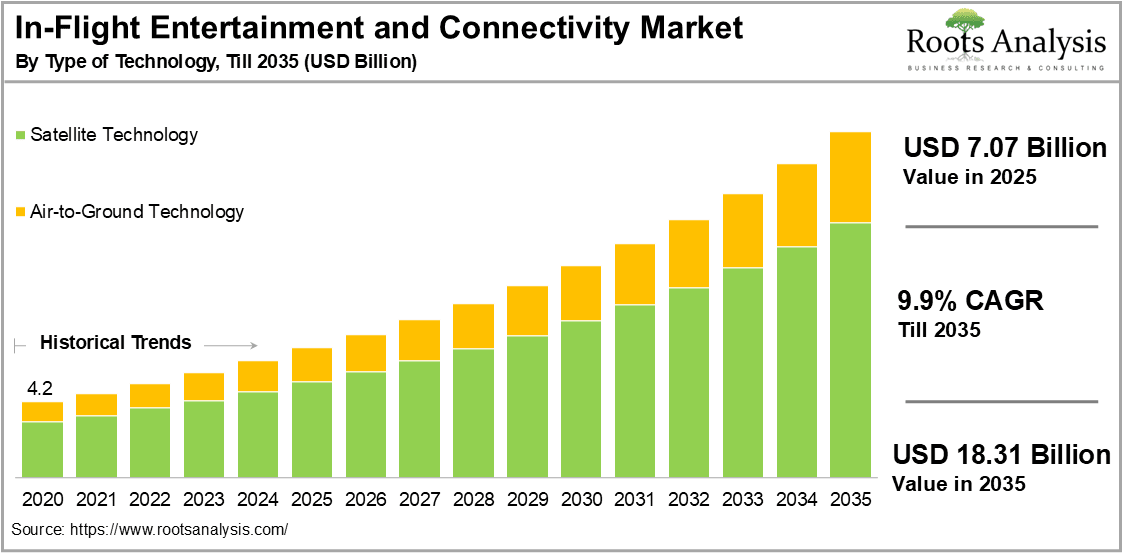
The global in-flight entertainment market size is projected to grow from USD 7.07 billion in 2025 to USD 18.31 billion by 2035, representing a CAGR of 9.9%, during the forecast period till 2035.
 |
The new research study consists of global in-flight entertainment and connectivity analysis, detailed market analysis, mega trends, patent analysis, porter five forces, SWOT analysis, value chain analysis and other strategic frameworks.
In-flight entertainment (IFE) encompasses the various media options available to passengers during flights, including movies, TV shows, music, games, and books. This content is typically accessed via personal screens mounted on seatbacks or through mobile devices, allowing passengers to enjoy it throughout their journey. Connectivity refers to the ability of travelers to access the internet while in the air. Many airlines now provide Wi-Fi services, enabling passengers to browse the web, check emails, and stay connected through messaging apps and social media.
The growth of the in-flight entertainment and connectivity (IFEC) market is driven by several factors, including the rising demand for personalized experiences, enhanced passenger engagement, and seamless connectivity onboard. A significant trend is the increasing desire for personalization; passengers are no longer content with standard entertainment offerings and seek tailored content that aligns with their individual preferences. Airlines are responding by providing personalized recommendations based on passenger data, including viewing history.
Additionally, airlines are expanding their content libraries to include a wider variety of options—like TV shows, movies, music, and games—to cater to diverse tastes. The need for uninterrupted connectivity is another critical factor propelling the IFEC market's expansion. Passengers want to maintain connections with friends, family, and colleagues while flying at high altitudes. To meet this expectation, airlines are implementing advanced connectivity technologies like Ka-band satellite systems that deliver faster and more reliable satellite internet services compared to traditional Wi-Fi options.
The in-flight entertainment market report presents an in-depth analysis of the various companies that are involved in offering in-flight entertainment and connectivity solutions, across different segments, as defined in the table below:
| Key Report Attributes | Details | |
| Historical Trend | Since 2020 | |
| Forecast Period | 2025-2035 | |
| Market Size Value in 2025 | $ 7.07Billion | |
| Market Size Value by 2035 | $ 18.31 Billion | |
| CAGR (Till 2035) | 9.9% | |
| Type of Offering |
|
|
| Type of Component |
|
|
| Types of Aircraft |
|
|
| Type of Technology |
|
|
| Type of Service |
|
|
| Type of Class |
|
|
| Type of End-Users |
|
|
| Type of Enterprise |
|
|
| Geographical Regions |
|
|
| Leading Market Players |
|
|
| PowerPoint Presentation (Complimentary) |
Available | |
| Customization Scope | 15% Free Customization | |
| Excel Data Packs (Complimentary) |
|
|
Based on the type of offering, the market is split into IF connectivity, and IF entertainment. Among these categories, IF entertainment segment growth is expected to dominate the market with a share of 85.85%. This growth is attributed to the increasing expectations of modern travelers for a diverse array of entertainment options, including movies, TV shows, music and games. This focus on providing high-quality entertainment not only improves passenger satisfaction but also serves as a competitive differentiator in a crowded market.
On the other hand, the IF connectivity segment is expected to witness rapid growth at a significant CAGR of 10.23% during the forecasted period. Airlines are increasingly recognizing the importance of providing reliable in-flight internet access during flights. Major airline businesses worldwide are continually seeking to improve their connection service offerings to provide customers with better speed and capacity, resulting in more ancillary profits, according to airline entertainment services report.
The global in-flight entertainment and connectivity market is segmented into various types of components such as connectivity, content and hardware. According to our in-flight entertainment and connectivity industry analysis, the connectivity segment will augment the segment's growth with the largest market share of over 64.56% by the next decade. The BYOD trend and wireless mobile electronic gadgets are expected to drive the segment growth. Further, the growth is largely attributed to airlines investing in advanced technologies such as satellite and air-to-ground connectivity to enhance passenger experiences. As travelers increasingly expect seamless internet access for work and leisure, airlines are prioritizing robust in-flight connectivity solutions, which are essential for meeting modern passenger demands.
On the other hand, it is worth highlighting that the hardware segment is expected to witness the fastest CAGR of around 11.72% during the forecasted period. This trend reflects ongoing innovations aimed at developing lightweight and advanced IFEC systems. Airlines are continuously upgrading their aircraft with new hardware components, such as satellite antennas and onboard servers, to improve both entertainment and connectivity options.
The market is segmented into various types of aircraft such as business jets, narrow body, regional jets and wide body. According to our in-flight entertainment and connectivity growth forecast, the narrow-body aircraft segment will augment the segment's growth with the largest market share of over 55.68% by the next decade. This dominance is driven by the increasing number of narrow-body aircraft being added to airline fleets, as they offer better fuel efficiency and are well-suited for short to medium-haul flights.
Furthermore, the business jets segment is expected to witness a growth of CAGR of 12.87% during the forecast period. The rising demand for private and business travel, particularly in emerging markets, is propelling this growth. Business jets provide a unique value proposition by offering enhanced comfort, privacy, and personalized services, which are increasingly appealing to corporate travelers.
The market is segmented into various types of technology, such as air-to-ground technology and satellite technology. According to our in-flight entertainment and connectivity market statistics, the satellite technology segment will augment the market's growth with a market share of 85.83% during the forecasted period. This dominance is largely due to the widespread adoption of satellite-based systems, which provide reliable and high-speed internet access to passengers during flights. Satellite connectivity in aviation enables airlines to offer seamless connectivity for various applications, such as in-flight streaming services market and real-time communication, which are increasingly demanded by travelers.
Furthermore, the air-to-ground technology segment is expected to witness the fastest CAGR of around 10.66% during the forecasted period. This growth is driven by advancements in air-to-ground connectivity solutions that offer cost-effective alternatives for providing internet access on shorter routes. As more airlines explore hybrid models that combine both satellite and air-to-ground technologies, the air-to-ground segment is gaining traction due to its potential for lower operational costs and improved service delivery in specific markets.
The market is segmented into various types of services, such as data connectivity, flight tracker, video display systems, and others. According to our IFEC industry trends, the data connectivity segment will augment the market's growth with a market share of 67.65% during the forecasted period. This growth is driven by the growing demand for dependable internet access during flights. As travelers increasingly seek seamless connectivity comparable to what they enjoy on the ground, airlines are focusing their investments on advanced data connectivity solutions, making it a significant factor in market growth.
Furthermore, the video display systems segment is expected to witness the fastest CAGR of around 12.28% during the forecasted period. This growth is fueled by advancements in display technology and the rising expectations of passengers for high-quality visual entertainment during their journeys. Airlines are progressively adopting cutting-edge video display systems that offer a more immersive viewing experience, including options for on-demand content and interactive features.
The market is segmented into various types of classes, such as business, economy, first and premium economy. According to our in-flight entertainment and connectivity analysis, the business class segment will augment the market's growth with a market share of 67.65% during the forecasted period. The segment growth is primarily due to the higher revenue generated from premium services offered to business travelers. Airlines are increasingly investing in advanced IFEC systems for business class to enhance passenger experience and meet the expectations of this lucrative customer segment.
Furthermore, the premium economy segment is expected to witness the fastest CAGR of around 11.93% during the forecasted period. This growth is driven by an increasing number of airlines introducing premium economy as a more affordable alternative to business class, offering enhanced comfort and amenities without the full cost of business travel. As more travelers seek a balance between cost and comfort, airlines are expanding their premium economy offerings, which includes improved IFEC systems to cater to this growing demand.
The market is segmented into various types of end-users, such as aftermarket, and original equipment manufacturer (OEM). According to our in-flight entertainment and connectivity analysis, the original equipment manufacturer (OEM) segment will augment the market's growth with a market share of 87.65% during the forecasted period. This growth is attributed to OEMs being at the forefront of adopting and implementing the latest technological advancements in IFEC systems, equipping new aircraft models with cutting-edge entertainment and connectivity solutions from the outset. This significantly enhances the overall passenger experience.
Furthermore, the aftermarket segment is expected to witness the fastest CAGR of around 13.26% during the forecasted period. This surge is largely driven by This growth can be attributed to airlines increasingly retrofitting existing aircraft with advanced IFEC systems to meet rising passenger expectations for connectivity and entertainment.
The market is fragmented into multiple types of enterprise namely large and small and medium enterprise. Currently, the large enterprise segment is anticipated to dominate the segment with 72.84% of the market share. However, small and medium enterprise segments are expected to witness a relatively higher (37.78%) growth rate until 2035. This is ascribable to their agility, innovation, focus on niche markets, and ability to adapt to changing customer preferences and market conditions.
This segment highlights the distribution of in-flight entertainment and connectivity market share by region, such as North America, Europe, Asia, Latin America, Middle East and North Africa, and the rest of the world. According to our regional analysis, North America currently exhibits dominance with 37.69% of overall market share. The market is driven by the availability of advanced high-speed internet infrastructure, increased data usage in both air and ground applications, and user customization features.
The “In-Flight Entertainment and Connectivity Market, Till-2035: Industry Trends and Global Forecasts” report features an extensive study of the current market landscape, market size and future opportunity within the IFEC market forecast period. The market report highlights the efforts of several stakeholders involved in this rapidly emerging segment of the service providers industry. Key takeaways of the global in-flight entertainment and connectivity market report are briefly discussed below.
The global in-flight entertainment systems growth is expected to be driven by the growing need to enhance passenger in-flight experience. The overall travel experience for passengers is significantly influenced by cabin interiors, comfortable seating, entertainment options, and high-speed internet access. Consequently, leading in-flight entertainment (IFE) service providers are concentrating on developing advanced technological solutions that ensure passenger satisfaction and safety during long-haul flights. Additionally, airline operators are investing in modernizing IFE connectivity and content offerings to replace outdated systems. Low-cost carriers are also upgrading traditional aircraft seating arrangements integrated with IFE systems to premium seating structures, which is anticipated to further stimulate market growth in the coming years.
According to the IFEC competitive landscape analysis, with the presence of several small and large companies, the market is experiencing intense competition and changing market dynamics. From large multinational companies to local players, companies are striving to enhance their competitive edge. In terms of market share, large enterprises and multinational companies are dominating the market. The key players are using strategies such as partnerships, acquisitions, ventures, innovations, novel product launches, R&D and geographical expansions in an attempt to solidify their position in the industry.
For instance, in November 2024, ASG and Maxposure partnered together to launch an advanced IFE system. In reference to this, Hugo L. Fortes, Vice President of Avionics Support Group stated that, collaborating with Maxposure will allow them to expand their offerings and enhance the in-flight experience for their airline partners and their passengers. Our combined expertise will ensure top-tier entertainment options while upholding the highest standards of safety and reliability.
Despite the strong market growth projection, there are several challenges in the in-flight entertainment and connectivity market. One significant obstacle is the high implementation and operational costs associated with installing and maintaining advanced IFEC systems. Airlines must invest heavily in both hardware and software to meet the rising expectations of passengers for seamless connectivity and entertainment options. Additionally, technical challenges in delivering consistent airline passenger connectivity solutions can impede service quality, particularly in regions with limited satellite coverage or bandwidth limitations.
With respect to regional industry insights, North America is likely to dominate the market for the forecasted period. The dominance of this region is majorly influenced by the presence of major players operating in the market. Additionally, North America boasts one of the largest and most mature aviation industries globally. It experiences one of the world’s highest air traffic volumes, with extensive domestic and international routes, driving a significant demand for advanced IFEC systems.
Examples of leading in-flight entertainment and connectivity manufacturers (which have also been captured in this market report, arranged in alphabetical order) include Anuvu, Astronics, BAE Systems, Burrana, Cobham, Collins Aerospace, Digecor, Eagle Entertainment, EchoStar, Eutelsat, FDS Avionics, Global Eagle Entertainment, Gogo, Honeywell, Inmarsat Global, Iridium Communications, Kymeta, Lufthansa Systems, Lumexis, Panasonic Avionics, Razor Secure, Rockwell Collins, Safran, SITA, SITAONAIR, SmartSky, Spafax, Thales, Thinkom, ViaSat.
The market report presents an in-depth analysis, highlighting the capabilities of various companies engaged in this domain, across different segments. Amongst other elements, the market report includes:
At Roots Analysis, we genuinely care about your success and understand that your business requirements are unique. While our in-flight entertainment and connectivity market research reports provide valuable insights, we recognize that they might not cover every aspect you need to make well-informed strategic decisions. To account for that, we offer 15% free report customization tailored to your specific needs. Whether you require additional quantitative analysis, qualitative insights, or any other information related to the in-flight entertainment and connectivity market, reach out us today at: support@rootsanalysis.com