


 Download Free Sample
 Buy Now
Market Size
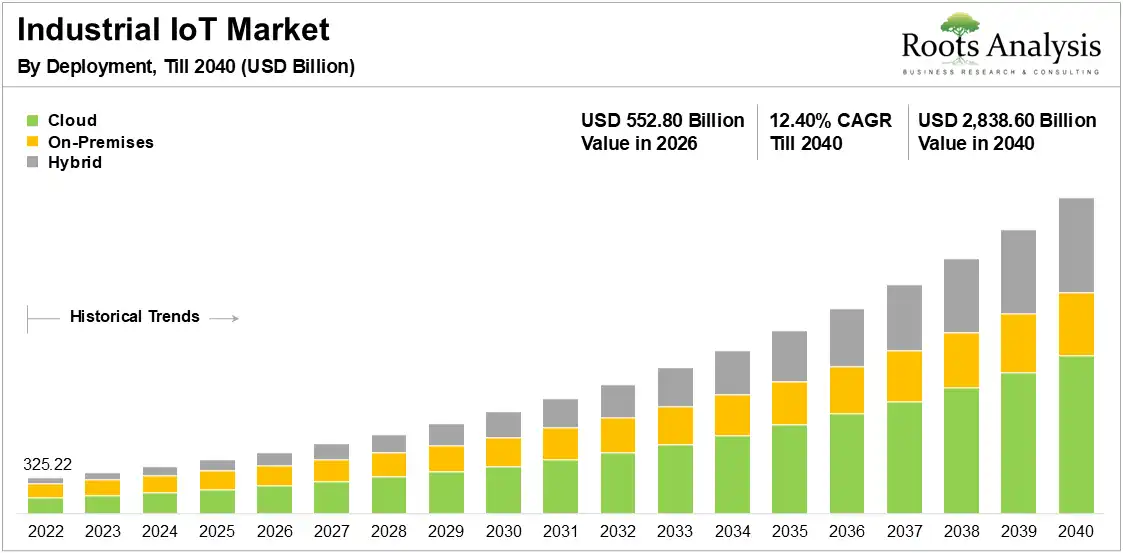
The global industrial IoT market size is projected to grow from USD 552.80 billion in 2026 to USD 2,838.60 billion by 2040, representing a CAGR of 12.40% during the forecast period 2026 to 2040.
See What’s in the Full Report – Request Your Complimentary Insights!
Market Report: Key Takeaways
- Based on offering, hardware captures maximum share (34.6%) in 2026, whereas services experience faster growth (13.8% CAGR) through 2040 ensuring sustained lifecycle integration.
- In terms of connectivity technology, wired segment dominates the industry with a 60.0% share in 2026, however wireless segment projects faster growth at a higher 14.9% CAGR till 2040 enabling remote edge architectures.
- Global industrial internet of things market statistics for deployment reveals that cloud holds the largest share (45.0%) in 2026, while hybrid showcases faster growth at a 15.7% CAGR till 2040 bridging local latency and remote scalability.
- In 2026, manufacturing vertical applications secures the maximum share (35.0%). Conversely, the agriculture sector is projected to grow at a leading 16.4% CAGR through 2040, driven by aggressive precision farming modernization.
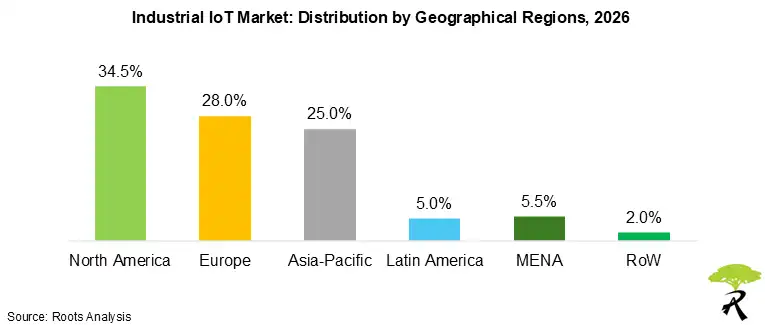
- Regionally, North America captures a dominant 34.5% share in 2026, whereas Asia-Pacific accelerates at a 14.1% CAGR till 2040 expanding robust sovereign industrial automation frameworks.
Industrial IoT Market Outlook
The industrial IoT market commands accelerated enterprise-scale deployment, directly driven by converging operational and information technology architectures. Industrial organizations prioritize edge-to-cloud frameworks for real-time data processing. Retrofitting legacy manufacturing infrastructure with advanced sensors and private 5G networks establishes dominant horizontal platform ecosystems over vertical silos.
Aggressive legislative mandates secure structural modernization, as the Net-Zero Industry Act forces global supply chains toward verifiable decarbonization. Predictive maintenance algorithms mitigate persistent labor shortages. Schneider Electric’s 2025 AI microgrid rollouts demonstrated how energy efficiency directives accelerate comprehensive digital transformation, protecting margins and ensuring compliance.
Future expansions leverage generative artificial intelligence to revolutionize human-machine interfaces effectively enabling fully autonomous production floors. The 2025 cross-border interoperability achieved by the Catena-X ecosystem cements a standardized global data fabric. This transition from basic telemetry to systemic optimization hardwires high-growth maturity across critical manufacturing infrastructure.
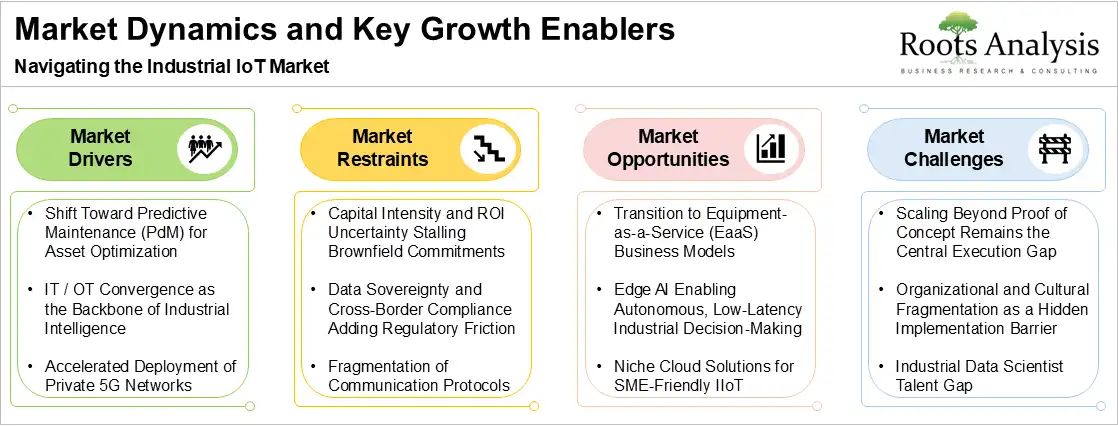
IIoT Market Dynamics: Growth Drivers, Restraints, Opportunities and Challenges
Pay Only for What You Need – The Best Way to Optimize
Industrial IoT Market Size Estimation Methodology
- As a starting point, we defined the market scope by segmenting the industrial IoT (IIoT) ecosystem into four core functional layers: hardware (including sensors, gateways, and robotics), software platforms and AI analytics, advanced connectivity technologies (such as 5G, LPWAN, and satellite), and comprehensive integration and maintenance services.
- Moving forward, we analyzed enterprise demand dynamics and technology adoption cycles, evaluating the penetration rates of brownfield connectivity upgrades versus greenfield smart factory investments. By utilizing S-curve diffusion models to map the historical transition from legacy machine-to-machine (M2M) systems to modern IIoT architectures, we established clear baseline maturity levels across diverse sectors like manufacturing, energy, and logistics.
- Building on this framework, we gathered critical supply-side and demand-side metrics, including hardware shipment volumes, software-as-a-service (SaaS) recurring revenues, and evolving average selling prices (ASPs) driven by economies of scale. These insights were captured through primary research with C-suite executives, plant managers, and technology providers to identify real-world ROI benchmarks, and rigorously cross-validated against secondary sources like Industry 4.0 regulatory roadmaps, patent filings, and vendor financial reports.
- Drawing upon these triangulated insights, we calculated the global Industrial IoT market size and projected the long-term commercial opportunity. This was achieved through a robust hybrid forecasting methodology that integrated bottom-up device deployment counts with top-down assessments of broader industrial automation and digital transformation spending, ensuring strict consistency across the industrial software and enterprise networking addressable markets.
- The overall projected market value was then systematically distributed across distinct market segments, allocating revenue by core layer / offering, technology type, and end-use sector. Geographic distribution was meticulously mapped by correlating regional industrial output and labor costs with major government-led digitalization initiatives, such as the European Green Deal and China Standards 2035, to accurately reflect localized infrastructure investments.
- Finally, in order to assess the sensitivity of our assumptions, we conducted a multivariate sensitivity and scenario analysis (base, optimistic, and conservative) on some of the most important parameters of our forecast methodology, evaluating the potential market impacts of supply chain volatility, fluctuating interest rates affecting capital expenditure (CAPEX), labor shortage-driven automation trends, and the varying adoption speeds of emerging technologies like 5G RedCap and Edge AI.
Industrial IoT Market Share Insights
IIoT Market Forecast Estimates by Connectivity Technology
- Wired connectivity commands the dominant market share as it underpins mission-critical operational technology stacks. Ethernet, PROFINET, and fieldbus networks secure deterministic latency, robust noise immunity, and high data integrity across harsh industrial environments, establishing mandatory prerequisites for continuous process lines.
- Established automation ecosystems continuously anchor new digital nodes onto legacy physical networks. In late 2025, HMS Networks launched advanced N-Tron Ethernet switches specifically engineered to maintain resilient, high-speed data acquisition across extremely harsh manufacturing environments, reinforcing hardwired backbones as the resilient core of real-time control loops.
- Wireless connectivity accelerates as the fastest-growing sub-segment (14.9% CAGR), propelled by industrial-grade 5G, LPWAN, and Wi-Fi 6E enabling dense, mobile-aware sensor meshes. Private 5G deployments within automotive and electronics manufacturing now support thousands of localized devices with sub-millisecond latency, aggressively de-risking flexible production layouts.
- In March 2026, Ericsson and Future Technologies expanded their strategic integration to scale deterministic private 5G architectures across North American industrial hubs. This aggressive deployment bridges the critical gap between localized AI compute capacity and enterprise edge networks, ensuring wireless agility structurally outpaces legacy installations.
Which End Use Vertical Drives Demand in Industrial IoT Market?
- Manufacturing commands dominant market share, driven by mature supply chain infrastructure and aggressive sensor deployments for predictive maintenance. Government smart factory mandates provide immediate regulatory tailwinds. In early 2026, Siemens accelerated this structural lead by deploying its Digital Twin Composer, actively establishing fully AI-driven, adaptive manufacturing environments.
- Agriculture exhibits the fastest vertical growth, propelled by urgent global food security mandates and aggressive precision farming modernization. Overcoming historic rural connectivity barriers, John Deere actively scales Starlink-integrated IIoT terminals across autonomous fleets. This satellite-driven enterprise deployment guarantees uninterrupted real-time telemetry and hyper-localized crop optimization, directly maximizing high-yield agricultural margins.
- Simultaneously, in April 2026, CropX expanded its IIoT ecosystem by launching the Apex sensor portfolio and AI-powered CropX Vision. This dense hardware-to-cloud integration guarantees hyper-localized root-zone telemetry, directly maximizing high-yield agricultural margins while drastically reducing systemic water consumption.
Want Information on Specific Region / Segment?
Industrial IoT Market Revenue Projections: Regional Outlook
Global IIoT Industry Analysis Indicates Dominance of North America in 2026
- North America commands the dominant market share, driven by deep-rooted Industry 4.0 infrastructure and entrenched predictive maintenance deployments across high-yield sectors. Regulatory frameworks and massive public-private capital actively accelerate edge-centric ecosystem integration.
- Specifically, Canada’s 2025 NGen Global Innovation Cluster actively co-invests millions into advanced manufacturing technology projects, directly bridging localized AI processing with enterprise-level supply networks. This structural maturity and early-adopter advantage secure a continuous plurality of global capital expenditure, even as absolute growth moderates against emerging markets.
Asia-Pacific Region is Poised to Experience Rapid Growth Through 2040
- Asia Pacific accelerates as the fastest-growing geography, propelled by state-led digitalization and aggressive 5G infrastructure scaling. Explicit smart factory subsidies fundamentally de-risk capital expenditure, successfully transitioning mid-sized regional manufacturers toward fully connected, data-driven operational models.
- In early 2026, India aggressively accelerated this momentum via its National Manufacturing Mission and the CII-INCIT Smart Industry Readiness Index framework. These systematic policy interventions deploy massive capital incentives to standardize edge analytics and digital twin adoption across heavy industrial clusters, driving a sustained structural shift in global connectivity valuation.
Market Ecosystem Analysis
Industrial IoT Market Competitive Landscape and Strategic Consolidation
The industrial IoT market ecosystem exhibits intense consolidation as legacy automation providers aggressively acquire specialized software capabilities to build full-stack edge-to-cloud architectures. This strategic convergence eliminates fragmented legacy networks, actively forcing fierce competition between established industrial hardware giants and agile, data-centric automation startups.
Industrial IoT Market Established Top-Tier Conglomerates Scaling Enterprise-Grade Automation Infrastructure
- Global industrial conglomerates aggressively modernize manufacturing environments by embedding advanced edge processing directly into legacy hardware. In April 2026, Rockwell Automation demonstrated cloud-connected factory operations at Hannover Messe, successfully integrating its Emulate3D dynamic digital twin software with advanced cloud analytics to optimize complex facility layouts.
- Simultaneously, Honeywell executed a massive strategic realignment throughout early 2026, launching a dedicated Industrial Automation business segment. This restructuring prioritizes connected edge devices and systemic telemetry extraction, directly accelerating the transition toward fully autonomous operations. These high-capital infrastructure deployments establish dominant market shares by effectively bridging operational technology divides and ensuring resilient, uninterrupted global supply chain continuity.
Startup Innovation Reshaping Software-Defined Network Automation
- Agile technology startups systematically disrupt traditional hardware monopolies by introducing highly scalable, software-defined network (SDN) frameworks. In late 2025, HighByte released critical updates to its Intelligence Hub, advancing Industrial DataOps by routing normalized plant-floor data to the cloud via a Unified Namespace.
- Simultaneously, TRACTIAN expanded its predictive maintenance portfolio, deploying Agentic AI workflows where localized sensors autonomously initiate enterprise resource planning work orders to preempt mechanical failures.
- Furthermore, in early 2026, HiveMQ introduced advanced MQTT data brokers to guarantee massive scalability for software-defined automation frameworks. These precise integrations effectively dismantle proprietary communication bottlenecks, instantly converting isolated heavy machinery into resilient, highly interoperable digital assets.
Industrial IoT Market Trends
IIoT Connectivity and Ecosystem Architecture
- The immediate impact of 5G on IIoT market growth directly accelerates edge computing in industrial automation. This low-latency network architecture fundamentally transforms production lines, exponentially driving M2M communication revenue as decentralized hardware processes critical telemetry data locally.
- Aggressive infrastructure modernization significantly amplifies industrial IoT sensors and gateways demand across legacy facilities. Comprehensive smart factory ecosystem analysis reveals that deploying these standardized endpoints eliminates historic interoperability bottlenecks, successfully cementing resilient, high-yield digital operations across previously isolated manufacturing hubs.
IIoT Autonomous Operations and Cyber Resilience
- Unprecedented digital twin market integration directly empowers enterprise-scale simulations, systematically accelerating predictive maintenance market growth. Furthermore, deploying advanced asset tracking and management solutions eliminates supply chain blind spots, actively securing profit margins against unforeseen mechanical failures and logistical disruptions.
- Accelerated industry 4.0 technology adoption forces legacy operators toward comprehensive smart manufacturing deployments. However, this systemic transition heightens network vulnerabilities, elevating IIoT cybersecurity market impact as global enterprises actively secure expanding threat landscapes to guarantee uninterrupted, highly automated operational continuity.
Your Business is Unique – Why Shouldn’t Your Report Be?
IIoT Market Access Considerations
Strategic Integrator Partnerships
Commercializing industrial automation heavily relies on system integrators and specialized distributors acting as dominant market gatekeepers. Scaling deployment requires vendors to orchestrate robust channel partnerships that align integration incentives. This ecosystem-centric architecture establishes a formidable structural barrier against isolated product innovators attempting direct-sales penetration.
Industrial IoT Market Regulatory Compliance Thresholds
Stringent legislative frameworks, specifically the impending enforcement of the EU Data Act and Cyber Resilience Act mandates, aggressively filter market participation. Mandating secure-by-design architectures and localized processing elevates commercialization costs, systematically favoring established incumbents equipped to deploy verifiable, encrypted governance models.
IIoT Market Capital Restructuring Models
Prohibitive upfront infrastructure costs associated with heavy sensor deployment and legacy network modernization frequently trap initial projects in pilot purgatory. To accelerate mid-market access, competitive vendors actively transition from restrictive capital expenditure models toward dynamic service-based subscriptions, engineering rapid commercial validation.
How Stakeholders Benefit from the Key Focus Areas of Our Industrial IoT Industry Report
The IIoT market is gaining momentum as industries accelerate digital transformation to enhance operational efficiency, predictive capabilities, and automation. This report equips stakeholders with actionable insights to navigate market complexity, identify growth opportunities, and make informed strategic, investment, and technology decisions. It supports faster commercialization, targeted expansion, and effective adoption of Industrial IoT solutions across sectors.
- Unmet Needs and Market Gaps in Industrial IoT Market: The report identifies critical gaps in interoperability, data integration, cybersecurity, and scalability that continue to challenge widespread Industrial IoT adoption. It highlights underserved industry verticals and emerging use cases where demand is outpacing current solutions. These insights help organizations refine product development strategies and uncover high-potential niches. Investors and solution providers can leverage this understanding to prioritize innovation and capture untapped market opportunities.
- Funding and Venture Investment Opportunities in Industrial IoT Industry: A comprehensive view of investment activity, funding patterns, and capital allocation trends is provided, offering clarity on where financial momentum is being built. The report pinpoints high-growth segments attracting venture capital and strategic investments, along with risk factors impacting returns. This enables investors to make data-driven decisions and align portfolios with scalable opportunities. Companies can also benchmark funding trends to shape their capital-raising strategies and expansion plans.
- Technology Innovation and Adoption Trends: Insights into evolving technologies such as edge computing, AI-driven analytics, digital twins, and 5G integration are thoroughly explored. The report assesses adoption drivers, barriers, and maturity levels across industries. This enables technology leaders to align product roadmaps with real-world demand and accelerate commercialization. Organizations can also prioritize investments in technologies that offer the highest operational and financial impact.
- Industrial IoT Market Competitive Landscape and Industry Analysis: The report delivers a detailed analysis of the competitive landscape, including key players, emerging innovators, and strategic positioning across the value chain. It examines competitive strategies such as product differentiation, pricing models, and ecosystem expansion. These insights help businesses refine market entry strategies and strengthen competitive positioning. Stakeholders can identify partnership targets, acquisition opportunities, and areas for differentiation.
- Mapping Strategic Partnerships and Ecosystem Synergies: The report highlights the growing importance of ecosystem-driven growth through strategic alliances, joint ventures, and platform-based collaborations. It identifies key partnership models that enable faster deployment and scalability of industrial IoT solutions. These insights support business development teams in identifying valuable collaboration opportunities. Companies can leverage partnerships to enhance capabilities, expand market reach, and reduce time-to-market.
- IIoT Market CAGR and Growth Trends: The study provides detailed industrial IoT market segmentation by offerings, deployment, connectivity technology, industry vertical, and region, along with a clear growth outlook. Further, the report identifies high-growth geographies and segments with strong adoption potential. This enables stakeholders to prioritize target markets and allocate resources efficiently. It also supports strategic expansion by aligning offerings with region-specific requirements and growth drivers.
Have Questions? Let’s Get Them Answered.
Industrial IoT Market: Scope of the Report
| Key Report Attributes | Details | |
| Forecast Period | Till 2040 | |
| Market Size 2026 | USD 552.80 Billion | |
| Market Size 2040 | USD 2,838.60 Billion | |
| CAGR (Till 2040) | 12.40% | |
| Segments Covered |
|
|
| Geographical Regions Covered |
|
|
| Key Sections Covered |
|
|
Industrial IoT Market Segmentation
The global IIoT industry report presents an in-depth analysis, highlighting the capabilities of various stakeholders, based on different segments such as offering, connectivity technology, deployment, vertical, geographical regions, and key players.
Market Share by Offering
- Hardware
- Connectivity ICs
- Logic Devices
- Memory Devices
- Processors
- Sensors
- Platform
- Application Enablement
- Connectivity Management Platforms
- Device Management
- Software
- Manufacturing Execution System (MES)
- Product Lifecycle Management (PLM)
- Supervisory Control and Data Acquisition (SCADA)
- Other Software
- Services
- Engineering and Consulting
- Improvement and Maintenance
- Installation and Commissioning
Market Share by Connectivity Technology
- Wired
- Ethernet
- Fieldbus
- Wireless
- Cellular / 5G
- LPWAN
- Wi-Fi
- Others
Market Share by Deployment
- Cloud
- On-Premises
- Hybrid
Market Share by Vertical
- Agriculture
- Energy and Utilities
- Healthcare
- Manufacturing
- Metals and Mining
- Oil and Gas
- Retail
- Transportation and Logistics
- Others
Market Share by Geographical Regions
- North America
- US
- Canada
- Mexico
- Rest of North America
- Europe
- Austria
- Belgium
- Denmark
- France
- Germany
- Ireland
- Italy
- Netherlands
- Norway
- Russia
- Spain
- Sweden
- Switzerland
- UK
- Rest of Europe
- Asia-Pacific
- Australia
- China
- India
- Japan
- New-Zealand
- Singapore
- South Korea
- Rest of Asia-Pacific
- Latin America
- Argentina
- Brazil
- Chile
- Colombia
- Venezuela
- Rest of Latin America
- Middle East and North Africa (MENA)
- Egypt
- Iran
- Iraq
- Israel
- Kuwait
- Saudi Arabia
- UAE
- Rest of MENA
- Rest of the World


