


 Download Free Sample
 Buy Now
IP Camera Market Size
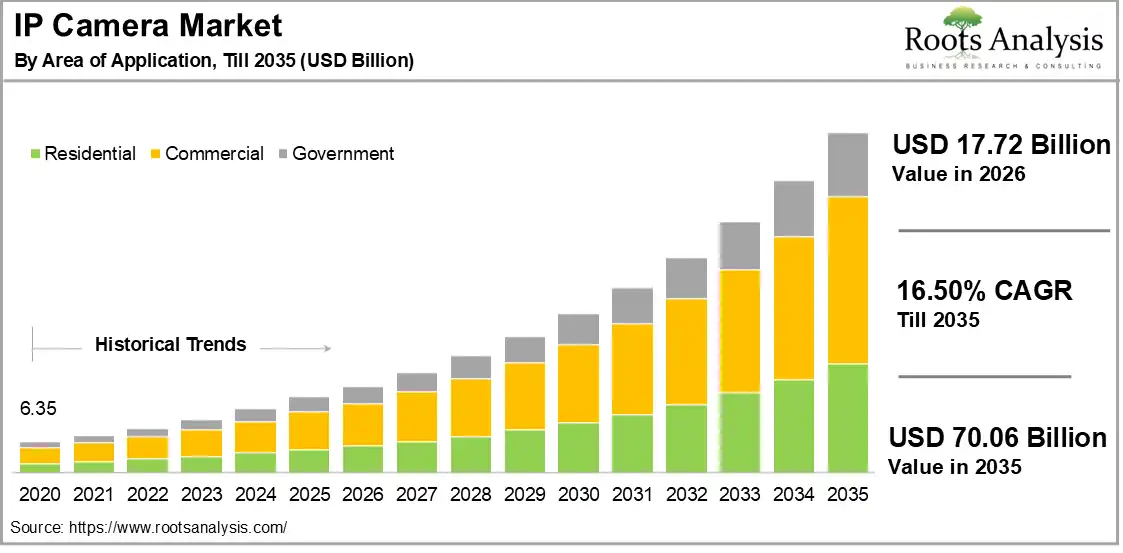
The global IP camera market is estimated to grow from USD 17.72 billion in 2026 to reach USD 38.04 billion in 2030 and USD 70.06 billion by 2035, with a CAGR of 16.50% during the forecast period 2026 to 2035.
See What’s in the Full Report – Request Your Complimentary Insights!
IP Camera Market Key Takeaways
- The increasing focus on smart surveillance for face and object detection as well as technological advancement such as AI-powered cameras and internet of things (IoT) for motion detection are majorly driving the market growth.
- In terms of product, the hardware sub-segment secures 77% of the overall revenue share, due to improved camera lifespan and development of integrated cameras with AI and IoT devices.
- In terms of application, the commercial sub-segment currently holds the largest market share of 67%, due to the increasing adoption of AI-powered video analytics and cloud-based surveillance solutions.
- With respect to the regional landscape, Asia-Pacific dominates the current market with a share of 50.63% due to the presence of prominent players such as Sony, Samsung and CP Plus, that are continuously driving the market growth through innovation and advancements.
IP Camera Market Trends and Overview
With the emergence of technological advancements coupled with the need of enhanced security has originated from an IP camera systems. Integrating a traditional camera like structure with smart chips gave rise to modern IP camera. These cameras share video recordings through internet protocol forwardly neglecting the need for storage.
Technological advancements such as the development of face and body recognition are emerging as a critical component in the global shift towards innovation and antenna advancements. These Wi-Fi IP cameras have high resolution that equip enhanced security by effortless recognition of objects or humans. Further, IP cameras provide two-way audio systems that allow users to hear and communicate with individuals near the camera. In addition, pan-tilt-zoom (PTZ) technology allows users to change directions and zoom in frame remotely through smartphone app control.
It is worth highlighting that easy video analytics have fostered the IP security cameras market. Notably, PoE IP cameras that uses ethernet cable for data transmission and electrical power has spurred the IP camera market trends. Moreover, ONVIF compliance allows cameras to communicate easily and H.265 compression for higher bandwidth have framed the market.
The IP camera market trends are expected to grow significantly in the forecasted period due to the rising integration of artificial intelligence for motion tracking. In addition, the integration of internet of things (IoT) for better device interoperability and enhanced surveillance will contribute to the expansion of the wireless IP cameras market. Further, the rising adoption of smart home integration is majorly driving the smart IP camera market growth.
Notably, the development of high-speed network speeds and enhanced reliability will continue to fuel the network IP cameras market growth. Moreover, IP66 ratings equip durability and efficient life cycle. Consequently, substantial investments and research for enhanced surveillance systems will fuel the IP camera market growth in the forecasted period.
Recently, Saagar Govil, CEO at Vicon mentioned “IP camera are empowering customers with a proactive solution that not only detects but also deters potential threats. This is a camera built for the complex challenges of today and tomorrow”.
IP Camera Market Recent Industry Developments
- In December 2025, Reolink entered into a retail partnership with Argos to launch its latest E331 indoor WiFi camera in the UK. This is now live to purchase as an Argos exclusive cameras.
- In October 2025, L&T Semiconductor Technologies signed a strategic partnership with CP PLUS to conjointly manufacture CCTV IP cameras over the next three years. These cameras will be powered by LTSCTs indigenously designed vision system-on-chip (SoC) technology.
- In February 2025, Traverse City police launched a private security camera partnership program for homeowners for enhanced safety in the city.
- In February 2025, Hanhwa Vision, a video surveillance and security solution company, launched a Q series camera that has 5 mega-pixel resolution and uses AI for enhanced working.
- In December 2024, Vicon, a surveillance solution company, partnered with Hailo, a AI chip manufacturer to enhance video intelligence.
- In October 2024, Consistent, a leading surveillance company, launched a new line of Night Hawk IP outdoor surveillance camera with high-quality and enhanced performance.
- In August 2024, Secureye, a surveillance solution company, launched the PHOENIX IP camera series.
Pay Only for What You Need – The Best Way to Optimize
IP Camera Market Share Insights
Hardware Sub-Segment to Gain the Maximum Market Share
By 2035, among these categories, the hardware segment is expected to gain 77% of IP camera market share. The prominent reason for this dominance includes improved camera lifespan and development of integrated cameras with AI and IoT devices. It is worth highlighting that body and facial recognition capabilities have played a pivotal role in dominance.
However, the services segment is expected to grow with a relatively higher growth rate (14.3%) till 2035. This can be attributed to enhanced image quality and analytic capabilities that are crucial for security solutions concerns.
Infrared Sub-Segment to Shape the Future of the IP Camera Industry
As per our research, the infrared sub-segment is projected to dominate with a market share of 44.21%. This can be ascribed to the efficient night vision and discreet monitoring. In addition, versatile applications such as parking lots and residential areas have accelerated the market growth.
On the other hand, the pan-tilt-zoom cameras are expected to grow at a relatively higher growth rate in the coming years. This can be attributed to their versatility and the capability to monitor large areas through a single device. PTZ cameras are being used increasingly in mass surveillance settings such as stadiums, city centers, and traffic surveillance where active surveillance and prompt response are of highest priority.
Consolidated Connection to Propel Market Growth
The consolidated sub-segment is anticipated to dominate the segment with 75% of market share by 2035. This can be attributed to simplified management that allows easy monitoring, troubleshooting and upgradation. It is worth highlighting that it allows effortless interoperability among cameras for enhanced security.
However, the distributed segment is expected to grow with a relatively higher CAGR during the forecast period. This can be due to reduced wide-area network (WAN) traffic and improved local storage. In addition, increased reliability due to central server and local-area network (LAN) switch failures.
Commercial Sub-Segment to Gain the Maximum Market Share
As per our research, the commercial sub-segment is projected to dominate with a market share of 67%. This can be ascribed to their remote accessibility that allows surveillance of multiple locations. Notably, easy integration and always working approach have contributed to the expansion of commercial security.
On the other hand, the residential sub-segment is expected to grow with a relatively higher CAGR in the forecast period. This can be attributed to the scalable properties that allow the addition of new camera easily. In addition, easy installation and cost-effectiveness has accelerated the residential security market. It is worth highlighting that surveillance for children and pet safety is boosting the indoor IP cameras market.
Asia-Pacific to Lead the Regional IP Camera Market Landscape
According to our analysis, Asia-Pacific exhibits dominance in the market with 50.63% of the IP camera market share in the global marketplace. This can be attributed to rising innovations and development in the domain. In addition, the growth is primarily due to the presence of prominent players such as Sony, Samsung and CP Plus, that are continuously driving the market growth through innovation and advancements. In addition, rapid urbanization and industrialization in emerging economies such as India, China, Japan and South Korea have fueled market growth.
However, North America is projected to drive the market at a relatively higher CAGR during this forecast period. This can be due to rising smart security demands and AI-powered surveillance. In addition, substantial government investments and favored regulations will aid market expansion.
Want Information on Specific Region / Segment?
IP Camera Market Dynamics
Competitive Landscape of Key Players in the IP Camera Industry
The competitive landscape of the IP camera market is marked by intense rivalry among large multinational companies and specialized IP camera players. Large enterprises hold over 75% of the market share, leveraging their scale to dominate space. Meanwhile, IP camera players focus on niche markets and specialized services, driving innovation with artificial intelligence solutions, strategic partnerships, and new feature launches. Major key players leading this market include Hikvision, Dahua, and Axis Communications, who are known for their advanced AI-driven technologies and global reach, setting the pace in an evolving and highly competitive landscape.
Key Market Drivers
The increasing focus on smart surveillance for face and object detection is majorly driving the market growth. In addition, technological advancement such as AI-powered cameras and internet of things (IoT) for motion detection will mark the IP camera to be a crucial innovation.
Key driving factors include the adoption of remote accessible surveillance solutions and night vision, and high image quality is majorly driving the market. It is worth highlighting that these are cost-effective and easy to install. Consequently, substantial government initiatives and investments will drive the growth in the forecasted period. Notably, demand for residential and industrial security
Market Challenges in IP Camera Market
Despite strong market growth projection, the IP camera market faces numerous challenges including high reliability on network that may hinder video quality, increase latency and bandwidth issues. Notably, they have less weather resistance that limit the IP camera market growth. Moreover, they are prone to hacking and unauthorized access. They also require high storage and network speed that adds further complexities. In addition, complex machine learning algorithms are also sabotaging market expansion.
Your Business is Unique – Why Shouldn’t Your Report Be?
IP Camera Market Segmentation
IP Camera Market: Scope of the Report
| Key Report Attributes | Details | |
| Historical Trend | Since 2020 | |
| Forecast Period | Till 2035 | |
| Market Size 2026 | $ 17.72 Billion | |
| Market Size 2035 | $ 70.06 Billion | |
| CAGR (Till 2035) | 16.50% | |
| Segments Covered |
|
|
| Key Players Profiled | ||
| PowerPoint Presentation (Complimentary) | Available | |
| Customization Scope | 15% Free Customization | |
| Excel Data Packs (Complimentary) |
|
|
Market Segments
Based on the research, we have segmented the IP camera market into type of component, type of product, type of connection, area of application, geographical regions, and key players.
Market Share by Type of Component
-
Hardware
- Services
Market Share by Type of Product
- Fixed
- Infrared
- Pan-Tilt-Zoom (PTZ)
Market Share by Type of Connection
- Consolidated
- Distributed
Market Share by Area of Application
- Residential
- Commercial
- Government
Market Share by Geographical Regions
- North America
- US
- Canada
- Mexico
- Rest of North America
- Europe
- Austria
- Belgium
- Denmark
- France
- Germany
- Ireland
- Italy
- Netherlands
- Norway
- Russia
- Spain
- Sweden
- Switzerland
- UK
- Rest of Europe
- Asia-Pacific
- Australia
- China
- India
- Japan
- New-Zealand
- Singapore
- South Korea
- Rest of Asia-Pacific
- Latin America
- Brazil
- Chile
- Colombia
- Venezuela
- Rest of Latin America
- Middle East and Africa (MEA)
- Egypt
- Iran
- Iraq
- Israel
- Kuwait
- Saudi Arabia
- UAE
- Rest of MEA


