AAV Technology: Innovations Driving Next-Generation Gene Therapies

.png)

Published: August 2026
Adeno-associated viral (AAV) vectors are widely used tools in gene therapy, designed to deliver healthy genes into cells to treat diseases. They are derived from the adeno-associated virus, a small, non-pathogenic virus that is naturally safe and capable of infecting both dividing and non-dividing cells. In gene therapy applications, this virus is engineered by removing its original genetic material and replacing it with a therapeutic gene, while retaining only the essential components required for delivery. This enables precise, stable, and long-term gene expression without integrating into the host genome, making AAV vectors a preferred and reliable platform for many therapeutic applications.
To translate this science into real-world treatments, advanced manufacturing technologies are used to produce AAV vectors at scale. Commonly, human cell systems such as HEK293 cells are used, where the necessary genetic elements are introduced to generate viral particles. Other platforms, including insect cell-based systems, are also utilized to improve scalability and efficiency. Following production, purification techniques such as chromatography are applied to ensure high-quality vectors by removing impurities and isolating functional viral particles. These continuous improvements in manufacturing and quality control have made AAV production more consistent and suitable for clinical and commercial use.
Engineered AAV vectors are now widely applied in treating a range of genetic and acquired diseases by delivering functional copies of defective genes into target cells. The technology has evolved significantly, with different serotypes, such as AAV2, AAV5, AAV8, and AAV9 being tailored to target specific tissues like the retina, liver, muscle, and central nervous system. This versatility has enabled broad use across both research and clinical settings, including several approved therapies. As innovations in vector design, delivery methods, and manufacturing continue to advance, AAV technology remains a highly promising platform for addressing a wide spectrum of diseases.
Interestingly, in January 2026, Lexeo Therapeutics announced licensing agreement with Ask Bio, for the use of a patented component of AB-1009 for the treatment of Pompe disease.
As innovations in vector engineering, manufacturing, and immune-modulation strategies continue to advance, AAV technology remains one of the most promising platforms for the treatment of a wide range of monogenic and complex diseases
Roots Analysis has conducted an exhaustive study on Adeno Associated Virus Vector Manufacturing Market featuring the current landscape and future opportunity for the companies engaged in this domain. In this article, we have highlighted some of the advances in AAV vector manufacturing technology that are likely to shape the evolution of this sector during the forecast period.
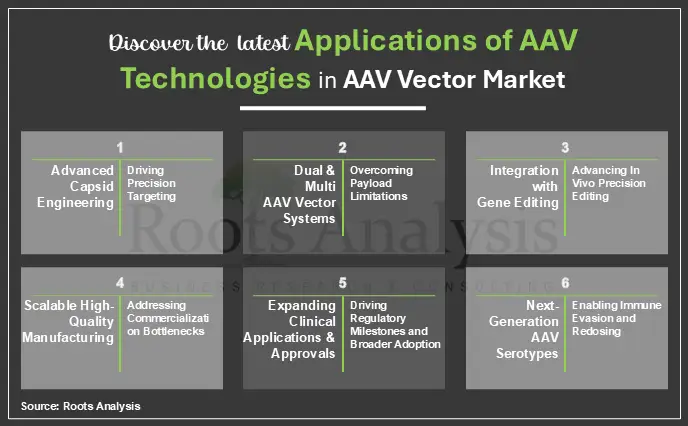
The following figure presents the applications of AAV Technology:
Interested in exploring all 140+ players engaged in offering advanced AAV technologies, along with their recent initiatives?
Advances in AAV Vector Technology That Are Likely to Shape the Future Potential of the Industry
1. Advanced Capsid Engineering: Driving Precision Targeting
Recent innovations in AAV technology are shifting their focus on capsid engineering, enabling highly specific targeting of tissues such as brain, retina, liver, and muscle. Techniques like direct evolution, rational design, and AI-based modeling are being used to redesign viral capsids for improved tropism and reduced immunogenicity. These engineered capsids overcome traditional limitations such as poor tissue specificity and immune neutralization. AI-driven platforms can now generate thousands of optimized capsid variants, accelerating discovery timelines. This allows gene therapies to be tailored for rare and complex diseases with higher efficiency. Additionally, improved receptor binding and intracellular trafficking enhance gene delivery success rates. These innovations are critical for expanding AAV applications beyond rare diseases into broader indications.
For example, in May 2026, Genethon partnered with Ampersand Biomedicines with an aim to co-develop next-generation AAV capsids with enhanced tissue specificity. This collaboration combines Genethon’s gene therapy expertise with Ampersand’s programmable biology platform to engineer highly targeted AAV vectors.
2. Dual and Multi-AAV Vector Systems: Overcoming Payload Limitations
AAV vectors have a limited capacity, which restricts delivery of large genes. To address this, dual-AAV and multi-vector systems have been developed, where a gene is split into parts and reassembled inside the host cell. This innovation enables treatment of diseases caused by large or complex genes. These systems use strategies like trans-splicing, overlapping sequences, or hybrid recombination to restore full gene function. This has significantly expanded the scope of AAV-based therapies. It is particularly useful for neurological and sensory disorders requiring larger genetic payloads. Such approaches also improve therapeutic durability and expression levels.
For example, in April 2026, Regeneron Pharmaceuticals announced the FDA approval of Otarmeni, the first dual-AAV vector-based gene therapy for genetic hearing loss, demonstrating real-world success of this approach.
3. Integration with Gene Editing Technologies: Advancing In Vivo Precision Editing
AAV vectors are increasingly being used as delivery vehicles for gene editing tools such as CRISPR-Cas systems and base editors. This combination enables precise correction of disease-causing mutations directly inside the body (in vivo editing). AAV provides efficient delivery to target tissues, while CRISPR enables accurate gene modification. Newer gene editing techniques avoid double-strand breaks, improving safety profiles. This integration is particularly promising for treating monogenic disorders at their genetic root. However, challenges such as off-target effects and immune responses are still being addressed. Continuous improvements in vector design and editing precision are making this approach more viable.
4. Scalable and High-Quality Manufacturing: Addressing Commercialization Bottlenecks
Manufacturing remains a key bottleneck in AAV therapy commercialization. Recent innovations focus on scalable production platforms, such as suspension cell systems and optimized transfection methods. These advancements improve yield, reduce costs, and ensure consistent vector quality. New analytical techniques like ddPCR, nanopore sequencing, and mass photometry enable better characterization of AAV vectors. Automation and process optimization are also enhancing reproducibility at commercial scale. Improved upstream and downstream processes are making therapies more accessible. These developments are crucial for meeting growing clinical and commercial demand.
5. Expanding Clinical Applications: Driving Regulatory Milestones and Broader Adoption
AAV technology is rapidly advancing from rare disease treatments to broader therapeutic areas, including metabolic, neurological, and sensory disorders. Increasing clinical success has led to more regulatory approvals and IND clearances, validating the platform’s potential. The technology’s ability to provide long-term gene expression makes it ideal for chronic conditions. Governments and regulatory agencies are also supporting accelerated approvals for breakthrough therapies. This momentum is driving investment and innovation across the gene therapy landscape. As clinical data matures, AAV therapies are expected to expand into larger patient populations. For example, in May 2026 FDA cleared an IND for an AAV-based therapy targeting a rare metabolic disorder, highlighting continued pipeline expansion.
6. Next-Generation AAV Serotypes: Enabling Immune Evasion and Redosing
One of the key limitations of traditional AAV therapies has been pre-existing immunity and the inability to redose patients due to neutralizing antibodies. To overcome this, researchers are developing next-generation AAV serotypes and engineered variants that can evade immune detection. These include synthetic capsids, stealth AAVs, and variants derived from non-human primates. Such innovations allow for improved transduction even in patients with prior exposure to AAV. Additionally, strategies like transient immunosuppression and IgG-degrading enzymes are being combined with these vectors to further enhance efficacy. This advancement is crucial for chronic diseases where repeat dosing may be required. It also expands the eligible patient population significantly. Overall, immune-evasive AAVs are unlocking the next phase of durable and flexible gene therapy treatments.
Companies Engaged in AAV Technology Market
- 3PBIOVIAN: 3PBiovian is a European Contract Development and Manufacturing Organization (CDMO) formed by the merger of 3P Biopharmaceuticals and Biovian. It specializes in end-to-end manufacturing services for advanced therapies. The company utilizes its AAVion® Platform for AAV manufacturing. It is designed to accelerate gene therapy programs from concept to clinical and commercial stages.
- Advanced BioScience Laboratories: Advanced BioScience Laborateries is a US-based CDMO. Following its 2024 merger with Ascend Advanced Therapies, ABL has significantly expanded its GMP capacity and AAV expertise, offering comprehensive services from process development to clinical and commercial-scale production. They utilize multiple production platforms, including suspension and adherent cell systems with single-use , to manufacture high-quality recombinant AAV vectors across various serotypes.
- Aldevron: Aldevron utilizes its proprietary royalty-free pALD-AAV System to provide provides a complete set of high-quality, ready-to-use plasmids for triple-transfection-based rAAV manufacturing, including rep/cap plasmids, two helper plasmid options and ITR-containing transgene cloning vectors. The system is available from research-grade to GMP-Source and cGMP quality levels, ensuring consistent supply, high performance, improved safety, and faster development timelines for gene therapy programs.
- Halix: Halix specializes in end-to-end development and GMP manufacturing of viral vectors for gene therapy, vaccines, and oncolytic viruses. The company offers flexible AAV manufacturing services using both adherent and suspension mammalian cell lines, with upstream production scalable up to 1,000 L single-use bioreactors. The company provides process development, purification, analytical testing, and regulatory assistance, making them a reliable partner for scalable AAV production from preclinical to commercial stages.
Future Perspectives
The future of AAV technology in gene therapy appears highly promising, driven by continuous innovations. Advanced capsid engineering, combining rational design, directed evolution, and machine learning, is expected to create highly targeted vectors with superior tissue specificity, enhanced transduction efficiency, reduced immunogenicity. Integration with gene editing tools like CRISPR and exploration of hybrid delivery systems will further broaden therapeutic scope into complex neurological, cardiovascular, metabolic, and oncology indications. Overall, with a strong pipeline, supportive regulatory frameworks, and projected adeno associated virus vector manufacturing market growth, AAV is poised to evolve into a more precise, safer, and versatile cornerstone of personalized precision medicine in the coming decade.
What About the Future Outlook of AAV Technology Market Around the World?
The above presentation features trends related to AAV technologies, which we have highlighted in our report. If you're interested, you can download the Sample Report on this topic by Roots Analysis. For personalized assistance in identifying the most relevant solutions based on your specific criteria, please don't hesitate to reach out to us at sales@rootsanalysis.com.
Sources:
- https://www.genethon.com/genethon-signs-licensing-agreement-with-askbio-for-the-development-of-an-investigational-gene-therapy-for-pompe-disease/
- https://3pbiovian.com/service-viral-vectors/services-aav-manufacturing/aav-platform/
- https://ablinc.com/virus-manufacturing/
- https://www.aldevron.com/catalog-products/viral-vector-plasmids/pald-aav
- https://www.halix.nl/viral-vector-cdmo-viral-vaccines/