
Lowest Price Guaranteed
Slides
117
Last Updated
August 2026
View Count
5632
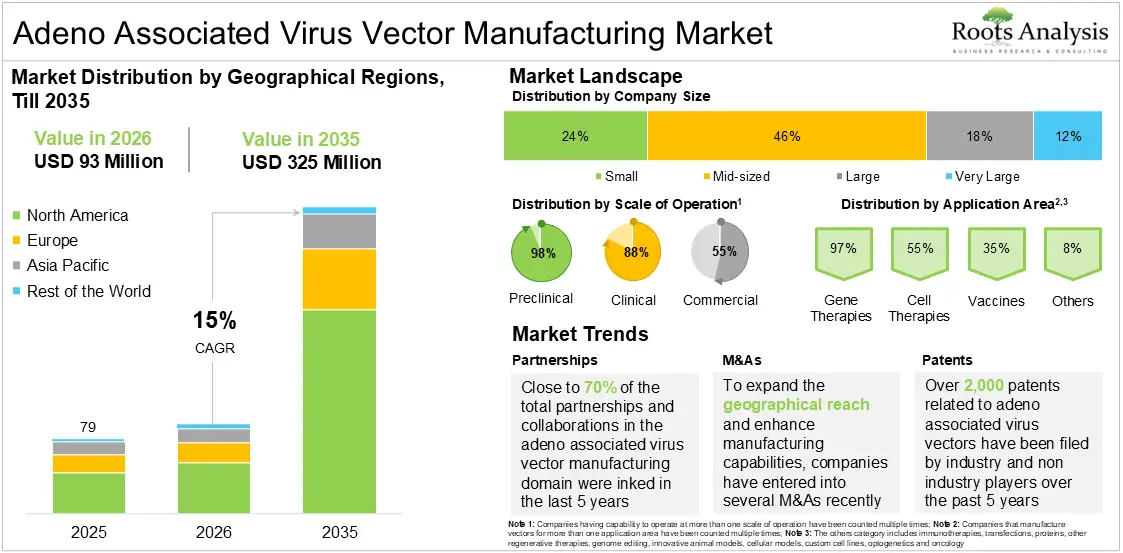
The adeno associated virus vector manufacturing market, valued at USD 79 million in 2025, is projected to reach USD 93 million in 2026 and USD 325 million by 2035, representing a CAGR of 15% during the forecast period 2026 to 2035.
To learn more about this report, request a free sample copy
Adeno associated virus vectors represent a cornerstone of modern gene therapy, engineered to enable precise delivery of genetic material to target cells while maintaining a favorable safety profile. By leveraging advancements in capsid engineering, promoter design, and vector optimization, AAV-based systems enhance transduction efficiency and tissue specificity, enabling the development of highly targeted and durable therapeutic interventions. The adeno associated virus vector domain continues to evolve rapidly, driven by innovations in vector design, manufacturing platforms, and purification technologies aimed at improving scalability and clinical performance. However, the field faces persistent challenges related to large-scale manufacturing, limited packaging capacity, immunogenicity concerns, and variability in transgene expression, alongside stringent regulatory requirements for quality, safety, and consistency.
Achieving cost-effective production and establishing standardized analytical and characterization frameworks remain critical barriers to broader commercialization. Nevertheless, expanding applications across rare diseases, neurological diseases, and ophthalmic conditions, coupled with increasing investments in gene therapy research, are expected to drive sustained growth in the adeno associated virus vector market.
Based on the research, we have segmented the adeno associated virus vector market into type of scale of operation, type of manufacturer, therapeutic area and geographical regions.
By Scale of Operation
By Type of Manufacturer
By Therapeutic Area
By Geographical Region
The market for AAV vector is poised for remarkable transformation and sustained growth in the coming years, driven by the growing number of clinical trials.
Arun Srivastava (Professor of Genetics and Chief of Division of Cellular & Molecular Therapy, University of Florida), stated, "the adeno-associated virus vector market is likely to witness considerable growth. Owing to the fact that two drugs, namely Luxturna and Zolgensma are already approved by USFDA and at least two more drugs are likely to get USFDA approval in the coming years, the adeno-associated virus vector therapy market is expected to reach USD 1 billion. Additionally, the growth rate of market depends on various factors. One such factor is the growing number of clinical trials. I am aware that there are more than 295 phase I/II ongoing clinical trials for adeno-associated virus vector. Based on this, the adeno-associated virus vector market is anticipated to grow at the rate of more than 15%.
Discussions with multiple stakeholders in this domain influenced the opinions and insights presented in this study. The market report includes transcripts of the following discussions:
In addition, the market report includes transcripts of the following other third-party discussions:
Based on the scale of operation, the segment is sub-divided into preclinical, clinical and commercial scale.
According to our report, the commercial scale manufacturing captures the largest share of the adeno associated virus vector market. This is because of the increasing number of therapies progressing from clinical trials to regulatory approval for various target indications drives this trend. Notably, around 150 companies worldwide are currently developing more than 600 AAV-based gene therapies, reflecting a robust clinical pipeline. Furthermore, as of 2026, regulatory authorities have approved at least eight AAV-based gene therapies globally, including BBM-H901, Upstaza, Itvisma, Luxturna, Zolgensma, Hemgenix, Roctavian, and Elevidys. These approvals highlight how multiple candidates have successfully transitioned from late-stage clinical development to commercialization.
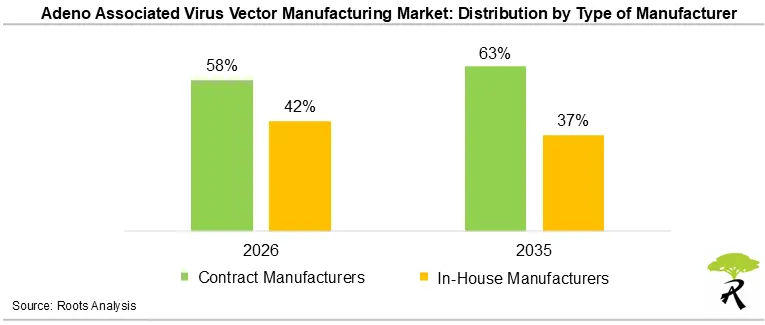
On the basis of type of manufacturer, the global market for adeno associated virus vector is segmented into contract manufacturers and in-house manufacturers.
According to our analysis, the contract manufacturers segment is expected to hold the majority (58%) of the adeno-associated virus manufacturing market share, and this trend is unlikely to change in the future. We attribute this dominance to the high capital costs, technical complexity, and specialized expertise required for GMP-compliant AAV manufacturing, which prompt most companies to outsource these activities. Additionally, contract manufacturers provide scalability, faster timelines, regulatory expertise, and risk mitigation, making them the preferred choice in this rapidly growing market. Notably, in January 2026, Genezen (a CDMO) and Atsena Therapeutics signed a partnership to support both clinical and commercial manufacturing of Atsena's AAV-based gene therapy pipeline, enabling streamlined and cost-efficient progression toward commercialization.
Based on therapeutic area, the market is sub-segmented into blood disorders, oncological disorders, rare disorders, musculoskeletal disorders, ophthalmic disorders, metabolic disorders, neurological disorders, sensory disorders, immunological disorders, infectious diseases and other disorders.
Based on our projections, the blood disorders segment is anticipated to capture the largest share of the adeno-associated virus vector manufacturing market. This is due to the growing clinical and economic burden of hematological conditions, particularly inherited blood disorders and blood-related cancers, which require long-term and often high-cost treatments. As a result, there is an increasing shift toward AAV-based gene therapies that offer the potential for durable or one-time treatment solutions. Furthermore, the advancement of AAV gene therapies targeting disorders such as hemophilia and sickle cell disease has led to a significant rise in late-stage clinical programs and regulatory approvals. This, in turn, is driving the demand for scalable, high-quality AAV vector manufacturing capabilities.
Further, the ophthalmic disorders segment is projected to witness a relatively higher CAGR over the forecast period. This growth is primarily driven by the increasing focus on developing adeno-associated virus vector-based gene therapies for a wide range of eye-related disorders, many of which currently lack effective long-term treatment options. Notably, Luxturna is an AAV-based gene therapy developed for the treatment of retinal dystrophy, highlighting the clinical potential of such approaches in ophthalmology.
On the basis of geographical regions, the global adeno associated virus vector market is segmented into North America, Europe and Asia-Pacific.
According to our projections, North America holds the majority share within the adeno-associated virus vector manufacturing market, and the trend is unlikely to change in the foreseen future. This can be attributed to the presence of several well-established players in this region and advanced healthcare infrastructure and research capabilities. This enables AAV therapy developers to conduct extensive clinical trials, which is required to meet the stringent regulatory guidelines of approval bodies. The region's favorable reimbursement landscape further strengthens market growth. Specifically, the US Centers for Medicare & Medicaid Services (CMS) has implemented several reimbursement initiatives, including product-specific permanent J-codes for eligible gene therapies and expanded Medicare coverage for select high-cost gene therapies in ambulatory surgical center settings. These measures simplify reimbursement processes, improve patient access to advanced therapies, and reinforce North America's dominant position in the global AAV vector manufacturing market.
| Key Report Attribute | Details | |
| Historical Trend | Since 2023 | |
| Forecast Period | Till 2035 | |
| Market Size 2026 | $ 93 Million | |
| Market Size 2035 | $ 325 Million | |
| CAGR (Till 2035) | 15% | |
| Segments Covered |
|
|
| Key Players |
|
|
| PowerPoint Presentation (Complimentary) |
Available | |
| Customization Scope | 15% Free Customization | |
| Excel Data Packs (Complimentary) |
Available | |