AI in Drug Discovery Market Analysis & Trends


Published: September 2026
The AI in drug discovery market has emerged as a transformative segment within the pharmaceutical industry, supporting the identification, validation, and optimization of drug candidates across increasingly complex development pipelines. By leveraging AI, machine learning, deep learning, and generative AI, drug developers can analyze large and diverse datasets and identify potential therapeutic targets.
Ongoing advancements for AI in clinical trials are improving the speed, efficiency, and precision of clinical research and development. A key development is the growing adoption of AI and machine learning platforms for patient recruitment, trial design, patient stratification, clinical data analysis, and outcome prediction. These capabilities enable researchers to identify suitable patient populations, optimize trial protocols, and monitor clinical outcomes more effectively while reducing operational complexities. Moreover, the integration of AI with real-world data, electronic health records, and advanced analytics is strengthening clinical decision-making and supporting more efficient trial execution.
Furthermore, increasing investments from pharmaceutical companies, biotechnology firms, technology providers, and venture capital investors are accelerating the adoption of AI across drug discovery workflows. Strategic collaborations and partnerships are also expanding access to proprietary datasets, computational infrastructure, and specialized AI platforms. As drug development costs continue to rise and conventional discovery timelines remain lengthy, the growing demand for faster, more precise, and cost-efficient approaches is expected to further drive the expansion of the AI in drug discovery market.
Roots Analysis has conducted an exhaustive study on AI in Drug Discovery Market featuring the current market landscape and future opportunity for the companies engaged in offering AI platforms for drug discovery, over a span of many years. In this article, we have highlighted some of the AI in Drug Discovery Analysis that are likely to shape the evolution of this industry.
Want to explore the latest advancements in AI in drug discovery market?
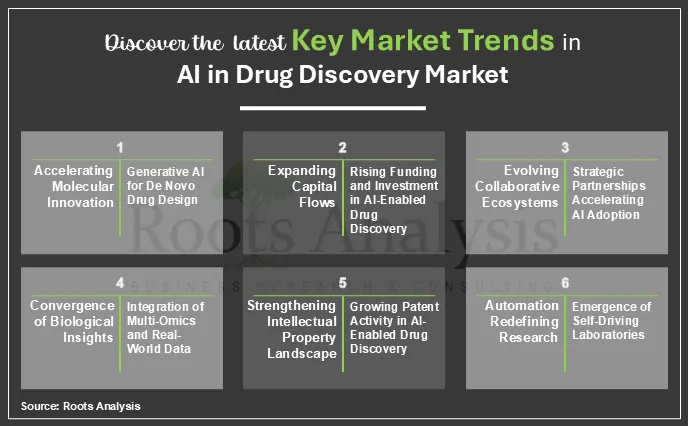
Latest Trends in AI in Drug Discovery Market That Are Likely to Shape the Market
1. Generative AI for De Novo Drug Design
Generative AI is transforming early-stage drug discovery by enabling the rapid design of novel molecules with desired biological and pharmacological properties. These models can explore large chemical spaces, generate potential drug candidates, and optimize molecular structures. As a result, pharmaceutical and biotechnology companies are increasingly adopting generative AI platforms to accelerate lead identification and reduce the time and resources required for conventional compound discovery.
2. Rising Funding and Investment in AI-Enabled Drug Discovery
Funding for AI-driven drug discovery has increased significantly as pharmaceutical companies, biotechnology firms, venture capital investors, and technology companies recognize its potential to accelerate drug development. Approximately USD 10 billion has been invested in AI-based drug discovery over the past two years, supporting the development of AI platforms, novel drug candidates, computational infrastructure, and technology-enabled biotech companies. This growing capital inflow is strengthening innovation, expanding AI adoption across discovery workflows, and accelerating the commercialization of AI-generated therapeutics. In May 2026, Alphabet’s AI biotech Isomorphic Labs raised USD 2.1 billion in Series B funding to develop and deploy its next-generation AI drug design engine, IsoDDE, and advance its in-house drug pipeline.
3. Strategic Partnerships Accelerating AI Adoption
Strategic partnerships have emerged as a key trend in the AI in drug discovery market, enabling pharmaceutical and biotechnology companies to access advanced AI platforms, proprietary datasets, and specialized computational capabilities. More than 75 companies entered into partnerships related to AI-driven drug discovery during the past year, with approximately 45% focused on research collaborations and strategic agreements. In August 2026, Novo Nordisk and AWS entered a strategic partnership to accelerate drug discovery through agentic AI and cloud technologies, including the launch of a co-innovation hub in London.
4. Integration of Multi-Omics and Real-World Data
The integration of AI in omics studies and real-world datasets is strengthening data-driven drug discovery. AI models can analyze information from genomics, transcriptomics, proteomics, electronic health records, and clinical datasets to identify disease patterns and potential therapeutic opportunities. Combining these diverse data sources enables researchers to develop more comprehensive disease models, improve patient stratification, and support the identification of biomarkers and drug targets.
5. Growing Patent Activity in AI-Enabled Drug Discovery
Patent activity is emerging as an important indicator of innovation in AI-enabled drug discovery, as companies seek to protect AI-generated molecules, computational methods, target identification platforms, and drug design technologies. Recent patent analyses indicate that AI/ML-linked pharmaceutical filings have increased, rising from 9% to 24% of pharmaceutical patent filings over five years.3 This growing intellectual-property activity reflects increasing commercialization of AI technologies and intensifying competition among pharmaceutical, biotechnology, and technology companies.
6. Emergence of Self-Driving Laboratories
The integration of AI with laboratory automation is giving rise to self-driving laboratories, representing a shift from AI-assisted analysis toward autonomous experimentation. These systems combine AI models, robotics, and automated instruments to design experiments, execute and analyze results, and refine subsequent experiments with limited human intervention. Companies such as Insilico Medicine are integrating AI-driven drug design with automated laboratory workflows, enabling faster iterative cycles of compound design, synthesis, testing, and optimization.
Conclusion
The AI in drug discovery market is expected to show significant growth in the coming years, driven by rapid advancements in generative AI, machine learning, automated laboratories, and data-driven drug design. Increasing funding, strategic partnerships, and patent activity are further strengthening the development and commercialization of AI-enabled technologies. These trends are enabling pharmaceutical and biotechnology companies to accelerate target identification, explore larger chemical spaces, and improve the efficiency of early-stage discovery.
While challenges such as data quality, regulatory uncertainty, and integration with conventional research workflows persist, continued technological advancements are expanding the practical applications of AI across drug discovery. The emergence of self-driving laboratories is further supporting a shift toward increasingly autonomous experimentation, while collaborations between pharmaceutical and technology companies are facilitating access to advanced computational capabilities and specialized expertise.
Ultimately, the convergence of AI, automation, biological data, and computational drug design is transforming conventional discovery processes. As investment and industry adoption continue to increase, AI is expected to become increasingly embedded across drug discovery workflows, supporting faster, and potentially more cost-efficient development of novel therapeutics.
Browse our full report on AI in Drug Discovery Market Trends: https://www.rootsanalysis.com/reports/ai-based-drug-discovery-market.html
Sources:
1. https://www.fiercebiotech.com/biotech/alphabets-ai-biotech-isomorphic-labs-bags-21b-series-b-fuel-next-gen-drug-design-model
2. https://pharmatimes.com/news/novo-nordisk-and-aws-form-ai-partnership-to-speed-drug-discovery/
3. https://www.cas.org/resources/cas-insights/pharma-patent-intelligence