BCL-2 Inhibitors Market

.png)

Published: April 2026
BCL-2 inhibitors are drugs that induce cancer cell death by disrupting the BCL-2 protein, which typically blocks apoptosis (programmed cell death). These medications function by attaching to BCL-2 proteins, releasing "pro-death" proteins that can subsequently instruct the cancer cell to undergo self-destruction. They are utilized as cancer therapeutics, including chronic lymphocytic leukemia (CLL) and acute myeloid leukemia (AML).
Based on mechanism of action, these therapies can be classified into combination and monotherapies. Combination therapies have gained popularity as they may eradicate cancer cells more efficiently than monotherapy. Monotherapy medications focus on cancer cells at various points in the cell cycle, whereas combination therapy enhances the chances of full eradication. Continuous scientific investigations and increasing clinical trial findings are greatly enhancing the treatment potential and clinical assurance in BCL-2 inhibitors. Venetoclax has led a new surge of research efforts, and its effectiveness has driven additional studies into next-generation BCL-2 inhibitors that offer enhanced safety, wider efficacy, and the potential to bypass resistance mechanisms.
Roots Analysis has conducted an exhaustive study on featuring the current landscape and future opportunity for the companies engaged in the BCL-2 Inhibitors Market domain. In this article, we have highlighted some of the BCL-2 inhibitors market trends 2025 that are likely to shape the evolution of this sector during the forecast period.
Want to explore more about BCL-2 inhibitors Market?
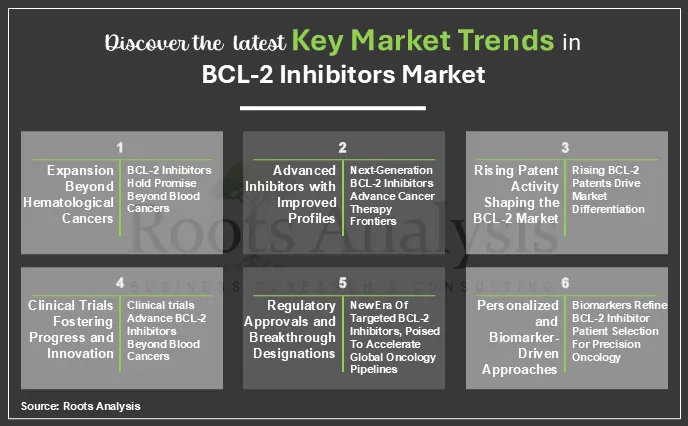
Bcl-2 Inhibitors Market Trends 2026 That Are Likely to Shape the Future Potential of the Industry
Expansion Beyond Haematological Cancers
Bcl-2 inhibitors were initially developed and approved primarily for hematological malignancies. These agents target the anti-apoptotic Bcl-2 protein, which is overexpressed in these blood cancers, enabling tumor cells to evade programmed cell death.
Now, research is actively extending their application to solid tumors, notably non-small cell lung cancer, HER2- positive breast cancer and small cell lung cancer. This shift is driven by preclinical and early-phase clinical data demonstrating Bcl-2 overexpression in these tumor types, often linked to chemotherapy resistance and poor prognosis. For instance, ongoing trials are combining Bcl-2 inhibitors with standard therapies like chemotherapy or PD-1 inhibitors to overcome apoptosis resistance in solid tumor microenvironments.
Advanced Inhibitors with Improved Profiles
Pharmaceutical companies are increasingly prioritizing the development of next-generation inhibitors, including second-generation iterations and innovative dual-pathway agents, that target Bcl-2 alongside closely related anti-apoptotic proteins such as MCL-1. These advanced molecules are engineered to deliver enhanced selectivity for their intended protein targets, minimizing off-target effects that plagued earlier compounds. They also promise superior pharmacokinetic profiles, expanded therapeutic windows for better safety and tolerability, and broader applicability—extending beyond traditional hematologic malignancies like leukemia and lymphoma into challenging solid tumors, such as those in breast, lung, or pancreatic cancers.
Rising Patent Activity Shaping the BCL-2 Market
Rising patenting activity in the field of BCL-2 inhibition is steadily reshaping the competitive and technological landscape of this market, as a broad range of industry and academic players move to secure protection for novel chemotypes, mechanisms, and therapeutic uses. This expanding body of intellectual property not only reflects strong scientific momentum but also serves as a key strategic lever for differentiation, partnering, and market exclusivity among developers.
Clinical Trials Fostering Progress and Innovation
Clinical trials play a pivotal role in advancing the BCL-2 inhibitors market by driving innovation, validating novel mechanisms, and expanding therapeutic indications beyond traditional hematologic malignancies. Over the past few years, there has been a steady increase in the number of clinical trials, reflecting heightened interest from drug developers in BCL-2 inhibitors as both monotherapy and combination regimens. This surge is fueled by efforts to overcome resistance to first-generation agents like venetoclax, with next-generation candidates such as lisaftoclax, sonrotoclax, and LP-118/LP-108 advancing through phases II and III for chronic lymphocytic leukemia, non-Hodgkin lymphoma, multiple myeloma, and Waldenström's macroglobulinemia. Ongoing studies emphasize combinations with BTK inhibitors, immunotherapies, and chemotherapy to deepen remissions, improve durability, and mitigate toxicities like tumor lysis syndrome, while exploring applications in solid tumors such as breast and prostate cancers.
Regulatory Approvals and Breakthrough Designations
The FDA breakthrough therapy designations for lead drugs like venetoclax have accelerated market acceptance and development of improved molecules. Regulatory support continues to enable faster patient access and fuels R&D investments. In June 2025, Ascentage Pharma, focused on fulfilling unmet medical needs in cancer, revealed that its unique Bcl-2 selective inhibitor, lisaftoclax (APG-2575), has received approval from China’s National Medical Products Administration (NMPA) for treating adult patients with chronic lymphocytic leukemia/small lymphocytic lymphoma.
Personalized and Biomarker-Driven Approaches
Increasing focus on precision medicine approaches involves using biomarkers to identify patients most likely to benefit from BCL-2 inhibitors. This enhances treatment efficacy and cost-effectiveness while advancing personalized oncology. Key biomarkers, such as MCL1 gene amplifications and deletions in miR-15 and -16, help predict patient responses and resistance mechanisms. Integrating functional assays like BH3 profiling further refines patient selection by uncovering specific BCL-2 family protein dependencies, enabling tailored therapeutic strategies that improve clinical outcomes and minimize adverse effects. These advances support more precise, individualized treatment plans in hematologic and other malignancies, driving better efficacy and reduced healthcare costs.
Conclusion
Given the increase in the number of clinical studies and patents registered in the past few years, the BCL-2 Inhibitors market has evolved into one of the growing segments of the pharmaceutical industry. Specifically, BCL-2 inhibitors, such as venetoclax and next-generation agents like lisaftoclax, are at the forefront of targeted cancer therapies, primarily developed to treat hematologic malignancies including chronic lymphocytic leukemia (CLL), acute myeloid leukemia (AML), and myelodysplastic syndromes (MDS), while also showing promising potential in overcoming drug resistance and expanding into solid tumor applications. Moreover, encouraging clinical results reported across different trials of these novel therapies have attracted significant capital investments and captured the interest of various pharmaceutical companies and research institutions.
Browse our full report on BCL-2 Inhibitors Market: https://www.rootsanalysis.com/reports/b-cell-inhibitors-market.html
Sources:
- https://pmc.ncbi.nlm.nih.gov/articles/PMC8904281/
- https://pmc.ncbi.nlm.nih.gov/articles/PMC11790632/
- https://www.researchgate.net/publication/362841594_Patent_landscape_of_inhibitors_and_PROTACs_of_the_anti-apoptotic_BCL-2_family_proteins
- https://www.mdpi.com/2218-273X/15/9/1304
- https://pmc.ncbi.nlm.nih.gov/articles/PMC12874710/