Biologics API Market Trends

.png)

Published: August 2026
The biologics active pharmaceutical ingredient (API) manufacturing landscape represents one of the most complex and rapidly evolving segments of the pharmaceutical industry. Unlike small molecule APIs, they are derived from living systems such as microbial or mammalian cells, making their production highly sensitive to process conditions, scalability constraints, and regulatory requirements. These APIs include a wide range of therapeutic modalities, such as monoclonal antibody, recombinant proteins, vaccines, cell and gene therapies, and antibody-drug conjugates. The inherent complexity of these molecules necessitates sophisticated upstream and downstream processes, including cell line development, fermentation or cell culture, purification, and stringent quality control measures.
Over the years, advancements in biotechnology and a deeper understanding of disease biology have significantly expanded the scope of biologics, leading to a growing pipeline of innovative therapies targeting chronic, rare, and previously untreatable conditions. This shift has placed biologics API manufacturing at the core of biopharmaceutical innovation. At the same time, manufacturers are required to balance productivity, cost-efficiency, and regulatory compliance, while ensuring consistent product quality and scalability across clinical and commercial stages. As a result, the biologics API manufacturing domain is witnessing continuous transformation, driven by technological innovation, strategic investments, and evolving business models.
Roots Analysis has conducted an exhaustive study of the Biologics API Market featuring the current market landscape and future opportunities for developers engaged in healthcare, over the span of next 9 years. In this article, we have highlighted some of the Biologics API Market Trends that are likely to shape the evolution of this industry.
Want to Explore the Competitive Landscape and Biologics API Market Trends?
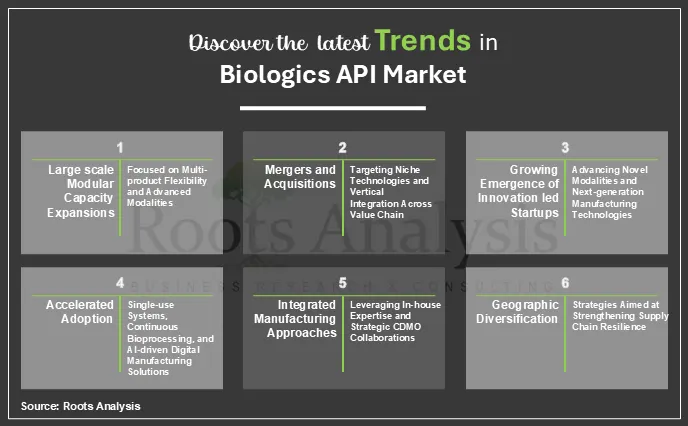
Latest Trends in Biologics API Market That Are Likely to Shape the Market
1. Large scale Modular Capacity Expansions Focused on Multi-product Flexibility and Advanced Modalities
Biopharmaceutical companies are undertaking large-scale and highly strategic capacity expansion initiatives to address the increasing demand both established and emerging therapeutic modalities. These expansions are characterized by the development of next-generation manufacturing facilities equipped with modular and flexible designs, enabling rapid scale-up and multi-product manufacturing within a single site. In particular, there is a growing emphasis on facilities capable of handling high-potency biologics, antibody-drug conjugates, and cell and gene therapy-related APIs, which require specialized containment and processing capabilities. Additionally, companies are investing in geographically distributed manufacturing hubs to ensure uninterrupted supply and reduce dependency on single-site operations. Such expansion efforts are often supported by long-term capital commitments and partnerships with governments, reflecting a broader industry push toward building resilient and future-ready manufacturing infrastructure.
2. Mergers and Acquisitions Targeting Niche Technologies and Vertical Integration Across the Value Chain
Mergers and acquisitions have emerged as a key strategic lever for companies seeking to strengthen their position in the biologics API manufacturing space. Rather than focusing solely on scale, organizations are increasingly targeting acquisitions that offer specialized technological capabilities, such as advanced biologics expression systems, peptide and oligonucleotide synthesis platforms, and expertise in complex conjugation processes. These transactions enable companies to rapidly expand their service offerings, access new customer segments, and accelerate time-to-market for novel therapies. Furthermore, acquisitions are being used to establish a stronger foothold in high-growth geographic regions and to integrate vertically across the value chain, from API development to finished product manufacturing. This trend highlights a shift toward capability-driven consolidation, where access to innovation and technical expertise is a primary driver of deal-making activity. For instance, in January 2026, Zydus acquired advanced biologics manufacturing facilities in the US to enter the global biologics CDMO domain.
3. Growing Emergence of Innovation led Startups Advancing Novel Modalities and Next-generation Manufacturing Technologies
The biologics API manufacturing ecosystem is witnessing the rapid emergence of startups that are focused on addressing specific challenges and opportunities within this domain. These companies are often built around proprietary technologies or novel manufacturing platforms designed to improve yield, reduce production costs, or enable the development of next-generation biologics. Many startups are specializing in niche areas such as gene editing-based therapies, mRNA production, synthetic biology, and cell-free protein synthesis, thereby expanding the scope beyond traditional modalities. Backed by venture capital funding and supported by favorable regulatory and policy environments in certain regions, these players are contributing to a more innovation-driven and competitive market landscape. Their ability to rapidly iterate and adopt unconventional approaches positions them as key contributors to the evolution of biologics manufacturing.
4. Accelerated Adoption of Single-use Systems, Continuous Bioprocessing, and AI-driven Digital Manufacturing Solutions
Technological innovation continues to play a transformative role in manufacturing, with increasing adoption of advanced bioprocessing solutions and digital tools aimed at enhancing efficiency, scalability, and product quality. Single use bioprocessing are becoming widely adopted due to their ability to reduce cleaning requirements, minimize cross-contamination risks, and enable faster changeovers between production batches. At the same time, continuous manufacturing approaches are gaining traction as they offer improved process consistency, reduced production timelines, and better resource utilization compared to traditional batch processes. The integration of digital technologies, including artificial intelligence, machine learning, and advanced data analytics, is further enabling real-time process monitoring, predictive quality control, and optimization of critical process parameters. Collectively, these advancements are facilitating a shift toward more automated, flexible, and data-driven manufacturing environments that can better support the increasing complexity.
For example, in March 2026, Merck KGaA entered into collaboration with BioNTech to supply single-use assemblies and consumables for mRNA and biologics API production, supporting rapid scale-up and multi-product facilities.
5. Integrated Manufacturing Approaches Leveraging In-house Expertise and Strategic CDMO Collaborations
The manufacturing strategies adopted by biopharmaceutical companies are evolving in response to the growing complexity and diversity of biologics pipelines. While large pharmaceutical companies continue to invest in expanding their in-house manufacturing capabilities to maintain control over critical processes and intellectual property, there is a parallel increase in the reliance on contract development and manufacturing organizations (CDMOs). These service providers offer specialized expertise, advanced infrastructure, and the ability to scale production rapidly, making them valuable partners, particularly for small and mid-sized companies. In many cases, organizations are adopting hybrid models that combine internal manufacturing for core products with outsourcing for specialized or capacity-intensive processes. This approach allows companies to optimize resource allocation, manage risks associated with demand fluctuations, and accelerate development timelines, thereby enhancing overall operational efficiency.
6. Geographic Diversification Strategies Aimed at Strengthening Supply Chain Resilience
The biologics API manufacturing landscape is becoming increasingly globalized, with companies actively diversifying their manufacturing footprints to enhance supply chain resilience and mitigate potential disruptions. This trend has been driven by a growing recognition of the risks associated with over-reliance on a limited number of manufacturing locations, as well as the need to ensure consistent supply in the face of geopolitical and economic uncertainties. As a result, manufacturers are establishing facilities across multiple regions, including emerging markets that offer cost advantages, skilled labor, and supportive regulatory frameworks. At the same time, there is a renewed focus on strengthening domestic manufacturing capabilities in developed regions to reduce dependency on external suppliers and improve supply chain security. This shift toward a more distributed and balanced manufacturing network is expected to play a critical role in supporting the long-term sustainability of the biologics API industry.
Conclusion
The biologics API manufacturing industry is evolving into a highly sophisticated and strategically important segment of the biopharmaceutical value chain. Driven by advancements in biotechnology and the increasing complexity of therapeutic modalities, manufacturers are continuously adapting their capabilities to meet emerging demands. Capacity expansions, strategic collaborations, technological innovations, and the rise of new market entrants are collectively reshaping the competitive landscape. As the industry moves forward, the ability to integrate advanced technologies, ensure supply chain resilience, and maintain high standards of quality and compliance will be critical in unlocking the full potential of biologics and supporting the next generation of therapeutic breakthroughs.
To know more about the complement inhibitors market trends, access full report: https://www.rootsanalysis.com/reports/biologics-api-market.html
Sources:
1. http://mountainside-medical.com/blogs/medical-supplies/exploring-top-10-trends-in-active-pharmaceutical-ingredients-api?srsltid=AfmBOorSl9hbt1emqFUHP1isH0VBxz_mKyoAMwco5UoasK8kjbj9AaMn
2. https://www.seqens.com/knowledge-center/enhancing-drug-development-comprehensive-guide/
3. https://neunco.com/contract-manufacturing/emerging-trends-in-api-contract-manufacturing-biotechnology-and-biopharmaceuticals/