Complement Inhibitor Drugs Market Trends

.png)

Published: August 2026
The complement inhibitors market is experiencing a transformative phase, driven by a deeper understanding of the complement system’s role in the pathogenesis of a wide range of life-threatening disorders. Historically, treatment approaches for complement-mediated diseases were largely dependent on broad immunosuppressive strategies; however, the emergence of targeted biologics and small molecule inhibitors has enabled more precise modulation of specific components within the complement cascade. Current development efforts are increasingly focused on selectively targeting key complement pathways, including C3, C5, Factor B, and Factor D, with the aim of overcoming limitations associated with earlier therapies, such as incomplete disease control, treatment burden, and the risk of breakthrough disease activity.
Furthermore, advancements in oral formulations, subcutaneous delivery platforms, extended dosing regimens, and biomarker-driven approaches are reshaping the diagnosis, monitoring, and long-term management of complement-mediated disorders.
The therapeutic scope of complement inhibitors has also expanded significantly beyond their traditional applications in hematological disorders. While indications such as paroxysmal nocturnal hemoglobinuria and atypical hemolytic uremic syndrome continue to represent key areas of focus, complement-targeted therapies are increasingly being evaluated across a broader spectrum of diseases, including geographic atrophy, myasthenia gravis, autoimmune disorders, and rare kidney diseases. This diversification of clinical applications is encouraging developers to establish broader and more sustainable pipelines aimed at addressing both rare diseases and larger patient populations, while improving treatment accessibility, convenience, and long-term outcomes.
Growing scientific interest and expanding clinical opportunities have further accelerated innovation, investment, and strategic activity across the biopharmaceutical sector. Companies are increasingly pursuing next-generation complement inhibitors, including oral and long-acting therapies, while simultaneously exploring lifecycle expansion strategies for approved products and establishing partnerships to strengthen their competitive positioning.
Overall, the convergence of technological advancements, expanding therapeutic applications, and increasing commercial competition is reshaping the complement inhibitors landscape. As the field continues to evolve, next-generation therapies with improved efficacy, safety profiles, and patient-centric delivery approaches are expected to play a pivotal role in defining the future of complement-targeted treatment.
Roots Analysis has conducted an exhaustive study of the complement inhibitors featuring the current market landscape and future opportunities for developers engaged in healthcare, over the span of next 9 years. In this article, we have highlighted some of the Complement Inhibitors Drugs Market Trends that are likely to shape the evolution of this industry.
Want to Explore the Competitive Landscape and Complement inhibitor Drugs Trends?
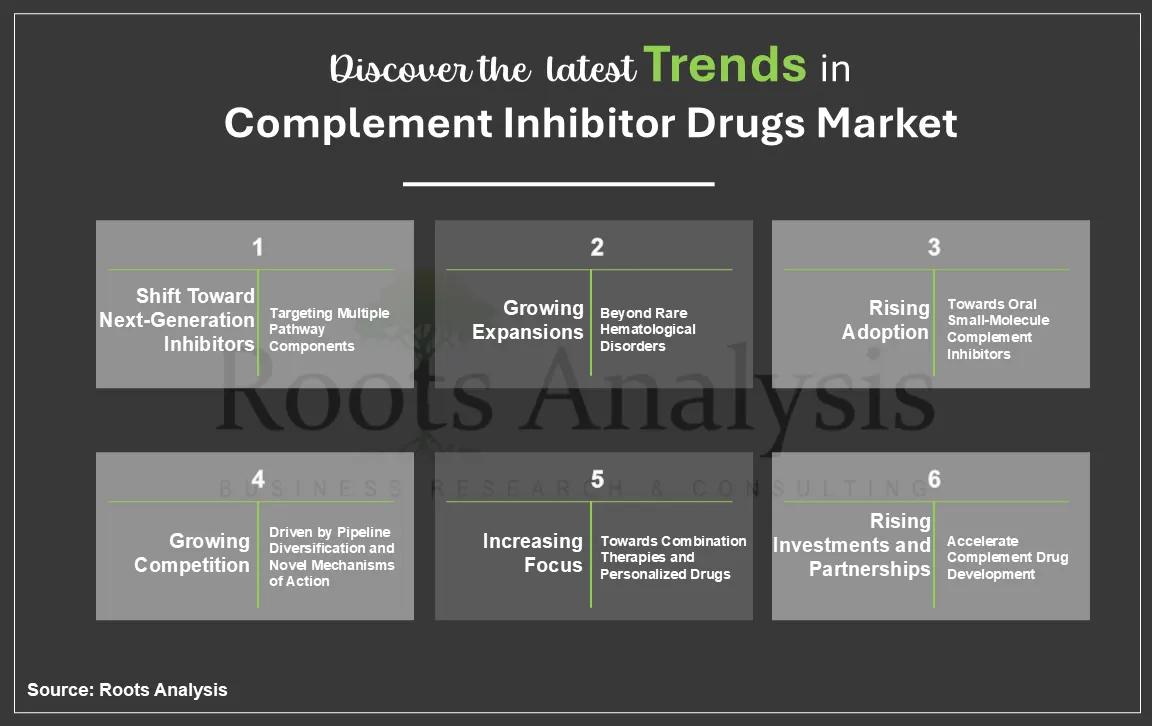
Latest Trends in Complement Inhibitor Drugs Market That Are Likely to Shape the Market
1. Shift Toward Next-Generation Complement Inhibitors Targeting Multiple Pathway Components
The complement inhibitors landscape is witnessing a transition from conventional C5-targeting therapies toward next-generation inhibitors designed to modulate multiple components of the complement cascade. While first-generation therapies established clinical proof-of-concept through terminal complement inhibition, developers are increasingly focusing on upstream targets to achieve broader disease control and address limitations associated with existing therapies. This trend is primarily driven by the growing understanding of complement biology and the role of different activation pathways in immune-mediated disorders. Novel inhibitors targeting earlier stages of the cascade are expected to expand therapeutic opportunities across renal, neurological, hematological, and ophthalmological indications, thereby increasing the addressable patient population.
2. Growing Expansion Beyond Rare Hematological Disorders
Complement inhibitors are increasingly moving beyond established indications such as paroxysmal nocturnal hemoglobinuria and atypical hemolytic uremic syndrome, with ongoing clinical investigations evaluating their potential in kidney diseases, autoimmune disorders, neuromuscular conditions, and ophthalmic disorders. The increasing recognition of complement-mediated inflammation as a disease-driving mechanism has encouraged pharmaceutical companies to explore applications across diverse therapeutic areas. This expansion is expected to accelerate market growth by enabling complement inhibitors to address larger patient populations and potentially transform treatment paradigms for several chronic and debilitating conditions.
3. Rising Adoption Towards Oral Small-Molecule Complement Inhibitors
The complement inhibitor pipeline is witnessing increased interest in orally administered small molecules, offering advantages over traditional intravenous and subcutaneous biologics therapies. Small-molecule inhibitors targeting components such as Factor B and Factor D are being developed to improve patient convenience, reduce treatment burden, and enhance long-term adherence. This shift toward oral formulations reflects the broader pharmaceutical industry's movement toward patient-centric treatment approaches. The availability of convenient administration routes may support earlier intervention, improve treatment compliance, and increase adoption among patients requiring chronic complement pathway modulation.
4. Growing Competition Driven by Pipeline Diversification and Novel Mechanisms of Action
The complement inhibitor market is becoming increasingly competitive, with several companies developing therapies differentiated by target specificity, route of administration, dosing frequency, and clinical application. Emerging candidates are targeting various complement pathways, including classical, alternative, and terminal pathways, creating a diversified competitive landscape. This competitive evolution is encouraging innovation in therapeutic design, as developers aim to overcome limitations associated with currently approved treatments, including frequent dosing requirements, incomplete pathway inhibition, and safety considerations. As more candidates advance through clinical development, differentiation based on efficacy, convenience, and cost-effectiveness will become increasingly important.
5. Increasing Focus Towards Combination Therapies and Personalized Complement Modulation
The complement inhibitor space is gradually moving toward precision medicine approaches, with researchers exploring combination strategies and biomarker-driven patient selection. Since complement activation varies significantly across diseases and patient populations, identifying individuals most likely to benefit from specific pathway inhibition has become a key area of focus. Advances in disease biology, biomarker identification, and molecular diagnostics are expected to support more personalized treatment strategies. These approaches may enable optimized therapeutic outcomes while reducing unnecessary exposure to complement-modulating agents.
6. Rising Investments and Partnerships to Accelerate Complement Drug Development
Growing commercial opportunities in complement-mediated diseases have encouraged increased investments, collaborations, and licensing activities among biotechnology and pharmaceutical companies such as Novartis, Otsuka Pharmaceuticals, Apellis Pharmaceuticals and Sanofi. Established players and emerging biotech firms are actively strengthening their complement inhibitor portfolios through internal development programs and strategic partnerships. The rising interest from industry stakeholders is fueled by the success of approved complement inhibitors and the potential for expansion into additional high-value indications. Continued investments are expected to accelerate innovation, enhance clinical development capabilities, and support the emergence of differentiated complement-targeting therapies.
Conclusion
The complement inhibitors landscape is witnessing significant transformation, fueled by advancements in disease understanding, targeted therapeutic development, and expanding clinical applications. While established C5 inhibitors continue to drive market growth, next-generation therapies targeting upstream complement components, along with oral and precision-based approaches, are expected to further enhance treatment options. Increasing investments, strategic collaborations, and growing adoption across diverse therapeutic areas are likely to accelerate innovation and broaden the impact of complement inhibition in managing complement-mediated disorders.
To know more about the complement inhibitors market trends, access full report: https://www.rootsanalysis.com/reports/next-generation-complement-therapeutics-market.html
Sources: