
Lowest Price Guaranteed
Slides
205
Last Updated
August 2026
View Count
12928
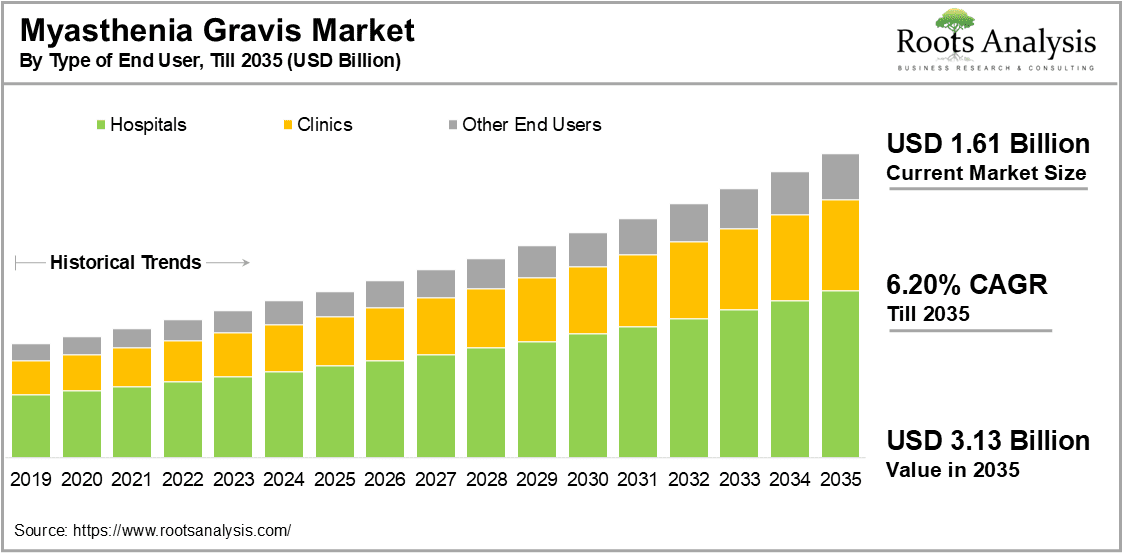
The global myasthenia gravis market is estimated to grow from USD 1.61 billion in 2024 to USD 3.13 billion by 2035, representing a compounded annual growth rate (CAGR) of 6.20% during the forecast period.
 |
To learn more about this report, request a free sample copy
Myasthenia gravis is a rare neuromuscular disorder that can cause voluntary muscle weakness in the head, eye, limb, and spinal cord. This disease comes under the category of autoimmune diseases wherein body’s immune system begins to produce antibodies that potentially block muscle cells from transmitting and receiving messages from nerve cells. The antibodies are produced against acetylcholine receptor (acHR), thereby impacting the transmission of electrical signals to the muscles. Patients suffering from myasthenic gravis may encounter symptoms, such as dropping eyes, swallowing difficulties, respiratory paralysis, double vision and mobility restrictions.
Recently, a rapid surge has been noticed in the number of patients with myasthenia gravis which has further necessitated the demand for advance therapeutic drugs that aid in slowing down disease progression. As per the report of the Myasthenia Gravis Foundation of America, over 70,000 people in US have been diagnosed with myasthenia gravis, indicating a significant increase in the number of patients. This rising incidence of myasthenia gravis has diverted the attention of industry players to develop advanced drugs for the patients.
It is important to highlight here that since 2017, the USFDA has approved several monoclonal antibodies-based drugs that has shown positive outcomes in patients with myasthenia gravis. Some of the potentially approved drug by the USFDA includes Eculizumab (Soliris®), Efgartigimod alfa (Vyvgart®), Ravulizumab (Ultomiris®), Rozanolixizumab (Rystiggo®) and Zilucoplan (Zilbrysq®). With increasing approval of therapeutic drugs, various industry players have accelerated their research and development activities to develop novel treatment options that helps in managing symptoms of such autoimmune diseases in order to offer a quality life to the patient.
Currently, several drugs that are under clinical pipelines have shown positive outcomes in patients with generalized myasthenia gravis. For instance, in June 2024, Johnson & Johnson announced positive results of nipocalimab Phase III clinical Vivacity-MG3 study in patients suffering from generalized myasthenia gravis. Given the positive outcomes of such clinical studies in patients with myasthenia gravis, various industry stakeholders has boosted their taking strategic initiatives followed by collaborations, investments and partnerships to enhance the development as well as successful approval of drugs for myasthenia gravis.
With acceleration of research and development activity in this field, we believe that myasthenia gravis market will continue to expand at a substantial rate during the forecast period.
The market research report highlights the information on key industrial leaders who are currently active across various segments of the industry as mentioned in the table below.
| Key Report Attributes | Details | |
| Historical Trend | Since 2019 | |
| Forecast Period | Till 2035 | |
| Market Size 2035 | $3.13 Billion | |
| CAGR (Till 2035) | 6.20% | |
| Type of Disease |
|
|
| Type of Drug Class |
|
|
| Type of Age Group |
|
|
| Type of End User |
|
|
| Distribution Channel |
|
|
| Geographical Regions |
|
|
| Key Companies Profiled |
|
|
| PowerPoint Presentation (Complimentary) |
Available | |
| Customization Scope | 15% Free Customization | |
| Excel Data Packs (Complimentary) |
Available | |
One of the key objectives of the market report was to estimate the current myasthenia gravis market size, opportunity and the market growth potential, over the forecast period, till 2035. We have provided informed estimates on the likely evolution of the market for the forecast period.
The myasthenia gravis industry analysis also features the likely distribution of the current and forecasted opportunity within the market across various segments, such as distribution by type of disease (ocular myasthenia gravis, congenital myasthenia gravis, generalized myasthenia gravis and transient myasthenia gravis), type of drug class (cholinesterase inhibitors, chromic immunomodulators, monoclonal antibodies, rapid immunotherapies and other treatments), type of age group (below 55 years and above 55 years), type of end user (hospitals, clinics and other end users), distribution channel (hospital pharmacies, retail pharmacies and online pharmacies), geographical regions (North America, Europe, Asia-Pacific, Middle East and North Africa, and Latin America) and leading players.
In order to account for future uncertainties associated with some of the key parameters and to add robustness to our model, we have provided three market forecast scenarios, namely conservative, base, and optimistic scenarios, representing different tracks of industry’s evolution.
All actual figures have been sourced and analyzed from publicly available information forums and primary research discussions. The financial figures mentioned in this market report are in USD, unless otherwise specified.
The myasthenia gravis market is categorized based on the type of diseases into ocular myasthenia gravis, congenital myasthenia gravis, generalized myasthenia gravis and transient myasthenia gravis. According to our projection, generalized myasthenia gravis accounts for the highest market share. This can be attributed to the increasing approval of therapeutic drugs from the USFDA and growing number of patients suffering from this condition.
It is important to highlight here that ocular myasthenia gravis also can evolve into generalized myasthenia gravis, which further increases the number of patients with generalized myasthenia gravis. However, ocular myasthenia gravis is likely to grow at a higher CAGR during the forecast period.
Based on the type of drug class, the myasthenia gravis market is segmented into cholinesterase inhibitors, chromic immunomodulators, monoclonal antibodies, rapid immunotherapies and other treatments. Among these, currently monoclonal antibodies hold the highest share (60%) of the overall market. This can be attributed to the growing approval of monoclonal antibodies based therapeutic drugs for the treatment of generalized myasthenia gravis. For instance, Soliris (eculizumab) is a monoclonal antibodies-based drug that has received approval from the USFDA and EMA for the treatment of adult patients with generalized myasthenia gravis.
It is important to highlight here that Soliris is the first complement inhibitor that has been approved (in 2018) for the treatment of disorder. Driven by the growing approval of monoclonal antibodies, this segment will continue to grow at a higher CAGR during the forecast period.
This market for myasthenia gravis treatment has been segmented across different age groups, such as below 55 years and above 55 years. It is important to highlight here that currently below 55 years age group accounts for the highest share of the market. This can be attributed to the growing incidence of myasthenia gravis amongst people below 55 years of age group. Driven by the growing prevalence of myasthenia gravis in people below 55 years of age, this segment will continue to grow at a higher CAGR during the forecast period.
The global market is categorized based on end user into hospitals, clinics and other end users. Among these, currently hospitals are dominating, holding 55% of the myasthenia gravis market share. This dominance is primarily due to the high demand for advanced therapeutic treatment and access to a large patient population at hospitals. A number of approved drugs such as Soliris (eculizumab) and Ultomiris (ravulizumab) are administered through intravsnous infusion in hospital setting or specialized clinic setting. Furthermore, the rising investment for the enhancement of healthcare infrastructure has contributed to the highest share of the hospitals.
However, with a growing shift towards specialized care services, the clinics will show lucrative growth potential and is estimated to grow at a higher CAGR during the forecast period. The recently approved antibody therapeutic Rystiggo is given once weekly through a 15 min subcutaneous infusion at infusion center / clinics and does not require hospital admissions.
On the basis of the distribution channel, the myasthenia gravis market value is segmented into hospital pharmacies, retail pharmacies and online pharmacies. Among these, hospital pharmacy register the highest share of the market driven by the rising number of hospitalization of patients with myasthenia gravis that require regular medication. Moreover, hospital pharmacies are the primary distribution channel of specialized drugs designed for myasthenia gravis patients.
However, in the long run, online pharmacies will grow at a substantial CAGR owing to the changing regulatory guidelines for online sales of prescribed medication by patients.
The global myasthenia gravis treatment market is distributed across various geographical regions, such as North America, Europe, Asia Pacific, Middle East and North Africa, and Latin America. Presently, North America accounts for the largest myasthenia gravis market share (50%). This can be attributed to the growing number of patients with myasthenia gravis in North American region and rising research efforts by the industry stakeholders. According to Myasthenia Gravis Foundation of America, there are more than 70,000 people living with this disorder in the US alone. Moreover, the advanced healthcare infrastructure and growing adoption of monoclonal antibodies and immunotherapies has further contributed to the highest share of this region.
However, in Asia Pacific, and Middle East and North Africa, the market will grow at a higher CAGR during the forecast period. This lucrative growth potential is likely to be the result of increasing awareness among people about myasthenia gravis and rising investment by healthcare experts for the development of advanced immunotherapies to treat patients with myasthenia gravis.
The “Global Myasthenia Gravis Market: Industry Trends and Global Forecast, till 2035” report features an extensive study of the current market landscape, market size, market share forecast, market outlook and future opportunities for the drug developers.
Presently, the global myasthenia gravis treatment market is witnessing the presence of several well-established and new entrants. The current focus of these industry stakeholders is on the development of advanced therapeutic modalities that can aid in managing disease conditions. Moreover, the stakeholders are actively engaged in the development of cell therapy for the treatment of autoimmune diseases (including myasthenia gravis).
Notably, Bristol Myers Squibb launched Autoimmunity Cell Therapy Network (ACTioN), a consortium that will foster the advancement of early-stage therapies towards approval. As per Daniela van Eickels, Vice President and Head of Medical Affairs, Cell Therapy, BMS, “There exist unmet needs that remain for patients with autoimmune disease, noting that in addition to complications caused by the diseases themselves, such as organ damage, the need to regularly take immunosuppressive treatments can contribute to the burden of the disease as well.”
Some other companies developing cell therapy for Myasthenia Gravis treatment include Arcellx, Cartesian Therapeutics and Kyverna Therapeutics. Overall, with more strategic initiatives of the stakeholders, the market will remain competitive during the projected period.
There are also some startups that have emerged for the development of novel therapeutics targeting autoimmune diseases including Myasthenia Gravis. In September 2024, Candid Therapeutics debuted with a funding of $ 370 million and is engaged in development of bispecific antibody, CND106, for Myasthenia patients.
Currently, the market is likely to be propelled by the increasing incidence of myasthenia gravis worldwide and rising awareness about the disease among people. This rising prevalence of myasthenia gravis has underscored the demand for advanced therapeutic treatment for managing disease condition.
Furthermore, the rising awareness about the consequences associated with disease and benefits of early diagnosis has resulted in the proper diagnosis and treatment. It is worth mentioning that June has been marked as Myasthenia Gravis Awareness month. The collective initiatives by non-industry and industry organizations to create advanced diagnostic tests, has further propelled the market growth during the forecast period. In January 2024, a team of researchers at University of Alberta revealed their research on development of a blood based biomarker test to allow rapid diagnosis of the disorder.
High cost associated with research and development of therapeutics drugs for myasthenia gravis may impede the market growth. It is important to highlight here that despite of growing incidence of myasthenia gravis, there are limited drugs approved by the USFDA. However, cost of such drugs, including Vyvgart myasthenia gravis cost and Ultomiris myasthenia gravis cost is high.
Owing to the limited therapeutic drug approval, pharmaceutical companies may witness challenge in meeting regulatory compliance and in finding treatment for unmet medical needs of patients with myasthenia gravis. Furthermore, the current therapeutic modalities that are available have shown several side effects, which is posing a challenge in treatment adherence. Thus, pharmaceutical companies needs to address these challenges and are required to develop cost-effective treatment modalities.
The myasthenia gravis treatment market is witnessing dramatic growth driven by the increasing research and development activities to develop targeted therapies. In order to accelerate the research on finding therapeutic treatment for myasthenia gravis, several industrial leaders are taking strategic initiatives such as collaborations, partnerships and acquisition deals. For instance, in September 2023, Recipharm signed a strategic partnership with AHEAD THERAPEUTICS for the advancements in the development of innovative therapies for patients with myasthenia gravis. Under this partnership, the companies will focus on scaling up manufacturing capabilities for the development of myasthenia gravis treatment. Within this workflow, complement inhibitors block dysregulated complement activation implicated in neurological, hematological and renal diseases.
In addition, the growing clinical pipeline of therapeutic drugs for treating myasthenia gravis, offer a significant opportunity to industrial stakeholders for rising their research initiatives in this industry. For instance, in October 2024, the Phase III PREVAIL trials initiated for Gefurulimab®, a bispecific nanoantibody developed by Alexion Pharmaceutical, which has the ability to bind to complement component 5 (C5) and treat generalized myasthenia gravis.
Moreover, the National Institute of Neurological Disorders and Stroke (NINDS) supports the research on specific biomarkers for myasthenia gravis that aid in diagnosis and treatment. As the R&D activities continue to increase to yield groundbreaking therapies, we believe that the myasthenia gravis market will continue to grow at a substantial rate during the forecast period.
The global myasthenia gravis treatment market is estimated to grow from USD 1.61 billion in 2024 to USD 3.13 billion by 2035. With growing number of patients with myasthenia gravis and increasing approval of drugs from the USFDA, the market will continue to grow at a compounded annual growth rate (CAGR) of 6.20% during the forecast period. Driven by the ongoing efforts, several drugs under clinical trials have been showing positive results, indicating a significant milestone in finding the treatment for patients with myasthenia gravis.
For instance, in October 2024, Amgen announced the positive results of Phase III MINT trial on UPLIZNA® (inebilizymab-cdon), an anti-CD19 antibody, for the treatment of myasthenia gravis. It is worth noting here that the patients showed a median improvement of 4.2 points on the 24-point activities of daily living scale (MG-ADL), in comparison to the 2.3-point improvement in the patients on placebo after 26 weeks of treatment. As stated by Vikram Karnani, Rare Disease Chief, Amgen, “Uplizna has a unique and differentiated product profile which makes it a very meaningful treatment option for MG patients. Uplizna works “upstream” of other approved treatments and has an advantageous dosing schedule, which is “important for a chronic disease, especially from a point of convenience for these patients.
Such positive results have catered the attention of the pharmaceutical industry in order to advance its development in therapeutic drugs.
Examples of key players engaged in the development of drugs targeting myasthenia gravis (which have also been captured in this report, arranged in alphabetical order) include Alexion Pharmaceuticals, Amneal Pharmaceuticals, Avadel, Amphastar Pharmaceuticals, Aurobindo Pharma, Astellas Pharma, Alkem, Bausch Health, Endo, Fresenius, Hikma Pharmaceuticals, Novartis, Pfizer, La Roche, Viatris and Zydus. This market report includes an easily searchable excel database of all the companies active in myasthenia gravis industry worldwide.
Several recent developments have taken place in this field, some of which have been outlined below.