Dual Chamber Prefilled Syringes Market Trends: Innovation in Biologic Reconstitution and Delivery


Published: September 2026
Dual chamber prefilled syringes are drug-delivery systems that store a lyophilized drug product and its diluent in separate chambers until administration. Activation enables reconstitution immediately before injection, allowing manufacturers to combine the stability benefits of a dry formulation with the convenience of a premeasured, ready-to-use delivery format. These systems are especially relevant for biologics and other injectable medicines that are unstable in solution over their intended shelf life.
The dual chamber devices market is evolving as pharmaceutical companies seek to reduce preparation complexity for healthcare professionals, patients and caregivers. Conventional lyophilized products may require vial reconstitution, transfer of diluent and manual dose preparation. Dual chamber prefilled syringes can consolidate these steps within a closed device, supporting more standardized handling and reducing the potential for preparation error.
Growth in sensitive biologics, peptides, vaccines and emergency-use injectables is reinforcing demand for reliable reconstitution technologies. The design challenge is substantial: manufacturers must preserve separation between chambers during storage, ensure complete and reproducible mixing during activation, and maintain container-closure integrity and injection performance through the product’s shelf life.
Recent innovation has focused on combination-product engineering, low-force activation mechanisms, safety integration and scalable fill-finish processes. As more therapies move toward outpatient and home-based administration, dual chamber prefilled syringes are likely to be assessed not only for drug stability but also for usability, device compatibility and patient confidence.
Roots Analysis has conducted an exhaustive study on Dual Chamber Devices Market featuring the current market landscape and future opportunity for the companies engaged in this domain, over a span of many years. In this article, we have highlighted various trends that are likely to shape the evolution of this market.
Want to explore the latest advancements in dual chamber devices industry?
Latest Trends in Dual Chamber Devices Market That Are Likely to Shape the Market
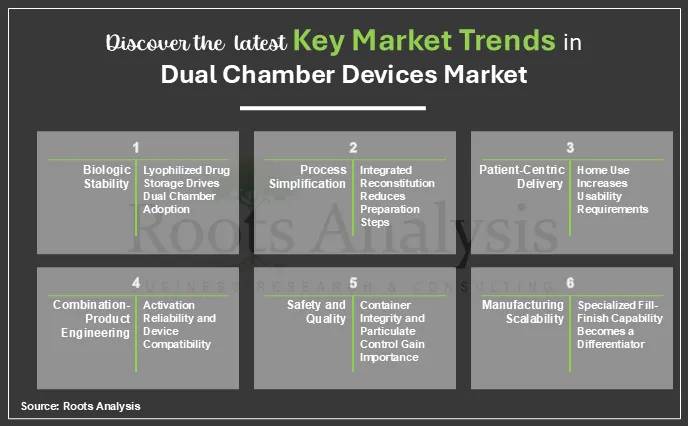
1. Biologic Stability: Lyophilized Drug Storage Drives Dual Chamber Adoption
Many biologics and complex injectable products are more stable in a lyophilized form than in a long-term liquid formulation. Dual chamber prefilled syringes allow the drug product and diluent to remain separated until the point of use, reducing the need for an external vial-reconstitution process.
This capability can be particularly valuable for products sensitive to hydrolysis, aggregation or degradation in solutions. For drug developers, the system may provide a route to improve shelf-life management while presenting the product in a more convenient administration format.
2. Process Simplification: Integrated Reconstitution Reduces Preparation Steps
Dual chamber syringes can simplify the administration workflow by integrating diluent transfer, reconstitution and injection into a single device. This may reduce the number of materials that must be handled at the point of care and help standardize preparation in clinics, hospitals and home settings.
Vetter’s Lyo-Ject® dual chamber syringe technology illustrates the use of integrated systems for lyophilized drug products. Such platforms are increasingly relevant where manufacturers seek to reduce drug-preparation complexity without compromising control over reconstitution performance.
3. Patient-Centric Delivery: Home Use Increases Usability Requirements
The expansion of self-administration is increasing demand for devices that are intuitive and require limited preparation. For a dual chamber prefilled syringe, this means the activation sequence, mixing process and injection steps must be clear and manageable for users with varying levels of dexterity and treatment experience.
Human-factors engineering is therefore becoming a central consideration in product development. Clear feedback, manageable activation forces and straightforward instructions can support correct use, while integrated safety features may help reduce needle-stick risk after administration.
4. Combination-Product Engineering: Activation Reliability and Device Compatibility
Dual chamber prefilled syringes are combination products that require coordination between the drug formulation, primary container, elastomer components and delivery mechanism. The system must reliably move the diluent into the drug chamber, achieve adequate mixing and deliver the intended dose without leakage, clogging or loss of sterility.
This technical complexity is raising demand for development partners with expertise in syringe engineering, container-closure integrity, usability studies and automated assembly. Successful commercial systems must demonstrate consistent activation and injection performance across manufacturing lots and throughout the approved shelf life.
5. Safety and Quality: Container Integrity and Particulate Control Gain Importance
The dual chamber format introduces additional interfaces and moving components compared with a conventional prefilled syringe. Manufacturers must therefore manage risks associated with stopper movement, lubrication, particulates, breakage, extractables and leachables, as well as the quality of the lyophilized cake and diluent.
These requirements encourage earlier collaboration between formulation, packaging and device-development teams. Suppliers that provide comprehensive component characterization and robust quality documentation can help reduce risk during development, validation and regulatory review.
6. Manufacturing Scalability: Specialized Fill-Finish Capability Becomes a Differentiator
Commercializing a dual chamber prefilled syringe requires specialized fill-finish expertise. The manufacturing process may involve separate fillings of the drug and diluent, lyophilization, component placement, assembly, inspection and functional testing. Each operation must be aligned to the device’s activation mechanism and the product’s stability profile.
As demand increases for biologic and lyophilized drug products, specialized CDMOs and device suppliers are likely to play a larger role in the market. Scalable manufacturing capacity, validated assembly processes and strong change-control systems will be important differentiators for suppliers serving dual chamber device programs.
Conclusion
Dual chamber prefilled syringes offer an important solution for injectable products that require reconstitution before administration. Their ability to combine separate storage, controlled mixing and dose delivery supports the development of more convenient biologic and lyophilized drug presentations. Future market growth is expected to depend on advances in usability, activation reliability, safety and scalable fill-finish manufacturing.
Browse our full report on Dual Chamber Devices Market: https://www.rootsanalysis.com/reports/dual-chamber-devices-market.html
Sources: