Glycolysis Inhibitors: Emerging Trends in Cancer Metabolism-Based Therapeutics


Published:
Glycolysis inhibitors are investigational cancer-metabolism therapies designed to disrupt the use of glucose and the production of metabolic intermediates that tumor cells require for growth and survival. Many tumors exhibit increased glucose uptake and glycolytic activity, even in the presence of oxygen, a phenomenon commonly associated with the Warburg effect. This creates a potential therapeutic opportunity, but it also presents a significant challenge because normal tissues rely on glucose metabolism as well.
The glycolysis inhibitor landscape includes approaches directed at glucose transporters, hexokinase, phosphofructokinase-related pathways, lactate dehydrogenase and lactate transport. Rather than representing a single product class, these modalities target different points in the glycolytic and lactate-handling network. Their development is shaped by the need to achieve sufficient tumor selectivity, manage on-target systemic toxicity and identify patients whose cancers are most dependent on the relevant metabolic pathway.
Recent research is moving the field away from broad, non-selective metabolic suppression toward biomarker-led and combination-based strategies. Developers are evaluating how tumor genotypes, hypoxia, metabolic phenotypes and microenvironmental features influence sensitivity to glycolysis disruption. This is important because metabolic plasticity can enable cancer cells to shift toward oxidative phosphorylation, glutamine metabolism or alternative nutrient sources when glycolysis is inhibited.
Within the cancer metabolism-based therapeutics market, glycolysis inhibitors remain an emerging opportunity rather than a mature commercial class. Their future depends on the ability to translate strong biological rationale into clinically tolerable, differentiated therapies. Advances in metabolic imaging, molecular profiling and rational combination design are expected to shape how these candidates are developed and positioned.
Roots Analysis has conducted an exhaustive study on Cancer Metabolism Based Therapeutics Market featuring the current market landscape and future opportunity for the companies engaged in this domain, over a span of many years. In this article, we have highlighted various trends that are likely to shape the evolution of this market.
Want to explore the latest advancements in cancer metabolism based therapeutics industry?
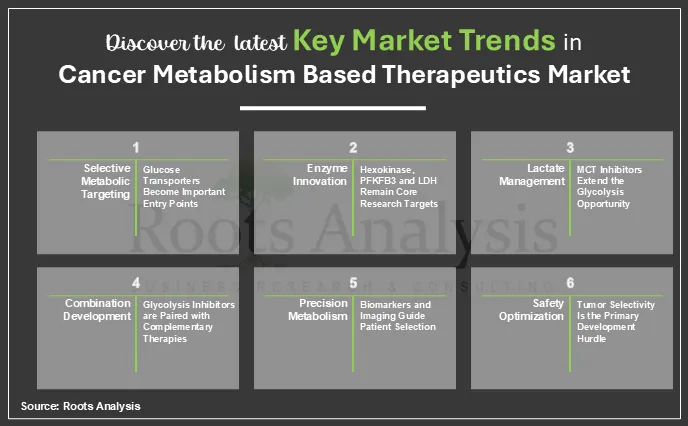
Latest Trends in Cancer Metabolism Based Therapeutics Market That Are Likely to Shape the Market
1. Selective Metabolic Targeting: Glucose Transporters Become Important Entry Points
Glucose transporters, particularly GLUT1, are being investigated as potential targets because many tumors require high levels of glucose uptake to sustain glycolysis. Inhibiting glucose transport may reduce the availability of a key fuel source and limit the production of metabolic intermediates used for biosynthesis.
The key market challenge is achieving selectivity because glucose transport also supports normal tissues. Consequently, product development is increasingly focused on identifying tumor types and biomarker profiles in which transporter dependence is pronounced, rather than pursuing unselected broad-population strategies.
2. Enzyme Innovation: Hexokinase, PFKFB3 and LDH Remain Core Research Targets
Multiple glycolytic enzymes are being investigated as therapeutic targets. Hexokinase 2 is involved in the first committed step of glycolysis, while PFKFB3 regulates fructose-2,6-bisphosphate levels and can promote glycolytic flux. Lactate dehydrogenase A is important for converting pyruvate to lactate and maintaining metabolic redox balance.
These targets illustrate the diversity of the glycolysis inhibitor pipeline. Each offers a different mechanism for disrupting tumor metabolism, but each also requires careful assessment of selectivity, pharmacology and potential compensatory mechanisms. The strongest opportunities are likely to emerge where enzyme dependence can be linked to a defined tumor subtype or molecular context.
3. Lactate Management: MCT Inhibitors Extend the Glycolysis Opportunity
Lactate production and export are closely connected to glycolytic tumor metabolism. Monocarboxylate transporters, including MCT1 and MCT4, help regulate lactate movement across cell membranes. Inhibiting these pathways may disrupt lactate handling, alter tumor pH and create metabolic stress in cancers that rely on high glycolytic activity.
AZD3965, an MCT1 inhibitor initially developed by AstraZeneca, has been evaluated in early clinical studies in advanced solid tumors and lymphomas. Although lactate transport inhibition is distinct from directly blocking a glycolytic enzyme, it represents an important adjacent strategy within the broader effort to exploit glycolysis-dependent tumor biology.
4. Combination Development: Glycolysis Inhibitors are Paired with Complementary Therapies
Cancer cells can adapt to glycolysis inhibition by activating alternative energy pathways. This is encouraging the evaluation of glycolysis-targeting agents in combination with therapies that block oxidative phosphorylation, glutamine metabolism, angiogenesis, DNA repair or oncogenic signaling.
Combination approaches may also increase the relevance of glycolysis inhibitors in resistant disease. The commercial rationale is strongest when the combination is supported by a defined biological mechanism and can be deployed in a biomarker-selected patient population, rather than relying on empirical metabolic suppression.
5. Precision Metabolism: Biomarkers and Imaging Guide Patient Selection
The success of glycolysis inhibitors is likely to depend on identifying tumors with a clear metabolic vulnerability. Potential selection approaches include genomic alterations, expression of glucose transporters or glycolytic enzymes, hypoxia-associated signatures, lactate-related markers and functional metabolic imaging.
This trend is bringing glycolysis inhibitor development closer to precision oncology. A therapy that may have limited activity in an unselected population could show greater clinical utility when matched to tumors with elevated glycolytic dependence or a restricted ability to compensate through alternative metabolic pathways.
6. Safety Optimization: Tumor Selectivity Is the Primary Development Hurdle
Because glycolysis is fundamental to normal physiology, systemic toxicity is a major development consideration. The challenge is to sufficiently impair tumor metabolism without causing unacceptable effects in glucose-dependent tissues or limiting the dose that can be safely administered.
Newer development strategies are therefore prioritizing tumor-selective biology, intermittent dosing, targeted delivery and combination regimens that permit lower exposure to the metabolic inhibitor. Progress in these areas will determine whether glycolysis inhibitors can advance from compelling research tools to clinically differentiated cancer therapeutics.
Conclusion
Glycolysis inhibitors represent an emerging segment of cancer metabolism-based therapeutics, with potential targets spanning glucose transport, glycolytic enzymes and lactate handling. The field is shifting toward biomarker-led, selective and combination-based development in response to metabolic plasticity and safety constraints. Future market potential will depend on demonstrating that glycolysis dependence can be converted into durable, clinically actionable therapeutic benefit.
Browse our full report on Cancer Metabolism Based Therapeutics Market: https://www.rootsanalysis.com/reports/cancer-metabolism-based-therapeutics-market.html
Sources: