Heart Failure Drugs Market Trends

.png)

Published: June 2026
The heart failure drugs market has emerged as a critical component of the cardiovascular pharmaceutical industry, supporting the treatment, management, and long-term care of patients suffering from both acute and chronic forms of heart failure. It encompasses a wide range of therapeutic classes designed to improve cardiac function, reduce hospitalizations, and enhance quality of life across diverse patient populations.
Ongoing innovations are driving improved clinical outcomes and expanding treatment options for both heart failure with reduced ejection fraction and preserved ejection fraction. A key breakthrough comes from the widespread adoption of SGLT2 inhibitors, which have demonstrated strong cardio-protective and renal benefits beyond traditional therapies. These advancements, along with digital and remote patient monitoring tools and biomarker-driven approaches from leading pharmaceutical companies, are accelerating patient management while enabling optimization of therapies. Moreover, the increasing focus on cardio-renal-metabolic pathways and precision medicine has heightened the demand for more effective and individualized heart failure treatments.
Moreover, ongoing technological innovations in drug design, such as selective receptor modulation and metabolic pathway targeting, have boosted therapeutic precision, patient adherence, and overall scalability of care. These improvements not only reduce hospitalization rates and slow disease progression but also enable better management of indications like diabetes and chronic kidney disease, paving the way for improved survival and quality-of-life outcomes. In addition, the escalating prevalence of heart failure driven by aging populations, rising rates of hypertension, diabetes, and obesity, coupled with substantial R&D investments from pharmaceutical firms, has fueled the growth of this domain.
Roots Analysis has conducted an exhaustive study on Heart Failure Drugs Market featuring the current market landscape and future opportunity for the companies engaged in developing heart failure drugs, over a span of many years. In this article, we have highlighted some of the Heart Failure Drugs Market Trends that are likely to shape the evolution of this industry.
Want to explore the latest advancements in heart failure drugs market?
Latest Trends in Heart Failure Drugs Market That Are Likely to Shape the Market
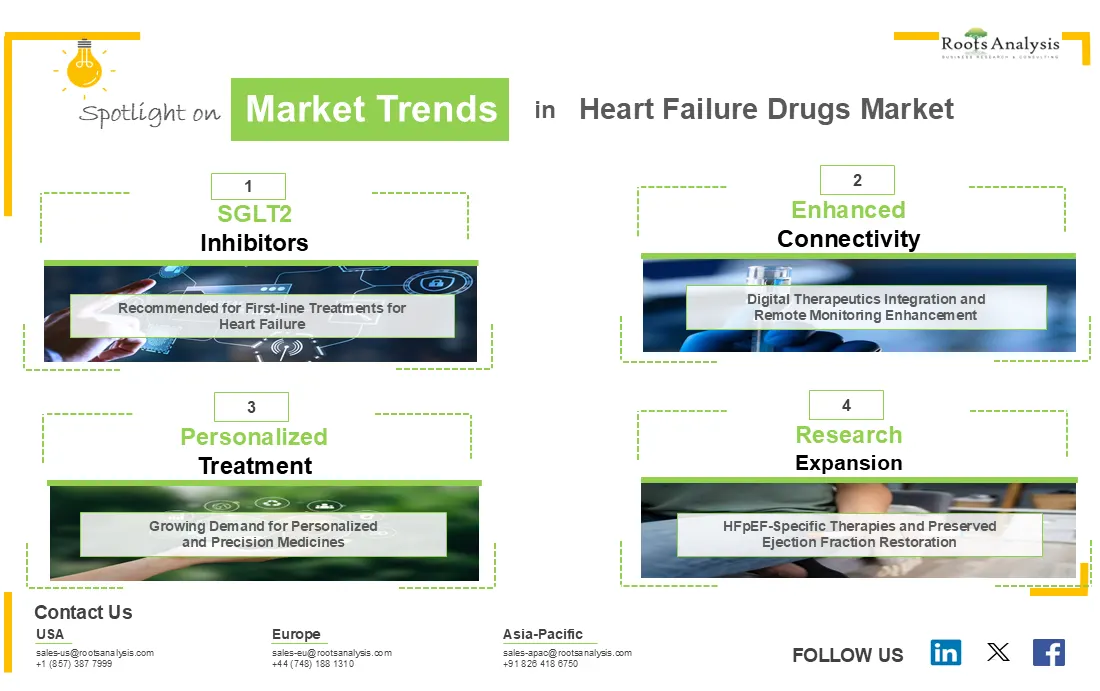
1. SGLT2 Inhibitors Recommended for First-line Treatments for Heart Failure
SGLT2 inhibitors are gaining attraction because they deliver broad cardio-protective benefits that extend beyond glycemic control.2 These inhibitors work by promoting natriuresis and reducing cardiac preload, which allows them to deliver functional improvements that can surpass traditional diuretics alone. Such inhibitors are especially crucial for both HFrEF and HFpEF populations, where understanding metabolic interactions can significantly influence long-term prognosis. As heart failure treatment increasingly targets overlapping cardio-renal-metabolic pathways, developers are expanding label indications and extensively conducting clinical trials.
2. Digital Therapeutics Integration and Remote Monitoring Enhancement
In the heart failure domain, innovations in digital therapeutics integration are revolutionizing adherence and monitoring for heart failure. These advanced solutions allow real-time physiologic tracking via wearable sensors and apps, which is remarkably important while dealing with conditions, such as ambulatory heart failure and frequent decompensation risks. By improving early intervention signals, this shift helps reduce acute exacerbations, permitting clinicians to predict events more accurately during long-term management stages. Further, pharmaceutical companies are increasingly incorporating digital platforms, like AI-driven alerts, to thoroughly optimize therapeutic efficacy of drugs.
3. Growing Demand for Personalized and Precision Medicines
Personalized medicine is reshaping the heart failure drugs market as therapies are increasingly tailored to individual genetic profiles rather than uniform populations. As developers design treatments based on specific pathways, such as inflammation or fibrosis markers, they are also creating more targeted assays that reliably quantify responses in heterogeneous patient subgroups. This shift also requires more validation protocols and better integration of clinical data, since results must immediately guide dosing, efficacy monitoring, and safety decisions for each patient.
4. HFpEF-Specific Therapies and Preserved Ejection Fraction Restoration
In the heart failure drugs market, innovations in HFpEF-targeted therapies are revolutionizing management for preserved ejection fraction heart failure. These advanced therapies allow for addressing diastolic dysfunction and microvascular issues, which is important while dealing with complex conditions, such as obesity-related heart failure and elderly patient populations. By improving ventricular relaxation and compliance, this permits clinicians to predict quality of life more accurately during long-term management stages. As pipeline for heart failure drugs domain is growing, pharmaceutical companies are increasingly incorporating HFpEF-specific agents, like GLP-1 analogs, to thoroughly optimize therapeutic efficacy. At the same time, it ensures alignment with regulatory requirements for durable outcome assessments. In April 2026, the FDA approved the first generic versions of Farxiga (dapagliflozin), developed by AstraZeneca, which is a heart failure drug with reduced ejection fraction for diabetes and heart failure.
Conclusion
The heart failure drugs industry is poised for robust growth over the coming years, driven by the expanding pipelines of next-generation therapies, including SGLT2 inhibitors, non-steroidal MRAs, and HFpEF-specific agents that address both reduced and preserved ejection fraction heart failure. While challenges such as patient heterogeneity, regulatory complexities, and the need for long-term outcome data persist, the industry is responding with better innovations. This includes personalization therapies, digital therapeutics integration, and approaches that enhance treatment precision and patient outcomes.
Furthermore, the growing emphasis on cardio-renal-metabolic pathways, remote monitoring technologies, and tailored therapies for diverse patient populations is driving demand for more effective and individualized treatment solutions. To address these dynamics, pharmaceutical companies are prioritizing combination regimens, AI-supported monitoring platforms, and targeted clinical development strategies. Ultimately, these trends signal a transformative shift toward more comprehensive, patient-centric heart failure management through technological advancements and strategic collaborations, ensuring improved survival rates, reduced hospitalizations, and broader access to life-changing therapies.
Browse our full report on Heart Failure Drugs Market Trends:
https://www.rootsanalysis.com/reports/heart-failure-drugs-market.html
Sources:
- https://pharmaceutical-journal.com/article/ld/managing-patients-with-cardiorenal-metabolic-disease
- https://pmc.ncbi.nlm.nih.gov/articles/PMC7315190/
- https://www.escardio.org/news/press/press-releases/heart-patients-set-to-receive-treatment-tailored-to-their-genetic-and-health-inf/
- https://www.fda.gov/drugs/drug-alerts-and-statements/fda-approves-first-generic-dapagliflozin-tablets