IDH Inhibitors: Trends Shaping Cancer Metabolism-Based Therapeutics


Published:
Isocitrate dehydrogenase (IDH) inhibitors are precision cancer therapies designed to target mutant forms of the IDH1 or IDH2 enzymes. Mutations in these enzymes can lead to the production of the oncometabolite 2-hydroxyglutarate, which disrupts normal cellular differentiation and contributes to tumor development. By selectively inhibiting mutant IDH enzymes, these therapies represent one of the most clinically validated approaches within the cancer metabolism-based therapeutics market.
The IDH inhibitor landscape has progressed from a focus on relapsed or refractory acute myeloid leukemia to a broader set of mutation-defined malignancies. Approved therapies include ivosidenib, enasidenib, olutasidenib and vorasidenib, with use across IDH-mutant acute myeloid leukemia, myelodysplastic syndromes, cholangiocarcinoma and diffuse low-grade glioma.
Recent market evolution is being driven by earlier-line use, broader molecular testing and the development of molecules optimized for specific disease settings. The August 2024 US approval of vorasidenib for IDH-mutant grade 2 astrocytoma or oligodendroglioma marked an important advance for the class by bringing a brain-penetrant dual IDH1 / IDH2 inhibitor into an earlier-stage glioma treatment setting.
Despite these advances, resistance, clonal evolution and incomplete response remain important clinical challenges. Consequently, IDH inhibitors are increasingly being evaluated through biomarker-led treatment strategies, rational combinations and sequencing approaches. These developments are expected to sustain interest in IDH biology as cancer drug developers explore the intersection of metabolic dysregulation and precision oncology.
Roots Analysis has conducted an exhaustive study on Cancer Metabolism Based Therapeutics Market featuring the current market landscape and future opportunity for the companies engaged in this domain, over a span of many years. In this article, we have highlighted various trends that are likely to shape the evolution of this market.
Want to explore the latest advancements in cancer metabolism based therapeutics industry?
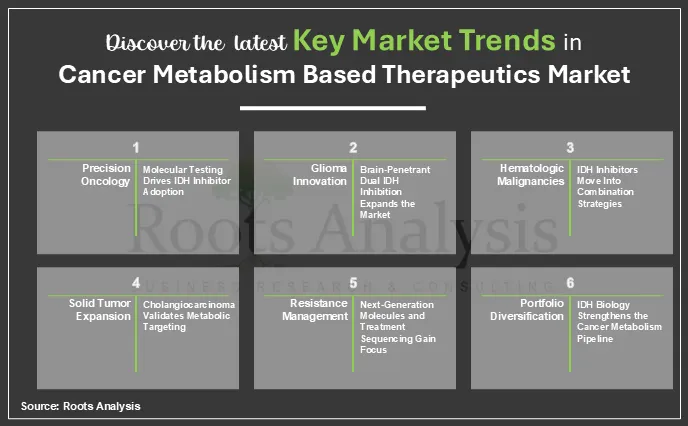
Latest Trends in Cancer Metabolism Based Therapeutics Market That Are Likely to Shape the Market
1. Precision Oncology: Molecular Testing Drives IDH Inhibitor Adoption
IDH inhibitors are dependent on the identification of actionable IDH1 or IDH2 mutations. This makes validated molecular testing integral to clinical adoption, from initial diagnosis through treatment selection and disease monitoring. The need for targeted testing is strengthening the connection between cancer metabolism therapeutics and precision-diagnostics infrastructure.
For drug developers, this biomarker-defined model supports more focused clinical development and patient selection. For healthcare systems, it reinforces the importance of timely genomic profiling in hematologic malignancies, gliomas and cholangiocarcinoma, where IDH mutation status can determine therapeutic eligibility.
2. Glioma Innovation: Brain-Penetrant Dual IDH Inhibition Expands the Market
The FDA approval of Servier’s vorasidenib, marketed as Voranigo®, for patients with susceptible IDH1 or IDH2-mutant grade 2 astrocytoma or oligodendroglioma following surgery represented a significant expansion of the IDH inhibitor class. Vorasidenib is designed to inhibit mutant IDH1 and IDH2 and reach the central nervous system, addressing a key requirement in diffuse glioma.
This approval demonstrates that IDH inhibitors can have clinical value beyond advanced hematologic cancers. It is also likely to encourage further investment in brain-penetrant metabolic therapies and earlier-intervention strategies for molecularly defined central nervous system tumors.
3. Hematologic Malignancies: IDH Inhibitors Move Into Combination Strategies
Acute myeloid leukemia remains a major market for IDH-targeted therapies. Ivosidenib, enasidenib and olutasidenib have established the relevance of mutant IDH inhibition in AML, while ivosidenib has also received approval in combination with azacitidine for newly diagnosed IDH1-mutated AML in adults who are not eligible for intensive induction chemotherapy.The next phase of development is
increasingly focused on combinations that address the biological heterogeneity of AML. Pairing an IDH inhibitor with hypomethylating agents, venetoclax or other targeted therapies may improve response depth in selected populations but also require careful management of safety and treatment sequencing.
4. Solid Tumor Expansion: Cholangiocarcinoma Validates Metabolic Targeting
The approval of ivosidenib for previously treated, locally advanced or metastatic IDH1-mutated cholangiocarcinoma provided important proof that metabolic targeting can create a clinically meaningful option in a solid tumor. This indication broadened the commercial relevance of IDH1 inhibition beyond hematologic cancer and highlighted the value of testing in rare, genomically defined patient populations.
The market impact extends beyond cholangiocarcinoma itself. The indication provides a model for evaluating metabolic vulnerabilities in other solid tumors, particularly where distinct mutations generate a druggable oncometabolite or alter tumor-cell differentiation.
5. Resistance Management: Next-Generation Molecules and Treatment Sequencing Gain Focus
Although IDH inhibitors can induce durable benefits in some patients, acquired resistance and disease progression remain key limitations. Resistance can arise through additional mutations, pathway adaptation or changes in the dominant malignant clone, creating a need for better treatment, sequencing and combination approaches.
This is sustaining investment in next-generation IDH inhibitors and in translational research that examines mechanisms of resistance. Companies that can combine potent, selective inhibition with appropriate central nervous system exposure, combination compatibility or differentiated mutation coverage may be better positioned in the evolving market.
6. Portfolio Diversification: IDH Biology Strengthens the Cancer Metabolism Pipeline
The commercial success of approved IDH inhibitors has validated cancer metabolism as a therapeutically actionable field. It has encouraged developers to pursue other metabolic targets that alter nutrient utilization, redox balance, mitochondrial function or tumor-microenvironment interactions.
For the broader cancer metabolism-based therapeutics market, IDH inhibitors provide an important benchmark. They show that a clearly defined metabolic alteration, matched with a robust diagnostic strategy and a selective drug, can create meaningful clinical and commercial differentiation in precision oncology.
Conclusion
IDH inhibitors have established a leading position within cancer metabolism-based therapeutics by translating a defined metabolic mutation into actionable precision medicines. Expansion into grade 2 glioma, AML and cholangiocarcinoma demonstrate the versatility of the approach, while resistance and combination strategies continue to shape future innovation. The market is expected to benefit from earlier molecular testing, broader use of biomarker-led care and continued development of next-generation metabolic therapies.
Browse our full report on Cancer Metabolism Based Therapeutics Market:
https://www.rootsanalysis.com/reports/cancer-metabolism-based-therapeutics-market.html
Sources:
1. https://www.fda.gov/drugs/resources-information-approved-drugs/fda-approves-vorasidenib-grade-2-astrocytoma-or-oligodendroglioma
2. https://www.fda.gov/drugs/resources-information-approved-drugs/fda-approves-ivosidenib-cholangiocarcinoma
3. https://www.fda.gov/drugs/resources-information-approved-drugs/fda-approves-ivosidenib-combination-azacitidine-newly-diagnosed-aml