Integration of Artificial Intelligence in Neurovascular Medical Devices

.png)

Published: August 2024
Neurovascular devices are the specialized medical tools used in the treatment of disrupted blood flow within the brain, addressing various neurovascular disorders, such as aneurysms, strokes, arteriovenous malformations and other vascular abnormalities of the brain. Over the years, these devices have significantly evolved, leading to advancements in the treatment of neurovascular conditions. During the late 1960s, the global neurovascular medical devices market witnessed a milestone in neurovascular disorder treatment with microsurgical techniques being introduced for the treatment of cerebral aneurysms. This innovation paved the way for the emergence of neurointerventional devices, which have drastically improved patient survival rates and reduced mortality associated with neurovascular disorders. As the field continues to evolve, ongoing research and development efforts are focused on enhancing the capabilities of these devices. The integration of artificial intelligence (AI) into neurovascular medical devices is particularly promising, as it holds the potential to revolutionize therapy for neurovascular diseases.
AI can assist in precise diagnostics, treatment planning and outcome prediction, thereby improving patient care. The modern neurovascular landscape includes a variety of minimally invasive treatment options, such as catheters, coils, stents and flow disruption devices. These innovations not only reduce the physical burden on patients but also enhance safety and efficacy in treating conditions like ischemic strokes and brain aneurysms. Continuous advancements in technology are expanding the range of patients who can benefit from these treatments, ultimately improving their quality of life.
Roots Analysis has conducted an exhaustive study on Neurovascular Devices Market featuring the current market landscape and future opportunity for the companies engaged in this market, over a span of 11 years. A key trend observed was the advancements for integration of AI in neurovascular medical devices.
Interested in Exploring Innovative Neurovascular Medical Devices and Their Applications?
Enhancing Neurovascular Care: The Role of AI in Neurovascular Devices
AI is generally defined as the ability of a machine to analyze data and use it to learn and model human behavior. In the past few years, there has been a significant increase in application of AI in the medical devices field, owing to its potential for accurate diagnosis, better clinical outcomes and more precise surgeries. Further, the impact and advancements in robotics and AI have the capability to improve the overall management of neurovascular disorders and thus enhance the endovascular neurosurgery field. AI technologies are being increasingly used in neurovascular devices for various purposes, including:
Image Analysis
AI algorithms hold the capability to analyze complex neuroimaging data such as MRIs and CT scans and can assist in the diagnosis and treatment of neurovascular conditions. These algorithms can help in identifying vascular abnormalities within the most torturous regions of the brain along with the quantitative measurements of neurovascular lesions.
Treatment Planning
By tailoring treatment plans to individual patient characteristics and preferences, AI-driven neurovascular devices can revolutionize personalized medicine, leading to better patient outcomes.
Surgical Assistance
AI-powered surgical robots systems are being developed to assist neurosurgeons during neurovascular surgeries. These systems can enhance precision, improve accuracy and reduce the risk of complications during complex neurovascular surgeries.
Predictive Analytics
AI algorithms can analyze large datasets to predict outcomes of neurovascular procedures, assess risks and optimize treatment strategies. This predictive analytics capability can help healthcare providers make informed decisions and improve patient outcomes.
Remote Monitoring
AI-enabled neurovascular devices can facilitate remote patient monitoring with various neurovascular conditions. These devices can collect real-time data, monitor changes in health parameters, and allow healthcare providers to track patient health metrics.
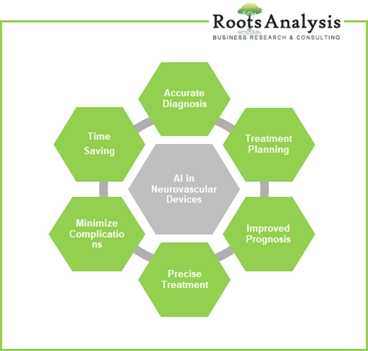
The Advantages of Integrating AI in Neurovascular Medical Devices
The following figure presents the various advantages of integration of AI in neurovascular devices:
Companies Integrating AI in Neurovascular Medical Devices
Rapid Medical
Rapid Medical has developed a first-in-human AI-powered robotic thrombectomy device, namely Tigertriever in order to allow automated stroke procedures. Tigertriever is a highly precise endovascular thrombectomy device that adapts autonomously to the patient’s anatomy to remove blood clots with less invasion, thus minimizing surgical trauma.
Siemens Healthineers
The company is focused on developing endovascular robotics and image guidance-assisted devices to address the unmet needs of patients with neurovascular disorders, thus improving overall patient care. In January 2024, Siemens Healthineers inaugurated a laboratory in collaboration with IISc, Bangalore for application of AI in neurology research. The laboratory will work on the development of open-source AI tools for accurate diagnosis of neurological disorders.
MicroPort
The company claims to be one of the leading surgical robotics companies through their commitment towards the development and commercialization of innovative robotics solutions. With their cutting-edge research technology, MedBot®, the company aims to provide quality of care to neurovascular disorders patients.
Medtronic
The company is focused on developing next-generation robotic assisted surgery (RAS) system in order to advance the minimally invasive surgical procedures for the treatment of various neurovascular disorders. Additionally, the company entered in to a distribution partnership with Viz.ai to distribute its AI based software that links with CT scanners to help spot strokes.
Future Perspectives
In the rapidly evolving landscape of healthcare, the integration of AI into neurovascular devices holds immense potential for the future of neurovascular disorders treatment. AI is poised to revolutionize neurovascular care by offering advanced capabilities in diagnosis, treatment and patient monitoring. One significant future perspective of AI in neurovascular devices lies in the realm of precise treatment. AI algorithms can analyze large datasets of patient-driven data, to tailor treatment plans specifically to each patient's unique requirements. This personalized approach can lead to more effective interventions and better outcomes for neurovascular disorders patients.
Moreover, AI-powered neurovascular devices are anticipated to enhance real-time monitoring and decision-making processes. Additionally, the integration of AI in neurovascular medical devices are expected to advance predictive analytics capabilities. By leveraging machine learning algorithms, these devices can forecast potential complications, treatment responses and outcomes based on historical data and ongoing patient monitoring. This predictive ability empowers healthcare professionals to proactively address issues, optimize treatment plans and improve overall patient management. In conclusion, the future of AI in neurovascular devices holds great promise in advancing neurovascular patient care. With enhanced precision, real-time monitoring and predictive analytics, AI-powered devices are poised to elevate the standard of care for patients suffering with neurovascular disorders, ushering in a new era of personalized and effective medical treatment.
What About the Future Outlook of AI in Neurovascular Medical Devices Around the World?
The above presentation features trends about the integration of AI in Neurovascular Devices, which we have highlighted in our report. If you're interested, you can download the Sample Report on this topic by Roots Analysis. For personalized assistance in identifying the most relevant solutions based on your specific criteria, please don't hesitate to reach out to us at sales@rootsanalysis.com.
Sources
- https://evtoday.com/news/rapid-medicals-robotic-tigertriever-used-in-fih-procedures-to-treat-ischemic-stroke
- https://www.sciencedirect.com/science/article/abs/pii/S1076633221003007
- https://operonstrategist.com/the-role-of-ai-in-medical-devices/
- https://www.ncbi.nlm.nih.gov/pmc/articles/PMC8971092/
- https://www.ncbi.nlm.nih.gov/pmc/articles/PMC8060210/
- https://pubmed.ncbi.nlm.nih.gov/32369662/
- https://www.ahajournals.org/doi/full/10.1161/STROKEAHA.123.042308
- https://www.ncbi.nlm.nih.gov/pmc/articles/PMC10438983/
- https://www.aidoc.com/learn/blog/the-role-of-ai-in-interventional-neuroradiology/
- https://www.siemens-healthineers.com/en-in/endovascular-robotics
- https://microport.com/healthcare-professional/surgical-robots
- https://www.medtronic.com/covidien/en-gb/robotic-assisted-surgery/hugo-ras-system.html