


 Download Free Sample
 Buy Now
Market Size
The global neurovascualar devices market, valued at USD 3,571 million in 2025, is projected to reach USD 3,882 million in 2026 and USD 7,011 million by 2035, with a 6.8% CAGR during the forecast period 2026 to 2035.

See What’s in the Full Report–Request Your Complimentary Insights!
Market Report: Key Takeaways
Market Size & Trends
- In terms of type of device, the neurothrombectomy device segment holds the highest share (~50%) of the market.
- With regards to therapeutic application, the ischemic stroke segment dominates the global market with more than 45% market share.
- Based on the end user, the hospitals and specialty clinics hold the largest market share (nearly 70%) in 2025.
- In terms of geographical regions, North America captures the majority of the market share, and Middle East and North Africa is likely to grow at a faster pace in the near future.
Key Market Statistics
- Market Size in 2026: $3,882 Million
- Estimated Market Size in 2035: $7,011 Million
- CAGR (2026-2035): 6.8%
- North America: Largest market in 2026
- Middle East and North Africa: Fastest growing region
Market Overview
It is worth highlighting that neurovascular disorders are recognized among the top five life-threatening disorders, accounting for significant economic burden across different geographical regions. According to World Health Organization, approximately 15 million new cases and five million mortalities worldwide, are caused by neurovascular disorders, annually. The key factors contributing to the pathogenesis and growing prevalence of neurovascular disorders include poor lifestyle, physical trauma, malnutrition, brain injury and congenital abnormalities.
Conventional surgical approaches used for the effective treatment of neurovascular disorders include open neurosurgery, microsurgery, craniotomy and bypass surgery. However, these approaches are not competent enough to treat the disease effectively. This is a result of their complex and time-consuming nature combined with a lower success rate, delayed recovery rate and requirement of expert supervision for performing such surgical operations.
In order to address these limitations associated with the existing surgical methods, neurovascular devices, such as intracranial stents, embolic coils, flow diverters, guidewires and catheters have emerged as a potential treatment option. Notably, these medical devices work by redirecting the blood flow disrupted at a specific region and present more precise and targeted results. Several technological advancements in the neurovascular devices and neurostimulation devices have led to consideration of these devices as a novel treatment option for treating neurovascular disorders. The market size for neurovascular devices will experience significant market growth over the forecast period because of the continuous research efforts, innovation and rising interest of investors in this domain.
Recent Developments
- In March 2026, Medtronic announced the acquisition of Scientia Vascular for USD 550 million upfront enhancing its neurovascular portfolio with advanced guidewires and microcatheters for stroke and aneurysm treatments.
- In October 2025, Toro Neurovascular entered into distribution agreement with Kaneka Medical America for its AspirationMAX and Route 77 catheter platform in order to improve access for neurovascular thrombectomy in acute ischemic stroke cases.
- In April 2025, Terumo Neuro received FDA Premarket Approval for the Roadsaver Dual-Layer Micromesh Carotid Stent System.
- In May 2025, Penumbra launched its Lightning Flash system, a next-gen aspiration thrombectomy platform for acute ischemic stroke, featuring 0.068 inch catheter with expanded access for faster revascularization in neurovascular interventions.
- In February 2025, NeuroVasc Technologies secured USD 30 million Series B funding in order to advance its NVX device for minimally invasive aneurysm treatment, supporting pivotal trials and global commercialization efforts.
Pay Only for What You Need – The Best Way to Optimize
Industry Experts on Global Neurovascular Devices Market
Players engaged in the neurovascular devices domain are continuously upgrading their portfolio. In 2025, Carsten Schroeder, (President and CEO, Terumo Neuro), states, “I would say that mechanical thrombectomy is still the fastest growing segment depending on how you look at it, it is more than double digits. Then, at the moment it is followed by hemorrhagic. The moment the embolics get approved for chronic subdural, I think we will see a massive creation of a market there.”
Neurovascular Devices Market Trends
- Rise in Partnership and Collaborations Activity: In recent years, several partnerships and collaborations have been established by neurovascular device developers. Such deals are forged to allow companies to expand their respective product portfolios in order to gain additional capabilities and increase visibility in this domain. It is worth highlighting that the partnerships signed in this industry have primarily been focused on the neurovascular catheters market, followed by the market for embolization devices. This can be attributed to the fact that catheters can be used alone or in conjunction with other neurovascular devices to facilitate the insertion and guidance of other devices, thus highly preferred for the treatment of wide-ranging neurovascular disorders. For instance, recently, Embolx partnered with Girlow in order to increase the distribution of their balloon occlusion microcatheters in Mexico, Central America, South America and the Caribbean.
- Significant Number of Acquisitions: including the acquisition of the US-based Pulse Technologies by Integer Holdings and Japan Medical Device Technology by Kaneka Neurovascular. We expect the neurovascular medical device companies to continue to form strategic alliance with other companies in order to expand their product portfolio, meet the customer demand and drive the market growth during the forecast period.
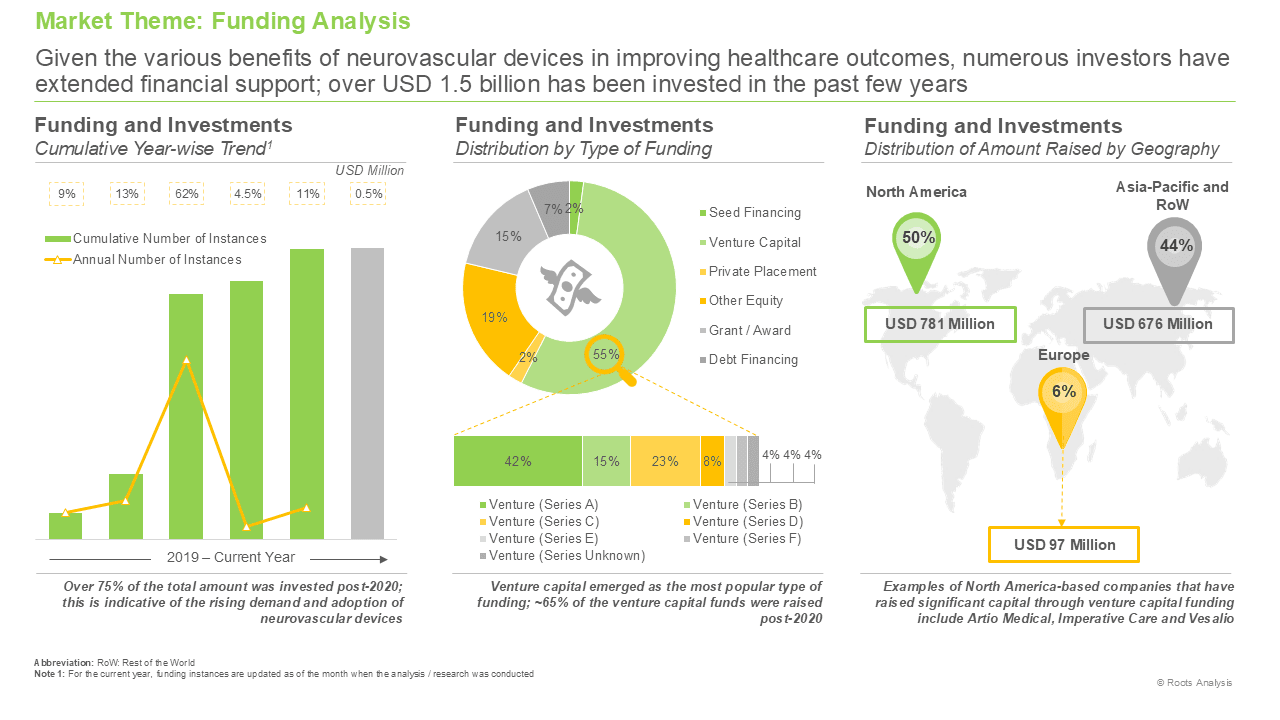
- Neurovascular Device Companies Have Experienced an Investment Growth in the Past Years: Over the years, monetary assistance from angel investors, venture capitalists, and funding schemes of various public and private organizations / funds, along with assistance from regulatory authorities, have allowed start-ups / small companies to progress their R&D efforts in the neurovascular devices industry. Notably, in the past five years, neurovascular device companies have raised a total amount worth around USD 1.5 billion for research and development activities in order to expand their product portfolio. Further, it is worth mentioning that most of the funding instances reported were venture capital rounds, followed by private placements.
Market Share Insights
Market Share by Therapeutic Application
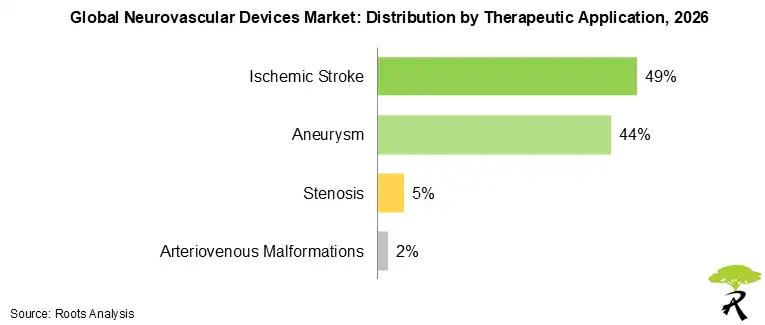
- This segment highlights the distribution of the neurovascular devices market across different therapeutic applications, such as ischemic stroke, aneurysm, stenosis and arteriovenous malformations (AVMs).
- It is worth highlighting that the neurovascular devices for ischemic stroke holds the largest share (more than 45%) in the current market. This can be attributed to the fact that ischemic strokes has the highest global incidence rate, accounting for around 3.3 million deaths, worldwide, each year.
- In the coming years, neurovascular devices used for aneurysm are anticipated to grow at a relatively faster pace (CAGR of 8.86%), owing to the growing demand for advanced devices to treat the complications associated with aneurysm treatment such as aneurysmal rupturing and severe bleeding.
Market Share by End Users
- The global neurovascular devices industry caters to a variety of end users, including hospitals and specialty clinics, ambulatory care centres and other end users.
- Hospitals and Specialty Clinics are expected to currently capture the highest share (71.2%), owing to the increased number of patient admissions within hospitals and specialty clinics for the treatment of various neurovascular disorders.
- The increased number of hospitalizations can be attributed to the increasing availability of innovative technologies along with expanding infrastructural activities within the hospitals across various countries.
- Further, ambulatory care centres are estimated to grow at a CAGR of 12.88%, during the forecast period, till 2035.
Market Share by Type of Device
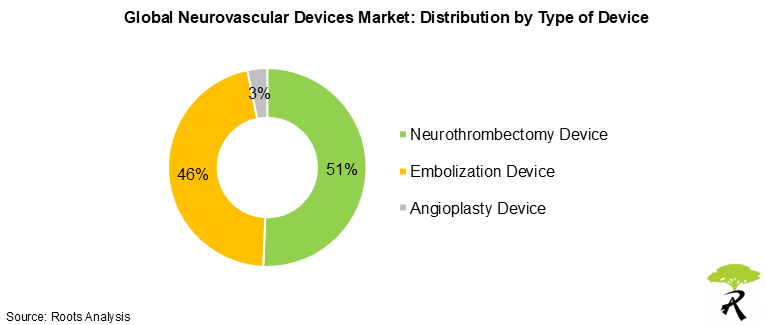
- The global market is segmented into different types of devices, such as neurothrombectomy devices, embolization devices and angioplasty devices.
- Among these devices, neurothrombectomy devices hold the maximum (~50%) neurovascular devices market share. This can be attributed to the high incidence rate of ischemic strokes accounting for 62.4% of all stroke cases worldwide. As neurothrombectomy devices are used for the treatment of ischemic strokes, the technical advancements in their structural dimensions, such as integration of imaging technologies and are rapidly transforming the therapeutic management of ischemic stroke.
- Further, in the coming years, the embolization devices are anticipated to grow at a CAGR of 8.65%, owing to the advancements in interventional technology and increased awareness among healthcare providers about the benefits of embolization devices for the treatment of aneurysms, coupled with growing prevalence of various neurovascular disorders.
Market Share by Key Geographical Regions
- This segment highlights the distribution of the global market across various geographies, such as North America, Europe, Asia-Pacific, Middle East and North Africa, and Latin America.
- According to our projections, North America captures the majority of share (47.2%) in the global market and this trend is unlikely to change during the forecast period (till 2035).
- This can be attributed to the increased clinical research activities for the targeted and minimally invasive treatment of neurovascular disorders in North America.
- Further, it is worth highlighting that the neurovascular devices market in Middle East and North Africa is expected to grow at a relatively higher CAGR (9.98%), during the forecast period. This can be attributed to the increasing economic and healthcare burden of various neurovascular disorders on Middle East and North Africa region.[1]
Want Information on Specific Region / Segment?
Key Market Insights
Advantages of Neurovascular Devices
Neurovascular devices have a wide range of advantages including their ability to provide site-specific treatments with lower surgical trauma and minimally invasive approaches for treating neurovascular disorders. Further, these neurovascular devices are manufactured under stringent regulatory guidelines in order to ensure the safety and efficacy of the device, thus ensuring positive healthcare outcomes.
Overall Market Landscape of the Neurovascular Device Companies
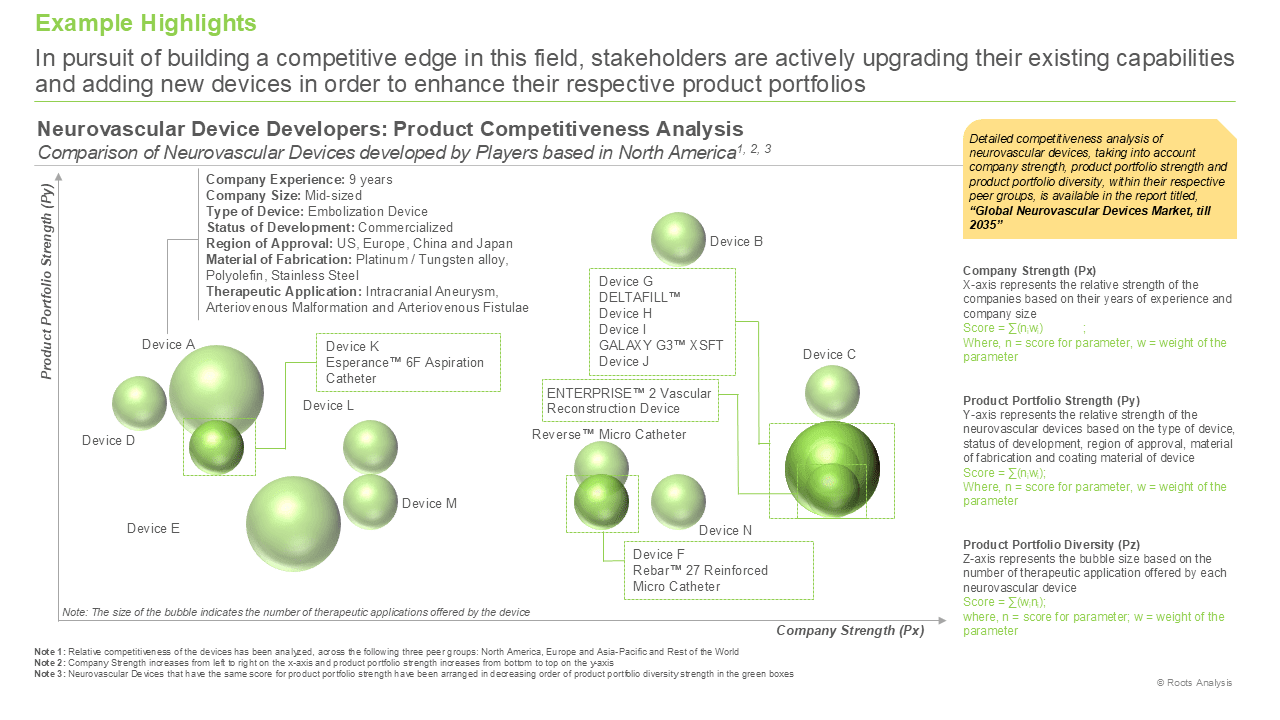
Presently, over 50 device developers are focused on offering neurovascular devices. The landscape features a mix of very large, large, mid-sized and small neurovascular device companies. Further, it is worth mentioning that majority (41%) of the neurovascular device companies are headquartered in North America; owing to the fact that the US has unified rules and regulations for the approval and post-marketing surveillance of medical devices. Examples of players based in North America include (in alphabetical order, very large developers) Integer Holdings, Johnson & Johnson, Medtronic Inc. and Stryker Corporation.
Market Size Analysis: What is the Opportunity for Neurovascular Device Companies?
The global neurovascular devices market size is likely to be worth $ 3,571 million in 2025 and will reach $ 7,011 million by 2035. In terms of the type of device, neurothrombectomy devices segment holds the largest share of the market, being minimally invasive in nature. The market size for embolization devices is likely to grow at a relatively higher CAGR of ~9% during the forecast period.
The growing prevalence of neurovascular disorders and favorable reimbursement policies for the use of neurovascular devices and procedures are the primary drivers of this market. Further, the limited side effects of these devices also serve as a key driver for the growth of this market.
Regional Analysis: Which Region Holds the Largest Neurovascular Devices Market Share?
North America is Leading the Market
North American companies are likely to dominate the market in 2035, with 41% of players based in the region enhancing their portfolios. Majority of neurovascular device developers have their headquarters in North America, followed by Asia-Pacific.
Middle East and North Africa: An Emerging Growth Spot
The market in Middle East and North Africa will grow at a relatively high CAGR (10%), during the forecast period till 2035. This is due to several factors, including increasing population and growing number of small and mid-sized device developers focused on promoting the application of neurovascular devices.
Have Questions? Let’s Get Them Answered.
What are the Key Drivers of Global Neurovascular Devices Market?
The increasing incidence of neurovascular disorders is a major driver for the increasing adoption of neurovascular devices. According to Centers for Disease Control and Prevention , around 3.1% of the adult population of the US experience brain stroke each year. According to World Health Organization, approximately 15 million new cases and five million mortalities worldwide, are caused by neurovascular disorders, annually. The key factors contributing to the pathogenesis and growing prevalence of neurovascular disorders include poor lifestyle, physical trauma, malnutrition, brain injury and congenital abnormalities.
Further, conventional methods (including open neurosurgery, microsurgery, craniotomy and bypass surgery) have often presented surgical complications, such as disruption of normal vasculature and longer recovery periods, leading to an increased adoption of innovative neuro interventional techniques and procedures.
Furthermore, over the past few years, various stakeholders have forged several alliances with players in this domain to develop modern neurovascular devices with the latest technology due to the rising demand for neurovascular devices. This will propel the growth of this industry.
Market Opportunities
This market is also influencing the growth in several associated industries. One such area is the coating of neurovascular devices. Companies like Biocoat offer medical device coating for several medical devices, including custom coatings for neurovascular devices. Additionally, several medical device contract manufacturing companies are also providing design, development and manufacturing service to the neurovascular device companies.
Market Segmentation Insights
Key Report Attributes
| Key Report Attributes | Details | |
| Historical Trend | Since 2019 | |
| Forecast Period | Till 2035 | |
| Market Size 2026 | $ 3,882 Million | |
| Market Size 2035 | $ 7,011 Million | |
| CAGR | 6.8% | |
| Type of Device |
|
|
| Therapeutic Application |
|
|
| End User |
|
|
| Geographical Regions |
|
|
| Excel Data Packs (Complimentary) |
|
|
| Key Players |
(Full list of 50+ companies captured is available in the report) |
|
| PowerPoint Presentation (Complimentary) |
Available | |
| Customization Scope | 15% Free Customization | |


