Key 5 Approved Lung Cancer Biomarker Tests

.png)

Published: April 2026
Lung cancer is one of the leading causes of cancer-related deaths worldwide, claiming more lives than any other malignancy due to its aggressive nature and frequent diagnosis at advanced stages. It is the third most common cancer in the US. Despite notable progress in recent years including improved five-year survival rates rising and advancements in targeted therapies, immunotherapies, and biomarker-driven precision medicine the disease continues to pose formidable challenges. Lung cancer biomarkers are measurable molecules (proteins, DNA, RNA) in tumor tissue or blood that indicate the presence, type, and progression of cancer.
There are two main types of lung cancer:
- Non-small Lung Cancer: It is the most common type of lung cancer. It accounts for over 80% of lung cancer cases.
- Small cell Lung Cancer: It grows more quickly and is harder to treat than NSCLC. It is often found as a relatively small lung tumor that is already spread to other parts of your body.
It is worth highlighting that the advancements in elucidating the molecular biology of lung cancer have led to the identification of a number of potential biomarkers that are highly relevant in the clinical management of patients with lung cancer.
Roots Analysis has conducted an exhaustive study on Cancer Biomarkers Market featuring the current market landscape and future opportunities for companies engaged in cancer biomarkers, over a span of next 9 years.
Key Five Approved Lung Cancer Biomarker Tests:
- VENTANA MET (SP44) RxDx Assay
- Oncomine Dx Express Test
- Oncomine Dx Target Test
- FoundationOne Liquid CDx
- AmpliSeq for Illumina Cancer Hotspot Panel v2
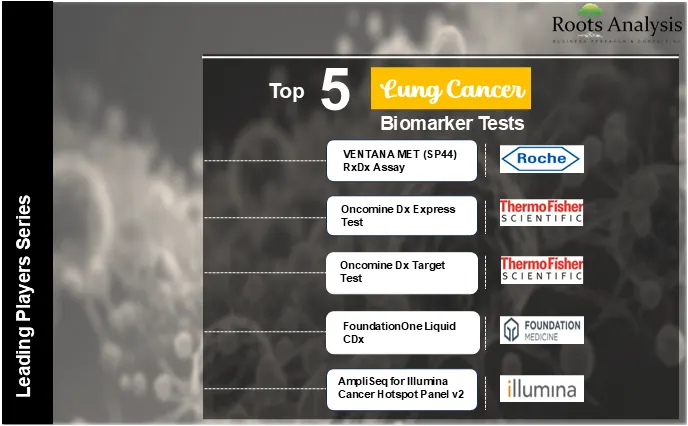
The figure below highlights the key five approved lung Cancer Biomarker tests:
Interested in exploring all ~77 players engaged in the cancer biomarkers market, along with their recent initiatives?
Discover Below the Details on Key 5 Lung Cancer Biomarker Tests
Let us dive deep into the details of the key 5 lung cancer biomarker tests. It is essential to note that the selection of key lung cancer biomarker tests can differ substantially according to the defined criteria.
1. VENTANA MET (SP44) RxDx Assay
The VENTANA MET (SP44) RxDx Assay is the first FDA-approved immunohistochemistry (IHC) assay developed by Roche. This assay can detect MET (c-Met) protein overexpression in non-squamous non-small cell lung cancer. It identifies patients with high MET expression (50% tumor cells with strong staining) eligible for telisotuzumab vedotin (Emrelis), an antibody-drug conjugate, prior therapy.
Roche: Company Overview
 |
Company Name | Year of Establishment | Headquarters | Number of Employees |
| Roche | 1996 | Switzerlad | 10,001+ |
To know more about lung cancer biomarker tests and the companies providing cancer biomarker testing solutions, access full report.
2. Oncomine Dx Express Test
Developed by Thermo Fisher Scientific Oncomine Dx Express Test is a companion diagnostic (CDx) to identify non-small cell lung cancer (NSCLC) patients. It detects EGFR exon 20 insertion mutations in NSCLC tumors, guiding treatment with sunvozertinib (Zegfrovy) for patients progressed on platinum-based chemotherapy. It supports rapid tumor profiling for this uncommon but targetable EGFR variant.
Thermo Fisher Scientific: Company Overview
 |
Company Name | Year of Establishment | Headquarters | Number of Employees |
| Thermo Fisher Scientific | 1956 | US | 10,001+ |
To know more about lung cancer biomarker tests and the companies providing cancer biomarker testing solutions, access full report.
3. Oncomine Dx Target Test
Oncomine™ Dx Target Test developed by Thermo Fisher Scientific is a companion diagnostic test essential for the identification of patients with unresectable or metastatic nonsquamous non–small cell lung cancer (NSCLC) whose tumors have HER2 tyrosine kinase domain (TKD)–activating mutations and may benefit from treatment with zongertinib (Hernexeos).
Thermo Fisher Scientific: Company Overview
|
Company Name | Year of Establishment | Headquarters | Number of Employees |
| Thermo Fisher Scientific | 1956 | US | 10,001+ |
To know more about lung cancer biomarker tests and the companies providing cancer biomarker testing solutions, access full report.
4. FoundationOne Liquid CDx
FoundationOne®Liquid CDx is an FDA-approved companion diagnostic that analyzes guideline recommended genes from blood sample. It is the only FDA-approved blood-based test to analyze over 300 genes including non–small cell lung cancer genes. It detects MET exon 14 skipping alterations in metastatic NSCLC to guide tepotinib (and related MET inhibitors).
Foundation Medicine: Company Overview
 |
Company Name | Year of Establishment | Headquarters | Number of Employees |
| Foundation Medicine | 2010 | US | 1,001-5,000 |
To know more about lung cancer biomarker tests and the companies providing cancer biomarker testing solutions, access full report.
5. AmpliSeq for Illumina Cancer Hotspot Panel v2
Developed by Illumina, AmpliSeq for Illumina Cancer Hotspot Panel v2 is a targeted resequencing assay for researching somatic mutations across the hotspot regions of 50 genes with known associations to cancer, as identified in the Catalogue of Somatic Mutations in Cancer (COSMIC) database.This panel enables highly sensitive variant detection within multiple cancer types, including lungs, colon, breast, ovarian, melanoma, and prostate. This panel has the capability to detect somatic mutations down to 5% variant allele frequency using local or cloud-based analysis.
Illumina: Company Overview
 |
Company Name | Year of Establishment | Headquarters | Number of Employees |
| Illumina | 1998 | US | 5,001-10,000 |
To know more about lung cancer biomarker tests and the companies providing cancer biomarker testing solutions, access full report.
What About Other Cancer Biomarkers Testing Solution Providers Around the World?
The above article features the key five lung cancer biomarker tests. If you're interested, you can download the Sample Report on this topic by Roots Analysis. For personalized assistance in identifying the most relevant solutions based on your specific criteria, please don't hesitate to reach out to us at sales@rootsanalysis.com.
Sources:
- https://my.clevelandclinic.org/health/diseases/4375-lung-cancer
- https://diagnostics.roche.com/global/en/products/lab/ventana-met-sp44-rxdx-assay-pid00001001.html
- https://www.linkedin.com/company/thermo-fisher-scientific/about/
- https://www.accessdata.fda.gov/cdrh_docs/pdf24/P240040C.pdf
- https://www.linkedin.com/company/roche/about/
- https://www.fda.gov/medical-devices/recently-approved-devices/oncominetm-dx-target-test-p160045s035
- https://www.foundationmedicine.com/test/foundationone-liquid-cdx
- https://www.linkedin.com/company/foundation-medicine
- https://www.illumina.com/products/by-type/sequencing-kits/library-prep-kits/ampliseq-cancer-hotspot-panel.html
- https://www.linkedin.com/company/illumina/about/