Key Players and Trends in AAV Vector Manufacturing

.png)

Published: August 2026
In the rapidly advancing field of recombinant and gene therapies, adeno-associated viral (AAV) vectors have become a foundational delivery platform. These non-pathogenic vectors transport therapeutic genetic material into target cells with a strong safety profile. Their flexibility supports the development of treatments tailored to individual genetic profiles, improving efficacy while limiting off-target effects.
As clinical pipelines expand and more therapies advance toward commercialization, the ability to produce high-quality AAV vectors at scale with improved yields, consistent quality, and reduced costs has emerged as a critical driver of progress. Advancements in process development, regulatory frameworks, and manufacturing capacity are collectively shaping a more efficient and accessible future for AAV-based gene therapies.
Roots Analysis has conducted an exhaustive study on AAV Vector Market featuring the current market landscape and future opportunity for this domain over a span of 9 years. Driven by the rising demand for gene therapies and personalized medicines, the AAV vector market is anticipated to grow at a higher pace in the coming decade.
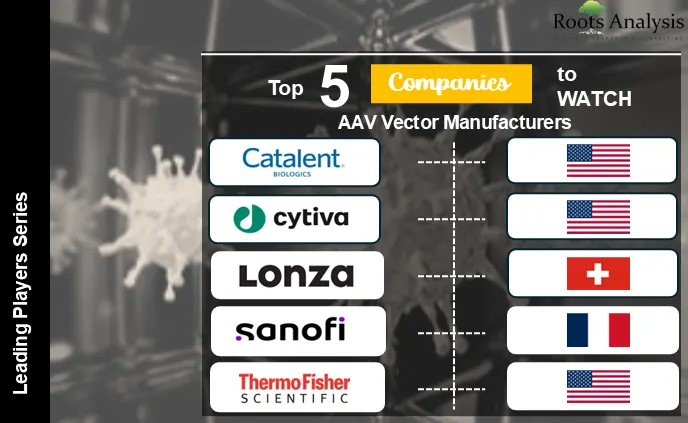
Top 5 AAV Vector Manufacturers
1. Catalent Biologics
2. Cytiva
3. Lonza
4. Sanofi
5. Thermo Fisher Scientific
Interested in exploring all 70+ AAV vector manufacturers, along with their recent initiatives?
Discover Below the Details on Top AAV Vector Manufacturers
Let us dive deep into the details of the top AAV vector manufacturers Companies. It is essential to note that the selection of top companies can differ substantially according to the defined criteria.
1. Catalent Biologics
Catalent Biologics is a prominent CDMO specializing in AAV vector manufacturing, providing integrated process development, production, and fill-finish services Following its acquisition by Novo Holdings, the company has continued to expand its gene therapy manufacturing capabilities and leverage proprietary platforms such as UpTempo™ AAV, which incorporates a specialized HEK293 cell line, pre-validated plasmids, and pre-qualified assays to accelerate timelines.
Recent Developments
In May 2026, Catalent Biologics entered a strategic partnership with Elpida Therapeutics to support late-phase manufacturing of an AAV9 gene therapy for Spastic Paraplegia Type 50 (SPG50), an ultra-rare neurodegenerative disorder.
To know more about the recent initiatives of Catalent Biologics and other AAV vector manufacturers companies, access our full report.
2. Cytiva
Cytiva is a global leader in viral vector bioprocessing, with extensive expertise in scalable solutions for adeno-associated virus (AAV) vector manufacturing. The company has consistently developed advanced upstream and downstream technologies, spanning single-use bioreactors, specialized chromatography resins, and automated purification platforms, to enhance process efficiency, viral particle yield, and overall product quality in gene therapy production.
Recent Developments
In May 2026, Cytiva announced FDA has granted Advanced Manufacturing Technology (AMT) designation to Cytiva’s ELEVECTA transient cell line for AAV manufacturing.
To know more about the recent initiatives of Cytiva and other AAV vector manufacturers, access our full report.
3. Lonza
Company Overview
Lonza is a Switzerland based company which is widely recognized as a global leader in this domain, offering integrated CDMO services across development and commercial stages. The company has a long-standing presence in viral vector manufacturing, including adeno-associated virus vectors, which are widely used in gene therapy. Lonza offers proprietary technologies to support AAV production, such as its HEK293 cell line and vector platforms.
Recent Developments
In May 2026, Lonza announced launch of its new xcite adeno-associated virus (AAV) stable producer cell line (PCL) technology designed to help gene therapy developers address challenges with scalability, cost of goods and process robustness as programs progress toward commercialization.
To know more about the recent initiatives of Lonza and other AAV vector manufacturers access our full report.
4. Sanofi
Company Overview
Sanofi is a leading biopharmaceutical company with strong capabilities in this domain. Sanofi’s Genomic Medicine Unit is actively engineering adeno associated virus capsids to improve tissue targeting, designing vectors that can preferentially enter specific cell types such as muscle or nerve cells to enable more efficient in vivo delivery of therapeutic genes.
Recent Developments
In September 2025, Sanofi announced SAR402663, an AAV gene therapy designed to treat wet age-related macular degeneration, has earned Fast Track Designation.
To know more about the recent initiatives of Sanofi and other AAV vector manufacturers, access our full report.
5. Thermo Fisher Scientific
Thermo Fisher Scientific is a US based company which is widely recognized as a global leader in this domain, offering comprehensive AAV vector solutions, including the CTS AAV-MAX Helper Free AAV Production System (mammalian) and insect cell platforms (Sf9 cells in Sf-900 II SFM) optimized for scalable suspension AAV production. The company also provide downstream purification and characterization tools such as AAV affinity, anion/cation exchange, and hydrophobic interaction chromatography resins for final viral vector products.
Recent Developments
In September 2025, Thermo Fisher Scientific announced that Dr. Park CDMO, a South Korea-based viral vector contract development and manufacturing organization (CDMO), has selected the company to supply advanced bioreactors and consumables for its new viral vector manufacturing facility
To know more about the recent initiatives of Thermo Fisher Scientific and other AAV vector manufacturers, access our full report.
Trends Shaping up AAV Vector Manufacturing Industry
As AAV vector manufacturing gains momentum, several key trends are shaping the landscape and influencing the future of gene therapy.
1. Personalized Medicine and Precision Targeting: A major development is the move toward personalized medicine and more precise targeting. AAV technology supports the creation of therapies customized to a patient’s unique genetic profile. This approach improves treatment effectiveness while reducing unwanted side effects, representing meaningful progress in patient care.
2. Regulatory Advancements: Regulatory frameworks for AAV vector manufacturing are adapting to the distinct challenges and possibilities of gene therapy. Agencies are collaborating with the pharmaceutical sector to develop clear guidelines and standards that protect safety and efficacy. Such cooperation helps streamline approvals and bring new treatments to patients more efficiently.
3. Expanded Applications: AAV vector manufacturing is no longer confined to a narrow set of conditions. The flexibility of these vectors allows their use across many therapeutic areas, including neurodegenerative disorders such as Parkinson’s disease. This broader application highlights the adaptability of AAV technology and its capacity to tackle a wider range of medical needs.
4. Industry Collaboration: Partnerships across the pharmaceutical industry are accelerating progress in AAV vector manufacturing. Companies are forming strategic alliances to combine complementary strengths, speed up development and production, and support the scale needed to meet rising demand for AAV-based gene therapies.
5. Scalability and Process Optimization: With rising demand for AAV-based gene therapies, the industry is increasingly focused on scalable manufacturing and process optimization. Improvements in bioreactor systems, higher-yielding cell lines, and more efficient purification methods are enabling greater production volumes while helping control costs and meet the quality standards needed for commercial supply.
Future Outlook: A Bright Future for AAV Vector Manufacturing
Looking ahead, the future of this domain is indeed bright. With continued investments from the pharmaceutical industry into AAV gene therapies, the field is set for substantial growth. Innovative companies are at the forefront, driving advancements and ensuring that AAV vectors are produced at the highest standards of quality and safety. The convergence of personalized medicine, regulatory advancements, expanded applications, industry collaboration, and optimized manufacturing processes paints a promising picture for the industry. With each milestone achieved, AAV vectors become more accessible and effective, offering renewed hope to individuals grappling with a wide range of genetic diseases. The journey of AAV vector manufacturing represents a profound commitment to innovation, resilience, and the unwavering pursuit of improved healthcare outcomes for everyone.
In conclusion, AAV vector manufacturing stands as a dynamic field with the potential to revolutionize gene therapy and personalized medicine. As AAV gene therapies progress towards commercialization, the contributions of key players such as Catalent Biologics, Cytiva, Lonza, Sanofi and Thermo Fisher Scientific are invaluable. The industry's dedication to meeting the growing demand for AAV vectors, coupled with emerging trends, sets the stage for a future where gene therapies are not just a possibility but a reality for patients worldwide.
What About Other Top AAV Vector Manufacturers Around the World?
The above article features the top AAV vector manufacturers selected from a pool of over 70 AAV vector manufacturers that we have compiled. If you're interested, you can download the Sample Report on this topic by Roots Analysis. For personalized assistance in identifying the most relevant solutions based on your specific criteria, please don't hesitate to reach out to us at sales@rootsanalysis.com.
Sources:
4. https://www.ddw-online.com/cytivas-transcient-cell-line-receives-fda-amt-designation-41671-202605/
5. https://www.lonza.com/specialized-modalities/cell-and-gene/viral-vectors
6. https://www.lonza.com/media-advisories/2026-05-12-14-00
8. https://www.sec.gov/Archives/edgar/data/1121404/000119312525219016/d29732dex991.htm