Latest Advancements in Nutraceutical Testing Labs

.png)

Published: February 2025
Over the last decade, the nutraceuticals market has witnessed a steady influx of health-benefit products, such as dietary supplements and fortified foods, and emerged as one of the most promising segments of the healthcare industry. Ongoing innovation and extensive research efforts in this domain have led to the development and utilization of several testing procedures aimed at achieving the desired quality of nutraceutical products.
The advent of advanced testing methods has transformed the testing landscape for nutraceuticals. This advancement has directly contributed to a growing demand for nutraceutical testing, creating a favorable environment for nutraceutical testing labs to thrive and expand their offerings. Developments in technologies like nanotechnology significantly improve the bioavailability and absorption of active nutraceutical ingredients, thereby maximizing their therapeutic effects. Additionally, technological advancements like organ-on-chip (promising alternative to conventional testing procedures) in the nutraceutical testing domain have resulted in the development of targeted and effective nutraceutical products.
With the growing demand of nutraceutical testing services and ongoing advancements in the technologies, the global nutraceutical product testing market is likely to grow, in the foreseen future. Roots Analysis has conducted an exhaustive study on Nutraceutical Product Testing Market featuring the current market landscape and future opportunity for the companies engaged in nutraceutical testing, over a span of 11 years. In this article, we have highlighted some of the latest advancements by the nutraceutical testing labs that are likely to shape the evolution of nutraceutical product testing market.
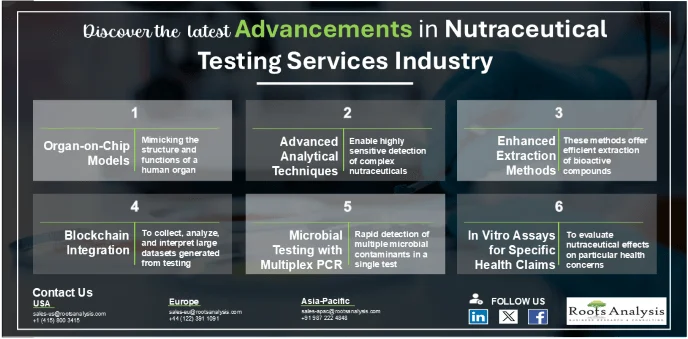
Want to Explore the Latest Technological Advancements Undertaken by Nutraceutical Testing Labs??
LATEST ADVANCEMENTS IN NUTRACEUTICAL TESTING LABS THAT ARE LIKELY TO SHAPE THE NUTRACEUTICAL PRODUCT TESTING MARKET
1. FORMULATION TECHNOLOGY ADVANCEMENTS
Several developments in formulation technology, such as nanoparticle formulation has emerged as a critical innovation for nutraceutical testing labs as it enhances the bioavailability, solubility and stability of nutraceuticals. This enhancement is of great importance for nutraceuticals with poor solubility and instability, especially when exposed to environmental factors such as light and temperature. Further, nutraceutical formulations can significantly improve the body's ability to absorb bioactive ingredients, thereby boosting their overall effectiveness and leading to better therapeutic outcomes. Moreover, encapsulation techniques play a vital role by safeguarding sensitive compounds from degradation, ensuring that they remain potent until they reach their intended target site.
2. SURGE IN THE ADVANCED TESTING METHODS
In recent years, there has been a notable increase in the number of advanced testing methods, such as mass spectrometry, nuclear magnetic resonance and gas chromatography used for testing by several nutraceutical testing service providers like Eurofins Scientific. This surge reflects the growing demand for precise identification and quantification of bioactive compounds in nutraceuticals, driven by consumer awareness of health benefits and regulatory requirements for product safety and efficacy.
3. AUTOMATION AND ROBOTICS INTEGRATION
Foreseeing the potential of robotics process automation in handling repetitive tasks such as sample preparation and data collection has been of great importance in the nutraceutical testing labs. It is worth mentioning that automated systems have the capability to conduct thousands of tests in one go, resulting in rapid testing of nutraceuticals. For example, Dyad Labs leverages automated liquid handling systems that depend on robotics to handle liquids. The robotic arms allow for safe handling and auto-programing for increased walk-away time in the lab.
4. NUTRACEUTICALS EMBRACING SUSTAINABILITY: A PATH TO GREEN TESTING METHODS
Nutraceutical testing labs have made significant progress in addressing sustainability concerns through innovative approaches. The utilization of eco-friendly materials, which are biodegradable and less harmful in testing has resulted in a significant reduction in the amount of waste generated during the testing process. Moreover, companies are initiating to incorporate nutraceutical testing processes that integrate reusable components, sustainable design features, and thorough lifecycle assessments. This approach aims to reduce environmental impact and foster environmentally friendly testing solutions.
5. BENEFITS ASSOCIATED WITH AI AND ML ADOPTION
The growth of the market has been significantly fueled by the rising adoption of AI and ML techniques, which results in predictive analytics and image recognition during the testing process. By utilizing AI stakeholders can analyze vast amount of data to anticipate the potential safety concerns and machine learning algorithms can be trained to identify contaminants and defected products through image analysis.
6. ONGOING EFFORTS: ESTABLISHING A ROBUST REGULATORY FRAMEWORK
Regulatory bodies and industry stakeholders are actively engaged in the development of comprehensive and streamlined regulatory framework for nutraceutical testing labs. This initiative focuses to bridge existing gaps by proposing a comprehensive Nutraceutical Research and Education Act that is tailored specifically for nutraceuticals, ultimately expediting regulatory approval processes and enhancing the quality and safety of these products.
CONCLUSION
The six latest advancements in nutraceutical testing labs are in line with the growing trends towards safe and effective use of nutraceuticals. Over the years, nutraceuticals have demonstrated significant potential for providing benefits to the individuals with less adverse reaction. The growing awareness among geriatric population across the globe has encouraged them to adopt nutraceuticals over pharmaceuticals. Further, the introduction of advanced testing methods is driving the nutraceutical product testing market with high precision and accuracy in nutraceutical testing.
Given the increasing demand for nutraceuticals, there is a growing need for customized product testing by the nutraceutical testing service providers as consumers increasingly seek personalized health solutions. This shift towards personalized nutrition encourages companies to develop tailored dietary supplements that address specific health needs, supported by technological innovations, such as digital twins and organ-on-chip.
Nutraceutical testing laboratories are undergoing significant transformation driven by various technological advancements that enhance product quality, safety and efficacy. Key innovations include the developments in formulation technology, which helps in enhancing bioavailability and stability of nutraceuticals. In addition, adoption of advanced testing methods, such as HPLC and PCR are enhancing traceability and consumer trust. The rising demand for microbial testing using multiplex polymerase chain reaction (PCR) is streamlining safety assessments by significantly reducing turnaround times for results. Moreover, in vitro assays are essential for evaluating the bioactive potential of nutraceuticals, with innovative solutions improving operational efficiency.
Further, implementation of AI, ML and robotics in the testing workflow has reduced the time and cost associated with the conventional testing methods. Furthermore, nutraceutical testing labs are constantly taking initiatives related to sustainability and enhancing regulations related to nutraceutical testing. It is worth mentioning that these advancements signify a positive shift towards innovation and responsibility within the nutraceutical product testing industry.
Browse our full report on Nutraceutical Product Testing Market: https://www.rootsanalysis.com/reports/nutraceutical-product-testing-market.html#overview