Products and Technologies Gaining the Attention of Skincare Companies

.png)

Published: February 2025
Considering the rising demand for personalized products for a specific skin type / condition, skincare companies are expected to process customer specific information and provide tailored solutions. Personalized skincare solutions hold the potential to provide effective treatment options for different skin types; technological advancements such as AI and AR are expected to drive the demand for such products.
The skincare industry is a vast and dynamic market, valued at billions of dollars. It offers a diverse array of products and services aimed at enhancing skin health and wellness. From cleansers and moisturizers to serums and specialized treatments, the skincare companies caters to the diverse needs, concerns, and preferences of consumers across various skin types. The skincare industry is marked by a continuous cycle of innovation, with the introduction of new ingredients, technologies and trends constantly shaping consumer demand and market dynamics.
As consumers become increasingly conscious of clean beauty, sustainability, and personalized solutions, the industry has adapted to meet these evolving preferences, ensuring it remains responsive to the changing needs of its global customer base. With the growing influence of social media, coupled with the increasing interest in improving skin health, the global skincare market is likely to grow, in the foreseen future.
Roots Analysis has conducted an exhaustive study on Skincare Market featuring the current market landscape and future opportunity for the skincare companies, over a span of 11 years. In this article, we have highlighted some of the latest trends in the skincare domain that are likely to shape the evolution of skincare market.
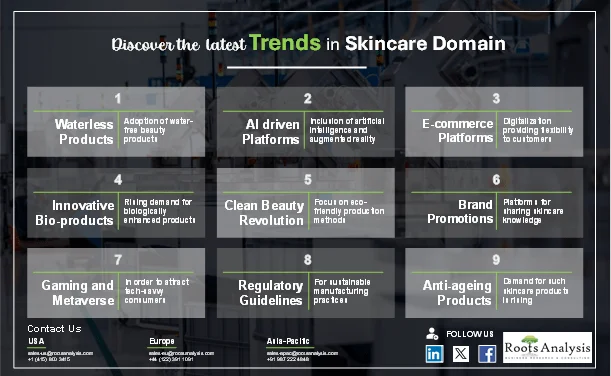
Want to explore the latest trends in skincare domain?
LATEST TRENDS SHAPING THE FUTURE OF SKINCARE COMPANIES
1. ADOPTION OF WATERLESS BEAUTY PRODUCTS
Waterless or water-free beauty products made by skincare companies are formulated without the inclusion of water. Unlike traditional beauty products that use water as a base, waterless formulations rely on active ingredients or botanical oils. Because to the absence of water, waterless beauty products tend to be more concentrated, as the active ingredients are not diluted with water. The waterless beauty trend was originally initiated in South Korea, emphasizing on increasing the potency and effectiveness of skincare products. Moreover, these products have an extended shelf life and are customizable according to the needs of the consumers.
2. PERSONALIZED SKINCARE WITH ARTIFICIAL INTELLIGENCE AND AUGMENTED REALITY
The skincare industry is evolving to meet the diverse needs of consumers with varying skin tones and textures. Owing to the rising awareness for good quality skin, consumers are seeking personalized products that address their specific needs, moving away from one-size-fits-all solutions that may not deliver results. Inclusion of artificial intelligence (AI) and augmented reality by different brands enables consumers to better gauge their skin conditions and look for solutions accordingly. In January 2024, DermaSensor received FDA approval for its first AI-powered tool to diagnose skin cancer. Some other companies evaluating AI in this field are Haut.ai, Perfect Corp. and L’Oreal.
3. INCLUSION OF INNOVATIVE BIO-PRODUCTS
With an increase in the demand for skincare products incorporating biomolecules such as peptides, antioxidants, and enzymes, biotechnology derived products are gaining traction in the industry. Extensive research done by skincare companies and the adoption of science-backed ingredients coupled with cutting-edge technology are driving the development of biologically enhanced skincare solutions.
Brands are increasingly prioritizing skin hydration and quality over cosmetic coverage, launching products that utilize probiotics and advanced formulas to deliver exceptional results in skin hydration and rejuvenation. In September 2022, Naturals launched the brand named Pearl with 18 chemical-free 100% natural sources organic products for beauty, skin and hair care.
4. ADOPTION OF CLEAN BEAUTY AND SUSTAINABLE PRACTICES
The clean beauty revolution promotes skincare products crafted with natural, safe components. Driven by rising concerns about the potential health risks and environmental impact of conventional formulations, consumers are inclining towards clean and natural skincare alternatives. As public consciousness about the benefits of clean beauty rises, so does the call for products that provide safer and more eco-friendly options.
5. THE EVOLVING REGULATORY GUIDELINES
One of the most significant regulatory shifts impacting the cosmetics industry is the growing emphasis on adopting sustainable manufacturing practices. This trend stems from the increasing influence of conscious consumerism, and commitment towards responsibility of reducing the ecological impact of cosmetic goods. Notably, in the US, a pivotal development occurred with the enactment of the Modernization of the Cosmetics Regulations Act by President Biden in late 2022. This legislation introduces the role of a US "Responsible Person" and includes substantial updates related to safety standards and labeling requirements for cosmetics.
6. PROMOTION BY SKINCARE COMPANIES FOR THEIR BRANDS ON SOCIAL MEDIA
Particularly in the skincare sector, the rise of social media platforms has changed the way consumers interact with different content and product offerings. Social media has influenced substantially on skincare practices, trends, and perceptions. Unlike traditional channels, social media serves as a resource for brands to promote skincare information, offering insights generated by skincare companies into diverse skincare concerns, remedies, and therapies. Platforms such as Instagram, Twitter, YouTube, and TikTok have emerged as most frequently used platforms used by skincare companies for sharing skincare knowledge.
7. GAMING AND METAVERSE TO DRIVE CONSUMER BASE
Gaming stands out as a rapidly expanding sector within the media industry, witnessing a significant rise in beauty and cosmetic product enthusiasts who integrate skincare into their daily streaming routines. The intersection of gaming and beauty presents a fertile ground for novel marketing strategies, empowering brands to develop inventive and captivating promotional initiatives to connect with fresh demographics.
CONCLUSION
Driven by the evolving self-care trends, a shift towards consumer preference for innovative skin care products is observed which focuses on product sustainaFbility and personalized routines. Presently, consumers have started emphasizing self-care rituals which ensure wellness of both, the mind and the body. With a growing focus on overall well-being, consumers seek innovative skincare products and routines that not only address specific skin concerns but also integrate elements of relaxation, mindfulness, and self-care.
It is worth noting that growing consumer awareness of the potential health and environmental effects associated with conventional skincare formulations has led to an increased focus on clean and natural skincare products. As the benefits of clean beauty become more widely recognized, there is a rising demand for products that provide safer and environmentally sustainable alternatives.
Browse our full report on Skincare Market: https://www.rootsanalysis.com/reports/skin-care-market.html#overview
SOURCES
- https://www.dermasensor.com/fda-clearance-granted-for-first-ai-powered-medical-device-to-detect-all-three-common-skin-cancers-melanoma-basal-cell-carcinoma-and-squamous-cell-carcinoma/
- https://www.thedailystar.net/business/organisation-news/press-releases/news/naturals-launches-new-organic-beauty-skin-and-hair-care-brand-pearl-3119546