Magnetic Refrigeration Market: A Technology on the Brink of Transformation

.png)

Published: October 2025
The refrigeration industry is at a turning point. For decades, cooling systems have relied on vapor compression technology, which is energy-intensive and often depends on refrigerants with a high global warming potential (GWP). Increasing environmental concerns, stricter regulations, and the need for greater efficiency have prompted researchers and companies to seek alternatives. One of the most promising options that has emerged is magnetic refrigeration. This technology utilizes the magnetocaloric effect and employs solid-state materials instead of traditional gases for cooling. Essentially, certain materials heat up when exposed to a magnetic field and then cool down when the field is removed, allowing for a cyclical refrigeration process without the use of harmful refrigerants. Although this concept is not new and has been studied for decades, recent advancements in materials science, engineering, and manufacturing are finally making it a viable commercial option.
In September 2025, Danfoss India launched a new Designed & Made-in-India STL Valve Family specifically for the sustainable cold chain sector. Earlier, in February 2025, a National Conference on ‘Sustainable Cooling and Doubling the Rate of Energy Efficiency Improvement’ was held in New Delhi. The conference focused on advancing energy efficiency, addressing rising cooling demand, and promoting sustainable cooling solutions.
Roots Analysis has conducted an exhaustive study on the sustainable refrigeration technology market, featuring the current market landscape and future opportunity for the companies engaged in offering magnetic refrigeration, over a span of 15 years.
The Growing Interest in Magnetic Refrigeration
One of the main reasons magnetic refrigeration is gaining industry attention is its potential to address two major challenges altogether: environmental impact and energy efficiency.
- High Energy Efficiency: Magnetic systems can be 20–30% more efficient at room temperature than compressor-based counterparts, driving substantial long-term energy savings.
- No Toxic Refrigerants: The shift away from gases and the risk of leaks or contamination, means systems are safer, simpler, and more durable.
- Lower Maintenance and Noise: Fewer moving parts allow magnetic refrigerators to operate quietly, with minimal vibration and reduced maintenance needs.
- Scalability: The flexible nature of this technology allows for customization, making it suitable for applications ranging from household appliances to large-scale commercial and industrial units.
Current Applications for Magnetic Refrigeration
- Commercial and Industrial Focus: The leading share of adoption is found in commercial refrigeration for supermarkets, restaurants, hotels, and cold storage facilities.
- Transportation Growth: As cold chain logistics and electric vehicle adoption surge, magnetic refrigeration offers sustainable options for trucks, trailers, and shipping containers.
- Healthcare and Food Retail: The precise temperature control and reliability make magnetic refrigeration an ideal technology for pharmaceutical and life sciences storage, where the cost of spoilage is high and regulations are stringent. Similarly, food retail operations are shifting to greener technologies, encouraged by both public relations and government mandates.
Innovations Driving the Market Forward
- Advanced Magnetocaloric Materials: Researchers have developed multi-layered materials and composites that expand the operational temperature range while minimizing the reliance on rare-earth elements.
- Magnet Design: The introduction of compact, high-strength permanent magnets and innovative rotary designs has led to reductions in system size and improvements in efficiency.
- Additive Manufacturing: 3D printing is being explored for producing complex heat exchange geometries, allowing for more efficient thermal transfer.
- Hybrid Systems: the integration of magnetic refrigeration with traditional cooling serves as a transitional pathway, offering partial benefits while lowering costs and mitigating risks.
Magnetic Refrigeration: Trends Impacting Market Growth
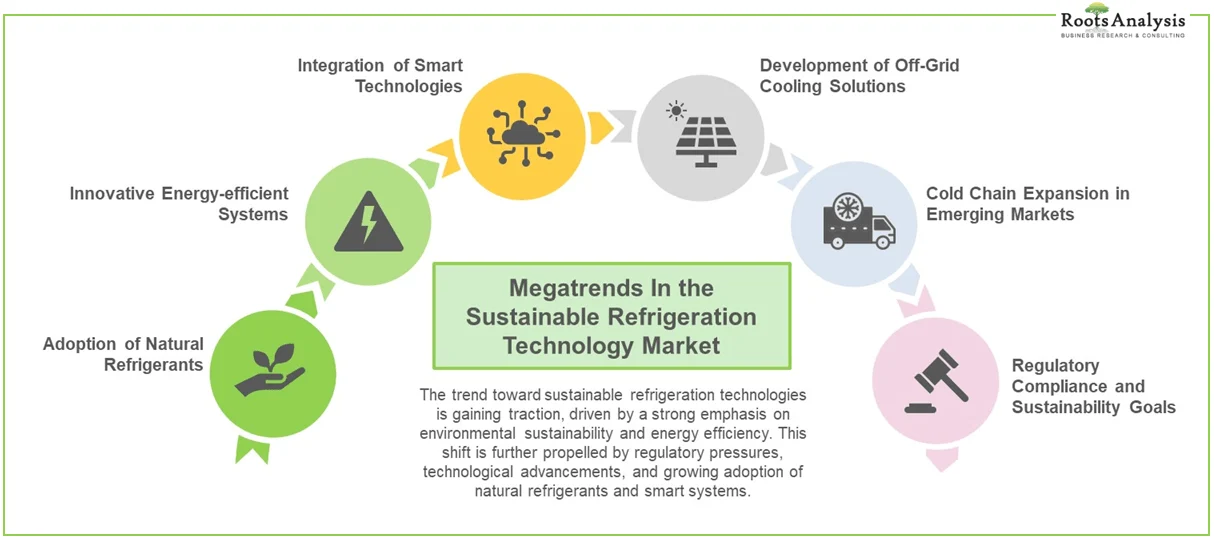
The magnetic refrigeration industry is rapidly evolving with technological innovations in material science and regulatory pressure to adopt eco-friendly materials, leading to its application across various commercial and industrial sectors. The following figure represents magnetic refrigeration market trends:
Interested in exploring advanced magnetic refrigeration market, its advantages, applications, and market trends?
Market Challenges
While magnetic refrigeration is gaining momentum, several challenges persist:
- Material Costs: The performance of magnetic refrigeration depends heavily on rare-earth materials like gadolinium or specially engineered alloys. These materials can be expensive and face supply chain risks.
- Temperature Range Limitations: Magnetic refrigeration is most efficient within certain temperature ranges. Expanding operational capability to handle a wider variety of refrigeration needs, from deep freezing to ambient cooling, requires further optimization of materials.
- Complex Heat Exchanger Technology: Magnetic cooling systems require unique heat transfer mechanisms, which necessitate advancements in heat exchanger efficiency to be optimized for commercial production.
Competitive Landscape
While large appliance manufacturers are exploring with in-house development, a number of startups and research spin-offs are emerging as specialized technology providers. Companies like Magnoric often partner with established OEMs to integrate magnetic systems into existing product lines. Moreover, players, such as Camfridge and MAGNOTHERM offer complete refrigeration systems. Notably, in February 2025, Aspen entered into a R300 million collaboration with Energy Partners to build, operate, and manage a state-of-the-art centralized ammonia-based cooling and heating plant at its Gqeberha production site.
Future Perspectives
As concerns around climate change and sustainability continue to rise, the magnetic refrigeration market is well-positioned to lead the way towards greener cooling solutions. Recent product launches, such as MAGNOTHERM’s ECLIPSE 2D refrigerator, highlight a new phase of commercial readiness, where energy efficiency, low noise, and zero global warming potential become industry benchmarks. With increasing government regulation, brand commitment to sustainability, and growing awareness among consumers and businesses, the magnetic refrigeration market is poised for substantial growth in the coming future.
What About the Future Outlook of Magnetic Refrigeration Market Trends in the Industry Around the World?
The above presentation features magnetic refrigeration market trends, which we have highlighted in our report. If you're interested, you can download the Sample Report on this topic by Roots Analysis. For personalized assistance in identifying the most relevant solutions based on your specific criteria, please don't hesitate to reach out to us at sales@rootsanalysis.com.
Sources
- https://www.passionateinmarketing.com/danfoss-india-launches-new-designed-made-in-india-stl-valve-family-for-sustainable-cold-chain-sector/#google_vignette
- https://www.pib.gov.in/PressReleasePage.aspx?PRID=2106170
- https://www.pressebox.com/pressrelease/magnotherm-solutions-gmbh/magnetic-cooling-market-ready-commercial-refrigerator-launches-in-germany/boxid/1224450
- https://energypartners.co.za/energy-partners-aspen-pharmacare-sign-r300m-caas-agreement/