Rapid Transfer Port Bags: Trends Shaping Closed Biopharmaceutical Manufacturing


Published:
Rapid transfer port (RTP) bags are single-use containment assemblies designed to move materials into or out of controlled environments while maintaining separation between the clean processing zone and the external environment. They are commonly used with alpha-beta rapid transfer port systems in isolators, restricted-access barrier systems and other high-containment operations. By enabling closed, controlled transfer of components, intermediates and waste, RTP bags can support sterility assurance and operator protection.
The rapid transfer port market is gaining relevance as pharmaceutical and biotechnology manufacturers expand aseptic processing, high-potency drug handling and advanced therapy production. These operations require reliable movement of sterile parts, single-use assemblies and materials without disrupting the environmental control of the critical processing zone. RTP-compatible bags are increasingly deployed as a flexible alternative to rigid transfer containers in applications where disposal after use or rapid changeover is advantageous.
Recent development has focused on the integration of single-use bags with validated transfer ports, robust film materials and application-specific accessory configurations. Bag assemblies may be designed for gamma sterilization, cold storage, high-containment handling and compatibility with connectors or tubing systems. This is increasing the value placed on supplier quality systems, material characterization and documented compatibility across the complete transfer assembly.
Automation and modular facility design are also influencing demand. As manufacturers deploy isolator-based fill-finish lines and compact cleanroom suites, they require repeatable transfer solutions that can support standardized workflows. The market is therefore shifting from individual RTP components toward engineered bag-and-port systems that address specific manufacturing, containment and waste-handling needs.
Roots Analysis has conducted an exhaustive study on Rapid Transfer Port Market featuring the current landscape and future opportunity for the companies engaged in rapid transfer port domain. In this article, we have highlighted the key trends and technological advancements that are expected to shape the future of rapid transfer port bags across the global pharmaceutical and biotechnology industries.
Want to Explore the Competitive Landscape, Technological Advancements in the Rapid Transfer Port Bags?
Rapid Transfer Port Bags Trends Transforming Aseptic and High-Containment Pharmaceutical Manufacturing
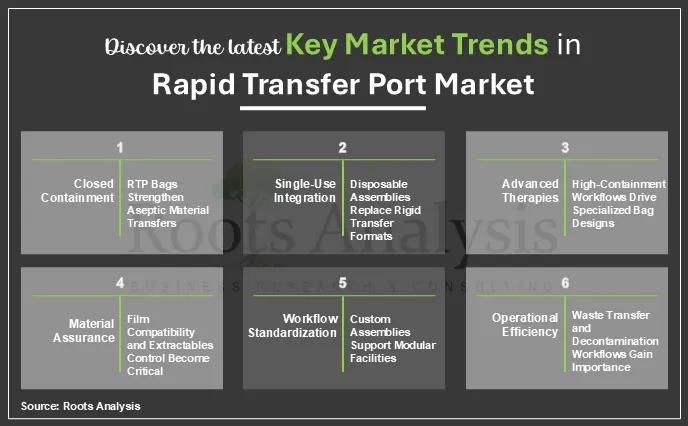
1. Closed Containment: RTP Bags Strengthen Aseptic Material Transfers
Maintaining a closed barrier between the process environment and external surroundings is a central requirement in aseptic and high-containment manufacturing. RTP bags enable sterile or controlled transfer of components and materials through compatible alpha-beta transfer ports, helping reduce the need to open barrier systems or manually handle items within critical zones.
Getinge’s La Calhène® DPTE® transfer technology is a well-established example of the alpha-beta transfer-port approach used in pharmaceutical containment. RTP-compatible bag assemblies extend this concept by providing a flexible, disposable enclosure for materials that must be introduced into or removed from isolators and restricted-access environments.
2. Single-Use Integration: Disposable Assemblies Replace Rigid Transfer Formats
The expansion of single-use bioprocessing is increasing interest in disposable transfer solutions that can be discarded after use. RTP bags can reduce cleaning and decontamination activities associated with reusable transfer containers, while offering flexibility for multiproduct facilities and clinical manufacturing suites.
This trend is particularly relevant to manufacturers operating small or variable batch sizes. Preconfigured RTP bag assemblies can be supplied for specific use cases, such as sterile-component transfer, product-contact consumable transfer or waste removal, reducing on-site assembly and helping standardize operating procedures.
3. Advanced Therapies: High-Containment Workflows Drive Specialized Bag Designs
Cell and gene therapy, viral-vector production and high-potency drug manufacturing are increasing the need for segregated and highly controlled material flows. RTP bags can support these workflows by enabling transfer between rooms, isolators and processing equipment without compromising containment or exposing sensitive materials to unnecessary environmental risk.
The growing use of modular cleanrooms and closed processing suites is expected to increase demand for RTP bag configurations tailored to small-volume, high-value manufacturing. Suppliers that can provide application support, suitable film materials and validated assembly designs are likely to be better positioned in this segment.
4. Material Assurance: Film Compatibility and Extractables Control Become Critical
RTP bags are increasingly evaluated as part of a complete single-use system. Pharmaceutical manufacturers need information on film composition, sterilization compatibility, particulate control, extractables and leachables, mechanical strength and storage conditions, particularly where bags are used near or within critical manufacturing areas.
This requirement is shifting competition toward suppliers that can provide robust material data packages and change-control procedures. For end users, bag performance must be assessed not only during transfer but also across transport, storage, gamma irradiation and interaction with the chosen RTP interface.
5. Workflow Standardization: Custom Assemblies Support Modular Facilities
RTP bag adoption is being supported by a wider move toward standardized and modular manufacturing workflows. Rather than relying on one generic bag, manufacturers increasingly require application-specific formats with defined dimensions, port orientation, closure options, labels and accessory components.
Customizable assemblies can help align material transfer with the geometry of an isolator or barrier system and reduce the likelihood of handling errors. This trend is expected to create demand for suppliers that can combine engineering support with scalable production and controlled configuration management.
6. Operational Efficiency: Waste Transfer and Decontamination Workflows Gain Importance
RTP bags are used not only to introduce sterile materials but also to remove waste and used consumables from controlled zones. Flexible, closed disposal systems can support safer waste handling and reduce the need for operators to intervene in high-risk areas.
As isolator-based processes become more common, the ability to integrate RTP bags into decontamination and waste-transfer procedures is likely to become an important differentiator. Suppliers that demonstrate compatibility with validated cleaning, sterilization and containment workflows can help manufacturers improve both compliance and line productivity.
Conclusion
Rapid transfer port bags are becoming a more important component of closed pharmaceutical and biotechnology manufacturing. Demand is driven by the need to maintain aseptic control, support single-use operations, enable advanced therapy workflows and streamline isolator-based production. The market is likely to favor engineered RTP bag systems that combine reliable containment performance with material transparency, configuration flexibility and efficient operational integration.
To know more about the rapid transfer port technology, access full report: https://www.rootsanalysis.com/reports/rapid-transfer-port-market.html
Sources: