Ready to Use Cartridges: Trends Reshaping Injectable Drug Packaging


Published:
Ready to use (RTU) cartridges are pre-processed primary packaging components supplied for aseptic filling, commonly in nested tub-and-tub configurations. They are designed to eliminate selected in-house preparation steps, such as washing, siliconization, depyrogenation, sterilization and, in certain systems, pre-capping. Their principal value is operational: enabling drug-product manufacturers to concentrate on aseptic filling, inspection and device assembly rather than component preparation.
The format is gaining relevance as injectable therapies move toward self-administration. Cartridges can be integrated into pen injectors, autoinjectors, wearable injectors and other delivery systems, making them particularly relevant for chronic-use and biologic medicines. The commercial decision therefore extends beyond the container itself to dimensional performance, closure compatibility, filling-line fit and the intended patient-use device.
Current product development is focused on sensitive formulations and higher delivery volumes. SCHOTT Pharma positions its cartriQ® BioPure ready-to-use glass cartridge for complex biologics, while its large-volume cartriQ® range addresses subcutaneous delivery needs. Stevanato Group and Gerresheimer likewise offer ready-to-fill cartridge platforms in standard nest-and-tub configurations, illustrating continued supplier investment in standardized, device-compatible formats.
Manufacturing efficiency and sterility assurance are also shaping adoption. RTU formats can support isolator-based or restricted-access-barrier-system filling by reducing component-handling steps inside the aseptic process. This makes them relevant to the wider evolution of aseptic fill-finish manufacturing, where throughput, intervention reduction and validated process control are important priorities.
Roots Analysis has conducted an exhaustive study on Ready to Use Pharmaceutical Packaging Market featuring the current market landscape and future opportunity for the companies engaged in offering ready to use cartridges, over a span of 9 years. In this article, we have highlighted some of the recent trends in ready to use cartridges market that are likely to shape the market.
Want to Explore the Recent Trends in Ready to Use Cartridges Market??
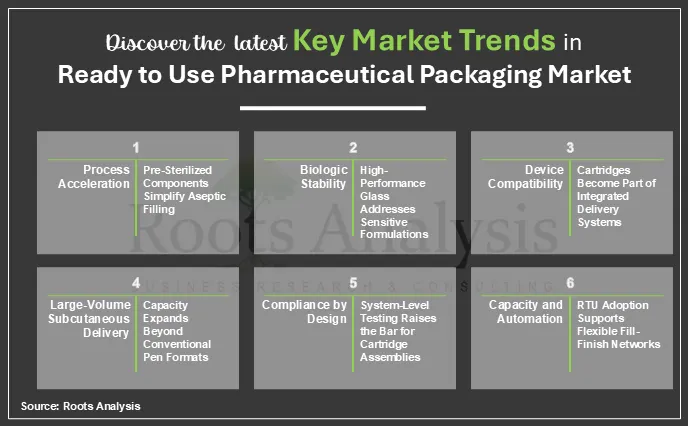
Recent Trends in Ready to Use Cartridges Market
1. Process Acceleration: Pre-Sterilized Components Simplify Aseptic Filling
RTU cartridges shift selected preparation activities upstream to the packaging supplier. By arriving washed, siliconized, sterilized and organized for automated handling, they can reduce the equipment footprint and workflow complexity required at the drug-product site. The benefit is especially material for manufacturers introducing injectable products or expanding flexible filling capacity without adding extensive component-preparation operations.
Stevanato Group states that its EZ-fill® cartridges avoid several production steps, including siliconization, crimping and sterilization. The wider trend is not simply faster filling; it is a more standardized, lower-touch component flow that can facilitate changeovers and reduce operational variability in aseptic manufacturing.
2. Biologic Stability: High-Performance Glass Addresses Sensitive Formulations
For biologics and other sensitive injectables, cartridge selection increasingly depends on the interaction between the formulation and the containment system. Glass composition, extractables and leachables, silicone distribution, dimensional tolerances and container-closure integrity can affect both product stability and device functionality. Consequently, suppliers are differentiating RTU offerings through material science and process-control capabilities rather than sterilization status alone.
SCHOTT Pharma’s cartriQ® BioPure is positioned as a Type I borosilicate-glass cartridge with reduced risk of pH shift and tight dimensional and cosmetic limits for sensitive drugs. Such developments indicate that ready-to-use cartridges are becoming a formulation-enabling component for complex biologics, not merely a convenience format.
3. Device Compatibility: Cartridges Become Part of Integrated Delivery Systems
The cartridge must perform reliably within the final delivery device. This includes compatibility with plungers, seals, needle assemblies and dose-setting mechanisms, alongside functional requirements such as gliding force, dose accuracy and reseal performance. As self-administration expands, packaging suppliers are increasingly developing cartridge systems around device-platform requirements rather than generic container specifications.
Gerresheimer offers Gx® Advance RTF® cartridges in EZ-fill® nest-and-tub configuration for applications including insulin and GLP-1 therapies. SCHOTT Pharma similarly positions cartriQ® cartridges for pen injectors, autoinjectors and on-body delivery devices. This alignment with prefilled syringes and injectable drug-delivery formats reflects a broader shift toward integrated containment-and-delivery solutions.
4. Large-Volume Subcutaneous Delivery: Capacity Expands Beyond Conventional Pen Formats
The rise of higher-dose subcutaneous biologics is increasing interest in cartridges that can support larger fill volumes and wearable or on-body delivery systems. These products require a balance of glass strength, geometry, siliconization, closure design and delivery-device performance. The resulting demand is pushing suppliers to extend RTU cartridge portfolios beyond conventional 1.5 mL and 3 mL formats.
Stevanato Group supplies large-volume cartridges from 5 mL to 20 mL in bulk or steam-sterilized EZ-fill® formats. SCHOTT Pharma’s cartriQ® Large Volume platform is also designed for large-volume biologic delivery. This trend expands the role of RTU cartridges in product-development programs where patient-friendly administration must be balanced with increasingly complex dosing requirements.
5. Compliance by Design: System-Level Testing Raises the Bar for Cartridge Assemblies
Regulatory and compendial expectations increasingly emphasize the function of the completed packaging-and-delivery system. For cartridges, this means that container closure integrity, needle self-sealing capability and elastomeric-component performance must be considered together, not assessed as unrelated component attributes.
West Pharmaceutical Services highlighted the December 2025 officialization of USP <382>, which addresses the functional suitability of elastomeric components in parenteral packaging and delivery systems. This focus is expected to favor suppliers that can provide validated cartridge, plunger and seal assemblies with system-level technical support, helping drug developers reduce late-stage compatibility risk.
6. Capacity and Automation: RTU Adoption Supports Flexible Fill-Finish Networks
The expansion of automated sterile filling is reinforcing demand for components that can be fed consistently into isolator-based lines. In January 2026, Sharp Sterile Manufacturing announced a USD 28 million expansion of its Lee, Massachusetts site, including a fully automated IMA Life isolated filling line for RTU vials. Although the new line is vial-focused, the investment signals the broader direction of sterile manufacturing: facilities are being designed around automation-compatible, pre-sterilized primary packaging.
For cartridge programs, this supports the case for standardized nest-and-tub formats that align with automated handling, visual inspection and high-containment filling environments. The commercial advantage will increasingly rest with suppliers and CDMOs able to coordinate RTU component specifications with equipment configuration, device assembly and reliable supply planning.
Conclusion
Ready to use cartridges are developing into strategic components of injectable drug delivery. Pre-sterilized processing, improved biologic compatibility, integrated device performance, large-volume formats, system-level compliance and automation-ready supply are likely to shape adoption. As injectable therapies become more patient-centric and operationally complex, the most valuable RTU cartridge solutions will combine containment performance with predictable fill-finish execution.
Browse our full report on Ready to Use Pharmaceutical Packaging Market: https://www.rootsanalysis.com/reports/pre-sterilized-ready-to-use-primary-packaging-market/224.html
Sources:
1. https://www.schott-pharma.com/en/products/pharmaceutical-cartridges/cartriq
2. https://www.schott-pharma.com/en/products/pharmaceutical-cartridges/cartriq-biopure
3. https://www.schott-pharma.com/en/products/pharmaceutical-cartridges/cartriq-large-volume
4. https://www.stevanatogroup.com/en/products-capabilities/drug-containment-solutions/industry-needs-and-solutions/ez-fill-platforms/ez-fill-cartridge-platform/