Recent Trends in Advanced Wound Care Market

.png)

Published: August 2026
The global advanced wound care landscape is undergoing a significant transformation, with wound management evolving beyond conventional approaches toward more specialized and multidisciplinary strategies to support wound healing. This evolution is being driven by the growing adoption of advanced dressings, wound healing medical devices, bioengineered skin and dermal substitutes, and technology-enabled wound care solutions. Historically, wound management has been challenged by delayed healing, recurrent infections, and complex wound characteristics, particularly among patients with chronic and hard-to-heal wounds. These challenges have contributed to a substantial healthcare burden, encouraging healthcare providers to adopt more specialized treatment approaches and advanced technologies aimed at accelerating wound healing, reducing complications, and improving overall patient outcomes.
The development of advanced dressings, skin substitutes, and wound healing medical device is transforming the management of hard-to-heal wounds. These innovations are enabling healthcare providers to adopt targeted treatment strategies based on wound characteristics, severity, and individual patient needs. Advanced solutions, including negative pressure wound therapy, bioengineered skin and dermal substitutes, and antimicrobial technologies, are increasingly being used to support tissue repair, manage infection, and promote wound closure. These solutions are particularly valuable for wounds associated with tissue loss, prolonged inflammation, infection, or delayed healing, leading to improved wound management and reduced treatment-related complications. Further, the integration of digital wound assessment, AI-enabled monitoring, and personalized treatment approaches is supporting informed clinical decision-making and strengthening continuity of care across healthcare settings.
With the growing adoption of advanced wound care products, recent trends in advanced wound care market are increasingly centered on smart technologies, digital healthcare monitoring, and personalized treatment strategies. Emerging technologies are enabling more proactive wound management, with greater emphasis on early identification of healing complications and timely intervention. Further, patient-centric technologies are supporting wound care across hospitals, outpatient facilities, and home-care settings. These developments are also encouraging manufacturers to focus on solutions that improve patient convenience, simplify treatment delivery, and support long-term wound management. Collectively, these advancements are expected to strengthen care coordination, expand the adoption of advanced wound care solutions, and improve patient outcomes.
Roots Analysis has conducted an exhaustive study on Advanced Wound Care Market featuring the current market landscape and future opportunity for the advanced wound care products and product providers. In this article, we have highlighted some of the recent trends in advanced wound care market that are expected to shape the future of wound management, technologies and treatment approaches.
Want to Explore the Recent Trends in Advanced Wound Care Market?
Recent Trends in Advanced Wound Care Market
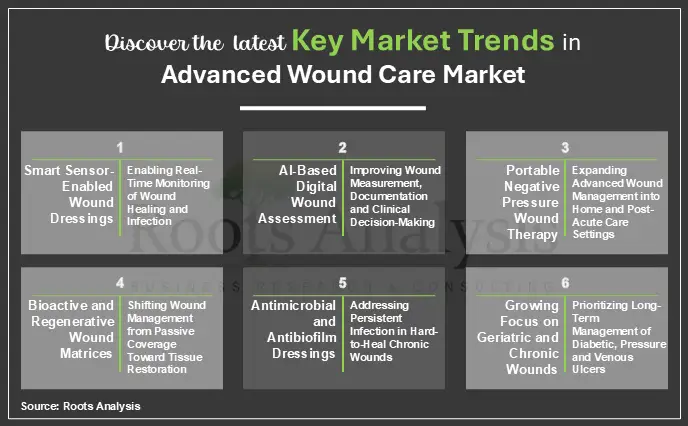
1. Smart Sensor-Enabled Wound Dressings: Enabling Real-Time Monitoring of Wound Healing and Infection
The emergence of smart and sensor-enabled dressings is becoming one of the important technological trends in the advanced wound care market, enabling healthcare providers to move beyond conventional visual wound assessment. These next-generation dressings incorporate sensors capable of monitoring parameters such as temperature, moisture, pH and other indicators associated with wound healing and infection. By providing continuous information about changes within the wound microenvironment, such technologies can help clinicians identify healing complications earlier while potentially reducing unnecessary dressing removal. Further, wireless connectivity is enabling wound information to be transmitted to healthcare professionals for remote patient monitoring. A recent article published in January 2026, features a connectivity-related innovation, presenting a wireless, battery-free, multimodal sensor integrated with a colorimetric wound dressing for diabetic ulcer management.
2. AI-Based Digital Wound Assessment: Improving Wound Measurement, Documentation and Clinical Decision-Making
Integration of artificial intelligence and digital wound assessment technologies is increasingly transforming the advanced wound care market by enabling more standardized and data-driven wound evaluation. Traditionally, wound dimensions, tissue characteristics and healing progression are frequently assessed visually, introducing variability between healthcare professionals. AI-enabled imaging platforms can analyze wound photographs, estimate wound dimensions, classify wound characteristics and track changes across successive assessments, thereby supporting more consistent clinical documentation. These technologies are particularly relevant for chronic wounds requiring repeated monitoring over prolonged treatment periods. Further, integration with smartphones, telehealth platforms and electronic clinical workflows can facilitate wound monitoring across hospitals, outpatient clinics and home-care settings. In this context, one of the advanced wound care companies, Mölnlycke, is increasingly exploring digital wound-care solutions that support data-driven insights, standardized documentation and connected wound management across healthcare settings.
3. Portable Negative Pressure Wound Therapy: Expanding Advanced Wound Management into Home and Post-Acute Care Settings
The increasing availability of portable and patient-friendly negative pressure wound therapy systems represents another prominent trend in the advanced wound care market. Traditionally associated with hospital-based management of complex wounds, NPWT is increasingly being adapted for post-acute and home-care environments through lightweight pumps, simplified interfaces and single-use systems. This transition allows patients requiring prolonged wound management to continue therapy outside hospitals while supporting mobility and potentially reducing the frequency of facility-based care. Such solutions are particularly relevant for diabetic foot ulcers, pressure injuries, surgical wounds and other hard-to-heal wounds requiring extended treatment.
4. Bioactive and Regenerative Wound Matrices: Shifting Wound Management from Passive Coverage Toward Tissue Restoration
Advances in bioactive matrices and skin substitutes are gradually shifting the recent trends in the advanced wound care market from passive wound protection towards therapies that are designed to actively support tissue regeneration. Products incorporating extracellular matrices, collagen-based scaffolds and other biologically active materials can provide structural environments that support cellular migration, tissue formation and the natural wound-healing process. These technologies are broadly being adopted in the management of hard-to-heal wounds that fail to respond adequately to conventional dressings, including diabetic foot ulcers and venous leg ulcers. Further, growing commercial activity and continued product development are expanding the availability and clinical application of these regenerative wound care approaches, supporting their integration into advanced wound management.
5. Antimicrobial and Antibiofilm Dressings: Addressing Persistent Infection in Hard-to-Heal Chronic Wounds
The growing emphasis on effective management of microbial burden and biofilms is driving innovation in antimicrobial and antibiofilm solutions across the advanced wound care market. Chronic wounds can develop persistent microbial communities that are difficult to manage using conventional wound dressings, contributing to prolonged inflammation and delayed healing. Consequently, manufacturers are increasingly developing multifunctional dressings that combine exudate management with antimicrobial and antibiofilm activity to improve the wound environment. Furthermore, innovation is extending beyond conventional silver-based technologies toward alternative antimicrobial mechanisms designed to provide broader and more targeted control of microbial burden and biofilm formation.
6. Growing Focus on Geriatric and Chronic Wounds: Prioritizing Long-Term Management of Diabetic, Pressure and Venous Ulcers
The growing prevalence of chronic diseases and an aging population is increasing the demand for advanced wound care products for long-term wound management. Older adults are more likely to develop chronic wounds such as pressure injuries, venous leg ulcers and diabetic foot ulcers due to factors including reduced mobility, poor circulation and multiple underlying health conditions. Further, the rising prevalence of diabetes is increasing the number of patients at risk of developing diabetic foot complications. According to the 2025 IDF Diabetes Atlas, approximately 589 million adults aged 20–79 years are living with diabetes worldwide. These trends are encouraging healthcare providers to increasingly adopt advanced dressings, negative pressure wound therapy, antimicrobial products and skin substitutes to support the management of complex and hard-to-heal wounds.
Conclusion
These six recent trends in the advanced wound care market reflect the ongoing shift toward more personalized, technology-driven, and patient-centered approaches to wound management. Advances in smart dressings, AI-based wound assessment, portable negative pressure wound therapy, and regenerative wound matrices are enabling healthcare providers to improve wound monitoring and treatment. Antimicrobial and antibiofilm technologies, along with the growing focus on geriatric and chronic wounds, are further strengthening the management of complex and hard-to-heal wounds. Looking ahead, continued innovation across these areas is expected to improve wound-healing outcomes, expand access to advanced therapies, support home-based care, and strengthen the adoption of advanced wound care solutions.
Browse our full report on Advanced Wound Care Market: https://www.rootsanalysis.com/reports/advanced-wound-care-market.html
Sources:
- https://pmc.ncbi.nlm.nih.gov/articles/PMC13090253/
- https://advanced.onlinelibrary.wiley.com/doi/10.1002/adfm.202532167
- https://www.rmit.edu.au/news/all-news/2025/jul/wound-monitor
- https://pmc.ncbi.nlm.nih.gov/articles/PMC12335118/
- https://pubmed.ncbi.nlm.nih.gov/40931370/
- https://diabetesatlas.org/data-by-indicator/diabetes-estimates-20-79-y/people-with-diabetes-in-1000s/