Recent Trends in Nucleic Acid Isolation and Purification Market

.png)

Published: August 2026
The rapid expansion of genomics, molecular diagnostics and precision medicine has significantly increased the importance of reliable nucleic acid isolation and purification. DNA and RNA extracted from biological samples serve as the starting material for a wide range of downstream applications, including polymerase chain reaction (PCR), next-generation sequencing (NGS), gene expression analysis, liquid biopsy and molecular diagnostic testing.
As these applications become increasingly sophisticated, laboratories require nucleic acids with greater purity, integrity and consistency. Consequently, sample preparation is evolving from labor-intensive manual procedures toward standardized and automated workflows capable of processing diverse sample types, including blood, tissue, formalin-fixed paraffin-embedded (FFPE) samples, circulating cell-free DNA (cfDNA), microbial samples and cultured cells.
The overall nucleic acid isolation and purification market is also witnessing continued technological innovation across kits, reagents and instruments. In particular, magnetic particle-based purification, automated benchtop systems and high-throughput extraction platforms are gaining prominence owing to their ability to reduce hands-on processing, improve reproducibility and support scalable laboratory operations.
Further, growing adoption of precision oncology, liquid biopsy, infectious disease testing and advanced sequencing techniques is creating demand for methods capable of recovering high-quality nucleic acids from low-input and difficult-to-process samples. At the same time, manufacturers are focusing on integrated workflows that combine sample collection, stabilization, extraction and downstream processing, thereby reducing variability across the pre-analytical workflow.
Roots Analysis has conducted an exhaustive study on Nucleic Acid Isolation and Purification Market trends featuring the current market landscape and future opportunities in this field.
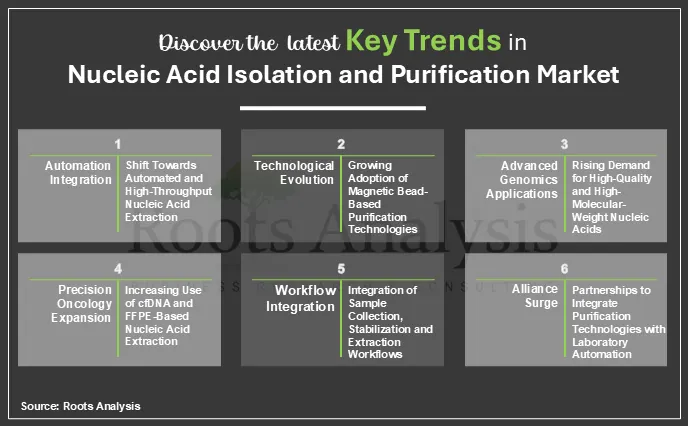
Want to explore the latest trends in Nucleic Acid Isolation and Purification Market?
Latest Trends in Nucleic Acid Isolation & Purification Industry that are Likely to Shape the Market
1. Laboratory Automation: Paradigm Shift from Manual Extraction to Walkaway Sample Preparation
One of the most prominent trends in the nucleic acid isolation and purification market is the increasing transition from manual extraction methods toward automated sample preparation. Manual workflows typically require repeated pipetting, centrifugation and washing steps, making them labor-intensive and susceptible to operator-related variability. Automated platforms, on the other hand, can standardize extraction conditions while reducing hands-on time and increasing laboratory throughput.
Companies are consequently expanding their automated sample preparation portfolios across different laboratory scales. For instance, in February 2026, QIAGEN launched QIAsprint Connect, a compact high-throughput platform capable of automated purification of up to 192 DNA or RNA samples per run. The company is also developing QIAmini for laboratories requiring low-throughput walkaway automation. Such developments indicate that automation is increasingly becoming accessible not only to centralized high-volume laboratories but also to smaller research facilities.
2. High-Quality Nucleic Acid Recovery: Growing Requirements from Advanced Genomics and Sequencing
The growing use of next generation sequencing, long-read sequencing and other advanced genomic technologies is increasing the importance of nucleic acid quality during the pre-analytical stage. Unlike conventional assays, many sequencing applications require nucleic acids with specific characteristics related to molecular weight, integrity, concentration and contaminant levels. Poor extraction quality can negatively affect library preparation, sequencing efficiency and downstream data interpretation.
This has encouraged solution providers to develop extraction chemistries tailored to demanding genomic workflows. For example, Thermo Fisher Scientific offers magnetic bead-based workflows for isolating high-molecular-weight DNA suitable for advanced genomics applications; its MagMAX HMW DNA Kit can isolate DNA fragments of up to 300 kb from blood, cells and tissues using either manual processing or KingFisher automation. As sequencing technologies continue to evolve, extraction products optimized for high-integrity and low-input nucleic acids are likely to gain increasing importance.
3. Precision Oncology and Liquid Biopsy: Rising Demand for Specialized cfDNA and FFPE Extraction
Precision oncology is creating new requirements for extracting clinically meaningful nucleic acids from increasingly challenging samples. Liquid biopsy workflows, for example, depend on the recovery of low-abundance circulating cell-free DNA from plasma, while tissue-based molecular profiling frequently requires DNA and RNA to be isolated from FFPE specimens. These samples can be difficult to process because nucleic acids may be present at low concentrations or may have undergone fragmentation and chemical modification.
As a result, companies are developing specialized extraction workflows capable of improving recovery while preserving compatibility with sensitive downstream assays. QIAGEN's next-generation QIAsymphony Connect platform is being developed for automated clinical nucleic acid extraction across oncology, liquid biopsy and infectious disease applications. Similarly, solutions are increasingly being designed to sequentially recover DNA and RNA from the same FFPE specimen, helping laboratories obtain more molecular information from limited clinical material. This trend is expected to strengthen as molecular profiling becomes increasingly integrated into oncology research and diagnostic workflows.
4. Workflow Integration: Combining Sample Collection, Stabilization and Extraction
Another emerging trend is the development of integrated pre-analytical solutions that extend beyond nucleic acid extraction alone. Biological samples may undergo multiple collection, transportation, stabilization and preparation steps before DNA or RNA is isolated. Variability introduced at any of these stages can affect downstream molecular analysis, prompting laboratories and product developers to place greater emphasis on end-to-end sample management.
In April 2026, Covaris introduced its truCOLLECT solution, an integrated system intended to support decentralized whole-blood collection, stabilization and downstream DNA processing for clinical research and biopharmaceutical laboratories. Such platforms highlight a broader movement toward connecting sample collection with standardized downstream preparation. Over time, integrated workflows can help reduce manual transfers, limit pre-analytical variability and enable samples collected outside conventional centralized laboratories to enter genomic and molecular testing workflows more efficiently.
5. Sustainability-Focused Sample Preparation: Reduction in Plastic and Consumable Waste
The increasing volume of molecular testing and genomic research has also heightened attention toward the environmental footprint of laboratory workflows. Nucleic acid isolation frequently involves disposable pipette tips, reagent vessels, extraction plates, cartridges and packaging. As laboratories increase throughput, these single-use consumables can generate substantial quantities of plastic waste.
Consequently, sustainability is increasingly being incorporated into the design of newer sample preparation systems. QIAGEN stated that consumables used with its QIAsprint Connect platform can reduce plastic use by up to 50% and packaging volume by approximately 40% compared with standard consumables in the market. Such initiatives demonstrate how manufacturers are attempting to balance high-throughput processing requirements with laboratory sustainability objectives. Going forward, reduced consumable usage, optimized reagent volumes and more resource-efficient instrument designs are likely to become increasingly important purchasing considerations.
6. Alliance Surge: Partnerships to Integrate Purification Technologies with Laboratory Automation
Partnerships between sample preparation technology developers and laboratory automation companies are another notable trend shaping the market. Rather than developing every element of the extraction workflow internally, companies are increasingly combining specialized nucleic acid preparation technologies with established robotic liquid-handling platforms. This approach can accelerate workflow development and provide laboratories with more integrated, application-specific solutions.
For instance, in July 2025, Covaris and Hamilton announced a strategic partnership to co-market the truXTRAC FFPE SMART Solution powered by the Hamilton Sonication STAR liquid-handling platform. The collaboration integrates Covaris' FFPE sample preparation technology with automated liquid handling to provide a walkaway workflow for nucleic acid extraction from FFPE samples. Such collaborations are particularly relevant for clinical genomics and high-throughput laboratories, where reducing manual handling while maintaining reproducibility is a key operational priority.
Conclusion
Recent trends in the nucleic acid isolation and purification market indicate that sample preparation is moving toward a more automated, standardized and application-specific future. Growing requirements from advanced genomics, precision oncology, molecular diagnostics and liquid biopsy are driving demand for extraction technologies capable of recovering high-quality DNA and RNA from increasingly diverse and challenging samples.
At the same time, high-throughput automation, integrated sample-processing workflows and magnetic particle-based purification technologies are helping laboratories improve reproducibility while reducing hands-on processing. Sustainability considerations are also becoming increasingly relevant as companies redesign consumables and workflows to reduce laboratory waste.
In addition, strategic partnerships between extraction technology providers and automation companies are enabling the development of more integrated sample preparation solutions. Collectively, these trends are expected to strengthen the role of nucleic acid isolation and purification as a critical enabling step across genomics, diagnostics, pharmaceutical research and precision medicine, supporting sustained growth of the market over the coming years.
Browse our full report on Nucleic Acid Isolation and Purification Market Advances: https://www.rootsanalysis.com/reports/nucleic-acid-isolation-and-purification-market.html
Sources:
- https://corporate.qiagen.com/English/newsroom/press-releases/press-release-details/2026/QIAGEN-Showcases-QIAsprint-Connect-High-Throughput-Automation-System-for-Labs-Worldwide-at-SLAS-2026/default.aspx
- https://www.thermofisher.com/in/en/home/life-science/dna-rna-purification-analysis/automated-purification-extraction/automated-magmax-kits-nucleic-acid-extraction/high-molecular-weight-dna-extraction.html
- https://www.qiagen.com/us/applications/automated-sample-preparation/qiasymphony-connect-overview
- https://prevention.cancer.gov/research-areas/networks-consortia-programs/lbc?utm_source=chatgpt.com