Recent Trends in Ready to Use Vials Market

.png)

Published: July 2026
The global pharmaceutical primary packaging landscape is undergoing a structural transition away from traditional bulk-delivered components toward pre-sterilized / ready to use (RTU) formats. Historically, drug manufacturers operated extensive, resource-heavy wash-and-prep lines within their own facilities, allocating large cleanroom footprints to water-for-injection (WFI) washing systems, autoclaves and energy-intensive depyrogenation tunnels.
The advent of pre-sterilized / ready to use primary packaging has fundamentally reshaped this paradigm. By shifting the entire burden of component washing, depyrogenation and sterilization upstream to specialized packaging manufacturers, the pharmaceutical industry has unlocked a leaner, more agile manufacturing model that minimizes capital expenditure and shortens commercialization timelines. Among various RTU formats, ready to use vials have emerged as one of the most versatile and widely adopted packaging solutions for injectable pharmaceuticals.
Their compatibility with a broad range of drug products including biologics, vaccines, biosimilars, oncology therapies, peptides and orphan drugs, makes them indispensable across both clinical and commercial manufacturing. By eliminating multiple upstream container preparation steps, RTU vials not only reduce operational complexity but also support flexible manufacturing, rapid batch changeovers and seamless integration with automated aseptic fill finish manufacturing lines.
With the growing adoption of RTU vials, the recent trends in ready to use vials market are primarily focused on gloveless nest-and-tub integration for automated aseptic processing, AI-enabled quality inspection, advanced glass materials, next-generation vial technologies, innovative surface coating solutions, and smart laser-based traceability for enhanced product authentication. Collectively, these advancements are improving the efficiency, safety and reliability of ready to use vials.
Roots Analysis has conducted an exhaustive study on Ready to Use Pharmaceutical Packaging Market featuring the current market landscape and future opportunity for the companies engaged in offering ready to use vials, over a span of 9 years. In this article, we have highlighted some of the recent trends in ready to use vials market that are likely to shape the next generation of pharmaceutical fill / finish operations and primary packaging solutions.
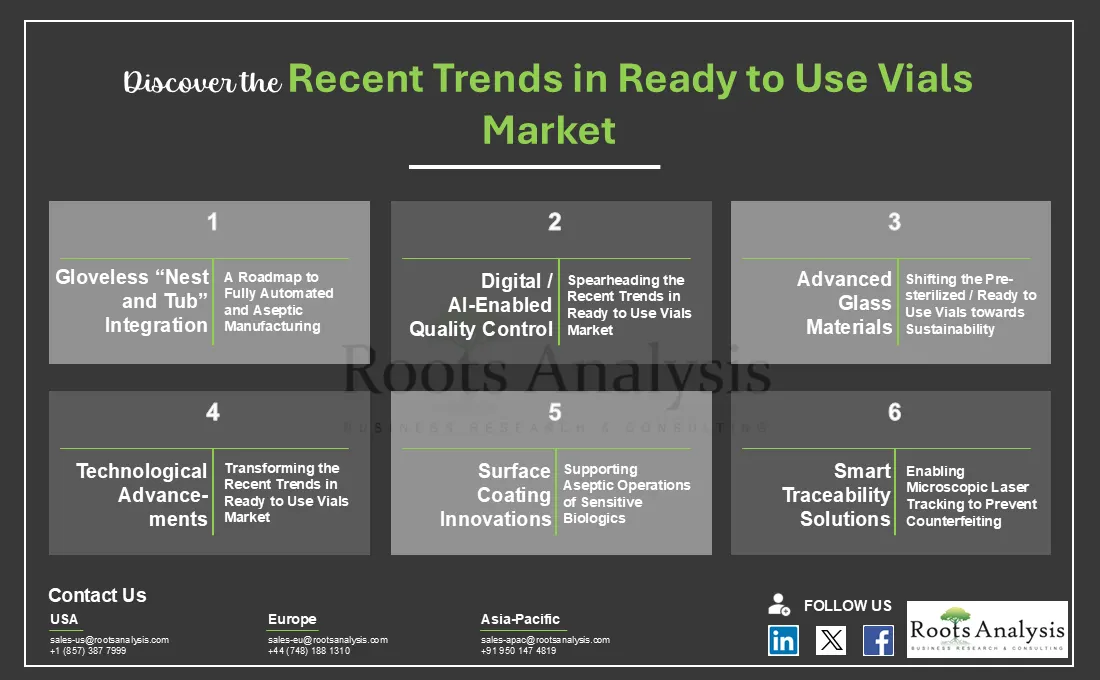
Want to Explore the Recent Trends in Ready to Use Vials Market?
Recent Trends in Ready to Use Vials Market
1. Gloveless “Nest and Tub” Integration: A Roadmap to Automated and Aseptic Manufacturing
Among the recent trends in the ready to use vials market, the increasing adoption of gloveless "nest and tub" packaging systems has emerged as a major advancement in aseptic pharmaceutical manufacturing. Unlike conventional bulk packaging, RTU vials supplied in sterile nests and tubs can be directly transferred to automated filling lines without manual handling or additional preparation steps. This significantly minimizes the risk of particulate contamination, glass-to-glass contact, and operator intervention while improving production efficiency. The technology is particularly beneficial for biologics, vaccines and personalized medicines, where sterility assurance is critical. For instance, Fischer Söhne strengthened its Nest and Tub portfolio for RTU vials by offering customizable configurations that enhance vial protection, reduce particle generation and breakage and enable seamless integration with automated aseptic fill / finish lines.
2. Digital / AI-Enabled Quality Control: Spearheading the Recent Trends in Ready to Use Vials Market
Digitalization and artificial intelligence are among the most transformative trends in the ready to use vials market, enabling manufacturers to achieve higher accuracy in quality inspection while supporting fully automated aseptic manufacturing. AI-powered vision systems are increasingly becoming capable of detecting cosmetic defects, dimensional inconsistencies, particulate contamination and container integrity issues with greater accuracy than conventional inspection methods. Reflecting this trend, Stevanato Group has integrated its deep learning-based Vision AI technology into the MAVIS® inspection platform to improve defect detection for RTU vials, syringes, and cartridges. Similarly, Syntegon has incorporated AI-assisted visual inspection capabilities into its AIM 8+ and AIM 9 platforms, enabling high-speed, automated inspection of RTU vials and lyophilized injectable products.
3. Advanced Glass Materials: Shifting the Pre-sterilized / Ready to Use Vials towards Sustainability
Material innovation has become one of the defining recent trends in the ready to use vials market, with manufacturers increasingly developing advanced glass solutions that combine superior performance with improved sustainability. Next-generation Type I borosilicate and chemically strengthened glass offer enhanced mechanical strength and improved compatibility with complex biologics, thereby reducing vial breakage and product loss. In this context, manufacturers are investing in lightweight glass designs and energy-efficient production processes to lower carbon emissions throughout the packaging lifecycle. Innovations such as Corning Valor Glass and SCHOTT FIOLAX exemplify this shift toward durable and environmentally responsible RTU vial solutions.
4. Technological Advancements: Transforming the Recent Trends in Ready to Use Vials Market
Continuous technological innovations are reshaping the recent trends in the ready to use vials market, with manufacturers introducing next-generation vial platforms that enhance drug compatibility, manufacturing efficiency and supply chain resilience. One notable advancement is the development of hybrid polymer–glass RTU vials, which combine the chemical resistance of glass with the durability of polymer to minimize breakage during handling and transportation. These technological developments are allowing RTU vials to better support the rapidly expanding pipeline of biologics, vaccines, biosimilars, and advanced therapeutic products.
5. Surface Coating Innovations: Supporting the Aseptic Packaging of Sensitive Biologics
Advancements in surface engineering are playing a pivotal role in improving the performance of RTU vials for highly sensitive injectable therapies. Manufacturers are increasingly adopting advanced siliconization techniques, low-particle internal coatings and barrier surface treatments to minimize protein adsorption, reduce extractables and leachables, and enhance drug-container compatibility. As a result, several companies, such as SCHOTT Pharma offer EVERIC bio polymer vials featuring advanced barrier coating technology to improve compatibility with highly sensitive biologics and advanced therapies.
6. Smart Traceability Solutions: Enabling Unit-Level Laser Tracking to Prevent Counterfeiting
The increasing emphasis on product authentication and supply chain transparency is driving the adoption of advanced traceability solutions for single use assemblies such as RTU vials. Manufacturers are incorporating permanent laser-etched 2D Data Matrix codes, GS1-compliant serialization, smart labels and vial-level unique identification technologies directly onto RTU vials, enabling each container to carry a unique digital identity throughout its lifecycle. Such innovations strengthen anti-counterfeiting measures, facilitate regulatory compliance, and enable real-time tracking from manufacturing to patient administration.
Conclusion
These six recent trends in the ready to use vials market are in line with the pharmaceutical industry's ongoing transition toward smarter, more automated and digitally connected aseptic manufacturing. Continuous innovation in vial design, materials, quality control and digital traceability is enabling pharmaceutical manufacturers to meet increasingly stringent regulatory requirements while supporting the commercialization of complex biologics and advanced therapies. Looking ahead, these developments are expected to further accelerate the adoption of RTU vials as a preferred primary packaging solution across the pharmaceutical industry.
Browse our full report on Ready to Use Pharmaceutical Packaging Market: https://www.rootsanalysis.com/reports/pre-sterilized-ready-to-use-primary-packaging-market/224.html#overview
Sources:
- https://www.millrocktech.com/wp-content/uploads/2021/09/2021_Hybrid-Pharmaceutical-Vials-for-lyophilized-biological-drugs-and-vaccines.pdf
- https://www.stevanatogroup.com/en/products-capabilities/drug-containment-solutions/industry-needs-and-solutions/ez-fill-smart/
- https://fischersoehne.ch/en/tubs-and-nests/
- https://www.schott-pharma.com/en/products/vials
- https://www.syntegon.com/solutions/pharma/automated-visual-inspection-systems/
- https://www.dwk.com/na/primary-packaging/ready-to-use-and-custom-solutions