Single Use Downstream Bioprocessing Market Trends: Automation, Intensification and Sustainable Manufacturing


Published: September 2026
Single use downstream bioprocessing refers to the use of disposable assemblies, including bags, tubing, filters, connectors, mixers and flow paths, to purify, concentrate, formulate and transfer biopharmaceutical products. These technologies reduce cleaning and sterilization requirements while enabling more flexible manufacturing configurations than conventional stainless-steel systems.
The market is evolving from the adoption of individual disposable components toward increasingly integrated downstream platforms. Manufacturers are combining single-use filtration, tangential flow filtration (TFF), chromatography flow paths, buffer handling systems and fluid-management assemblies to reduce manual interventions and simplify process transfer across development, clinical and commercial facilities.
Growth in biologics, biosimilars, cell and gene therapies, and other complex modalities is reinforcing the need for agile manufacturing capacity. Single-use downstream systems are particularly valuable where product portfolios are diverse, batch sizes vary, and rapid changeovers are required. Their ability to limit cross-contamination risk and minimize water-for-injection and clean-in-place requirements also supports deployment in multiproduct facilities.
At the same time, higher product titers and more complex molecules are increasing pressure on downstream purification operations. Technology providers are therefore focusing on high-capacity membranes, intensified chromatography, modular skids, advanced sensors and automated control systems that can improve productivity without compromising product quality or regulatory compliance.
Sustainability, supply-chain resilience and extractables and leachables assessment are also becoming central purchasing considerations. As a result, the single use downstream bioprocessing market is likely to be shaped by solutions that deliver flexibility alongside stronger lifecycle management, data integrity and material traceability.
Roots Analysis has conducted an exhaustive study on Single Use Downstream Bioprocessing Market featuring the current market landscape and future opportunity for the companies engaged in this domain, over a span of many years. In this article, we have highlighted various trends that are likely to shape the evolution of this market.
Want to explore the latest advancements in single use downstream bioprocessing industry?
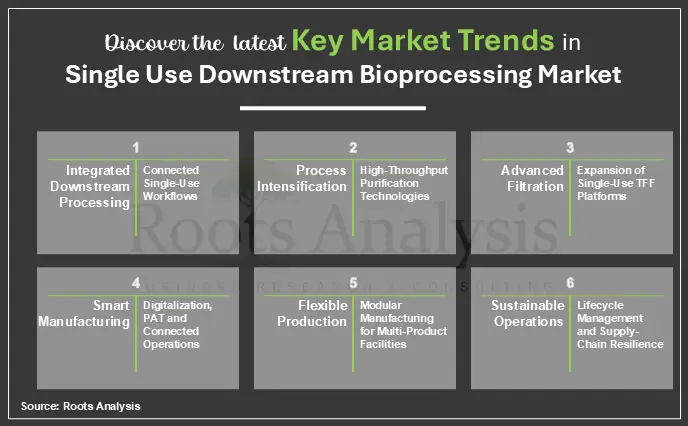
Latest Trends in Single Use Downstream Bioprocessing Market That Are Likely to Shape the Market
1. Integration of Disposable Downstream Workflows
The market is moving beyond standalone single-use bags and filters toward integrated downstream processing trains. These workflows connect clarification, virus filtration, ultrafiltration / diafiltration, chromatography and final bulk handling through preconfigured disposable assemblies, reducing the number of open handling steps and manual connections.
Integrated designs can shorten facility turnaround times and simplify technology transfer between process-development laboratories, clinical manufacturing suites and commercial sites. Cytiva’s single-use downstream portfolio, including disposable flow kits and systems for filtration and chromatography workflows, illustrates the industry’s direction toward connected, application-specific processing platforms.
2. Intensified Purification for High-Titer Biologics
Rising upstream titers are increasing the burden of throughput on clarification, chromatography and TFF operations. Consequently, biomanufacturers are adopting intensified downstream approaches, such as membrane chromatography, multicolumn chromatography, high-flux filtration and continuous or semi-continuous purification configurations.
Single-use flow paths are increasingly important in these intensified operations because they enable rapid configuration changes and reduce the cleaning validation burden associated with multiproduct facilities. This trend is expected to increase demand for disposable chromatography devices, high-performance membranes and scalable TFF systems capable of supporting greater product loads while preserving recovery and product quality.
3. Expansion of Single-Use TFF and Filtration Platforms
Filtration remains a critical enabling technology in downstream bioprocessing, particularly for concentration, buffer exchange, clarification and viral safety applications. Suppliers are expanding single-use TFF offerings to support faster deployment, flexible batch volumes and reduced cleaning requirements across monoclonal antibodies, recombinant proteins, vaccines and emerging biologics.
Repligen’s KrosFlo® RS TFF systems exemplify the shift toward flexible filtration platforms that can accommodate both flat-sheet cassettes and hollow-fiber filters. Such versatility is especially relevant for CDMOs that must support multiple client programs and process formats within constrained manufacturing footprints.
4. Digitalization, Process Analytical Technology and Connected Operations
Digitalization is emerging as a major differentiator in downstream processing. Real-time measurement, automated data capture and connected equipment can improve process understanding, support deviation management and enable more consistent scale-up and technology transfer.
The integration of process analytical technology, smart sensors and predictive models is likely to help manufacturers optimize filtration performance, monitor protein concentration and identify process variability earlier. Repligen has highlighted the use of connected downstream processing, combining in-line and at-line analytics, smart equipment and digital twins to accelerate development and improve process-transfer outcomes.
5. Modular Manufacturing Supports Clinical and Multi-Product Capacity
The continued growth of clinical-stage biologics and personalized therapies is increasing demand for manufacturing systems that can be deployed rapidly and reconfigured efficiently. Modular single-use downstream units allow manufacturers and CDMOs to establish segregated processing suites without the lengthy construction and validation timelines associated with large stainless-steel installations.
This model is particularly relevant for companies operating multiple low- to medium-volume programs. By using modular skids and disposable flow paths, facilities can improve scheduling flexibility, reduce changeover activities and support a broader product portfolio. This trend is expected to strengthen the role of single-use downstream technologies in decentralized, regional and multiproduct manufacturing strategies.
6. Sustainability and Supply-Chain Assurance Become Strategic Priorities
Although single-use technologies can reduce water consumption, energy use and cleaning chemicals, they also generate polymer-based waste. As sustainability expectations become more stringent, biopharmaceutical companies are increasingly evaluating the full environmental footprint of disposable assemblies, including raw-material sourcing, transport, waste treatment and end-of-life management.
In parallel, supply disruptions have reinforced the importance of standardized components, dual sourcing and closer supplier-manufacturer collaboration. Technology providers are responding through better material traceability, standardized assemblies and lifecycle assessment initiatives. The market is therefore expected to favor suppliers that can demonstrate both reliable availability and credible environmental-management strategies.
Conclusion
The single use downstream bioprocessing market is transitioning toward more integrated, intensified and digitally enabled operations. Increasing biologics complexity, demand for flexible manufacturing capacity and the need to improve process efficiency are likely to sustain adoption of disposable filtration, fluid-management and purification technologies. Going forward, suppliers that combine scalable performance with supply assurance, automation and sustainability-focused innovation are expected to be best positioned to capture market opportunities.
Browse our full report on Single Use Downstream Bioprocessing Market: https://www.rootsanalysis.com/reports/single-use-downstream-bioprocessing-market.html
Sources: