Chromatography Market Size
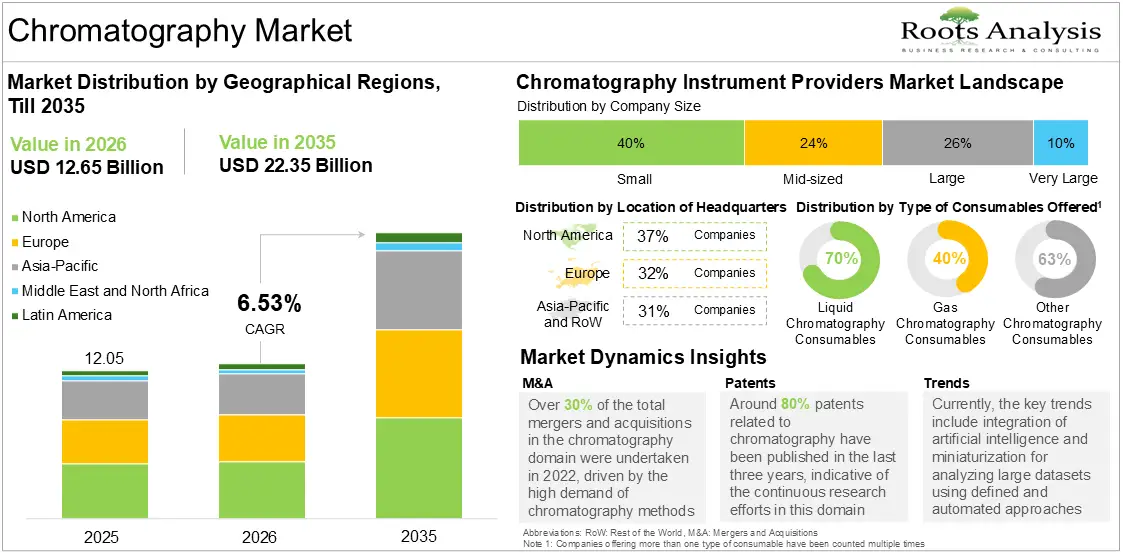
The chromatography market, valued at USD 12.05 billion in 2025, is projected to reach USD 12.65 billion in 2026 and USD 22.35 billion by 2035, with a 6.53% CAGR during the forecast period 2026 to 2035.
To learn more about this report, request a free sample copy
Chromatography is an analytical technique used for the separation, identification and purification of complex mixtures. It is worth noting that chromatography has undergone significant development since its invention by Mikhail Tsvet in the early 1900s. The core principle of this technique involves distribution of analytes between a moving fluid stream, namely the mobile phase (which can be either liquid or gaseous), and a stationary phase (which can be either solid or liquid). For liquid-phase separations, buffer preparation helps control mobile-phase conditions that influence reproducibility and separation performance.
Presently, chromatography is utilized across different industries, including pharmaceutical, biotechnology, chemical, food, petrochemical, and other industries. In recent years, the pharmaceutical industry has seen a significant increase in the demand for chromatography systems for qualitative and quantitative analysis of a wide range of complex samples. This surge in demand is driven by their wide range of applications across fields such as large-scale translational studies, oncology precision medicine, virus research and vaccine development.
In the coming future, chromatography techniques are likely to play a vital role in forensics and diagnostics as well as in novel drug development. With ongoing technological advancements, the applications of chromatography systems and instruments will continue to expand, ultimately driving innovation in research and development within diverse industries.
Chromatography Market: Report Attributes
| Key Report Attributes |
Details |
| Historical Trend |
Since 2021 |
| Forecast Period |
Till 2035 |
| Market Size 2026 |
$ 12.65 Billion |
| Market Size 2035 |
$ 22.35 Billion |
| CAGR (Till 2035) |
6.53% |
The chromatography market analysis also features the likely distribution of the current and forecasted opportunity across various segments, such as type of chromatography product, type of chromatography instrument, type of liquid chromatography, type of chromatography component, format of stationary phase, end user and geographical regions.
We have created three market forecast scenarios, conservative, base and optimistic, to account for future uncertainties in key parameters and enhance the robustness of our model. These scenarios represent different tracks of the industry's evolution.
Recent Developments in Chromatography Industry
- In September 2025, Testa Analytical entered into an agreement with Mazet & Co to expand the access of their flow measurement technologies across French-speaking regions of Europe and North Africa. The collaboration aims to enhance customer support in these markets and underscore the commitment of both organizations to provide advanced chromatography solutions tailored to needs of separation scientists and process engineers.
- In July 2025, Waters Corporation entered into a merger agreement with "Biosciences & Diagnostic Solutions Business" of Becton, Dickinson and Company to improve their overall market access, expand its portfolio, enhance service support and automation capabilities for multiplex diagnostics by utilizing Water's Liquid Chromatography - Mass Spectrometry technologies.
- In July 2025, Shimadzu entered into a distribution agreement with Sepragen to expand the exclusive sales and service of bioprocess chromatography systems across Asian countries such as India, Japan, South Korea and Southeast Asia.
- In June 2025, Waters Corporation announced the launch of its first protein A affinity chromatography columns, which are designed for use in titer measurements in biologic drug development. These new columns facilitate the generation of large datasets in upstream bioprocessing and enable faster method optimization in downstream workflows.
Chromatography Market Segmentation Insights
The market research report presents an in-depth analysis of the various companies providing chromatography instruments and consumables across different segments, as defined in the table below:
Chromatography Market: Market Segmentations
| Market Segmentations |
Details |
| Type of Chromatography Product |
- Instruments
- Consumables
- Other Products
|
| Type of Chromatography Instrument |
- Liquid Chromatography Instruments
- Gas Chromatography Instruments
- Other Chromatography Instruments
|
| Type of Liquid Chromatography |
- High Performance Liquid Chromatography (HPLC)
- Ultra-high Performance Liquid Chromatography (UHPLC)
- Size-Exclusion Chromatography
- Flash Chromatography
- Other Techniques
|
| Type of Chromatography Component |
- Stationary Phase
- Mobile Phase
|
| Format of Stationary Phase |
- Prepacked Columns
- Bottles / Bulk Resins
- Other Formats
|
| End User |
- Pharmaceutical and Biotechnology Industries
- Academic and Research Institutes
- Other End Users
|
| Geographical Regions |
- North America
- Europe
- Asia-Pacific
- Middle East and North Africa
- Latin America
|
| Market in North America |
|
| Market in Europe |
- Germany
- France
- UK
- Italy
- Spain
- Rest of the Europe
|
| Market in Asia-Pacific |
- China
- South Korea
- India
- Japan
- Rest of Asia-Pacific
|
| Market in Middle East and North Africa |
- Israel
- Saudi Arabia
- Iran
- Rest of Middle East and North Africa
|
| Market in Latin America |
|
Owing to the ongoing technological advancements, growing demand for robust purification methods and expanding utilization of chromatography techniques across different sectors, particularly in life sciences domain, we believe that the global chromatography market is likely to grow at a steady rate during the forecast period.
Chromatography Market Share Insights
Market Share by Type of Chromatography Product: Instruments Segment Holds the Largest Market Share
- The global chromatography market includes different types of chromatography products, namely instruments, consumables and other products. Presently, instruments segment captures 70% of the market share. This is due to the increased utilization of chromatography instruments for various processes such as separation, purification, and identification of components in complex mixtures. Additionally, there are ongoing advancements in research and the continuous need for sophisticated instrumentation for both qualitative and quantitative analysis.
- It is worth highlighting that the market for consumables is likely to grow at a relatively higher CAGR (7.8%), during the forecast period. This is due to the rising interest of stakeholders in the development of customized consumables such as biodegradable column packing materials for different applications.
Market Share by Type of Chromatography Instrument: Liquid Chromatography Instruments Segment to Dominate the Overall Market
- In the current year, liquid chromatography instruments accounted for more than 65% of the overall market share, owing to the fact that liquid chromatography is widely used for separating complex mixtures, especially polar and thermolabile compounds, that are difficult to analyze with other techniques like gas chromatography.
- Further, the gas chromatography market is likely to grow at a relatively higher CAGR (7.6%), during the forecast period, owing to the cost-effectiveness and user-friendly characteristics of such instruments.
Market Share by Type of Liquid Chromatography: Ultra-high Performance Liquid Chromatography (UHPLC) Segment to Grow at a Higher CAGR
- Based on the type of liquid chromatography instruments, the liquid chromatography market includes high performance liquid chromatography (HPLC), ultra-high performance liquid chromatography (UHPLC), size-exclusion chromatography, flash chromatography and other techniques. Among these segments, the high performance liquid chromatography (HPLC) segment occupies highest market share (66%). This is due to the fact that pharmaceutical and biotechnology sectors rely heavily on HPLC for accurate and reliable analytical results to meet stringent regulatory requirements prior to new drug launches.
- It is worth noting that the liquid chromatography instrumentation market for ultra-high performance liquid chromatography (UHPLC) segment is likely to grow at a relatively higher CAGR (7.3%), during the forecast period, owing to its ability to provide faster analysis, improved resolution, and enhanced sensitivity as compared to traditional chromatography techniques.
Market Share by Type of Chromatography Component: Stationary Phase Segment to Dominate the Market
- Based on the type of chromatography component, the chromatography consumables market includes stationary phase and mobile phase. Among these segments, the stationary phase segment occupies highest market share (60%) in the current year. This is due to their significant role in efficiently separating and purifying analytes, coupled with other contributing factors such as high resolution, selective interactions and cost-effective attributes.
- It is worth noting that the consumables market for mobile phase segment is likely to grow at a relatively higher CAGR (8.7%), during the forecast period, owing to the advancements in mobile phase formulations and integration with sophisticated hyphenated chromatography techniques (such as LC-MS and GC-MSE).
Market Share by Format of Stationary Phase: Prepacked Columns Segment to Hold the Highest Market Share
- Presently, prepacked columns segment (40%) dominates the market and is likely to grow at a relatively higher CAGR (8.0%), during the forecast period.
- This is due to the fact that these columns are pre-assembled with stationary phase materials, which eliminates the need for time-consuming and labor-intensive packing procedures, significantly reducing the overall time for chromatographic separations.
Market Share by End User: Academic and Research Institutes Segment to Grow at a Higher CAGR
- The pharmaceutical and biotechnology industries segment captures 75% of the overall market share. This is due to the high demand for chromatography in the pharmaceutical and biotechnology industries, as they use this technique for the separation, identification, and purification of biomolecules and chemical compounds.
- However, the academic and research institutes segment is likely to grow at a higher CAGR of close to 7.1% during the forecast period, owing to the expanding fundamental and translational research in proteomics, metabolomics and synthetic biology, which require flexible, high-resolution chromatography techniques for complex sample analysis and method development.
Market Share by Geographical Regions: Asia-Pacific to Propel in the Chromatography Sector in the Coming Years
- According to our projections, North America is likely to capture the majority (~40%) of the chromatography market share in the current year, and this trend is unlikely to change in the future. This is due to the presence of major industry players in the US, along with the increasing adoption of advanced technologies, particularly AI-automated and miniaturized chromatography instruments.
- It is worth highlighting that the market in Asia-Pacific is likely to grow at a relatively higher CAGR (6.8%), during the forecast period. This is due to the availability of cost-effective chromatography products and strong governmental initiatives promoting innovative analytical technologies in the life sciences sector.
Chromatography Market: Report Deliverables
| Report Deliverables |
Details |
Excel Data Packs
(Complimentary) |
- Chromatography Instrument Providers Market Landscape
- Chromatography Instrument Providers Company
- Competitiveness Analysis
- Chromatography Consumable Providers Market Landscape
- Patent Analysis
- Mergers and Acquisitions
|
| Key Players |
- Market Forecast and Opportunity Analysis
- Agilent Technologies
- Bio-Rad Laboratories
- Gilson
- JASCO
- MilliporeSigma
- Revvity (Previously known as PerkinElmer)
- Sartorius
- Shimadzu Scientific Instruments
- Thermo Fisher Scientific
(A complete list of more than 140 companies is available in the report) |
PowerPoint Presentation
(Complimentary) |
Available |
| Customization Scope |
15% Free Customization |
Chromatography Market Major Takeaways
The “Chromatography Market (2nd Edition): Industry Trends and Global Forecasts, till 2035” market report features an extensive study of the current chromatography competitive landscape, company competitiveness analysis, patent analysis, mergers and acquisitions, market impact analysis and market size and future opportunities within the industry, during the forecast period.
Chromatography Competitive Landscape
The market report highlights the efforts of several stakeholders engaged in this rapidly emerging segment of the healthcare sector. Key takeaways of the market report have been briefly discussed below.
Chromatography Instrument Providers Competitive Landscape
The current chromatography instrument providers market landscape features close to 90 companies including very large, large, mid-sized and small companies. These companies have the required expertise to provide various chromatography instruments, across different geographical regions. It is worth noting that majority (38%) of the providers are headquartered in North America, owing to the robust research initiatives and substantial investments made by both public and private investors in the region.
Notably, ~70% of the chromatography instrument providers offer liquid chromatography instruments, followed by gas chromatography instruments (~40%). In addition to this, over 65% of the companies are offering chromatography instruments for pharmaceutical and biopharmaceutical applications.
Chromatography Consumable Providers Competitive Landscape
The current chromatography consumable providers market landscape features close to 95 companies that have the required capabilities to offer a wide range of chromatography consumables. Of these, 38% of the companies are small firms, indicating the growing interest of stakeholders in this domain.
It is worth noting that close to 70% of the providers are offering reverse phase chromatography consumables. Further, majority of chromatography consumables (99%) are being used for separation / purification purposes, followed by scale-up and process development.
Chromatography Market Size Analysis: Global Market to Grow at High CAGR
The global market for chromatography is likely to be worth $ 12.65 billion in 2026 and will reach $ 22.35 billion by 2035. In terms of the type of chromatography product, instruments segment holds the largest share of the chromatography market, due to the rising interest of stakeholders in the development and commercialization of more advanced, automated and miniaturized chromatography systems.
Further, the market size for consumables is likely to grow at a relatively higher CAGR of 7.8% during the forecast period. This is a result of growing adoption of green chromatography consumables, increasing environmental awareness and the principles of green chemistry, along with rising interest of stakeholders in the development of customized consumables such as bioengineered resins for various application areas.
Regional Analysis: Which Region Holds the Largest Share of the Chromatography Industry?
North America is Leading the Market
North American companies are likely to dominate the global chromatography market by 2035, owing to the robust research and development activities, coupled with increasing demand for chromatography techniques in the characterization of novel and complex molecules such as biologics.
Asia-Pacific: An Emerging Growth Spot
The market in Asia-Pacific is likely to grow at a relatively high CAGR (6.8%), during the forecast period till 2035. This is due to the fact that majority of Asian countries like China, India and Japan are investing heavily in domestic drug manufacturing, which rely extensively on chromatography for critical analytical and purification purposes. Furthermore the growing biologics CRO and CMO industry in this region will drive the market growth.
Chromatography Market Drivers and Market Challenges
Ongoing Technological Advancements Contributing to Expanded Applicability
Technological advancements in chromatography, including the integration of sophisticated detection systems, artificial intelligence and miniaturized systems have supported widening the applicability of chromatography across various research and industrial sectors. Further, the emergence of continuous chromatography systems has enabled efficient and automated separation for improving overall process productivity, while minimizing associated costs.
It is worth mentioning that the rise in environmental concerns associated with chromatography utilization have further impelled the development of sustainable chromatography consumables such as green solvents and supercritical fluids, which acts as a significant driver for the chromatography market growth. Example of the most commonly used supercritical fluids include carbon dioxide (CO2). Further, relatively less common supercritical fluids include nitrous oxide, propane, ammonia and ethane.
What are the Key Challenges Facing the Market?
Despite their several benefits, the utilization of chromatography presents several challenges. One of the most significant challenges is the market competition from alternate techniques such as crystallization, high-resolution ultrafiltration, membrane filtration, and high-pressure refolding methods, which offer rapid and higher throughput separations.
Additionally, automated and hyphenated chromatography techniques, such as LC-MS and GC-MS require extensive on-site technical support for various operations, including method development, sample preparation and data analysis. The lack of readily available technical assistance for the operation and maintenance of these advanced instruments poses a significant barrier to their widespread adoption.
Key Market Trends in Chromatography Market
Rising Innovation Efforts Amongst the Industry Stakeholders to Foster Progress and Automation in Expanding their Applicability
Stakeholders in this domain have undertaken numerous mergers and acquisitions, allowing them to expand their respective instruments and consumables portfolios and enhance their capabilities and visibility. Further, in the last five years, merger and acquisition initiatives undertaken by chromatography companies have increased at a growth rate of 4%. Notable examples include (in reverse chronological order) merger of Waters and BD Biosciences (July), acquisition of Lucidity by Hypha Labs (May) and merger of Alsachim, and Biomaneo (a reagent company of Shimadzu) (April).
Surge in the Number of Patent Applications Related to Chromatography
It is worth highlighting that there has been a notable rise in the number of patents published within the chromatography market. More than 1,380 patents related to chromatography industry have been registered in the past three years, indicating robust research and development activities in the domain to expand the applications of chromatography instruments and consumables. Notably, the majority of patents in this domain include patent applications (60%), followed by granted patents (35%).
Key Market Trends: Fueling Innovation and Driving Efficiency
The chromatography market is currently shaped by several trends, including growing focus on the development of micro-chromatography systems designed to improve efficiency and reduce solvent consumption. Further, automation and data analytics are gaining attention, with advanced software and integrated systems streamlining workflows and enhancing data analysis capabilities. Moreover, the rising emphasis on sustainability is driving the adoption of green chromatography practices and eco-friendly solvents. These trends collectively drive the market growth, propelled by continuous advancements aimed at improving analytical performance, operational efficiency and overall functionality.
Frequently Asked Questions
What is the concept of chromatography?
Chromatography is a fundamental biophysical technique that enables the separation, identification, and purification of components from a mixture, facilitating both qualitative and quantitative analysis.How big is the chromatography market?
The chromatography market size is likely to be worth USD 12.65 billion in 2026.What is the projected CAGR of chromatography industry through 2035?
The chromatography market is estimated to grow at a CAGR of 6.53% during the forecast period, till 2035.Which key factors are driving the growth of the chromatography market among pharmaceutical and healthcare companies?
With pharmaceutical and biopharmaceutical companies expanding their R&D, there is a rising demand for advanced chromatographic techniques to analyze complex biological samples, ensuring high product purity and quality.Who are the leading manufacturers and suppliers competing in the chromatography market?
Leading manufacturers and suppliers in the chromatography market include Agilent Technologies, Bio-Rad Laboratories, Gilson, JASCO, MilliporeSigma, Sartorius, Shimadzu Scientific Instruments and Thermo Fisher Scientific.What regional markets are expected to experience the fastest growth in chromatography adoption over the next decade?
North America emerged as the key region occupying around 40% share in the chromatography market.What challenges and limitations do organizations face when implementing advanced chromatography systems?
Organizations face significant challenges in implementing advanced chromatography systems, primarily due to high capital and operational costs. Beyond financial hurdles, the complexity associated with instrument operation, labor and time intensive nature of sample preparation along with the lack of skilled personnel poses significant challenges to market growth.What impact do regulatory requirements have on chromatography system adoption in key markets?
Regulatory requirements set strict standards for quality, safety and data integrity. Key regulatory bodies, such as the U.S. Food and Drug Administration (FDA) and the European Medicines Agency (EMA), mandate rigorous analytical testing throughout the pharmaceutical product lifecycle, from R and D to manufacturing and quality control. This necessitates the use of advanced, highly sensitive, and reproducible chromatographic methods to detect and quantify impurities, ensure drug potency and confirm product stability.Which chromatography techniques (e.g., HPLC, GC, LC-MS) are seen as the highest demand in pharma and biotech applications?
Among chromatography techniques, HPLC-GC is experiencing high demand in the pharmaceutical and biotechnology sectors, especially for identifying unknown biological compounds such as proteins and peptides. While GC-MS play vital roles in specific applications, HPLC-based methods are the primary workhorses for a broad range of critical analyses.