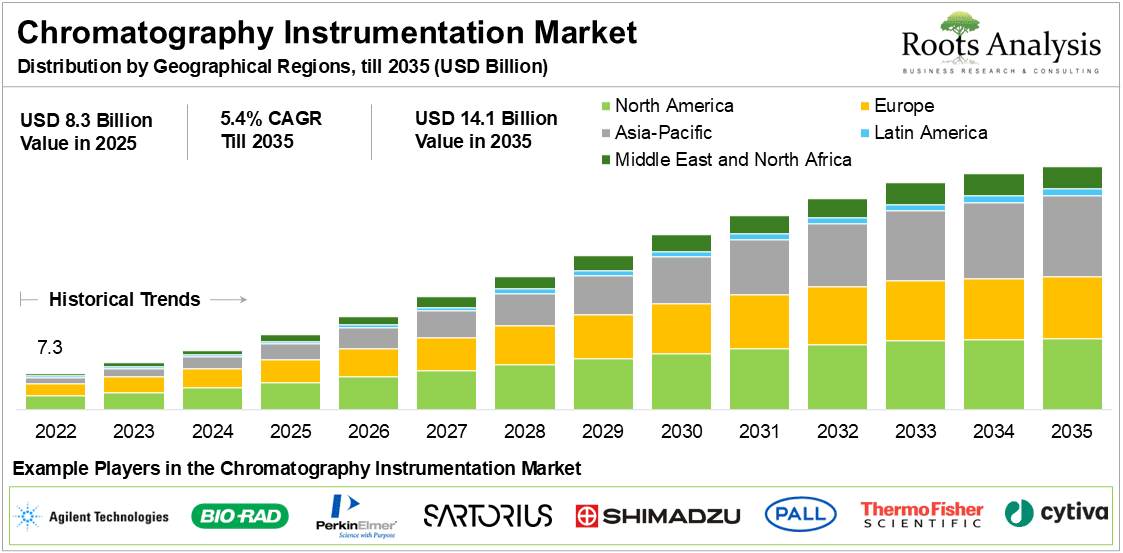
Global Chromatography Instrumentation Market Size
The chromatography instrumentation market is estimated to grow from USD 7.9 billion in 2024 to reach USD 8.3 billion in 2025 and USD 14.1 billion by 2035, representing a higher CAGR of 5.4% during the forecast period.
To learn more about this report, request a free sample copy
Chromatography is a vital analytical technique used for the separation, identification, and purification of components in a mixture. It involves the distribution of each analyte between a mobile phase (liquid or gas) and a stationary phase (solid or liquid). This technique finds applications in various industries, including pharmaceutical, biotechnology, chemical, environmental, food, and petrochemical.
In the pharmaceutical industry, there has been a growing demand for chromatography systems and consumables attributed to their use in qualitative and quantitative analysis of complex samples, large-scale translational research studies, oncology precision medicine, virus research, and vaccine development.
Chromatography Instrumentation Market: Report Attributes
| Key Report Attributes |
Details |
| Historical Trend |
Since 2022 |
| Forecast Period |
Till 2035 |
| Market Size 2025 |
$ 8.3 Billion |
| Market Size 2035 |
$ 14.1 Billion |
| CAGR (Till 2035) |
5.4% |
The market analysis also features the likely distribution of the current and forecasted opportunity within the chromatography instruments domain across various segments, such type of chromatography instrument, consumable format, end user and geographical regions.
We have created three chromatography instrumentation market forecast scenarios, conservative, base and optimistic, to account for future uncertainties in key parameters and enhance the robustness of our model. These scenarios represent different tracks of the industry's evolution.
Rapid technological advancements such as ultra-high-performance liquid chromatography, automated systems, and hybrid technologies are significantly improving analytical accuracy, operational efficiency, and sample throughput. These innovations are making chromatography instruments an essential tool for research, quality control, and process innovation across a wide range of industries.
Recent Developments in Chromatography Instrumentation Market
Several recent developments have occurred in the field of chromatography instruments, and we outline some of these below. These latest innovations in chromatography instrumentation technology, even if they arose after our market report’s release, support the overall market trends detailed in our analysis.
- In September 2026, Metrohm launched OMNIS IC, introducing a next-generation ion chromatography platform built around modular pumps, injectors, detectors, and dosing units. The system combines configurable hardware with automation spanning sample preparation through result validation, enabling laboratories to tailor configurations, expand capabilities, improve workflow efficiency, and obtain reproducible analytical results across changing application requirements.
- In August 2026, Shimadzu Scientific Instruments entered into a collaboration with ePrep in order to integrate ePrep ONE automated sample preparation with Shimadzu chromatography and mass spectrometry platforms. SSI will offer ePrep ONE across North America, supporting automated extraction, filtration, dilution, and derivatization, while enabling regulated laboratories to improve standardization, auditability, reproducibility, and operational efficiency.
- In August 2026, Chrysalis Services collaborated with VERDOT, placing VERDOT chromatography and tangential-flow-filtration equipment within Chrysalis GMP-ready facilities. Biotech and biopharma customers can access FlexiPro Chrom, FlexiPro TFF, and InPlace chromatography columns without purchasing or maintaining equipment, creating a flexible model for development work and reducing capital requirements.
- In May 2026, Agilent Technologies launched the 8890B and 8860B gas chromatographs with GC Assist adding intelligent monitoring, built-in troubleshooting, remote connectivity, and maintenance guidance.
- In April 2026, Shimadzu Scientific Instruments introduced Nexera X4 UHPLC, a next-generation liquid chromatography system featuring low-dispersion design, advanced fluid control, and high-speed, ultra-high-pressure analysis. The platform is intended to deliver enhanced sensitivity, sharper peaks, stable solvent delivery, and reliable separation performance for research and development applications in pharmaceuticals, food, environmental science, and chemistry.
Chromatography Instrumentation Market Segmentation Insights
The market research report presents an in-depth analysis of the various top chromatography instrumentation companies, across different segments, as defined in the table below:
Chromatography Instrumentation Market: Market Segmentations
| Market Segmentations |
Details |
| Type of Chromatography Instrument |
- Liquid Chromatography
- Gas Chromatography
- Others
|
| Type of Consumable Format |
- Prepacked Columns
- Bottles / Bulk resins
- Other formats
|
| End User |
- Pharmaceutical / Biotechnology Industries
- Academic and Research Institutes
- Other Industries
|
| Geographical Regions |
- North America
- Europe
- Asia-Pacific
- LAMEA
|
| Market in North America |
|
| Market in Europe |
- Germany
- France
- Italy
- Spain
- UK
- Russia
- Rest of Europe
|
| Market in Asia-Pacific |
- China
- India
- Japan
- South Korea
- Australia
- Thailand
- Malaysia
- Indonesia
- Rest of Asia-Pacific
|
| Market in LAMEA |
- Brazil
- South Africa
- Saudi Arabia
- UAE
- Argentina
- Rest of LAMEA
|
Rising adoption of chromatography techniques in drug discovery and other application areas is driving considerable growth in the chromatography instrumentation / systems market during the forecast period.
Chromatography Instrumentation Market Share Insights
Market Share by Type of Chromatography Instrument: Liquid Chromatography Holds the Largest Share
- The liquid chromatography instruments segment led the market, capturing the largest revenue share of more than 50.0% in 2025. Further, this segment is likely to grow at a CAGR of 5.9% over the forecast period.
- Rising research activity, particularly in the pharmaceutical and biotech industries, is fueling the demand for liquid chromatography techniques across multiple industries.
Market Share by Consumable Format: Bottle / Bulk Resins Holds the Largest Share
- The bottle / bulk resins segment led the chromatography instrumentation industry, capturing the largest revenue share of more than 45.0% in 2025.
- Industry players are increasingly focusing on advancing chromatography techniques to improve the efficiency of substance purification and separation. As a result, many users rely on chromatography resins as an effective solution for purifying complex biologic analytes.
- The pre-packed columns segment is likely to show the highest growth potential of more than 7%, annually, during the forecast period. Growing interest in pre-packed columns, driven by their convenience and cost-effectiveness for purifying large quantities of proteins, is fueling this strong chromatography instrumentation market growth.
Market Share by End User: Pharmaceutical / Biopharmaceutical Companies Dominates Chromatography Instrumentation industry
- The global chromatography instrumentation industry value is further divided into various sub-segments based on the end-users, such as pharmaceutical / biopharmaceutical companies, academic / research institutes and other industries.
- In 2025, the pharmaceutical / biopharmaceutical companies segment (~50%) dominates the market, and grows at a relatively higher CAGR, during the forecast period.
- This is a result of growing focus on the advancement of new entities and biologics for the treatment of different life-threatening disorders and diseases.
Market Share by Geographical Regions: Asia-Pacific to Propel in the Chromatography Instrumentation Sector in the Coming Years
- This segment highlights the distribution of market for chromatography instrumentation across various geographies, including North America, Europe, Asia-Pacific and LAMEA.
- According to our projections, North America is likely to capture the majority (~45%) of the chromatography instrumentation market share in 2025, and this trend is unlikely to change in the future.
- It is worth highlighting that the market in Asia-Pacific is likely to grow at a relatively higher CAGR (7.1%), during the forecast period. This is a result of increasing demand for chromatography instrumentation as well as affordable prices of these chromatography products in this region.
Chromatography Instrumentation Market: Report Deliverables
| Report Deliverables |
Details |
| Excel Data Packs (Complimentary) |
- Chromatography System Providers Market Landscape
- Company Competitiveness Analysis
- Chromatography Consumable Providers Market Landscape
- Patent Analysis
- Mergers and Acquisitions Analysis
- Market Sizing and Opportunity Analysis
|
Key Chromatography
Instrumentation Suppliers Profiled |
(Full list of ~75 companies captured is available in the report) |
PowerPoint Presentation
(Complimentary) |
Available |
| Customization Scope |
15% Free Customization |
Chromatography Instrumentation Market Major Takeaways
The “Chromatography Instrumentation Market: Industry Trends and Global Forecasts, till 2035” market report features an extensive study of the current chromatography system providers market landscape, company competitiveness analysis, chromatography consumable providers market landscape, patent analysis, mergers and acquisitions analysis and market size and future opportunities within the chromatography instrumentation industry, during the forecast period.
Competitive Landscape of Chromatography Instruments Providers
The current landscape features close to 75 large, mid-sized and small companies, which claim to offer various types of chromatography systems, including continuous chromatography system, gas chromatography system, gel permeation chromatography system, ion chromatography system, liquid chromatography system, and supercritical fluid chromatography system, for the detection, separation and purification of various types of analytes.
Nearly 70% of the companies offer liquid chromatography systems. Further, it is interesting to note that close to 15 companies provide chromatography systems that are operational at all the scales of operation (preclinical, clinical and commercial).
Market Size Analysis: What is the Opportunity for the Chromatography Instrumentation Market?
The global market for chromatography instrumentation is likely to be worth $ 8.3 billion in 2025 and will reach $ 14.1 billion by 2035. Increasing R&D activities and growing interest of stakeholders towards separation and purification techniques in pharmaceutical industry are driving this market, which is likely to grow at a CAGR of 5.74% over the forecast period.
In terms of type of chromatography system, currently, liquid chromatography systems are likely to capture the major market share, followed by gas chromatography systems.
Regional Analysis: Which Region Holds the Largest Share of the Chromatography Instrumentation Market?
North America is Leading the Market
Most companies that develop chromatography instrumentation, such as HPLC manufacturing companies and gas chromatography manufacturing companies, are based in North America, followed by those in Europe. Currently, North America and Europe capture over 70% of the global market share.
It is worth noting that, in recent years, demand for chromatography systems and chromatography consumables in the North America region has witnessed a tremendous increase.
Asia-Pacific: An Emerging Growth Spot
The market in Asia-Pacific is expected to grow at a relatively high CAGR (7.1%), during the forecast period till 2035. This is due to several factors, including anticipated drug approvals and growing need for separation processes in biopharmaceutical manufacturing in the region.
What are the Key Drivers of Chromatography Instrumentation Market?
The primary factors driving the growth of the chromatography instrumentation industry include evolving process-specific needs across different industries, advanced features of chromatography techniques, and ongoing technological advancements.
Various industries, such as pharmaceutical, forensic and molecular biology, utilize chromatography techniques for purification, separation, identification, and analysis of compounds across multiple processes and scales. To meet the needs of these industries, chromatography companies like HPLC system manufacturers are developing efficient chromatography instruments.
Further, technological advancements in chromatography have led to the discovery of new techniques, such as silica-based monolith columns with reduced particle and column size for UPLC, automated UPLC, and advanced detection systems. Additionally, companies have launched several advanced pre-packed columns in the market, offering more convenient and cost-effective solutions.
Key Market Opportunities in Chromatography Instrumentation Market
The key market opportunities in the chromatography instrumentation domain include the increasing demand for advanced analytical instruments, the growing pipeline of complex drug molecules, and rising research activity in the pharmaceutical and biotech industry.
This has led to the development of novel resins and convenient formats to fulfill specific purification needs for complex drug molecules. Additionally, the usage of chromatography is increasing across various research and industry processes, leading to a rise in demand for different types of chromatography consumables. As a result, chromatography consumable providers are also actively expanding their product portfolio to meet the growing demand.
Chromatography Instrumentation Market Report Coverage
The market report presents an in-depth analysis, highlighting the capabilities of various stakeholders in the chromatography instrumentation industry, across different geographies. Amongst other elements, the market report includes:
- An Infographic Executive Summary
- Chromatography System Providers Market Landscape
- Company Competitiveness Analysis
- Chromatography Consumable Providers Market Landscape
- Patent Analysis
- Mergers and Acquisitions Analysis
- Market Forecast Analysis
- Adjacent Market Analysis
From the Author’s Desk
Author’s View on Chromatography Instrumentation Market
In my view, this market is growing steadily, fueled by consistently strong global sales of these instruments. Ongoing research efforts, coupled with the expanding need for precise analytical tools across sectors such as pharmaceuticals, environmental testing, and food safety, are driving the demand for chromatography instruments. Looking ahead, the market for chromatography instrumentation will likely continue growing at a healthy pace, with no major shifts expected in the near future.
About Authors
Lead Author: Ajay Sharma
Lead Reviewer: Parneet Kaur
Chief Editor: Aashima Bhalla
Glossary
- Chromatography System: Chromatography systems comprise of all of the sample separation equipment, including stationary and mobile phase. These systems are purification units that allow the isolation of specific compounds from a complex mixture.
- Supercritical Fluid Chromatography: Supercritical fluid chromatography (SFC) is a separation technique that involves separation of the mixture in column using a supercritical fluid as mobile phase.
- Gas Chromatography: It is an analytical technique used to separate, identify, and quantify volatile compounds in a mixture by passing them as vapors.
- Liquid Chromatography: Liquid chromatography is a technique that separates components of a mixture based on their different interactions with a stationary phase and a liquid mobile phase as they pass through a column.
Frequently Asked Questions
What is chromatography?
Chromatography is a laboratory technique used to separate, identify, and purify components of a mixture by distributing them between a stationary phase and a mobile phase.What are the types of chromatography?
There are four main types of chromatography. These are Liquid Chromatography, Gas Chromatography, Thin-Layer Chromatography and Paper Chromatography.How big is the chromatography instrumentation market?
The global market size of chromatography instruments is estimated to be USD 8.3 billion in 2025.What is the projected market size for chromatography instrumentation?
The global market size of chromatography instruments is estimated to reach USD 14.1 billion by 2035.What is the chromatography instrumentation market growth rate?
The global chromatography instrumentation industry is estimated to grow at a CAGR of 5.4% during the forecast period till 2035.How big is the global gas chromatography market?
The global market size of gas chromatography market is estimated to be USD 2.6 billion in 2025.Which are the top chromatography instrumentation companies?
Agilent Technologies, Bio-Rad Laboratories, Cytiva, PerkinElmer, Pall Corporation, Sartorius, Shimadzu, Shodex, ThermoFisher Scientific and Waters Corporation.