Sustainable Lab Plastics: Reducing the Environmental Footprint of Laboratory Workflows

.png)

Published: February 2025
Laboratories are at the forefront of scientific research, innovation, and discovery, but they also contribute significantly to plastic waste generation. Single-use plasticwares, such as pipette tips, petri dishes, centrifuge tubes, and microplates are extensively used in daily laboratory operations due to their convenience, sterility, and cost-effectiveness.
However, the growing environmental concerns associated with plastic pollution have accelerated the demand for sustainable solutions in laboratory settings. The emergence of sustainable lab plastics is reshaping this landscape by offering eco-friendly alternatives that maintain the high performance, durability, and sterility required for rigorous scientific applications.
Sustainable lab plastics refers to laboratory equipment and consumables made from materials designed to reduce environmental footprint. This includes products made from recyclable materials, biodegradable polymers, bio-based plastics derived from renewable resources, and reusable alternatives that can withstand sterilization processes. The shift towards sustainable lab plastics is driven by increasing environmental awareness, evolving regulatory frameworks and corporate commitments to reducing carbon footprints.
Roots Analysis has conducted an exhaustive study on the Sustainable Laboratory Plasticware Market, featuring the current market landscape and future opportunity for the companies engaged in offering sustainable laboratory plasticware, over a span of 10 years.
Interested in exploring advanced sustainable lab plastics, their features, applications, and market trends?
Key Features of Sustainable Lab Plastics
- Recyclability: Many sustainable lab plastics are designed for recycling, allowing laboratories to reduce waste and conserve resources.
- Biodegradability: Some laboratory plasticware are made from biodegradable materials that break down naturally over time, alleviating long-term pollution concerns.
- Reusability: There is an ongoing transition from single-use to reusable labware that not only cuts down on waste but can also lead to cost savings.
- Innovative Materials: Advances in material science, such as bio-based plastics and chemically recycled resins have led to the development of plastics that are both high-performing and environmentally friendly.
- Eco-Friendly Manufacturing: Sustainable practices are being used in production, such as using renewable feedstock and minimizing waste, further enhance the sustainability of laboratory plasticware.
Applications for Sustainable Lab Plastics
- Life Sciences and Biotechnology: In research labs, sustainable labware are being adopted for multitude of tasks including liquid handling and cell culture.
- Pharmaceutical Research and Development: Used in pharma industry for drug discovery, chemical synthesis, and formulation processes.
- Environmental and Clinical Testing: Environmental testing or diagnostics labs use it for specimen collection, testing reagents, and storage containers.
- Industrial Laboratories: Used in chemical and materials testing labs to achieve sustainability goals while maintaining safety and the integrity of testing processes.
Sustainable Lab Plastics: Trends Impacting Market Growth
The sustainable lab plastics industry is rapidly evolving with technological innovations in material science and regulatory pressure to adopt eco-friendly materials, leading to its application across various fields including pharma industries and clinical testing labs. The following figure presents sustainable lab plastics market trends:
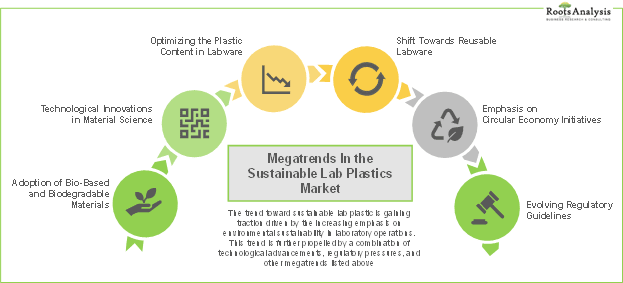
Adoption of Bio-Based and Biodegradable Materials
Adoption of biobased and biodegradable materials in the production of lab consumables is gaining momentum. These innovative materials are derived from renewable sources such as used cooking oil, sugarcane, and corn starch, thereby significantly reducing the reliance on fossil fuels. Companies such as Eppendorf are at the forefront of this transition to sustainable labware by creating high-performance lab plastics.
Technological Innovations in Material Science
Advanced material science is driving the development of high-performance sustainable plastics that can match or exceed the properties of conventional polymers. Innovations such as improved biodegradable medical polymers, and chemically recyclable plastics are expanding the range of applications for sustainable lab consumables, enabling them to meet more stringent requirements and high-performance demands.
Optimizing the Plastic Content in Labware
There is an increased emphasis on reducing plastic usage without compromising their quality. Manufacturers are innovating designs that significantly reduce overall plastic usage, thereby minimizing waste. For instance, Biotix has developed pipette tips that contain over 30% less plastic compared to traditional options. This reduction helps laboratories decrease their environmental footprint while also leading to cost savings in procurement and disposal.
Shift Towards Reusable Labware
The shift towards reusable lab consumables is becoming increasingly prominent as laboratories strive to minimize waste and lower operational costs. This trend is fueled by advancements in cleaning technologies that facilitate safe reuse of labware through effective sterilization.
Emphasis on Circular Economy Initiatives
Currently, circular economy initiatives are gaining traction within the labware market as manufacturers and laboratories work together to minimize plastic waste through recycling and repurposing efforts. These initiatives involve establishing closed-loop systems where used laboratory plastics can be collected, recycled, and reused effectively.
Evolving Regulatory Guidelines
Governments and regulatory bodies are imposing stricter regulations on single-use plastics, prompting manufacturers and laboratories to escalate innovation in material science and develop lab consumables that are eco-friendly and functional. Consequently, there is a growing emphasis on adopting standards and certifications that validate the sustainability claims of these products. One such standard is ACT Environmental Impact Factor Label, which provides independent assessment of lab products based on their environmental impact, helping laboratories to make informed purchasing decisions.
Future Perspectives
In the rapidly evolving landscape of scientific research, these ongoing sustainable lab plastics market trends hold immense potential in reshaping the future of this industry. From the development of biodegradable and recyclable materials to the adoption of closed-loop recycling systems, the industry is poised to reduce environmental impact while maintaining the integrity and efficiency of research processes. Driven by environmental awareness, regulatory pressures, and the principles of the 3Rs (reduce, reuse, recycle), laboratories will increasingly adopt sustainable solutions. Ultimately, these trends will reduce the environmental footprint of laboratory workflows, contributing to global sustainability goals and fostering greener, more responsible laboratory operations.
What About the Future Outlook of Sustainable Lab Plastics Market Trends in the Industry Around the World?
The above presentation features sustainable lab plastics market trends, which we have highlighted in our report. If you're interested, you can download the Sample Report on this topic by Roots Analysis. For personalized assistance in identifying the most relevant solutions based on your specific criteria, please don't hesitate to reach out to us at sales@rootsanalysis.com.
Sources
- https://www.eppendorf.com/product-media/doc/en/9793799/Consumables_Publication_Consumables-BioBased_Advancing-Sustainable-Science-Plastic-Consumables-made-Biobased-Materials.pdf
- https://primebiopol.com/plastic-recyclable-biodegradable-compostable-differences/?lang=en
- https://www.thermofisher.com/in/en/home/life-science/lab-plasticware-supplies/reusable-plasticware.html
- https://www.eppendorf.com/product-media/doc/en/9793799/Consumables_Publication_Consumables-BioBased_Advancing-Sustainable-Science-Plastic-Consumables-made-Biobased-Materials.pdf
- https://pmc.ncbi.nlm.nih.gov/articles/PMC5978172/
- https://biotix.com/innovation/sustainability/
- https://www.mygreenlab.org/blog-beaker/cutting-laboratory-plastic-waste-the-power-of-reusable-consumables
- https://www.tandfonline.com/doi/full/10.2144/btn-2018-0185