T-Cell Immunotherapy Market Trends

.png)

Published: November 2025
T-cell therapies (including CAR-T, TIL and TCR therapies) are cell therapies that utilize patient’s own cells (autologous), or those from a healthy donor (allogeneic) and are genetically re-programmed to combat various diseases. Notably, CAR-T therapy is a form of immunotherapy in which a patient’s T cells are genetically modified to express chimeric antigen receptors, enabling these cells to specifically recognize and eliminate cancer cells upon reinfusion. Tumor-infiltrating lymphocyte (TIL) therapy extracts the immune cells directly from a patient’s tumor, expands and activates them ex vivo, and then reinfuses them to enhance the immune response against cancer. T-cell receptor (TCR) therapy genetically engineers T cells to express specific T-cell receptors that target cancer-associated antigens, directing targeted immune attack on tumor cells.
Based on mechanism of action, these therapies can be classified into active and passive immunotherapies. Active immunotherapy aims to stimulate / activate the immune system using methods, such as administration of diseases-specific antigens to invoke an immune response. On the contrary, passive immunotherapy involves the introduction of pre-sensitized immune system mediators, against a specific antigen, into a diseased host. It is important to mention that passive immunotherapy provides immediate protection against the tumor antigens and does not induce immunological memory. Notable examples of immunosuppressive drugs based on passive immunotherapy approach are cytostatic drugs, glucocorticoids and immunophilins.
Roots Analysis has conducted an exhaustive study on T-cell Therapy Market featuring the current landscape and future opportunity for the companies engaged in the T-cell immunotherapy domain. In this article, we have highlighted some of the T-cell market trends 2025 that are likely to shape the evolution of this sector during the forecast period.
Want to explore more about T-cell Therapy Market??
T-Cell Therapy Market Trends 2025 That Are Likely to Shape the Future Potential of the Industry
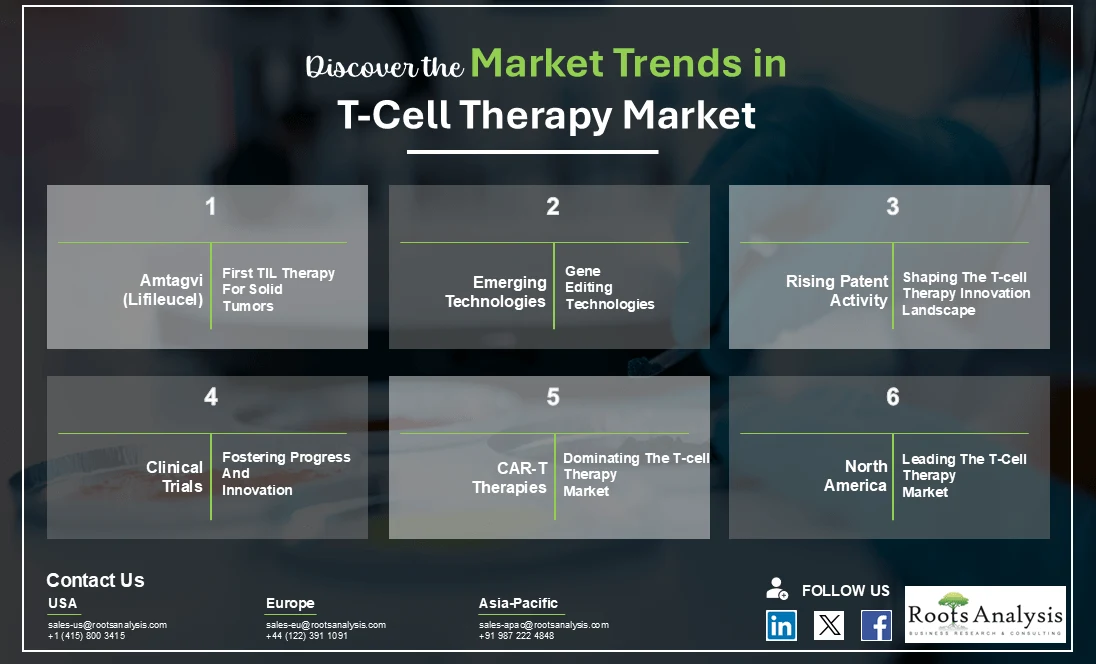
1. Amtagvi (Lifileucel): First TIL Therapy Approved for Solid Tumors
Amtagvi (lifileucel) is the first tumor-infiltrating lymphocyte (TIL) therapy approved for the treatment of solid tumors (specifically advanced melanoma). Notably, Amtagvi uses the patient’s own immune cells extracted directly from the tumor, which are expanded ex-vivo and reinfused to boost the body’s natural ability to attack cancer cells. Such therapies marks a major milestone in immunotherapy domain, offering new hope for patients with difficult-to-treat melanoma and potentially paving the way for TIL therapies in other solid cancers.
2. Emerging Technologies: Genome Editing Technologies
Genome editing technologies (including CRISPR / Cas9) are reshaping the T cell immunotherapy market by enabling the formation of multiplex edits, resulting in more potent and safe cell therapies. Notably, editing knockouts, such as TRAC, B2M, and PD1 minimize graft versus host disease and evade host rejection. Further, recent studies have demonstrated that genome editing could serve as a platform to fight against all types of cancers by developing personalized cancer therapies based on genotype-specific targets.
3. Rising Patent Activity: Shaping the T-Cell Therapy Innovation Landscape
The increasing interest of industry as well as non-industry stakeholders in the domain of T-Cell therapies has led to the expansion of associated intellectual capital. A number of patents have been filed by several companies / organizations in order to protect novel intellectual property generated within this field. It is interesting to note that majority of the patents were filed / granted in North America; of which close to 65% patents were filed in the US.
In March 2025, Cellogen Therapeutics secured the regulatory approval for patent of bi-specific third generation CAR-T cells developed in India.
4. Clinical Trials: Fostering Progress and Innovation
The clinical trials play an important role in advancing the T-cell immunotherapy market by fostering innovation and expanding therapeutic indications. In the past few years, there has been a steady increase in number of clinical trials, reflecting growing interest of drug developers in the development of advanced cell therapies. Notably, majority of the clinical trials evaluating T-cell therapies are focused on hematological malignancies, such as acute lymphoblastic leukemia, non-Hodgkin lymphoma, and multiple myeloma. Further, in October 2025, Calibr-Skaggs Institute announced positive results obtained in Phase I clinical trial of their CAR-T therapy CLBR001 + SWI019 for the treatment of autoimmune diseases (including myositis, systemic sclerosis, lupus, and rheumatoid arthritis).
5. CAR-T Therapies: Dominating the T-Cell Therapy Market
Various CAR-T therapies (including Kymriah®, Yescarta® and Tecartus®) are dominating the T-cell therapy market. Notably, Kite Pharma reported annual sales of USD 1.6 billion for Yescarta in the year 2024. This can be attributed to the growing adoption of therapy across patients with multiple lymphoma along with established physician trust and significant reimbursement support.
6. North America: Leading the T-Cell Therapy Market
Currently, North America captures majority of the market share as per the T-cell immunotherapy industry analysis. This can be attributed to the presence of major market players and well-established regulatory framework in this region. Further, ongoing technological advancements along with established reimbursement options from government and private organizations within this region is propelling the adoption of cell therapies, fueling T-cell immunotherapy market in North America during the forecast period.
Conclusion
Given the increase in the number of clinical studies and patents registered in the past few years, the T-cell therapy market has evolved into one of the rapidly growing segments of the pharmaceutical industry. Specifically, T-cell immunotherapies, including CAR-T therapies, TCRs and TILs, are currently at the forefront in immunotherapy domain, and are primarily being developed for the treatment of various disorders, including blood cancers and solid tumors. Moreover, encouraging clinical results reported across different trials of these novel therapies have attracted significant capital investments and captured the interest of various pharmaceutical companies and research institutions.
Browse our full report on T-Cell Therapy Market: https://www.rootsanalysis.com/reports/t-cell-therapies-market/261.html
Sources: