Understanding Virtual Biopsy Technology

.png)

Published: March 2025
Virtual biopsy is an advanced healthcare tool which is utilized in diagnosis and screening of various ailments. This technology operates by employing advanced imaging techniques for sample image acquisition which are further processed by using modern software to gather diagnostic insights. Over the years, researchers and healthcare professionals have been actively involved in research and development activities to evolve current diagnostic solutions into safer virtual biopsy technology.
This has led to several advancements, such as incorporation of machine learning algorithms into imaging techniques to support comprehensive data analysis and result generation. Conclusively, these innovations are incorporated by virtual biopsy device developers to enhance their current device portfolio aiming to offer efficient data interpretations and rapid result generation.
Advanced technological integration in virtual biopsy devices is utilized in finding anomalies in patient samples and data analysis, thereby assisting physicians in making informed decisions to monitor patient health. The modern technological developments include incorporation of AI and ML algorithms, usage of better and effective imaging technology. Along with this, identification of biomarkers used for specific disease diagnosis can also accelerate the enhancements in device portfolio.
These innovations will help with comprehensive data analysis and offer valuable inferences which could be missed by the human eye. Continuous advancements in technology are expanding the range of patients who can benefit from faster and safer diagnosis, ultimately improving the quality of healthcare services.
Roots Analysis has conducted an exhaustive study on advancements for integration of AI in virtual biopsy devices featuring the current market landscape and future opportunity for the companies engaged in offering virtual biopsy devices, over a span of 11 years.
Interested in exploring innovative Virtual Biopsy Devices and their applications?
Improving Patient Care Management: The Advantages of Virtual Biopsy Technology
Advancements in virtual biopsy technology have boosted the efficiency of overall healthcare domain by assisting healthcare professionals in gathering relevant information for disease diagnosis and treatment planning. Moreover, the impact and advancements in virtual biopsy helps in generation of accurate and faster results by elimination of manual sample extraction and data analysis. The implementation of virtual biopsy technology can offer several advantages, including:
Detailed Data Capturing
One of the innovations in virtual biopsy is adoption of more advanced and efficient imaging technologies to gather patient data. Imaging technologies include magnetic resonance imaging (MRI), optical coherence tomography (OCT) and ultrasound are used to acquire three dimensional and high-resolution images. These image formats aid in providing detailed information about the patient condition which usually got missed while performing convention biopsy procedures.
Efficient Data Analysis
AI and ML integrated software developed are used in association with existing virtual biopsy devices to support enhanced data analysis. This can be done by identification of patterns and quantify biomarkers via AI and ML when sample image is compared with reference data for analysis. Thus, slight variation on either of the factors will further be detected and process to aid physicians in making validated decisions during ailment screening or diagnosis.
Faster Result Generation
By eliminating the requirement of manual and time-consuming surgeries, the time for overall result generation process could be reduced leading to timely initiation of patient treatment. Thus, this practice will reduce the mortality rates significantly by mitigating the disorder at initial stages of therapy.
Patient Safety
Virtual biopsy technology supports patient comfort during disease screening and diagnosis by employing image capturing approach, unlike performing operations for sample extraction. Moreover, advanced imaging technology employed does not use harmful ionizing radiation, hence protecting patients from harmful radiation exposure.
Cost Effectiveness
Virtual biopsy devices use imaging technology and eliminate the additional treatment cost lingering to sample extraction surgeries and maintenance of operating room for diagnosis procedure. Thus, incorporation of virtual biopsy devices helps in making the overall treatment process cost effective for the patients.
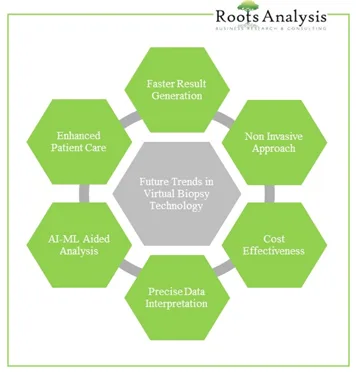
The following figure presents the advantages of virtual biopsy technology:
Companies Offering Novel Developments in Virtual Biopsy Technology
- AI Metrics: The company has developed a virtual biopsy device, namely Liver Surface Nodularity (LSN) module in order to cater to hepatological and oncological disorders. LSN uses advanced computed tomography (CT) scans to monitor nodules on the liver surface.
- GE HealthCare: The company is focused on integrating imaging technology portfolio with AI software to address the unmet needs of healthcare by targeting oncological disorders. Thus, by offering shorter turnaround time these devices can provide healthcare support to manage the rising number of cancer cases.
- Quibim: The company offers a wide range of virtual biopsy devices, each focusing on different body organs, including prostate, breast, brain, liver, lung and prostate. Thus, enhancing overall patient care management in healthcare.
- Siemens Healthineers: The company is focused on developing virtual biopsy devices which involve MRI and ultrasound imaging technology integrated with AI software assisting in the treatment of various disorders.
Future Perspectives
In the rapidly evolving landscape of healthcare, the virtual biopsy technology holds immense potential for the future of diagnosis and screening practices. Advanced software and imaging technology are poised to revolutionize patient care management by offering accurate and faster results. One significant future perspective of AI in virtual biopsy devices lies in the realm of biomarker identification and quantification.
Each disease possesses a variation in specific biomarkers, thus by recognizing these biomarkers aids in targeting many more diseases. This will help to provide better healthcare services for the patients. Moreover, by leveraging deep learning algorithms, virtual biopsy devices can detect anomalies and predict future outcomes based on historical data and ongoing patient monitoring. This predictive ability empowers healthcare professionals to proactively address issues, optimize treatment plans and improve overall patient management.
In conclusion, this advanced diagnostic technology holds great promise in advancing holistic patient care. With enhanced precision and predictive analytics, AI-ML powered devices are poised to elevate the standard of care for patients, ushering in a new era of personalized and effective medical treatment.
What About the Future Outlook for Virtual Biopsy Technology?
The above presentation features advantages of virtual biopsy and future outlook. Additional details on the companies and their product offerings have been highlighted in our report. If you're interested, you can download the Sample Report on this topic by Roots Analysis. For personalized assistance in identifying the most relevant solutions based on your specific criteria, please don't hesitate to reach out to us at sales@rootsanalysis.com.
Sources
- https://pmc.ncbi.nlm.nih.gov/articles/PMC10077420/
- https://www.sciencedirect.com/science/article/pii/S0893395224001443
- https://www.sciencedirect.com/science/article/pii/S0169743924000923
- https://pmc.ncbi.nlm.nih.gov/articles/PMC8973284/
- https://www.science.org/doi/10.1126/sciadv.adi5794
- https://www.nature.com/articles/s41598-020-63821-y
- https://bme.umich.edu/2016/02/24/virtual-biopsy/