
Lowest Price Guaranteed
Slides
170
Last Updated
July 2026
View Count
28212
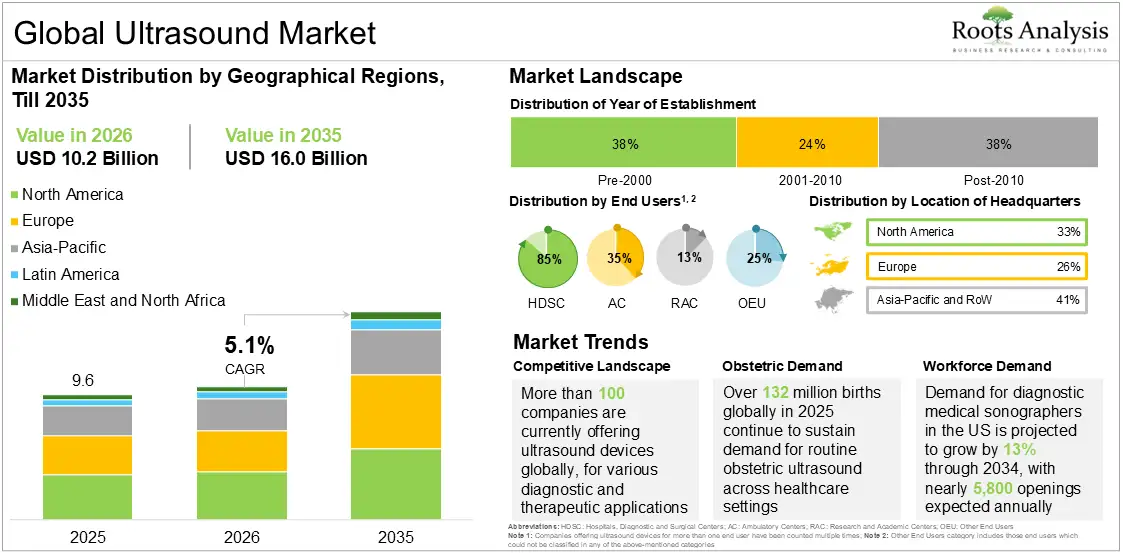
The ultrasound market is estimated to grow from USD 9.6 billion in 2025 to reach USD 10.2 billion in 2026 and USD 16.0 billion by 2035, representing a CAGR of 5.1% during the forecast period.
To learn more about this report, request a free sample copy
Ultrasound imaging, also known as ultrasonography, is a non-invasive, safe and cost-effective medical imaging technique that utilizes high frequency technologically advanced sound waves to produce an image of internal organ / tissue of the patient being examined. It assists the healthcare professionals in diagnoses and assessment of various body organs, including vascular scanning, cancer screening, urologic scanning, pulmonary scanning and pregnancy monitoring.
The MedTech industry has observed a rise in the development of advanced ultrasound systems in response to the challenges associated with conventional ultrasound systems (including high operational and maintenance cost, difficulty in patient transportation to the radiology departments, high chances of battery degradation and hard-drive failure, the need for highly trained professionals and limited adoption in under-developed countries).
In recent years, there has been a notable increase in demand for handheld / point-of care ultrasound devices. Notably, healthcare professionals can scan patients and transmit images to smartphones using these easily portable devices. Further, several advancements, such as higher resolution, high-fidelity transmission, and advanced visualization capabilities resulting in enhanced workflow, have improved the overall features of the ultrasound devices.
| Key Report Attributes | Details | |
| Historical Trend | Since 2019 | |
| Forecast Period | Till 2035 | |
| Market Size Value by 2026 | $ 10.2 Billion | |
| Market Size Value by 2035 | $ 16.0 Billion | |
| CAGR (Till 2035) | 5.1% | |
The ultrasound market analysis also features the likely distribution of the current and forecasted opportunity within the ultrasound domain across various segments, such as type of product offered, device portability, type of device display, type of technology, application area, end user, geographical regions and key players
We have created three market forecast scenarios, conservative, base and optimistic, to account for future uncertainties in key parameters and enhance the robustness of our model. These scenarios represent different tracks of the industry's evolution.
The market growth over the next decade is likely to be fueled by an increased adoption of advanced imaging solutions for medical diagnosis, rising number of patients with chronic illnesses, and substantial healthcare expenditure across various geographies. Further, the increasing prevalence of chronic disorders in geriatric population, coupled with the improved efficacy and safety of therapeutic ultrasound systems, is likely to drive market growth.
Several recent developments have taken place in the field of ultrasound, and we outline some of these below. These developments, even if they arose after our market report’s release, support the overall ultrasound industry trends detailed in our analysis.
The market research report presents an in-depth analysis of the various ultrasound companies / ultrasound machine manufacturers, across different segments, as defined in the table below:
| Market Segmentations | Details | |
| Type of Product Offered |
|
|
| Device Portability |
|
|
| Type of Device Display |
|
|
| Type of Technology |
|
|
| Application Area |
|
|
| End User |
|
|
| Geographical Regions |
|
|
| Market in North America |
|
|
| Market in Europe |
|
|
| Market in Asia-Pacific |
|
|
| Market in Middle East and North Africa |
|
|
| Market in Latin America |
|
|
In the past few years, there has been a notable increase in the number of advanced ultrasound devices launched on the market. Recently, Butterfly launched iQ3, which is a user-friendly device with smaller probe faces, an enhanced battery and improved weight distribution. During the launch, Joseph DeVivo (President, Chief Executive Officer and Chairman, Butterfly), states, “Butterfly iQ3 is the turning point for digital ultrasound. Butterfly started a revolution in ultrasound when we commercialized the world’s first fully digital handheld ultrasound in 2018, and subsequently, iQ+ in 2020.”
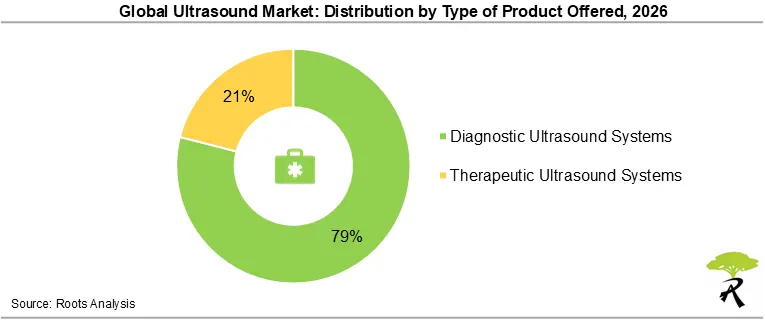
Based on the type of product offered, the global market is segmented into diagnostic ultrasound systems and therapeutic ultrasound systems. According to our market projection, the diagnostic ultrasound systems hold the largest share (80%) in the global ultrasound market. This highest share is due to the widespread use of ultrasound systems across clinical applications including obstetrics, cardiology, emergency care and general imaging. Hospitals, diagnostic centers, and outpatient clinics rely heavily on diagnostic ultrasound for routine patient checkups, making demand consistent and high. In addition, the growing burden of chronic diseases like cardiovascular disorders and cancer has further increased the demand for reliable imaging tools.
In the upcoming years, therapeutic ultrasound systems segment will show robust growth, anticipating registering the highest CAGR. These systems are increasingly being adopted in physiotherapy clinics, orthopedic centers, and cancer treatment facilities due to their non-invasive nature. Technologies like High-Intensity Focused Ultrasound (HIFU) are gaining traction as alternatives to surgery, which is attracting significant interest from specialists and clinical buyers. Rising awareness around non-invasive treatment options among both physicians and patients will be contributed to its highest growth rate in the future.
Based on the type of device portability, the global market is segmented into trolley / cart-based ultrasound devices, and handheld / point-of-care ultrasound devices. According to our analysis, trolley and cart-based ultrasound systems currently hold the largest share (90%) of the market. This lucrative share is due to the high adoption across hospitals, diagnostic centers, and specialty clinics due to their superior image quality, advanced feature sets, and ability to support multiple transducer types for diverse clinical applications. Their larger screens, powerful processing capabilities, and extensive connectivity options make them the preferred choice for high-volume imaging departments where diagnostic accuracy is the top priority.
In the future, handheld and point-of-care ultrasound devices are expected to grow at the highest CAGR during the forecast period. Their compact size, wireless connectivity, and ease of use are making them increasingly popular among emergency physicians, rural healthcare providers, and general practitioners who need quick bedside diagnostic insights. In addition, the growing adoption of point-of-care ultrasound in emergency departments, ICUs, and remote healthcare settings is significantly expanding the overall user base beyond traditional radiology and imaging specialists.
The global market is segmented across different type of device display, such as colored display, and black / white display. Based on our market analysis, colored display ultrasound systems currently account for the largest share (80%) and is likely to remain dominant in the global ultrasound market. These systems offer enhanced image clarity and better visualization of blood flow, tissue differentiation, and anatomical structures, making them the preferred choice across hospitals and advanced diagnostic centers.
Notably, the color doppler imaging, which is a key feature of colored display systems, is widely used in cardiology, obstetrics, and vascular imaging, all are high-volume clinical areas. As healthcare infrastructure continues to improve globally, more facilities are upgrading from basic systems to colored display units to meet clinical accuracy standards. The higher adoption in developed markets further solidifies the market share of this segment.
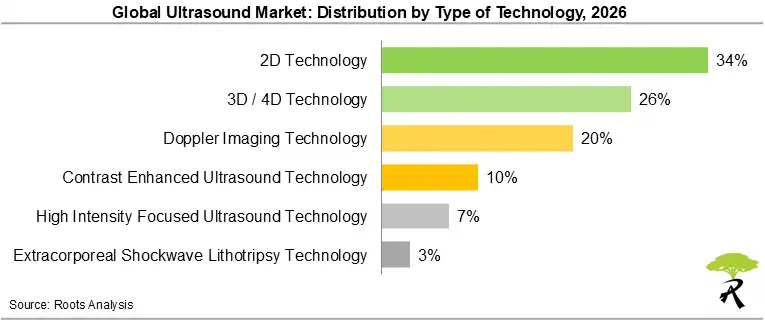
Based on the type of technology, the global market is categorized into 2D technology, 3D / 4D technology, doppler imaging technology, contrast enhanced ultrasound technology, high intensity focused ultrasound technology and extracorporeal shockwave lithotripsy technology.
According to our market report, 2D ultrasound technology accounts for 35% of the overall market share. This highest share is due to its widespread adoption across virtually every clinical setting. It is the most established and well-understood imaging technology, routinely used in obstetrics, abdominal imaging, cardiac screening, and general diagnostics. Further, it is relatively lower cost compared to advanced technologies which makes it accessible to a broad range of healthcare facilities, from large hospitals to small clinics. The simplicity of operation and availability of trained professionals who can interpret 2D images further strengthens its dominant position.
Contrastingly, 3D /4D ultrasound technology is likely to grow at the highest CAGR during the forecast period. This unprecedented growth is driven by rising demand for advanced fetal imaging and improved diagnostic accuracy. These technologies provide three-dimensional visualization and real-time volumetric imaging, which significantly enhances the ability to detect structural abnormalities and complex conditions. Notably, specialty clinics, women's health centers, and high-end diagnostic facilities are actively investing in 3D / 4D systems to differentiate their service offerings.
Based on the application area, the market for ultrasound is segmented into radiology / general imaging, cardiology, obstetrics / gynecology, urology, musculoskeletal systems, and other application areas.
According to our analysis, radiology / general imaging segment holds the largest revenue share of the market. Unlike specialized applications, general imaging covers abdominal, pelvic, thyroid, breast, and soft tissue scanning, making it the most frequently performed ultrasound procedure across hospitals, diagnostic centers, and clinics worldwide. The growing number of diseases that can be assessed through general imaging ensures a consistently high and recurring demand for ultrasound systems in this category. Radiologists and general physicians also rely on ultrasound as a first-line, cost-effective, and radiation-free diagnostic tool, which further drives its high utilization rate.
In the coming years, the obstetrics / gynecology segment is expected to register the highest CAGR during the forecast period. This growth is driven by the rising demand for prenatal screening, fetal monitoring, gynecological imaging, and maternal health assessment across both developed and emerging markets. Ultrasound remains a preferred imaging modality in obstetrics due to its non-invasive nature, real-time visualization capability, and absence of ionizing radiation. Expanding access to maternal healthcare services, increasing awareness of routine pregnancy monitoring, and growing adoption of advanced 3D / 4D ultrasound systems are further expected to accelerate growth in this application segment.
On the basis of end user, the global market is categorized across diagnostic centers, ambulatory and surgical centers, maternity centers, and research and academic centers. According to the global ultrasound market forecast, hospitals account for the largest share in the global ultrasound market by end user, owing to their ability to serve a high volume of patients across multiple clinical departments simultaneously. Unlike other end users, hospitals use ultrasound systems across a wide range of applications including emergency care, cardiology, obstetrics, radiology, and surgery. In addition, the presence of trained sonographers, radiologists, and specialists within hospital settings drives significantly higher equipment utilization rates. ensures frequent use of ultrasound equipment.
Conversely, diagnostic centers will show lucrative growth, anticipated to grow at the highest CAGR of 7.2% during the forecast period. This is likely to be driven by the global shift toward outpatient care and the increasing preference for standalone diagnostic facilities. As patients look for faster, more affordable, and convenient diagnostic options outside of hospitals, independent diagnostic centers are seeing a high ultrasound demand.
Based on geographical regions, the global market is segmented into North America, Europe, Asia-Pacific, Middle East and North Africa, and Latin America. Currently, North America captures the majority (50%) of the market share, and this trend is unlikely to change in the future. This highest share is supported by its well-established healthcare infrastructure, high healthcare spending, and early adoption of advanced medical imaging technologies. Further, the US has large number of hospitals, diagnostic centers, and specialty clinics that use ultrasound systems extensively across multiple clinical applications. Strong reimbursement frameworks for ultrasound-based diagnostic procedures encourage frequent usage and consistent equipment upgrades across healthcare facilities. The presence of leading ultrasound manufacturers and a highly competitive market environment also drives continuous product innovation and availability of cutting-edge systems.
Notably, Asia-Pacific is projected to register the highest CAGR in the global ultrasound market, making it the most exciting growth region for manufacturers and investors over the coming years. The region's growing population, rising middle class, and rapidly expanding healthcare infrastructure are the primary forces driving accelerated ultrasound adoption. Countries like China, India, and Asian nations are witnessing significant government investment in public healthcare, including maternal health programs and rural diagnostic outreach initiatives that directly fuel ultrasound demand.
| Report Deliverables | Details | |
| Excel Data Packs(Complimentary) |
|
|
| Key Ultrasound Companies Profiled |
|
|
| PowerPoint Presentation(Complimentary) | Available | |
| Customization Scope | 15% Free Customization | |
The “Ultrasound Market: Industry Trends and Global Forecasts, till 2035” market report features an extensive study of the current market landscape, company competitiveness analysis, publication analysis and market size and future opportunities within the ultrasound industry, during the forecast period.
The current market landscape features leading companies across different regions, which claim to offer various diagnostic and therapeutic ultrasound systems, in terms of difference in portability (cart-based, handheld and point-of-care devices). Some of these companies are actively engaged in the integration of advanced technologies into these devices so as to reduce human errors, increase quantitative assessment for imaging data and offer real-time support to its end users for detection across various clinical specialties.
GE Healthcare is the leader in the ultrasound market, gaining this position through multiple acquisitions since 1998. These include Diasonics Vingmed (1998 for cardiovascular ultrasound), Kretztechnik (2001 for women’s health ultrasound), and BK Medical (2021 for surgical and therapeutic ultrasound). The company paid USD 1.45 billion for the purchase of BK Medical in September 2021, which helped them expand their portfolio of ultrasound systems from diagnostics to surgical and therapeutic segments. Philips and Fujifilm hold the second and third largest share in the market.
The global market is likely to be worth $ 10.2 billion in 2026 and will reach $ 16.0 billion by 2035. In terms of device portability, handheld ultrasound scanners market segment is likely to observe the highest CAGR during the forecast period.
Various factors, such as better portability and convenience, cost-effectiveness, rapid imaging, user-friendly interface and enhanced patient care are the primary drivers of this market. Moreover, many handheld devices can be connected to smartphones / tablets, allowing easy sharing of images, and immediate consultation with the specialists (either in person or through teleconsultation).
North American companies will likely dominate the global ultrasound industry in 2035, with close to 35% of players based in the region strengthening their ultrasound portfolio. This can be due to the rising geriatric population and prevalence of chronic diseases, along with easy regulatory approval of ultrasound devices in this region.
The market in Asia-Pacific is likely to grow at a relatively high CAGR (6.9%), during the forecast period till 2035. Various factors, including favorable government policies and financial support for research and development, and rising healthcare expenditures are driving the market in Asia-Pacific. Handheld ultrasound devices are helping the medical imaging technology reach the rural areas in countries like India.
The increasing prevalence of chronic conditions results in the need for accurate diagnosis and evaluation. This has led to the increased demand for ultrasound systems offering radiation-free and non-invasive diagnosis. The rising healthcare costs associated with these diseases underscores the critical need for early detection and timely clinical decision making. Notably, ultrasound can visualize internal organs and detect abnormalities at an early stage, which often results in early treatment and improved survival rates of the patients.
The shift towards outpatient treatments in ambulatory centers has also resulted in the increasing demand for point-of-care diagnostics, particularly ultrasound systems, enabling quick and easy diagnoses of the patients suffering from various indications. This supports the healthcare professionals to take accurate and informed decisions.
The integration of artificial intelligence (AI) into ultrasound imaging solutions has transformed the potential of this industry. AI algorithms enhance resolution of generated images through reduction of artifacts and noise, resulting in more accurate diagnostics.
Ari Moskowitz, (Deputy Director, Medical Devices & AI, Bill & Melinda Gates Foundation) mentions “Developing automated AI capabilities on ultrasound with a simplified user interface can enable the product to reach a broader set of health care practitioners and help in addressing health equity by lowering the barriers to training and enabling faster exams.”
Additionally, AI provides real-time feedback during patient examinations, which supports the healthcare professionals to make better decisions that facilitates efficient clinical decisions. It is worth mentioning that the AI-based ultrasound systems can be integrated with electronic health records (EHRs), facilitating easy access to patient history and enabling personalized healthcare. As AI technology continues to evolve, it is likely to play an increasingly important role in the growth of the diagnostic ultrasound market.
Strategic acquisitions have helped the current market leaders achieve a significant share of the market. GE Healthcare, Philips Healthcare and Fujifilm have all acquired the smaller players to increase their capabilities across the sub-segments of the ultrasound industry. GE Healthcare’s acquisitions have been mentioned before. Philips acquired ATL Ultrasound in 1998 and HP Medical in 2001, while Fujifilm acquired Sonosite in 2012 and Hitachi Diagnostics Imaging in 2021.
Even the smaller players have been acquiring for expanding their capabilities. In January 2025, Hologic acquired Gynesonics for a sum of USD 350 million to enter into women’s health ultrasound market. Gynesonics’ Sonata System conducts intrauterine imaging and transcervical treatment of certain symptomatic uterine fibroids.
In addition to the acquisition of ultrasound manufacturers, the market leaders have also been actively acquiring companies developing ultrasound analysis tools and image analysis software. Majority of the recent acquisitions have taken place for AI-based analysis tools - Philips acquired DiA Imaging Analysis in 2023 and GE Healthcare acquired Intelligent Ultrasound Group PLC’s clinical artificial intelligence (AI) software business in July 2024.
The market report presents an in-depth analysis, highlighting the capabilities of various ultrasound manufacturers, across different geographies. Amongst other elements, the market report includes:
As the MedTech industry progresses towards both conventional and innovative ultrasound devices (with technological advancements and integration of artificial intelligence), the market will grow at a steady rate. Over the past years, there has been a shift towards adoption of portable ultrasound devices. These devices enable point-of-care imaging, which offers flexibility to the healthcare professionals to perform diagnostics at any place (the patient's bedside or in remote locations). With the ongoing technological advancements in ultrasound devices, along with the rise in patients suffering from chronic diseases, we anticipate a steady growth in the industry, till 2035.