


 Download Free Sample
 Buy Now
AI in Ultrasound Market Overview
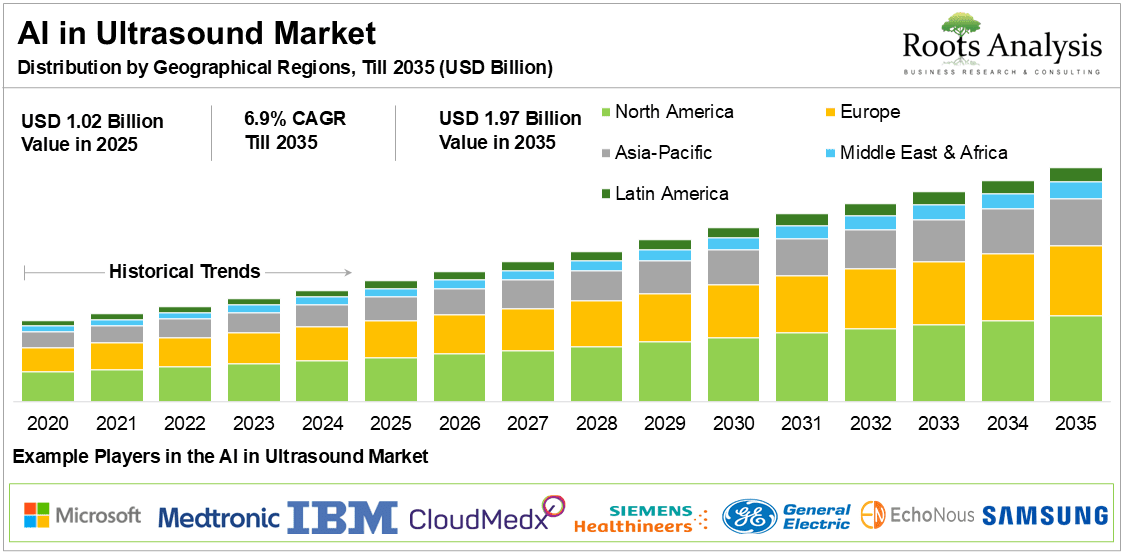
The global AI in ultrasound market size, valued at USD 0.94 billion in 2024, is projected to reach USD 1.02 billion in 2025 and USD 1.97 billion by 2035, representing a CAGR of 6.9% during the forecast period.
 |
Would Like to Preview the Actual Report?
AI in Ultrasound Market: In Summary
- The consistent shortage of skilled radiologists and rising risk of chronic conditions are the key driving forces of AI in ultrasound market.
- Market players, such as Philips (Netherland), NIVIDA (US), are Medtronic (US) are continually encouraging technological innovation to develop AI in portable ultrasound devices for bedside diagnosis during emergencies and remote diagnosis.
- Owing to the ongoing demand for advanced diagnostics tools, such as AI-powered ultrasound for early disease diagnosis and monitoring, the market is likely to register a higher CAGR of 6.9% during the forecast period.
- In terms of technology, the diagnostics imaging segment is dominating the market by securing 40% of the overall market share due to the increasing usage for image diagnosis to detect diseases. However, the 2D / 3D /4D ultrasound segment is likely to register a higher CAGR in the future.
- Deep learning segment is dominating by holding over 35% of the market share. The high adoption of deep learning technologies for anatomical structure analysis and imaging data interpretation is driving its demand to be integrated with ultrasound.
- Software tools segment is the largest share (more than 60%) of the market. This growth stems from the widespread adoption of software tools for disease diagnosis. Moreover, these software does not require hardware systems, which eliminate the additional cost of installing devices.
- In terms of regions, North America is holding 37% of the overall revenue share due to the rising adoption of advanced AI-powered diagnostics technologies and high prevalence of chronic conditions. However, in Asia-Pacific, the market is likely to grow at a CAGR during the forecast period.
- Partnership and Collaborations between industrial players and hospital organizations are leveraging partnerships and collaborations to expand the adoption of AI in ultrasound across all geographical regions.
- The future focus will be on the AI-enabled portable ultrasound devices and AI ultrasound applications in telehealth for remote diagnosis.
AI in Ultrasound Market Introduction
Artificial intelligence (AI) in ultrasound refers to the use of AI algorithm and machine learning software / technologies to automate imaging analysis, data interpretation, measurements and accurate analysis of anatomical structures. The data analysis through AI tools improves accuracy and efficiency of ultrasound imaging, allowing clinicians to plan treatment, guide surgeons in performing complex surgeries, and managing diseases.
Have Questions? Let's Get Them Answered
The demand for AI-driven ultrasound image interpretation has significantly increased due to the rising incidence of chronic conditions and shortage of skilled personnel. Furthermore, the rising focus on women health concerns, specifically women of reproductive age, and pregnancy is likely to bolster the demand for AI-powered ultrasound systems. Notably, the AI algorithm can help fetal biometry in prenatal scans and reduce the time required for diagnosis by clinicians.
The significances offered by the AI in ultrasound has catered to the attention of industrial players for innovation. For instance, in January 2025, Samsung Medison (affiliate of Samsung Electronics, South Korea) launched an AI-powered ultrasound systems for advanced Ob-Gyn applications. Likewise, several market players, such as Medtronic (US), Philips (Netherland) and CloudMex (US) are aiming for designing AI-powered portable / handheld ultrasound scanners which can help in remote diagnosis. The consistent innovation in this field and demand for advanced diagnostics tools is likely to drive AI in ultrasound market at an unprecedented rate in the upcoming years.
AI in Ultrasound Market: Report Attributes
| Key Report Attribute | Details |
| Historical Trend | Since 2020 |
| Forecast Period | Till 2035 |
| Market Size 2025 | USD 1.02 Billion |
| Market Size 2035 | USD 1.97 Billion |
| CAGR (Till 2035) | 6.9% |
One of the key objectives of the AI in ultrasound market report was to estimate the current size, opportunity, and the market growth potential, over the forecast period, till 2035. We have provided informed estimates on the likely evolution of the market for the forecast period.
The global AI in ultrasound market analysis also features the likely distribution of the current and forecasted opportunity within the market across various segments, such as type of solution, type of technology type of ultrasound technology, application area, end user, geographical regions, and leading players.
Want Information on Specific Region / Segment?
In order to account for future uncertainties associated with some of the key parameters and to add robustness to our model, we have provided three market forecast scenarios, namely conservative, base, and optimistic scenarios, representing different tracks of industry's evolution.
Recent Developments in AI in Ultrasound Market
Several recent developments in the field of AI in ultrasound technologies have occurred and we have outlined some of these below:
- In July 2025, Ultrasound AI (Paris) signed a partnership with MedLatam (US) to expand access to life saving AI-powered diagnostics across Brazil.
- In July 2025, Apollo Hospitals (India) entered into a strategic collaboration with Healthineers to develop AI-enabled diagnostic and imaging solutions for liver disease management.
- In March 2025, the NIVIDA (US) signed a collaboration agreement with GE Healthcare (US) to advance its innovation in autonomous imaging and focus on the development of autonomous X-ray technologies and AI-based ultrasound applications.
- In March 2025, Philips (Netherland) unveils its newly developed AI-enabled compact ultrasound 5500CV portable ultrasound systems designed to use at bedside in hospitals for cardiac imaging, making it more accessible across diverse care settings.
AI in Ultrasound Market Segmentation Insights
The market report presents an in-depth analysis of AI in ultrasound technologies providers who are currently active across various segments of the industry as mentioned below:
AI in Ultrasound Market: Market Segmentation
| Market Segmentation | Details |
| Type of Solution |
|
| Type of Technology |
|
| Type of Ultrasound Technology |
|
| Application Area |
|
| End User |
|
| Geographical Regions |
|
Industry Experts on AI in Ultrasound Market
AI in ultrasound holds a promising future, driven by its ability to provide accurate data for disease diagnosis. Experts believe that AI has a broad scope in medical imaging, and the market will expand in the future.
During an acquisition deal with GE Healthcare, Nock Sleep (Chief Operating Officer at Intelligent Ultrasound) stated that, 'I really believe that we are at the start of a wave of AI making a profound difference to medical imaging, and especially ultrasound'. 'By becoming a part of the GE HealthCare family will help speed the adoption of this technology and make ultrasound even easier for customers to use.'
AI in Ultrasound Market Share Insights
Market Share by Type of Solution: How Software Tools are Dominating the Market?
- Based on the type of solution, the global market is segmented into software tools, services and devices. According to the AI in ultrasound market report, the software tools segment is dominating the market by holding more than 60% of the overall revenue share. The widespread adoption of software to enhance ultrasound imaging and performance accuracy is likely to fuel its demand.
- It is important to note here that services segment is likely to grow at a higher CAGR during the forecast period. This can be ascribed due to the growing adoption of cloud-based services and complexity associated with technological operations are driving the shift to third party services for AI in ultrasound devices.
Market Share by Type of Technology: Why Deep Learning Segment Holds Majority of the Share?
- The global market is segmented across different types of technology, such as machine learning, natural language processing, deep learning, context-aware computing, computer vision, and others. According to the artificial intelligence ultrasound analysis market, the deep learning segment is securing over 60% of the market share. This can be ascribed to the growing adoption of deep learning for sonography to understand the fetal condition.
- It is important to highlight here that machine learning segment is likely to show robust growth, anticipated to register higher CAGR in the future. This can be attributed to the increasing usage of machine learning with ultrasound to diagnose cardiovascular diseases and other chronic conditions.
Market Share by Type of Ultrasound Technology: Will Diagnostic Imaging Segment Continue to Dominate in the Future?
- This segment highlights the distribution of global market across different types of ultrasound technology, such as diagnostics imaging, therapeutic, 2D / 3D / 4D ultrasound imaging, high intensity focused ultrasound, extracorporeal shockwave lithotripsy, doppler ultrasound and others. Based on the AI ultrasound industry analysis, the diagnostic imaging segment is dominating the market, accounting for 40% of the market share. The rising prevalence of chronic conditions is necessitating the demand for computer-aided diagnosis ultrasound for faster diagnostics.
- Notably, the 2D / 3D / 4D ultrasound imaging segment is likely to grow at a higher CAGR during the forecast period. This lucrative growth stems from the growing acceptance of 2D / 3D / 4D ultrasound imaging for surgical guidance, obstetrics, cardiology and surgical guidance is likely to fuel its demand in the future.
Market Share by Application Area: Do Neurology Segment Holds Maximum Share in the Future?
- Based on the application area, the global market is segmented into radiology, cardiovascular, gastroenterology, obstetrics and gynecology, neurology, and others. According to the AI-powered ultrasound diagnostics market, the neurology segment accounts for nearly 40% of the overall revenue share. The widespread adoption of artificial intelligence enabled ultrasound for detecting neuro-vascular diseases, neurosurgery planning and brain injury detection.
- It is worth noting that the obstetrics and gynecology segment is expected to grow at a higher CAGR during the forecast period. The growing women health concerns, such as breast cancer has necessitated the demand for AI-assisted lesion detection and classification in breast ultrasound.
Market Share by End User: How Hospitals & Clinics Segment is Dominating the Market?
- The global market is further categorized across different end users, such as hospitals & clinics, research labs and diagnostics centers and others. According to the AI in ultrasound market forecast, the hospitals & clinics segment is dominating the market by securing 35% of the overall revenue share. Several factors, such as rising prevalence of chronic conditions and required bedside diagnostics solutions in emergency care are driving the adoption of AI in ultrasound software and services.
- It is worth noting that the research labs and diagnostics centers segment is likely to propel at the fastest CAGR during the forecast period. This highest growth rate stems from the growing adoption of advanced infrastructure in research labs and diagnostics centers to support patient diagnosis is likely to increase the demand of AI-enabled ultrasound technologies.
Market Share by Geographical Regions: Will North America Dominate the Market in the Future?
- The global market is distributed across North America, Europe, Asia-Pacific, Middle East & Africa, and Latin America. According to our analysis, the North America is accounting for the Several factors, such as 37% of the overall AI in ultrasound market share. This highest share is driven by the increasing healthcare infrastructure, adoption of AI technology and rising shift towards telehealth services for remote consultation.
- In Asia-Pacific, the market for AI in ultrasound is likely to grow at a higher CAGR during the forecast period. The increasing partnerships across healthcare sector and market players to increase access of AI in ultrasound for faster diagnostics of diseases and rising incidence of chronic conditions are the key factors driving the growth of the market in this region.
AI in Ultrasound Market: Report Deliverables
| Report Deliverables | Details |
| Excel Data Packs (Complimentary) |
|
| Key AI in Ultrasound Companies Companies Profiled |
(A complete list of companies captured is available in the report) |
| PowerPoint Presentation (Complimentary) | Available |
| Customization Scope | 15% Free Customization |
AI in Ultrasound Market Key Takeaways
The "AI in Ultrasound Market Report: Industry Trends and Global Forecasts, till 2035" market report features an extensive study of the current market landscape, market size, market share, market growth, market trends, market value, market forecast, market outlook, statistics, and future opportunities for market players. The market research report lays emphasis on the AI-driven ultrasound image interpretation solutions that are being developed. Key takeaways of the market report are briefly discussed below.
Market Competitive Landscape: What Makes AI Powered Medical Imaging Industry Competitive?
Notably, the global AI medical imaging ultrasound market seems moderately competitive, featuring several well-established startup companies. The current focus of market players is on technological innovations to streamline diagnostic workflow of clinicians. Notably, the industrial players, such as GE Healthcare (US), Siemens Healthineers (Germany) and Philips Healthcare (Netherland) are aiming to develop AI-enabled imaging solutions, advanced AI integration in ultrasound systems, and integration of AI solutions on cloud platforms. These consistent efforts and strategic initiatives are likely to maintain long-term competitiveness in the market.
Market Size Analysis: What Advances are Being Made in Ultrasound Report Generation?
In 2025, the global AI ultrasound market size is valued at USD 1.02 billion and is poised to reach USD 1.97 billion by 2035. The growth stems from the increasing focus of industrial players on precision measurements with AI in cardiac ultrasound imaging. Notably, the consistent focus on personalized ultrasound report generation by using natural language models and vision-language to reduce diagnostic workflow is likely to drive the demand for AI in ultrasound, which is expected to be a key driver for the market.
AI In Ultrasound Market Drivers: What Factors are Propelling Market Growth?
Artificial intelligence integration with ultrasound has proven to be a game changer in improving diagnostic efficiency. Driven by its ability to generate market reports in real-time, healthcare industry is increasingly focused on workflow optimization in ultrasound with AI, which is likely to be a key AI in ultrasound market growth factor for the market. Some other notably drivers are listed below:
- High Prevalence of Chronic Diseases: Healthcare industry is witnessing a significant burden of chronic conditions, such as cardiovascular diseases, gastrointestinal diseases, and cancer. Automated ultrasound measurement with AI plays a significant role in diagnosis diseases with higher accuracy. Real-time analysis helps in planning treatment for the patients efficiently, which is likely to raise the demand for AI in ultrasound for diagnosing and managing chronic conditions.
- Radiologist Shortage: It is important to highlight here that the persistent shortage of radiologist staff specifically in rural areas is driving the demand for advanced AI-powered ultrasound which can be used by non-radiologists for diagnosis. Notably, the computer-aided diagnosis ultrasound technology is simple to use and can be used by non-specialized staff in conducting diagnostic-grade scans, which is likely to drive its demand in the future.
AI in Ultrasound Market Challenges: What Factors are Impeding Market Growth?
- High Cost: It is important to highlight here requirement of robust software development; hardware integration and AI Algorithms make AI in ultrasound more expensive. Additionally, the maintenance cost may enhance the overall cost of these advanced technologies, limiting its adoption across small hospitals and clinics.
- Lack of Data Quality and Standardization: One of the significant challenges in the adoption of AI in ultrasound is data inconsistency and data quality issues. Lack of data standardization in diagnostic imaging protocols may pose a significant challenge for the market players.
AI in Ultrasound Market Trends: What are the Future Opportunities in AI in Ultrasound Industry?
It is important to note here that the continuous improvement in deep learning models and machine learning algorithms are enhancing AI capabilities in automated interpretation and imaging analysis. Some more notable trends that are shaping the industrial growth are listed below:
- Point-of-Care Ultrasound AI Integration: The growing focus on point-of-care diagnosis, specifically in emergency care and remote settings, is likely to be a key trend for the market. Notably, the point-of-care diagnostics or ultrasound devices are playing a crucial role on bedside diagnostics and remote diagnosis, making it an invaluable tool in managing chronic conditions and improving patient outcomes.
- AI Ultrasound Applications in Remote and Telemedicine Settings: It is interesting to highlight here that the adoption of teleradiology is encouraging the demand for AI-powered ultrasound. These AI algorithms help in remote diagnosis, allowing healthcare professionals to provide consultation in real-time to manage disease conditions. Moreover, the future focus will also be on using multi-fusion models where AI combines with multitude of technologies for accurate diagnosis.
What Types of Partnerships are Driving Commercialization?
Driven by the high demand for AI in ultrasound, the market players are undertaking strategic initiatives, such as acquisitions, partnerships and collaborations. For instance, in January 2025, Hologic (US) has acquired Gynesonics with an upfront investment of USD 350 million to enter into women’s health ultrasound industry. The acquisition aims to increase access of Sonata® System to diagnose women diseases at early stage. As more market players continue to forge strategic partnerships, it is expected that the market will grow at a higher CAGR in the future.
Pay Only for What You Need – The Best Way to Optimize
AI in Ultrasound Market Report Coverage
The market report presents an in-depth analysis, highlighting the capabilities of various stakeholders in the AI in ultrasound industry, across different geographies. Amongst other elements, the market report includes:
- An Infographic Executive Summary
- Regulatory Scenario
- Comprehensive Database of Leading Players
- Competitive Landscape
- Company Competitiveness Analysis
- Startup Ecosystem in the AI in Ultrasound Market
- Company Profiles
- Porter’s Five Forces Analysis
- Partnerships and Collaborations
- Market Forecast and Opportunity Analysis
- Adjacent Market Analysis
- Key Winning Strategies
- Value Chain Analysis
Glossary
- Artificial Intelligence (AI): It refers to the computational machine’s ability to simulate or mimic human intelligence, including decision-making and pattern recognition capabilities
- Machine Learning (ML): It is a subset of AI that enables computers to learn and improve from experience without being explicitly programmed for each task.
- Deep Learning: It is a specialized form of machine learning using neural networks with multiple layers to analyze and interpret complex data patterns.
- Point-of-Care Ultrasound (POCUS): It refers to the portable ultrasound imaging performed at the patient's bedside for immediate diagnostic assessment.
From the Author’s Desk
Author’s View on AI in Ultrasound Market
AI in ultrasound market future seems promising and transformative, driven by the increasing adoption across healthcare sector. The future of this industry will be centered around augmented reality, multi-modal fusion, and wearable ultrasound. These key trends promise to enhance diagnostic accuracy for treatment decisions. Furthermore, the future focus on industrial players will be on low-cost ultrasound devices, and portable AI ultrasound to increase its accessibility across remote areas. The future of ultrasound is a synergistic one, where AI empowers healthcare providers to enhance precision, optimize workflows, and improve patient outcomes globally.
Customization Opportunities
At Roots Analysis, we genuinely care about your success and understand that your business requirements are unique. While our market research reports provide valuable insights, we recognize that they might not cover every aspect you need to make well-informed strategic decisions. To account for that, we offer 15% free report customization tailored to your specific needs. Whether you require additional quantitative analysis, qualitative insights, or any other information related to the electric vehicles market, reach out to us today at support@rootsanalysis.com


