
Lowest Price Guaranteed
Slides
190
Last Updated
November 2024
View Count
12853
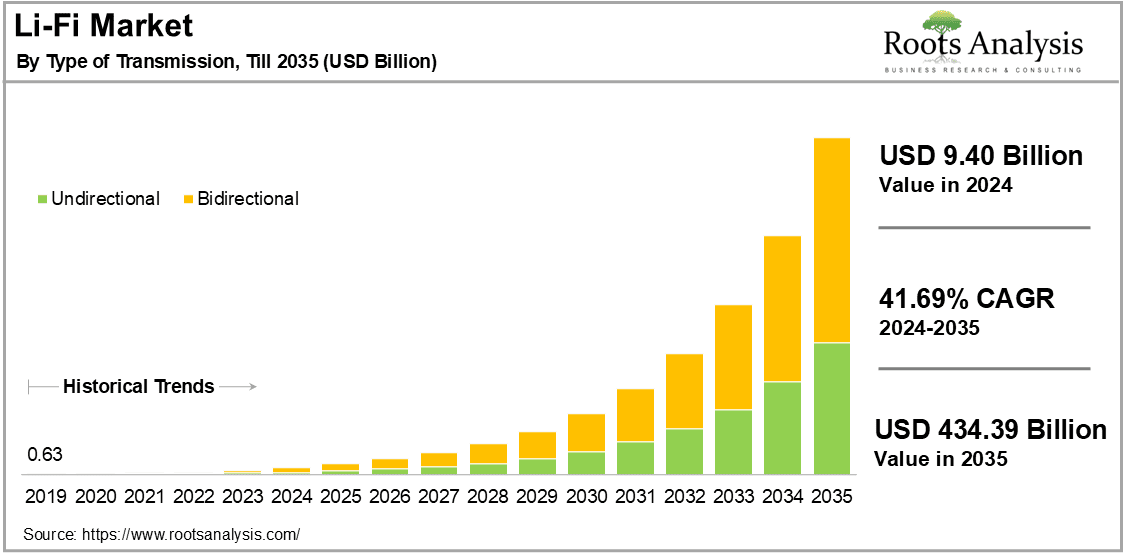
The global Li-Fi market is estimated to grow from USD 9.40 billion in 2024 to USD 434.39 billion by 2035, representing a higher CAGR of 41.69% during the forecast period.
 |
To learn more about this report, request a free sample copy
The new research report covers detailed analysis of current industry size, growth trend, challenges, future opportunities, SWOT analysis and value chain analysis.
With growing demand for high-speed communication systems in industries, Li-Fi technology emerges as a potential solution that offers secure and breakthrough communication. It stands for Light Fidelity, a form of wireless communication technology that employs LEDs (Light Emitting Diodes) or visible lights for sending and receiving data signals. One of the reasons for widespread adoption is Li-Fi uses visible light over radio frequency waves that are secure from interference of nearby signals and devices. Moreover, Li-Fi enables real-time communication with improved data security, making it a preferable choice in automotive, healthcare, retail and telecommunication industries for wireless communication. It is worth noting here that Li-Fi technology has a broad range of applications in the aerospace industry as it helps to reduce dependence on wires and cables communication technology that has added additional weight on aircraft.
Furthermore, in deployment of smart cities, Li-Fi technology plays a crucial role in facilitating high-bandwidth communication and fast data transferring. With the development of smart cities and autonomous vehicles, there is a requirement to upgrade existing road infrastructure by implementing Li-Fi for traffic control and vehicle-to-infrastructure communication and also for enhancing road safety. It is interesting to highlight here that in July 2024, Velmenni has received grant from the Indian Ministry of Defense under the iDEX initiative. The aim of the grant is to utilize Li-Fi technology for establishing wireless communication in modern warfare. Driven by the growing adoption across various sectors, the key players of the industry have accelerated their efforts for the development of innovative wireless communication technology. Considering the ongoing efforts and increasing acceptance, we believe the Li-Fi market will continue to grow at a steady rate.
The market study report provides in-depth analysis of various players who are currently active in this industry across various segments as mentioned in the table below.
| Key Report Attributes | Details | |
| Historical Trend | 2019-2023 | |
| Base Year | 2023 | |
| Forecast Period | 2024-2035 | |
| Market Size 2024 | $9.40 billion | |
| Market Size 2035 | $434.39 billion | |
| Market Growth Rate | CAGR of 41.69% from 2024-2035 | |
| Distribution by Component |
|
|
| By Type |
|
|
| Distribution by Transmission Type |
|
|
| Distribution by Type of Application |
|
|
| Company Size |
|
|
| Business Model |
|
|
| By End User |
|
|
| Key Geographical Region |
|
|
| Key Companies Profiled |
(A full list of key companies captured is available in the report) |
|
| PowerPoint Presentation (Complimentary) |
Available | |
| Customization Scope | 15% Free Customization | |
| Excel Data Packs (Complimentary) |
|
|
One of the key objectives of this market report is to provide a detailed market forecast analysis in order to estimate the existing market size and future opportunities for Li-Fi market players over the next decade. Based on several parameters, likely industry trends, partnerships, and primary validation, we have provided an informed estimate of the market evolution during the forecast period 2024-2035. The market report also features the likely distribution of the current and forecasted opportunity within the Li-Fi market based on various relevant parameters, such as Distribution by Component (LED Lamps, Photodetector, Optical Sensor, Microcontroller, Software and Others), Type (Li-Fi Lamp, Li-Fi Dongle, Access Point and Li-Fi Kit), Transmission Type (Unidirectional and Bidirectional), Application (Advanced Tracker, Location Based Services, Standalone Tracker, Indoor Networking, Underwater Communication Line, Smartphone and Others), Company Size (Large Enterprises and Small and Medium Enterprises), Business Model (B2B, B2C and B2B2C), End User (Automotive, Retail, Healthcare, Aerospace and Defense, Government, Transportation, Education, Consumer Electronics, and Others), Geographical Region (North America, Europe, Asia-Pacific, Latin America, Middle East and North Africa, Rest of the World: Industry Size and Future Forecast. In order to account for future uncertainties with some of the key parameters and to add robustness to our model, we have provided three market forecast scenarios, namely conservative, base, and optimistic scenarios, representing different tracks of the industry's evolution.
All actual figures have been sourced and analyzed from publicly available information forums and primary research discussions. The financial figures mentioned in this market report are in USD unless otherwise specified.
Based on the type of component, the global Li-Fi market is segmented into LED lamps, photodetector, optical sensor, microcontroller, software and others. According to our projection, currently LED lamps hold the highest share of the market. The largest share can be attributed to the growing adoption of smart LED lamps as primary data transmission mode in various technologies. LED lamps or LED lighting are highly energy efficient, cost-effective and offer high-speed communication, making it an ideal option for data transmission and wireless communication. It is worth noting that photodetectors hold the second highest share of the market and are likely to grow at higher CAGR during the projected period as these sensors play a significant role in data reception across various applications with higher speed. Furthermore, photodetectors are increasingly being deployed into autonomous vehicles, smart devices and IoT systems where high speed and precision is required for communication.
On the basis of type, the global Li-Fi market is segmented into Li-Fi Lamp, Li-Fi Dongle, Li-Fi Access Point and Li-Fi Kit. Based on our market study, presently Li-Fi Access Points occupies the highest share of the market. The highest share is likely to be driven by the growing adoption in various sectors, such as healthcare, retail and education. Access Point serves as an epicenter for Li-Fi networks and is crucial for maintaining high speed, robust connectivity and secured network during data transmission. Moreover, Li-Fi Access Point is less prone to cyber security attacks as compared to other network types which is why a lot of financial organizations and government agencies are adopting them on a large scale. It is worth highlighting here that Li-Fi lamps are likely to grow at a higher CAGR owing to the widespread integration of Li-Fi lamp technology into smart lighting systems for high-speed connectivity and lighting.
Based on the type of transmission, the global Li-Fi market is segmented into unidirectional and bidirectional. According to our projection, currently bidirectional transmission holds the largest share of the market. This dominance is likely to be the result of high demand for bidirectional transmission-based Li-Fi in commercial and enterprises applications. Bidirectional transmission offers real-time data transmission which is highly essential for quick feedback sharing in industries like healthcare and automotive industry for continuous communication. It is worth noting here that the trend of growth remains unchanged during the forecast period and bidirectional transmission will grow at a higher CAGR during the forecast period.
On the basis of application, the global Li-Fi market is segmented into advanced tracker, location-based services, standalone tracker, indoor networking, underwater communication line, smartphone and others. Driven by the high demand for indoor networking in healthcare sectors, educational sectors, shopping malls and retail sector, indoor networking accounts for the highest share of the market. Notably, indoor networking provides high speed internet connectivity for fast data transmission within confined spaces, thereby reducing the risk of security breach. In the long run, we believe that smartphone integration and location-based services are poised to grow at a substantial CAGR during the forecast period. This can be attributed to the fact that location-based services are in great demand for real-time tracking and accurate indoor positioning. Moreover, it also provides advanced mapping applications to various retailers for accurate visualization of foot traffic flow.
Based on the company size, the Li-Fi market is segmented into large enterprises and small and medium enterprises. According to our projection, currently large enterprises occupy the highest share of the market. The highest share is likely to be the result of higher adoption rate of Li-Fi technology for high-speed and scalable communication with complex infrastructure. Various large companies like Signify and PureLiFi are currently emphasizing offering advanced Li-Fi networking solutions that can integrate with existing infrastructure and provide secured networks for data transmission. Small and medium enterprises on the other hand are anticipated to grow at a higher CAGR during the forecast period. This can be attributed to the growing focus of small and medium enterprises on the development of cost-effective Li-Fi networking solutions to make it more accessible by small vendors.
On the basis of end user, the Li-Fi market is segmented into automotive, retail, healthcare, aerospace and defense, government, transportation, education, consumer electronics, and others. According to our projection, currently retail users account for the highest share of the market and the trend of growth is likely to remain unchanged during the forecast period. The highest growth share is attributed to the increasing integration of Li-Fi technology within the retail sector as an indoor networking positioning element to enhance the shopping experience of the customer. It is worth noting that Li-Fi can easily be integrated with smartphone allowing retailers to track indoor movements with the help of LEDs and light bulbs. The application can be used for determining customer preferences, which is useful for creative advertising campaigns and marketing strategies. Furthermore, the integration of Li-Fi also helps in tracking inventory status within real time that further helps in inventory management. Based on our analysis, the automotive segment is estimated to show lucrative growth potential during the forecast period. This can be attributed to the growing demand for Li-Fi technology within automobiles and traffic lights for safety.
Based on the key geographical region, the global Li-Fi market is distributed into North America, Europe, Asia-Pacific, Latin America, Middle East and North Africa and the rest of the world. According to our analysis, currently, North America accounts for the highest share of the market. The highest share can be attributed to the increasing requirement for energy efficient and cost-effective Li-Fi based networking devices that offer high-speed bandwidth within North American region. Moreover, North America is the epicenter for advanced technological innovations, such as cloud computing, smart buildings and electronic products. Additionally, the growing demand for state-of-the-art networking technology in United States Navy is likely to be the key reason for highest growth share. In Europe, the Li-Fi market is expected to grow at a higher CAGR during the forecast period. Europe has a well-established market for autonomous cars that require Li-Fi networking solutions for vehicle-to-vehicle connectivity to avoid collisions. Owing to the growing demand for Li-Fi networking technologies in the European region, the market is anticipated to show lucrative growth potential.
The “Global Li-Fi Market Till 2035; Distribution by Component (LED Lamps, Photodetector, Optical Sensor, Microcontroller, Software and Others), Type (Li-Fi Lamp, Li-Fi Dongle, Access Point and Li-Fi Kit), Transmission Type (Unidirectional and Bidirectional), Application (Advanced Tracker, Location Based Services, Standalone Tracker, Indoor Networking, Underwater Communication Line, Smartphone and Others), Company Size (Large Enterprises and Small and Medium Enterprises), Business Model (B2B, B2C and B2B2C), End User (Automotive, Retail, Healthcare, Aerospace and Defense, Government, Transportation, Education, Consumer Electronics, and Others), Geographical Region (North America, Europe, Asia-Pacific, Latin America, Middle East and North Africa, Rest of the World: Industry Size and Future Forecast”; Industry Trends and Future Forecast: report features an extensive study of the current market landscape, market size and future opportunity within the Li-Fi industry, during the given forecast period. The market report highlights the efforts of several stakeholders involved in this rapidly emerging segment of the service providers industry. Key takeaways of the Li-Fi market report are briefly discussed below.
Currently, the market landscape features the presence of several small, medium-sized and large enterprises who are currently offering advanced Li-Fi technologies for a wide range of industries. With an aim of delivering innovative Li-Fi networking solutions, the key players of the industry are taking strategic initiatives, such as mergers, collaborations, acquisitions and partnerships. Overall, the Li-Fi market seems highly fragmented and competitive as leading industries in this field are continually concentrating on research and development activities for providing cost-effective as well as secured networking solutions. It is worth highlighting here that various start-up and small companies are also leveraging a competitive edge to enhance their product portfolio and provide innovative solutions. As more industrial leaders continue to enter this industry, we believe the Li-Fi market will grow at a steady pace during the forecast period.
Some of the potential drivers that are propelling the Li-Fi market are growing demand for secured wireless communication technology within commercial sector and shift towards smart homes. Currently, optical sensors-based technologies and smart devices are increasingly used in the construction of smart cities, which is likely to raise the demand for Li-Fi technology integrated smart devices in the future. Furthermore, Li-Fi technology is offering safe connectivity for wide range of applications, such as smartphones, smart lightings and location-based networking services. It is worth highlighting here that Li-Fi technology is less prone to cyber threats and offers high speed data transmission, the inherent security becomes a primary reason for widespread adoption of this wireless communication technology.
Despite its significant adoption, this growing industry witnessed several challenges that impede its growth. One of the potential challenges is the limited range of Li-Fi networks. LED bulbs used in networking technology have limited range that restricts their usage across long distance. Furthermore, physical barriers may also disrupt its networking speed and connectivity.
The existing range limitation of Li-Fi technologies has raised the demand for high-speed data transmission wireless communications alternatives that cover large areas are anticipated to be a primary growth factor for the market. In addition, the growing integration of Internet of Things applications for interference-free communication supports the growth of the market during the forecast period. Li-Fi networks can enhance the IoT applications by enabling secure and high-speed communication, which is expected to be a growth factor for the market during the forecast period. Moreover. The enhanced security-based communication is expected to provide enormous growth opportunities for the industrial leaders.
Examples of key players who are currently active in the Li-Fi industry (which have also been captured in this market report, arranged in alphabetical order) include ACUITY BRANDS LIGHTING, Aegex Technologies, BARTEC PIXAVI, Caterpillar, ECOM Instruments GmbH, GENERAL ELECTRIC, Getac Technology, Koninklijke Philips N.V., KYOCERA Corporation, LVX SYSTEM, LightPointe Communications, LUCIBEL, Oledcomm, pureLiFi, Panasonic Corporation, RugGear, Signify Holding, Sonim Technologies, Velmenni OÜ, Zero1 Pte and Zebra Technologies. This market research report includes an easily searchable excel database of all the companies providing Li-Fi products worldwide.
The market report presents an in-depth analysis, highlighting the capabilities of various companies engaged in this domain across different segments. Amongst other elements, the market report includes:
Several recent developments have taken place in the Li-Fi market. We have outlined some of these recent initiatives below. These developments, even if they took place post the release of our market report, substantiate the overall market trends that have been outlined in our analysis.
At Roots Analysis, we genuinely care about your success and understand that your business requirements are unique. While our market research reports provide valuable insights, we recognize that they might not cover every aspect you need to make well-informed strategic decisions. To account for that, we offer 15% free report customization tailored to your specific needs. Whether you require additional quantitative analysis, qualitative insights, or any other information related to the Li-Fi market, reach out us today at: support@rootsanalysis.com