


 Download Free Sample
 Buy Now
Market Size
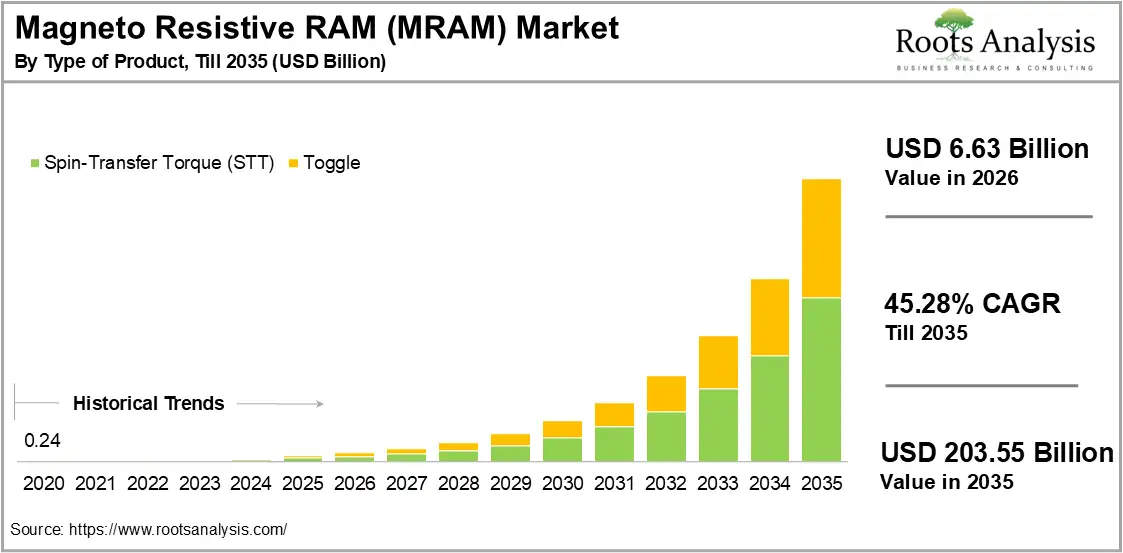
The global magneto resistive RAM market, valued at USD 6.63 billion in 2026, is projected to reach USD 29.51 billion in 2030 and USD 203.55 billion by 2035, with a CAGR of 45.28% during the forecast period 2026 to 2035.
See What’s in the Full Report - Request Your Complimentary Insights!
Key Takeaways
- Driven by an increasing demand for non-volatile memory technologies for data security during power loss, MRAM market is growing rapidly.
- In terms of product, the spin-transfer torque sub-segment secures the highest overall revenue share (66%) as it offers enhanced compatibility with existing dynamic random-access memory (DRAM) and static random-access memory (SRAM) architecture.
- Based on areas of application, the enterprise storage sub-segment is contributing the maximum (42%) to the overall MRAM market size due to the advanced data protection properties of MRAM that safeguards data in power loss and critical data-in-flight situations.
Market Overview
Traditional random-access memories (RAMs) used for data storage face a major issue, data loss in case of power loss. In addition, these have slow data storing and processing speed that require longer time. To save data from these losses, magneto resistive RAM (MRAM) are on a surge. By precisely depositing thin layers of metal in magnetic tunnel junction through various techniques, MRAMs are manufactured. These offer non-volatility that safeguards data in power loss. Further, they also provide high speed reading and writing.
The rising popularity of magneto resistive RAM (MRAM) is due to the introduction of edge computing for reduced data latency. Further, rising automotive memory solutions such as advanced driver-assistance systems due to fast sensor data processing have nurtured the market. It is worth highlighting that these systems use magnetic states instead of electric charges to store data, leading to lower standby power consumption. In addition, these systems have higher storage density and in-memory computing have made an impact on high-performance computing technology.
The global magneto resistive RAM (MRAM) market size is expected to grow significantly over the forecast period due to the MRAM’s crucial requirement in artificial intelligence development. It is worth highlighting that these radiation-resistant memory are capable of easily withstanding extremely high radiation that makes it ideal for aerospace applications. These semiconductor memory solutions offer high reliability in real-time data storage and updating. Moreover, the swift advancements in manufacturing processes for MRAM will enhance quality and performance. Notably, the ongoing research and development in digital transformation in electronics in emerging economies such as China, India and Japan will boost the market growth. Consequently, rapid investments for advancements in memory technology will fuel the domain growth.
Recently, Sanjeev Aggarwal, President and CEO at Everspin Technologies mentioned for the growing demand for fast, reliable memory solutions that address the needs of mission-critical systems, these MRAM solutions deliver the performance and reliability required across diverse applications.
Your Business is Unique – Why Shouldn’t Your Report Be?
Recent Developments
- In October 2025, Quintauris and Everspin Technologies entered into the strategic collaboration to bring advanced memory solutions into the Quintauris ecosystem. This aim to integrate Everspin’s proven MRAM technologies with Quintauris reference real-time platform.
- In March 2025, NXP Semiconductors, a leading semiconductor company, launched new automotive chip with 15x faster performance for smart vehicles.
- In March 2025, Everspin, a US-based semiconductor company launched high-reliability MRAM for automotive and satellite applications.
Market Share Insights
Spin-Transfer Torque to Gain the Maximum Market Share
The spin-transfer torque (STT) segment is anticipated to dominate the segment with 66% of MRAM market share in 2025. The prominent reasons for this can be extremely fast read and write speed coupled with smaller size. It is worth highlighting that they also offer enhanced compatibility with existing dynamic random-access memory (DRAM) and static random-access memory (SRAM) architecture aiding STT-MRAM market growth.
However, the toggle segment is expected to grow with a relatively higher CAGR of 36.28%. This can be attributed to the demand for non-volatile memory and data retention systems during power failures. In addition, these systems can easily collect data in real-time, making an impact in data storage innovations.
Embedded Sub-Segment to Drive the Market Growth
The embedded segment is augmenting the segment's growth with over 76.12% market share. Further, this segment is also expected to grow with a relatively higher CAGR in the forecasted period. This can be ascribed to the easy integration properties with standard CMOS logic processes. Moreover, high endurance and low power consumption boost IoT memory applications of MRAM. In addition, high speed work and real-time data processing will continue to fuel embedded MRAM market growth.
Large Enterprises to Gain the Maximum Revenue Share
The large enterprise is leading the segment with the major market shares. This can be attributed to their substantial financial resources, extensive research and development capabilities, established market presence and driven business growth in non-volatile memory market.
However, the small and medium enterprise segment is expected to growth with a relatively higher CAGR of 41.38% in the forecasted period. This can be ascribed to their agility in implementing new technologies, which allows them to quickly leverage the latest technologies for operational efficiency, cost reduction, and enhanced customer experiences.
Enterprise Storage to Dominate the MRAM Industry
Enterprise storage is leading the segment with the major market share (42%). This can be attributed to advanced data protection that safeguards data in power loss and critical data-in-flight situations. Notably, high endurance for frequent writing and updating has fostered high-speed memory solutions market.
On the other hand, the aerospace & defense segment is expected to grow with a relatively high CAGR of 20.49%. Prominent reasons for this rapid growth can be high radiation withstanding properties that acquires reliable operations in harsh environments. It is worth highlighting that MRAMs are efficient in data storage and processing and management of mission-critical systems for enhanced reliability.
Regional Analysis Suggests that North America will Lead the MRAM Market
North America exhibits dominance in the market with over 37% of the magneto resistive RAM (MRAM) market share in the global marketplace. This dominance can be attributed to several factors, including rapid ongoing development in industries and technologies. In addition, supportive government regulations and initiatives have played a major role in dominance. It is worth highlighting that North America acquires a big military and defense budget that allows it to spend a high amount of funds on technologies for enhanced defense. The presence of prominent players such as Honeywell, IBM and Avalanche Technology are continuously driving the market through innovations and technological advancements.
However, Asia is projected to grow with a relatively higher CAGR (30.68%) in the forecast period. Primary reasons for this growth include the high semiconductor manufacturing, particularly in Taiwan.
Want Information on Specific Region / Segment?
Market Dynamics
Magneto Resistive RAM Market Competitive Landscape
The global magneto resistive RAM (MRAM) market is witnessing intense competition driven by both large multinational corporations and emerging niche innovators. Major players such as Samsung Electronics, Everspin Technologies, and Intel dominate market share through extensive R&D, large-scale manufacturing, and strategic investments in advanced MRAM architectures.
Meanwhile, smaller companies continue to carve out specialized niches by developing customized solutions and forming strategic partnerships to strengthen their portfolios and regional presence. Across the industry, firms are accelerating product innovation, expanding alliances, and focusing on new feature integration to enhance MRAM performance and global competitiveness.
Key Drivers of Magneto Resistive RAM (MRAM) Market
An increasing demand for non-volatile memory technologies for data security during power loss is majorly driving the magneto resistive RAM (MRAM) industry. Further, the rising integration of MRAM in aerospace and defense due to extreme radiation resistance will contribute to the expansion of the demand for MRAM.
Moreover, enhanced reliability and working speed for faster data storage and processing will nurture the future of memory technologies. In addition, rapidly rising adoption of magneto resistive RAM (MRAM)s in enterprises, automotive, consumer electronics and robots will boost the market growth in the forecasted period.
Challenges in MRAM Market
Despite the strong market growth projection, the magneto resistive RAM (MRAM) market faces numerous challenges. The most common challenge is high design costs due to complex development. In addition, manufacturing requires integrated magnetic elements that may be flawed, forwardly leading to longer manufacturing time. Further, supply chain disruption and the requirement of skilled labor adds further complexities.
Pay Only for What You Need – The Best Way to Optimize
Market Segmentation
Magneto Resistive RAM (MRAM) Market: Scope of Report
| Key Report Attributes | Details | |
| Historical Trend | Since 2020 | |
| Forecast Period | Till 2035 | |
| Market Size 2026 | $ 6.63 Billion | |
| Market Size 2035 | $ 203.55 Billion | |
| CAGR (Till 2035) | 45.28% | |
| Segments Covered |
|
|
| Key Players Profiled |
|
|
| PowerPoint Presentation (Complimentary) | Available | |
| Customization Scope | 15% Free Customization | |
| Excel Data Packs (Complimentary) |
|
|
Market Segments
Based on research, we have segmented the magneto resistive RAM market into type of product, type of offering, type of enterprises, area of application, geographical regions, and key players.
By Type of Product
- Spin-Transfer Torque (STT)
- Toggle
By Type of Offering
- Embedded
- Stand-alone
By Type of Enterprises
- Large Enterprises
- Small and Medium Enterprises
By Area of Application
- Aerospace & Defense
- Automotive
- Consumer Electronics
- Enterprise Storage
- Robotics
By Geographical Regions
- North America
- US
- Canada
- Mexico
- Rest of North America
- Europe
- Austria
- Belgium
- Denmark
- France
- Germany
- Ireland
- Italy
- Netherlands
- Norway
- Russia
- Spain
- Sweden
- Switzerland
- UK
- Rest of Europe
- Asia-Pacific
- Australia
- China
- India
- Japan
- New-Zealand
- Singapore
- South Korea
- Rest of Asia-Pacific
- Latin America
- Brazil
- Chile
- Colombia
- Venezuela
- Rest of Latin America
- Middle East and Africa (MEA)
- Egypt
- Iran
- Iraq
- Israel
- Kuwait
- Saudi Arabia
- UAE
- Rest of MEA
Get an Instant Quote in 10 Minutes. Lowest Price Guaranteed


