
Lowest Price Guaranteed
Slides
204
Last Updated
April 2025
View Count
11297
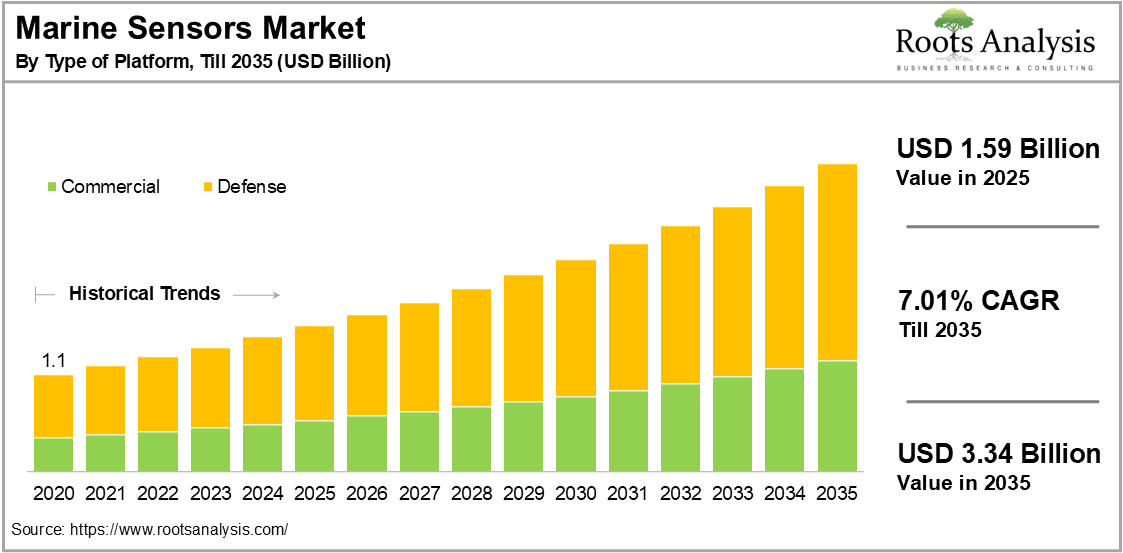
The global marine sensors market, valued at USD 1.04 billion in 2024, is projected to reach USD 1.59 billion in 2025 and USD 3.34 billion by 2035, representing a CAGR of 7.01% during the forecast period.
 |
The new research study consists of marine sensors industry analysis, detailed market forecast analysis, and providing actionable strategic recommendations.
According to the marine living planet index (LPI) of the UK government, 49% of biodiversity has vanished from the ocean. Watercrafts are considered as one of the factors respective to it. The unmonitored approach of operation leads to marine life killings due to crashes and residue. To reduce these numbers, marine sensors are on a surge. The integration of corrosion-resistance materials with epoxy forwardly coupled with dedicated functionalities originate marine sensors. These provide information about emissions and surroundings to prevent crashes and emissions.
Technological advancements, such as capability of detecting intrusions and potential attacks have played a major role in the defense applications of marine sensors. Further, these environmental monitoring sensors allow real-time underwater exploration information on water depth and temperature forwardly boosting underwater sensors market. The enhanced analysis of hazard routes and supports safe maritime operations will accelerate the navigation sensors market. In addition, the development of wireless sensor networks (WSNs) for unmanned operation has contributed to the expansion of marine research. These sensors are capable of reducing costs and improving data with the help of remotely operated vehicles (ROVs). It is worth highlighting that marine sensors are favored in aquaculture due to their dissolved oxygen and salinity analysis.
The global marine sensors market size is expected to grow significantly over the forecast period due to the dynamic supportive regulations. Further, technological advancements such as AI integration for predictive maintenance and autonomous navigation will aid the expansion of the oceanographic sensors market. Enhanced and secure communication will favor defensive adoption of the services.
Notably, pressure sensors are being used for reservoir monitoring and pipeline integrity for offshore oil and gas export. The growth of the domain can be described by the rising maritime and recreational activities. Moreover, the development of sensors according to the consumer requirements have strengthen the future of the market. It is worth highlighting that usage of marine sensors in hydrographic surveys, weather forecasting, tsunami detection and wave measurement will mark marine sensors to be a crucial innovation. Consequently, rising investments in development of advancements will contribute to the expansion of marine sensors charger market.
Recently, Mikko Nikkanen, Head of maritime, weather and environment at Vaisala mentioned designed to enhance both safety and performance marine sensor provides real-time wind information, helping to maximize operational windows and strengthen efficiencies.
The global marine sensors market research report presents an in-depth analysis of the various companies that are involved in offering marine sensors, across different segments, as defined in the table below:
| Key Report Attributes | Details | |
| Historical Trend | Since 2020 | |
| Forecast Period | Till 2035 | |
| Current Market Size | $ 1.59 Billion | |
| Market Size Value by 2035 | $ 3.34 Billion | |
| CAGR (Till 2035) | 7.01% | |
| Type of Product |
|
|
| Type of Connectivity |
|
|
| Type of Sales |
|
|
| Area of Application |
|
|
| Type of Platform |
|
|
| Geographical Regions |
|
|
| Leading Market Players |
|
|
| PowerPoint Presentation (Complimentary) | Available | |
| Customization Scope | 15% Free Customization | |
| Excel Data Packs (Complimentary) |
|
|
On the basis of the type of product, the marine sensors market is bifurcated into acoustic sensors, flow and level sensor, magnetic sensor, pressure sensor, temperature sensor and other product. The flow and level sensor segment is anticipated to dominate the segment with more than 45% market share of marine sensors in 2025. This can be due to high accuracy and reliability. In addition, they improve energy efficiency and reduce waste.
On the other hand, the acoustic sensors segment is expected to witness a relatively faster (8.48%) marine sensors market growth rate by 2035. This can be attributed to capability of intrusion detection, perimeter monitoring and identification of potential threat. They also monitor noise pollution and its impact on marine life.
Based on the type of connectivity, the global Marine Sensors market is split into wired and wireless. Currently, according to our analysis, the wired segment is augmenting the segment's growth with over 55% of the market share. This can be ascribed to the vast usage of GPS tracking, gyroscopes and accelerometers in the maritime industry. Further, the capability to detect pollutants, pH levels and oxygen content provide environmental and ocean monitoring.
However, the wireless segment is anticipated to grow with a relatively higher CAGR of 7.67% in the forecast period. The prominent reason for this growth can be easy deployment and real-time monitoring that equips automatic operation. In addition, they are significantly more secure in comparison to wired sensors. Further, their high applications in tide monitoring and corrosion monitoring will aid the expansion of the dissolved oxygen sensors market.
On the basis of the marine sensor types of sales, the marine propulsion sensors market is bifurcated into market and OEM. The OEM segment is anticipated to dominate the segment with more than 55% of market share in 2025. Further, this segment is forecasted to grow with a relatively higher CAGR of 7.43% till 2035. This can be attributed to the demand for tailored sensors for effective operations. In addition, a strong distribution network and sensor warranty will fuel the market growth in the forecasted period. Notably, rising demand for water current management and biofouling detection strengthens the flow sensors market.
Based on the area of application, the global marine sensors market report is segmented into communication/navigation, electronic warfare, intelligence/reconnaissance, surveillance /monitoring, target recognition and other application. According to our analysis, surveillance/monitoring is leading the segment with the major market share (40%). This can be attributed to their support to automatic identification systems (AIS), CCTV and radars. In addition, their high accuracy and reliability allows detecting any attack or threats in coastal security.
On the other hand, the communication/navigation segment is expected to grow with the relatively faster (7.55%) CAGR in the forecasted period. This can be ascribed to reliable and secure communication among military ships. In addition, they allow easy tracking and navigation for various boats.
Based on the type of platform, the global marine sensors market report is segmented commercial and defense. According to our analysis, the commercial lead the segment with the major market share (55%). This can be due to their capability of real-time monitoring of ship health such as structural integrity, potential threat detection and failure prevention. Further, rising adoption in aquaculture will aid the salinity sensors market.
However, the military segment is expected to grow with a relatively higher CAGR of 7.68% in the forecasted period. This can be due to their effortless approach of detecting other watercrafts and secure communication. In addition, integration of weapons and highly accurate radars will play a major role in level sensors market expansion.
This segment highlights the distribution of the marine sensors market across various geographical regions such as North America, Europe, Asia, Latin America, Middle East, North Africa, and the rest of the world. According to our marine sensors industry analysis, North America exhibits dominance in the market with over 40% of the marine sensors market share in the global marketplace. This can be attributed to government investments and initiatives for secure naval. In addition, the presence of prominent players such as Garmin and Honeywell have strengthened the market.
However, Asia is projected to grow with a relatively higher CAGR (8.12%) in the forecasted period. The rising adoption of marine sensors for cabin and engine control will expand the pressure sensors market in the region.
The “Marine Sensors Market, Till-2035: Industry Trends and Global Forecasts” report features an extensive study of the current market landscape, market size and future opportunity during the given forecast period. The market report highlights the efforts of several stakeholders involved in this rapidly emerging segment of the service providers industry. Key takeaways of the global marine sensors market report are briefly discussed below.
An increasing demand for highly accurate ship navigation and detection systems for military and commercial usage. In addition, waterway transportation has witnessed significant growth in watercraft such as yachts and ferries. Supportive regulations and initiatives will play a major role in the expansion. Notably, integration of weapons and highly accurate radars will continue to enhance port security. It is worth highlighting that rapid research and development in autonomous ships has framed the future of the water quality sensors market. Consequently, temperature analysis for safety and structural integrity will nurture temperature sensors market growth.
With the presence of several small and large marine sensors manufacturing companies, the competitive landscape of the marine sensors industry is experiencing intense competition and changing market dynamics. From large multinational manufacturing companies to local marine sensors players, companies are striving to enhance their competitive edge. In terms of market share, large enterprises and multinational manufacturers are dominating the market.
While small marine sensors players are continuously improving their products to cater to niche markets by analyzing consumer preferences in boating, or they are offering specialized services. These industry players are focusing on adopting competitive strategies, such as developing innovative solution techniques, forming strategic alliances and partnerships to expand their portfolios and global footprint, investing in recent developments and new feature launches to enhance their marine sensors offerings.
The marine sensors market is being driven by several key megatrends. A few major ones include technological advancements, defense modernization, development of autonomous ships, coupled with investment and innovation surge.
Despite the strong market growth projection, numerous market challenges for marine sensors have risen. The most common challenge is hard and very costly maintenance due to their inaccessible area applications. Additionally, these sensors are easily affected by weather and ocean factors such as winds and storms. Notably, extremely high initial costs hamper market growth, while its limited range for detection adds further complexity. Consequently, continuous usage may degrade performance and efficiency forwardly sabotaging the growth.
North America currently holds a substantial share of approximately 40% in the marine sensors market opportunities. This dominance can be attributed to several factors, including supportive government initiatives and regulations for marine sensors. Further, the presence of prominent players such as Garmin and Honeywell are expanding the market through innovation and rapid advancements. In addition, North America has a large budget for defense that allows quick development and the adoption of advancements. Notably, defensive advancements such as USV and GPS tracking coupled with weapon integration have nurtured the dominance. It is worth highlighting that rapid investments in research and development have played a pivotal role in the expansion.
Examples of key player involved in the marine battery market (which have also been captured in this market report, arranged in alphabetical order) include BAE Systems, Curtiss Wright, Eaton Corporation, Garmin, Gill Instruments, Honeywell, Kongsberg, Lockheed Martine, NRG System, Raytheon, SAAB, TE Connectivity and Thales. This market report includes an easily searchable excel database of all the companies who have adopted the marine battery market.
The market report presents an in-depth analysis, highlighting the capabilities of various companies engaged in this domain, across different segments. Amongst other elements, the market report includes:
At Roots Analysis, we genuinely care about your success and understand that your business requirements are unique. While our market research reports provide valuable insights, we recognize that they might not cover every aspect you need to make well-informed strategic decisions. To account for that, we offer 15% free report customization tailored to your specific needs. Whether you require additional quantitative analysis, qualitative insights, or any other information related to the marine sensors market, reach out us today at: support@rootsanalysis.com