
Lowest Price Guaranteed
Slides
178
Last Updated
November 2024
View Count
11289
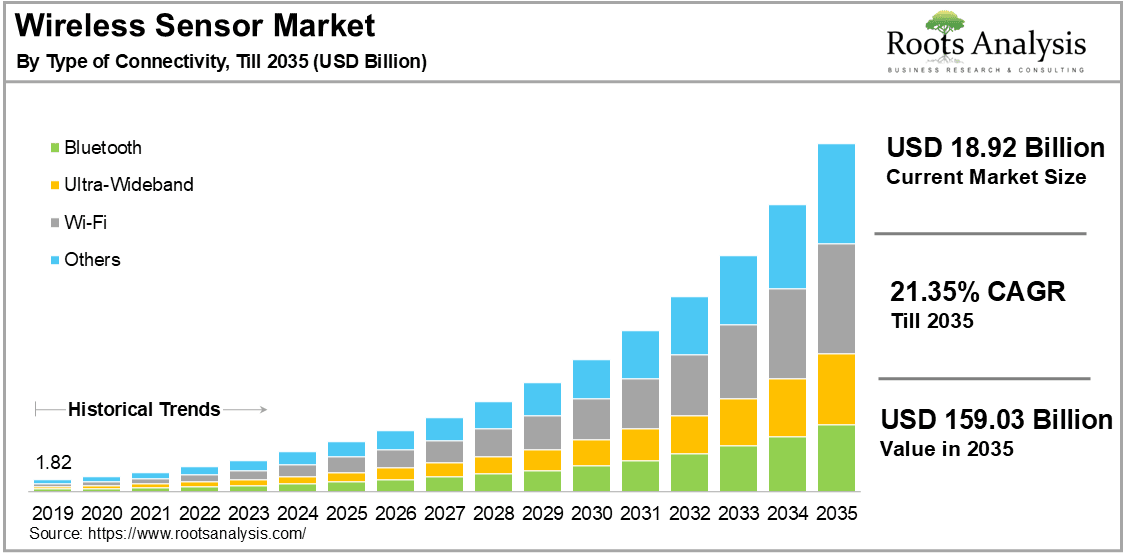
The wireless sensor market size is projected to grow from $18.92 billion in 2024 to $159.03 billion by 2035, representing a CAGR of 21.35% during the forecast period 2024-2035.
 |
To learn more about this report, request a free sample copy
The new research study consists of industry trends, detailed market analysis, key market trends of the wireless sensor market, SWOT analysis and value chain analysis.
Wireless sensor refers to a technology that detects and interprets motion which elevates standard setups. Sensing devices are capable of measuring various physical conditions or environmental parameters like temperature, pressure, humidity, luminosity, motion, gas sensor and other industrial sensors. These sensors operate by using electromagnetic / radio waves to detect and interpret motion. In addition, they transfer the collection of data to a central system, users’ devices, or gateways for monitoring and analysis with the help of microcontrollers or processors that process data collected and perform data conversion. Continuous technological advancements have boosted the significance of wireless sensors across various fields. Also, advanced communication technology such as Wi-Fi, Bluetooth, Zigbee, and cellular networks allow sensors to transmit data wirelessly, making it ideal technology in several industries. Subsequently, wireless sensors are employed in diverse applications from smart home security systems to health well-being, monitoring devices, and energy management systems as they advance the overall operational process and mitigate future problems.
Furthermore, the rising adoption of Internet of Things devices has fueled the demand for sensors, largely integrated with sensor technology to deliver real-time information and monitoring systems. Therefore, the growth of the wireless sensor market is expected to flourish with an outstanding CAGR throughout this forecast driven by the rising demand for industrial automation, remote monitoring, security, and safety applications. Also, worldwide, government initiatives and investments in smart city infrastructure including smart cities and smart grid are further attributed to accelerate the market growth during this forecast period.
The market report presents an in-depth analysis of the various service providers that are involved in offering wireless sensor market, across different segments, as defined in the table below:
| Key Report Attributes | Details | |
| Historical Trend | 2019-2023 | |
| Base Year | 2023 | |
| Forecast Period | 2024-2035 | |
| Market Size Value in 2024 | $ 18.92 Billion | |
| Market Size Value by 2035 | $ 159.03 Billion | |
| Growth Rate | CAGR of 21.35% from 2024 to 2035 | |
| Type of Sensor |
|
|
| Type of Connectivity |
|
|
| Type of Vertical |
|
|
| Geographical Regions |
|
|
| Leading Market Players |
|
|
| PowerPoint Presentation (Complimentary) |
Available | |
| Customization Scope | 15% Free Customization | |
| Excel Data Packs (Complimentary) |
|
|
The distribution of the global wireless sensor market is categorized into a variety of sensors such as ambient light sensors, blood oxygen sensors, chemical sensors, egg sensors, flow sensors, gas sensors, heart rate sensors, humidity sensors, image sensors, level sensors, motion & occupancy sensors, pressure sensors, proximity sensors, temperature sensor, and others. According to our projection, among the given categories, image sensors are anticipated to boost the growth of the segment with the major market share and will likely lead the market. Their widespread use in video surveillance, automotive, retail, and industrial applications forward the segment growth. Image sensors play a critical role in security cameras and control systems in improving the security level in homes, buildings, and public places. However, the temperature sensor segment is projected to grow at a higher CAGR due to its greater use in different industries from healthcare, and consumer electronics to automotive for monitoring and control processes.
This segment underscores the types of connectivity in the global wireless sensors market which include Bluetooth, infrared, radio frequency identification, ultra-wideband, Wi-Fi, ZigBee, z-wave, and others. As per market research, Wi-Fi connectivity is the most common technology which is widely being used in numerous sensors, thereby, escalating the growth of the segment with the highest market share. Moreover, the ultra-wideband segment is likely to grow at a substantial CAGR during this forecast period owing to its high precision accuracy, low interference, and high data transfer rates which are extensively used in location tracking, indoor navigation, and security systems.
Based on the type of vertical, the global wireless sensor market is segmented into aerospace & defense, agriculture, automotive & transportation, building automation, consumer electronics, energy & power, healthcare, industrial automation, oil & gas, transportation & logistics, and others. As per market research, the healthcare segment is attributed to dominating the market with the maximum market share owing to the increasing demand for sensors in the healthcare sector for medical devices and equipment. While building automation segment is expected to witness a notable CAGR in the upcoming decade due to the growing demand for security surveillance sensors and light sensors that aid in efficient energy, savings, and cost reduction.
This segment highlights the distribution of the Wireless Sensor Market across various geographical regions such as North America, Europe, Asia, Latin America, the Middle East, North Africa, and the rest of the world. In terms of market revenue, North America captures the largest market share and drives the wireless sensor market growth with its advanced industrial infrastructure, and increased adoption of IoT devices in the region. Furthermore, Asia is anticipated to expand at a faster growth rate with mounting demand for consumer devices, rapid industrial development, and a larger consumer base.
The “Wireless Sensor Market, Till-2035: Distribution by Type of Sensors (Ambient Light Sensors, Blood Oxygen Sensors, Chemical Sensors, EGG Sensors, Flow Sensors, Gas Sensors, Heart Rate Sensors, Humidity Sensors, Image Sensors, Level Sensors, Motion & Occupancy Sensors, Pressure Sensors, Proximity Sensors, Temperature Sensor, and Others) Type of Connectivity (Bluetooth, Infrared, Radio Frequency Identification, Ultra-Wideband, Wi-Fi, Zigbee, Z-Wave, and Others), Type of Vertical (Aerospace & Defense, Agriculture, Automotive & Transportation, Building Automation, Consumer Electronics, Energy & Power, Healthcare, Industrial Automation, Oil & Gas, Transportation & Logistics, and Others),Geographical Regions (North America, Europe, Asia, Latin America and Middle East and North Africa and Rest of the World): Industry Trends and Global Forecasts “report features an extensive study of the current market landscape, market size and future opportunity within their wireless sensor market, during the given forecast period. The market report highlights the efforts of several stakeholders involved in this rapidly emerging segment of the service providers industry. Key takeaways of the wireless sensor market report are briefly discussed below.
Industry 4.0 and Internet of Things (IoT) technology continue to advance the wireless sensor industry. Due to this, the wireless sensors market is going through a transformation with a rising need for real-time information and data insights which play a key role in wireless sensor technology. Thus, technology companies and sensor manufacturers are leveraging industry 4.0 technology and increasingly integrating sensors into the IoT ecosystem which aid in providing real-time data collection and monitoring across diverse applications from smart homes to industrial automation and healthcare. Correspondingly, the 5G integration with wireless sensors for greater connectivity is becoming an industry trend as it supports increased bandwidth, lower latency, high speed in data transfer, and reliable communication within sensor networks. As a result, by following these trends, industry players are availing lucrative opportunities in the global IoT sensors market.
Currently, numerous global and local sensor manufacturing and technology companies are operating in the wireless sensor market and boosting the competitive landscape. Mainly, established companies dominate the market with the acquisition of the largest market shares. Their advanced product portfolio and innovative technology position them in the global market for wireless sensors. Some of the prominent companies such as ABB, Analog Devices, Texas Instruments, Emerson, General Electric, Honeywell, and others stimulate market development through their efforts in research and development for advanced product ranges, cutting-edge technology, and strategic collaboration, partnership, acquisition, and mergers.
The wireless sensor market is projected to grow rapidly over this forecast period due to numerous key driving factors such as a hike in the use of IoT-connected devices across various applications like smart cities, industrial automation, and smart home appliances. This rising adoption of IoT devices has immensely boosted the demand for wireless sensors in several end-use industries. Additionally, the innovation in advanced communication technology similar to 5G, Bluetooth, and low power wide area network is contributing to improving the efficacy of wireless sensors, thereby lifting the market demand. Moreover, rising demand for remote monitoring, emphasis on environmental monitoring, and healthcare wearable devices are further anticipated to be significant key drivers for the wireless sensor market growth in the upcoming decade.
With respect to regional insights, North America’s advanced industrial infrastructure is a major factor in boosting the wireless sensor demand which highly depends on sensors technology to automate and monitor the process within applications industries. For instance, water lead sensors are extensively used in various applications that help in detecting plumbing failures or pipes that may burst. Similarly, oil & gas, chemical, and other industries heavily rely on wireless sensors for automated communication among critical industrial operational processes and systems to reduce future emergencies in various utilities, thereby augmenting the industrial sensor network market in the region. Furthermore, the region has strong spending on military and defense equipment that necessitates advanced sensors for aerial vehicles, drones, and fighter jets with high-end navigation systems. Therefore, these factors are collectively ascribed to fuel the wireless sensor market development over this projection period.
Examples of key service providers involved in the wireless sensor market (which have also been captured in this market report, arranged in alphabetical order) include ABB (Switzerland), Analog Devices (US), Emerson (US), General Electric (US), Honeywell (US), NXP Semiconductors (Netherlands), Schneider (France), Siemens (Germany), STMicroelectronics (Switzerland), TE Connectivity (Switzerland), Texas Instruments (US), Bosch (Germany). This market report includes an easily searchable Excel database of all the companies who have adopted the wireless sensor market.
The market report presents an in-depth analysis, highlighting the capabilities of various companies engaged in this domain, across different segments. Amongst other elements, the market report includes:
At Roots Analysis, we genuinely care about your success and understand that your business requirements are unique. While our market research reports provide valuable insights, we recognize that they might not cover every aspect you need to make well-informed strategic decisions. To account for that, we offer 15% free report customization tailored to your specific needs. Whether you require additional quantitative analysis, qualitative insights, or any other information related to the wireless sensor market, reach out us today at: support@rootsanalysis.com