
Lowest Price Guaranteed
Slides
177
Last Updated
March 2025
View Count
10589
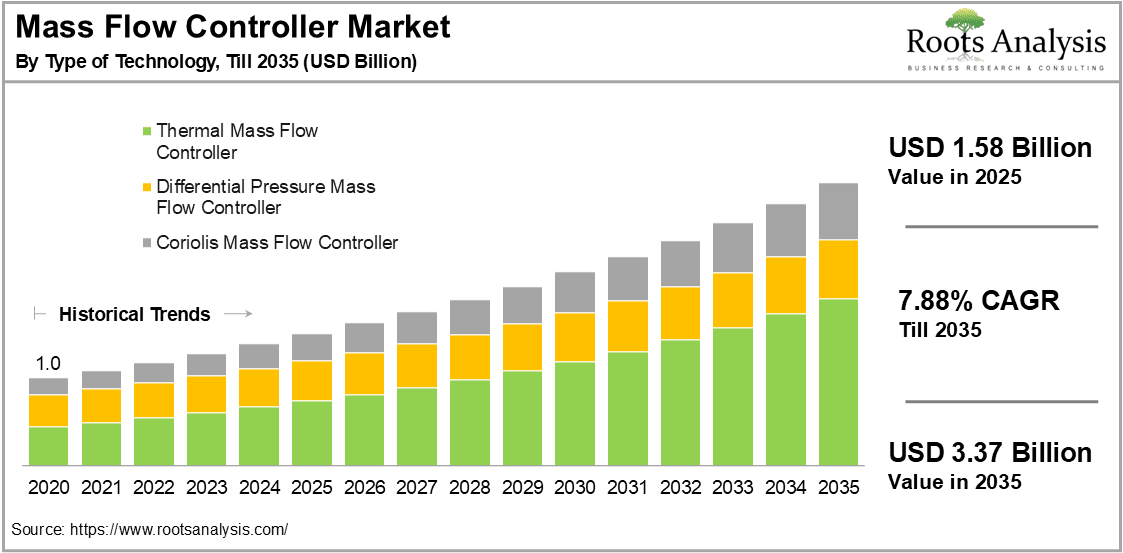
The mass flow controller market size is projected to grow from USD 1.58 billion in 2025 to USD 3.37 billion by 2035, representing a CAGR of 7.88% during the forecast period till 2035.
 |
To learn more about this report, request a free sample copy
The new research study consists of mass flow controller market and trends analysis, detailed market forecast analysis, and provide actionable strategic recommendations.
A mass flow controller (MFC) refers to a precision device that is engineered to measure and regulate the flow rate of fluids or gases in industrial operations. The purpose of the device is to ensure consistent and accurate flow based on mass rather than volume which is essential for applications from semiconductor manufacturing to pharmaceuticals where environmental factors such as temperature and pressure fluctuate. The rising penetration of industrial automation and industry 4.0 technologies across sectors is generating the demand for mass flow controller market. The impact of automation on flow control solutions has been transformative which is driving the adoption of advanced technologies like digital mass flow controllers for precise, efficient, and real-time process management across industries.
Therefore, the applications of mass flow controllers in oil and gas include precise measurement and regulation of gas flow in refining, petrochemical processes, and emissions monitoring, making the devices crucial to ensure efficiency and compliance with industry standards. Along with this, advancements in gas and liquid measurement technology have enhanced the accuracy, efficiency, and reliability of flow control solutions across diverse industrial applications, thus, stimulating the market growth. However, among the key end users, the semiconductor is the leading industry in terms of revenue generation.
As an effect, mass flow controller suppliers are capitalizing on this soaring demand by offering industry-specific advanced flow control solutions that ensure precise measurement and regulations on gases and liquids in various applications. Overall, coupled with key drivers, emerging trends such as growing demand for smart control solutions and the use of coriolis-based controllers are poised to flourish the market growth over this forecast period.
The mass flow controller market report presents an in-depth analysis of the various companies that are involved in offering mass flow controller, across different segments, as defined in the table below:
| Key Report Attributes | Details | |
| Historical Trend | Since 2020 | |
| Forecast Period | Till 2035 | |
| Current Market Size | $ 1.58 Billion | |
| Market Size Value by 2035 | $ 3.37 Billion | |
| CAGR (Till 2035) | 7.88% | |
| Type of Material |
|
|
| Type of Flow Rate |
|
|
| Type of Media |
|
|
| Type of Technology |
|
|
| Type of Connectivity |
|
|
| Type of End User |
|
|
| Geographical Regions |
|
|
| Leading Market Players |
|
|
| PowerPoint Presentation (Complimentary) |
Available | |
| Customization Scope | 15% Free Customization | |
| Excel Data Packs (Complimentary) |
|
|
The global mass flow controller market features different types of materials such as alloy, stainless steel and others. As per the mass flow controller market report, the stainless-steel segment is expected to dominate the market with the largest (~45%) share of the market by 2035. Stainless steel is generally corrosion-resistant, durable and able to perform in extreme temperatures with aggressive media, thereby, leading the segment. Also, its compliance with industry standards, precision, and reliability makes it ideal for manufacturing oil & gas, chemicals and renewable energy.
However, the alloy segment is anticipated to grow at a faster CAGR of (8.25%) during this forecast period. Alloy offers improved strength, corrosion resistance, and better durability with lightweight which are significant for several flow controller applications in industries from chemical to renewable energy sector.
The distribution of the market based on the type of flow rate is divided into low, medium, and high. According to our global mass flow controller market analysis, the low flow rate segment is projected to hold the highest (~43%) of the market share by 2035. This growth can be ascribed to its importance in semiconductor manufacturing, R&D, and biotechnology where precise flow control is essential. In addition, it supports the miniaturization of devices, energy efficiency, and clean energy technologies. Therefore, as the demand for smaller and more powerful electronics increases the need for semiconductor mass flow controllers will continue to grow.
Nevertheless, the high flow rate is expected to rise at a higher (8.62%) CAGR over this projection period. Industrial processes such as oil & gas power generation and chemical manufacturing require exact control of large volumes due to regulatory compliance which makes the segment crucial, fostering the market demand.
This segment of the market underscores the type media including gas mass flow controllers and liquid mass flow controllers. As per market research, the gas mass flow controller is anticipated to capture (~63%) of the market share by 2035. The key driving factor of the segment growth is the widespread use of the gas mass flow controller in the critical sector such as pharmaceuticals and clean energy which needs this type of mass flow controllers for emission monitoring and accurate control in manufacturing processes.
On the other hand, the liquid mass flow controller segment is likely to experience a notable (9.14%) CAGR during this forecast period. The mounting demand for process automation and Industry 4.0 boosts the implementation of liquid flow controllers integrated with digital protocols. Acceleration in smart manufacturing due to seamless integration with control systems for real-time monitoring and predictive maintenance advantages will push the market forward.
The distribution of the market based on the type of technology is split into coriolis-based mass flow controller, differential pressure-based mass flow controller, and thermal-based mass flow controller. According to our projection, the thermal mass flow controller segment. The thermal-based mass flow controllers are poised to capture the maximum (~48%) of the market share by 2035. The need for exceptional accuracy and reliability in chemical, pharmaceutical, and semiconductor manufacturing advances the demand for the technology. Thermal MFC are compatible with smart digital communication protocols which allow easy integration with industrial automation systems.
Whereas the coriolis-based mass flow controllers are predicted to rise at a higher CAGR of (9.4%) during this projection period. This technology offers real-time mass flow measurements without requiring temperature or pressure compensation. It can handle a wide range of fluids including gases, liquids, and even slurries which makes them suitable for numerous fields.
On the basis of the types of connectivity, the market is characterized into analog, devicenet, ethercat, ethernet IP, foundation fiedbus, mobdbus RTU, modbus TCP.IP, profibus, and RS-485. Between analog and digital connectivity, digital connectivity exhibits the dominance wherein, ethernet/IP is expected to hold (~40%) of the market share by 2035. Primarily, the advantages of enternet/IP fortify the segment’s growth which gives high speed, reliability, and scalability. Its seamless integration with SCADA systems, IIoT platforms and automation tools makes it a preferred choice for process automation.
While the Profibus segment is anticipated to experience a notable (8.95%) CAGR over this forecast period. Profibus drives the market owing to its compatibility with legacy systems and efficiency. As a result, it is widely adopted in oil & gas and chemical industries where it supports complex networks and performs well in harsh industrial environments.
This segment of the market for mass flow controllers is fragmented into a wide range of end-users ranging from chemicals, food & beverages, oil & gas, pharmaceuticals, semiconductors, water treatment, and others. As per this report, the semiconductor segment is predicted to occupy the largest (~42%) of the market share by 2035. The semiconductor industry leads the segment due to the importance of mass flow controllers in semiconductors manufacturing for precise gas flow and control during the process of etching and chemical vapor deposition. Further, the inflating demand for advanced electronics similar to smartphones, advanced computing technologies and IoT devices propel the expansion of the semiconductor sector which will likely hold this dominance.
However, the chemical industry is expected to grow at a significant CAGR of (9.77%) during this forecast period. The chemical field is one of the leading users of mass flow controllers that relies on the equipment to regulate the accurate flow of gases and liquids during reactions, mixing, and processing. As well as the stringent quality and safety assurance make the equipment necessary for the industry to meet strict safety and environmental standards in chemical production.
This segment highlights the distribution of the Mass Flow Controller Market across various geographical regions, such as North America, Europe, Asia, Latin America, the Middle East and North Africa, and the rest of the world. The market size of mass flow controllers in North America is dominates the global landscape with the highest (~46%) of the market share till 2035. Additionally, Asia is projected to expand at the fastest (10.74%) CAGR during this projection timeframe. The major factor behind the growth of the market is the manufacturing hub of semiconductors in Asia. Countries such as China, South Korea, and Taiwan are the global leaders in semiconductor production that need advanced flow control solutions for the manufacturing process. Apart from this, the expanding industrial based and mounting investment in clean energy along with government support and polices, the region will likely transform the trajectory for the mass flow controller market in the upcoming decade.
The “Mass Flow Controller Market, Till-2035: Industry Trends and Global Forecasts” report features an extensive study of the current market landscape, market size and future opportunities within the mass flow controller market, during the given forecast period. The market report highlights the efforts of several stakeholders involved in this rapidly emerging segment of the service providers industry. Key takeaways of the mass flow controller market report are briefly discussed below.
Significant key drivers such as growing demand in the semiconductor industry is contributing to elevating the mass flow controller market growth. The soaring implementation of semiconductors across myriad sectors from electronics to IoT devices raises the need for precise mass flow controllers in processes such as chemical vapor deposition and etching, driving the market demand. Additionally, the surge in demand for precision instruments in manufacturing processes is attributed to this market growth as industries are focusing on delivering high-quality products where these instruments ensure every aspect of the manufacturing process meets exact specifications.
Furthermore, rising awareness of the benefits of using smart flow meters is also expected to foster the market evolution. Ongoing innovation in the technology has excelled the benefits of smart flow meters that offer real-time monitoring, remote access, and improved accuracy that allow businesses to streamline their operations with regulatory compliances. Resulted in, these growth drivers for the mass flow controller industry are anticipated to double the market potential in the future as well.
Currently, several global and regional industry players such as Bronkhorst, Brooks Instruments, Alicat, HORIBA coupled with many others are boosting the competitive landscape of mass flow controllers industry. These top companies are leading the market competition with their advanced technologies, and tailored solutions. Their strategic partnership, high capital investment in R&D and cost-effective offerings are shaping the market dynamics. Industry players are constantly striving to retain their market position by emphasizing innovation and the production of smart mass flow controllers to cater to specific industry needs.
Along with key drivers, the market has some significant challenges such as technological complexity and the high cost of smart controllers which can impact the growth of the market. The integration of innovative technologies such as MEMS, IoT, and AI can increase system complexity and lead to potential issues in installation and operation. Also, the manufacturing of advanced controllers often is expensive which can confine the adoption particularly, among budget-constrained SMEs. Consequently, these considerable challenges in the mass flow controller market need to be addressed to take the market to its full potential growth.
According to a regional analysis of the mass flow controller market, North America is poised to dominate the market majorly owing to its advanced technological infrastructure and thriving semiconductor industry. This has strengthened the foundation of industrial automation and precision engineering which continue to raise the demand for advanced flow control solutions. Additionally, high R&D investment along with strict government standards encourage the adoption of high-precision flow control devices across industries. Moreover, the increased focus on renewable energy projects and hydrogen production has increased the demand for precise gas flow measurement and control solutions which substantially contributed to driving the development of the mass flow control market in North America and will likely retain this position in the forthcoming years.
Examples of key players involved in the market for mass flow controller (which have also been captured in this market report, arranged in alphabetical order) include Aalborg (US), Alicat Scientific (US), Axetris (Switzerland), Azbil (Japan), Bronkhorst (Netherlands), Brooks Instrument (US), Christian Burkert (Germany), Hitachi Metal (Japan), HORIBA (Japan), IMI Plc (UK), MKS Instruments (US), Omega Engineering (US), Oval (Japan), Parker Hannifin (US), Sensirion (Switzerland), Sierra Instruments (US), Teledyne Technologies (US). This market report includes an easily searchable excel database of all the companies who have adopted the mass flow controller market.
The market report presents an in-depth analysis, highlighting the capabilities of various companies engaged in this domain, across different segments. Amongst other elements, the market report includes:
At Roots Analysis, we genuinely care about your success and understand that your business requirements are unique. While our market research reports provide valuable insights, we recognize that they might not cover every aspect you need to make well-informed strategic decisions. To account for that, we offer 15% free report customization tailored to your specific needs. Whether you require additional quantitative analysis, qualitative insights, or any other information related to the mass flow controller market, reach out us today at: support@rootsanalysis.com