


 Download Free Sample
 Buy Now
Memristor Market Overview
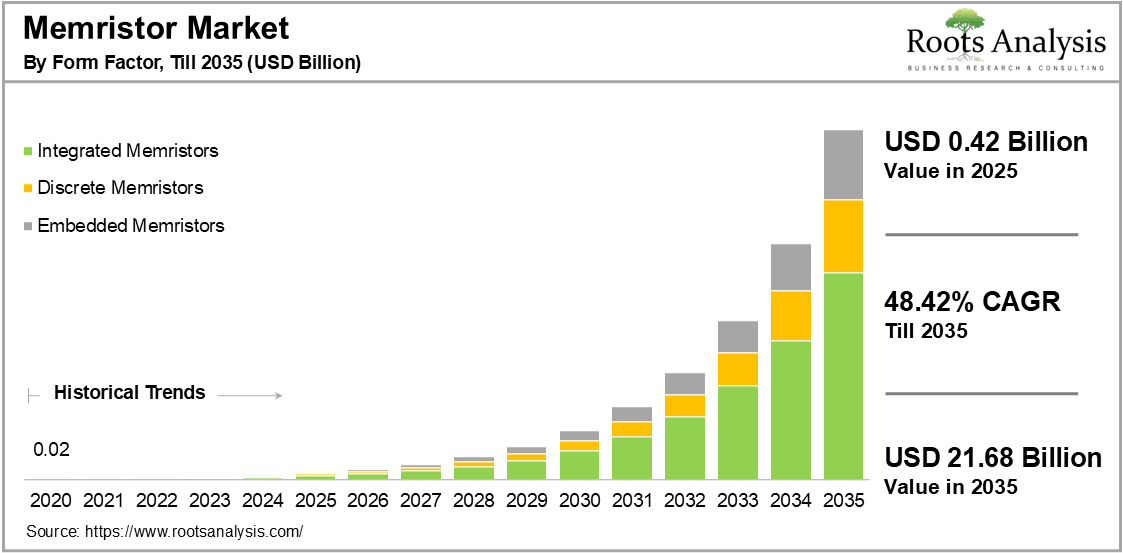
The global memristor market size, valued at USD 0.42 billion in 2025, is projected to reach USD 4.47 billion by 2030, and USD 21.68 billion by 2035, with a CAGR of 48.42% during the forecast period 2025-2035.
See What’s in the Full Report – Request Your Complimentary Insights!
A memristor, short for “memory resistor,” is a fundamental passive electronic element that dynamically adjusts its resistance depending on the past current flow and retains this memory even when powered off, making it a core technology in resistive switching memory. Beyond memory storage, these devices are pivotal in next-generation memory technology markets, especially for neuromorphic computing memristors, where synaptic-like processing can be emulated for efficient neural network implementations.
This innovation represents a significant shift from traditional memory technologies towards multifunctional platforms that integrate storage, computation, and sensing capabilities, fostering lower latency and reduced power consumption. The scalability of memristors and compatibility with semiconductor fabrication processes supports their integration in advanced electronic systems aimed at AI, edge computing, and adaptive sensor networks.
In essence, the rapid memristor market growth is driven primarily by the increasing uptake of non-volatile memory solutions, which are critical in enabling faster and more energy efficient memory devices across various end-user sectors, such as data centers, consumer electronics, and industrial IoT.
Recent Developments in the Memristor Market
The memristor market report presents several research and development activities led by established semiconductor firms and specialized startups. In addition, academic institutes are positively contributing to the development of advanced memory resistors. These efforts focus on enhancing device endurance, switching speeds, and energy efficiency to unlock broader commercial adoption.
- In January 2025, team of researchers at Korea Advanced Institute of Science and Technology (KAIST) developed a self-learning memristor. This memristor has the capability to correct errors and learn from mistakes.
- In November 2024, University of Kansas and University of Houston announced a joint project for development of atomically tunable memory resistors for brain-inspired advanced computing. The project is supported by industry players including Samsung, Intel and Micron.
Market Dynamics
Key Market Drivers Fueling Growth
- Rising Demand for High-Speed, Energy-Efficient Memory Solutions: Memristors, as non-volatile memory devices, offer ultra-fast switching speeds and significantly lower power consumption compared to traditional memory. This propels the memristor market growth globally.
- Emergence of AI, Neuromorphic Systems, and Edge Computing: Breakthroughs in neuromorphic computing and artificial intelligence hardware are propelling memristor adoption. As the ability of neuromorphic computing memristors to mimic synaptic functions is critical for next-gen AI hardware and edge devices demanding real-time analytics.
- Miniaturization and Adoption in Portable Electronics: The trend towards smaller, integrated components in smartphones, wearables, AR/VR, and medical devices sustains interest in energy efficient memory devices market solutions like memristors.
Market Challenges Limiting Adoption of Memristors
- Manufacturing Complexity and Scalability Challenges: Complex fabrication techniques, scaling issues, and low yield continue to challenge memristor industry, restricting cost-effective mass production.
- Competition from Established Memory Technologies: Established memory technologies such as NAND and DRAM retain price and ecosystem dominance, making it imperative that memristors provide differentiated performance or cost benefits for significant adoption.
- Endurance, Retention, and Long-Term Reliability Concerns: Although memristors boast potential for ultra-fast and low-power operation, certain device types (e.g., nanoionic) present challenges regarding data retention and long-term cycling reliability, especially under demanding workloads or environmental conditions.
Get an Instant Quote in 10 Minutes. Lowest Price Guaranteed
Market Share Insights
Resistive Memristors Dominate the Market, While Nanoionic Memristors Market is Growing Rapidly
The resistive memristors / resistive switching memory (ReRAM) market currently dominates the global memristor industry, capturing the largest market share. This dominance is attributed to their proven reliable switching characteristics, mature manufacturing processes, and versatility across both memory storage and logic computing applications.
Companies like Panasonic and Crossbar have actively developed resistive switching memory technologies, confirming broad industrial adoption. Moreover, the resistive segment's mature ecosystem facilitates rapid integration into consumer electronics, automotive systems, and industrial automation, enabling stable revenue growth and stronger market foothold.
In contrast, the nanoionic memristor segment is projected to have the fastest compound annual growth rate (CAGR) of 49.20% over the forecast period. This accelerated growth is driven by superior switching speeds, minimal energy loss, and longer device lifetimes compared to other memristor technologies.
Spin and Magnetic Memristor Technology Set to Grow Rapidly
Current memristor market forecast estimates indicate that molecular and ionic thin film technologies sub-segment hold the largest market share. However, spin and magnetic memristors are projected to experience the fastest CAGR of around 47.45%, driven by their energy-efficient characteristics, improved data storage density, and robust non-volatility.
These memristors are emerging as preferred choices for specialized computing solutions and the next-generation memory technology market, particularly in AI-driven and edge computing applications demanding high reliability and performance.
Integrated Memristors Dominate in Form Factor Segment
The integrated memristors hold the largest memristor market share. This is due to superior CMOS compatibility and ultra-low power requirements. These attributes make integrated memristors highly suitable for emerging applications in AI acceleration, neuromorphic computing, and energy efficient memory devices.
Additionally, the integrated form factor segment is expected to grow with a higher CAGR during the forecast period 2025-2035, reflecting increasing adoption rates in high-performance computing and edge device markets, where low-latency processing is a critical requirement.
Digital Memory Dominates the Application Segment
Currently, digital memory accounts for the largest memristor market share by application. This is due to its non-volatile nature, where it can retain information even when power is turned off. This is particularly advantageous for energy efficient memory devices, computing systems as well as low-power IoT sensor-based devices as it reduces the need for continuous refreshing of data, unlike volatile memory technologies, such as DRAM.
On the other hand, the neuromorphic & biological systems sub-segment is expected to witness the fastest CAGR (49.21%). The neuromorphic computing memristors are efficient in mimicking the brain’s ability to process multiple signals in parallel. Their fast and simultaneous data processing across many nodes, which further helps with significantly faster computation also boosts the growth of this market.
Pay Only for What You Need – The Best Way to Optimize
Consumer Electronics and Healthcare Sectors Lead End-Use Markets
Consumer electronics sector currently holds the majority (58.12%) of the end user market share, driven by memristor technology’s ability to deliver faster read / write speeds compared to traditional NAND flash memory. This leads to significantly improved user experiences in smartphone, smart TVs, and gaming consoles, areas where memory performance is paramount.
On the other hand, the healthcare sector is expected to witness the fastest CAGR due to increased use of memristors in wearable medical devices and portable diagnostics, benefiting from localized data processing and energy savings, which improve battery life and device durability.
Regional Insights: North America Leads While Asia-Pacific Grows Fastest
North America dominates the memristor industry, accounting for 40.72% share. The growth is driven by high investment levels in R&D by domestic companies and strong demand for non-volatile memory in AI accelerators and computing hardware. Further, as the US is one of the largest market for consumer electronics, memristor technology is increasingly finding its way into smartphones and smart home systems, resulting significant growth in the region.
Meanwhile, the memristor market in Asia-Pacific is set to witness the fastest CAGR (49.85%) during the forecast period, boosted by rapid technological advancements, manufacturing leadership, and expanding digital infrastructure across countries like China, South Korea, and Japan.
Want Information on Specific Region / Segment?
Market Key Takeaways
Competitive Landscape of Leading Companies in Memristor Industry
The memristor market remains highly competitive, shaped by large tech players and dynamic startups competing for leadership, globally. Strategic alliances, research partnerships, and mergers are accelerating the commercialization of non-volatile memory and specialized resistive switching memory devices.
The market is driven by breakthroughs in AI, IoT, and neuromorphic computing. It is also worth mentioning that the North America is currently dominating the memristors industry, whereas Asia Pacific is expected to grow fastest through 2032, supported by massive electronics manufacturing and strategic investments in AI (especially in China and South Korea). Europe’s leading research institutions and the region’s push for advanced automotive and industrial solutions also contribute to robust growth.
Memristor Market Growth in Edge Computing
The rapid rise of edge computing is significantly accelerating the growth of the memory resistor industry. Memristors serve as highly energy-efficient memory components enabling real-time data processing at the network edge, while ensuring reduced power consumption and enhanced reliability in challenging operating conditions. These factors are expected to sustain robust market demand, reinforcing a strong growth outlook for memristors in edge computing applications.
Applications of Memristors in IoT Devices
- Memristors facilitate energy-efficient memory storage in IoT, crucial for battery-powered and resource-constrained sensors, thereby fueling widespread IoT adoption.
- Local rapid computation via memristors aids faster and lower-latency operations.
- Growth of neuromorphic computing memristors holds the potential to transform AI-powered and smart IoT devices, accommodating ever-evolving network demands.
Performance Benefits of Memristor-based Memory
- Non-volatile memory delivers ultra-fast switching and scalable density, especially in comparison to conventional solutions.
- Supports lower power consumption (up to 100× less than flash memory).
- Multi-level cell storage capability supports high-performance digital and analog memory applications.
- The memristor market trends point to advanced neuromorphic and AI systems as major users of these benefits.
Emerging Suppliers in the Memristor Market
- Over 40 suppliers spanning startups and MNCs, currently supply core memristor technologies worldwide.
- Startups ecosystem of suppliers in North America, Europe, and Asia is highly competitive, supported by strategic partnerships and increased R&D investments.
Memristor Integration in Next-Generation Processors
- Integrated memristor chips enable true in-memory computation, fusing processing and storage for new performance frontiers.
- They enable development of in-memory computation devices that combine storage and processing to reduce data constrictions.
- Integration challenges remain, but innovations are ongoing to embed memristors into CPUs and AI accelerators for better efficiency.
Investment Opportunities in Memristor Startups
- Significant venture capital is fueling memristor market growth across startups focused on new device concepts, materials, and system architectures.
- M&A and joint ventures are reshaping industry boundaries, with a rise in both specialized and diversified memristor companies.
- The growing demand from edge computing, AI, and high-density memory for big data / IoT enhances the commercial potential for innovative memristor technologies, thereby continuing to attract early-stage and strategic investors.
Unlock Deeper Insights – Schedule Your Personalized Workshop Today!
Memristor Market: Scope of the Report
| Key Report Attributes | Details | |
| Historical Trend | Since 2020 | |
| Forecast Period | Till 2035 | |
| Market Size 2025 | USD 0.42 Billion | |
| Market Size 2035 | USD 21.68 Billion | |
| CAGR (2025 - 2035) | 48.42% | |
| Type of Memristor |
|
|
| Technology |
|
|
| Form Factor |
|
|
| Application |
|
|
| End Use Industry |
|
|
| Geographical Regions |
|
|
| Key Players Profiled | ||
| PowerPoint Presentation (Complimentary) | Available | |
| Customization Scope | 15% Free Customization | |
| Excel Data Packs (Complimentary) |
|
|


