


 Download Free Sample
 Buy Now
Market Size
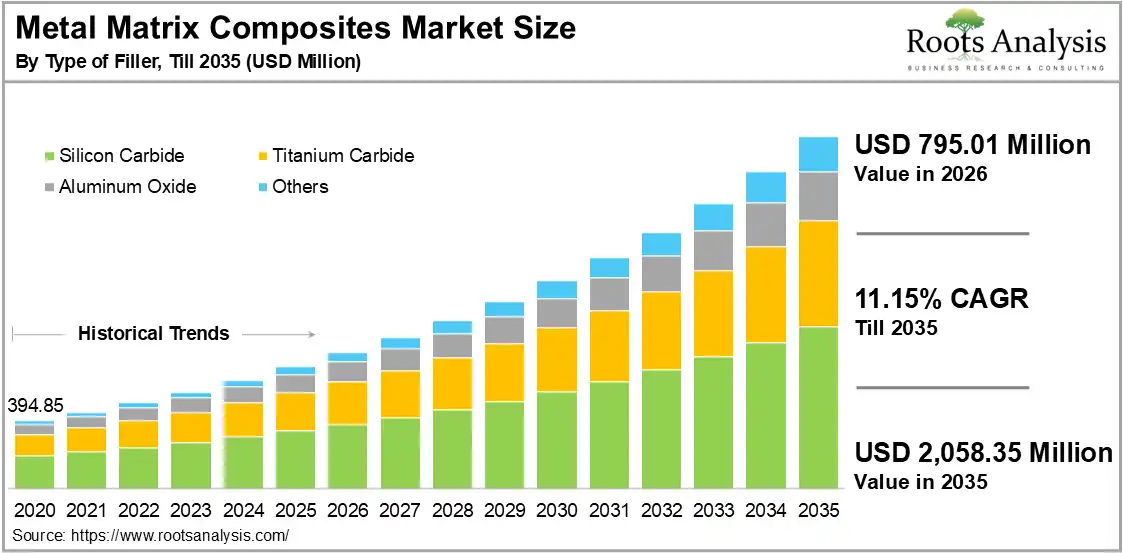
The global metal matrix composite market size is projected to reach USD 795.01 million in 2026, USD 1,348.65 million in 2030, and USD 2,058.35 million by 2035, representing the 11.15% CAGR during the forecast period.
See What’s in the Full Report - Request Your Complimentary Insights!
Market Overview
A metal matrix composite (MMC) is a class of advanced materials composed of a metallic matrix, such as aluminum, magnesium, copper, or titanium, reinforced with secondary phases, such as ceramic reinforced metal composites particles (e.g., alumina, silicon carbide) or fibers. The reinforcement is embedded within the continuous metal matrix, resulting in a material that combines the ductility and conductivity of metals with enhanced strength, stiffness, and wear resistance provided by the reinforcements. MMCs are typically classified based on the type of reinforcement used- continuous, discontinuous or particles.
MMCs have emerged as a transformative solution in materials engineering, offering a unique balance of lightweight properties and mechanical robustness. As industries strive for efficiency and sustainability, MMCs are increasingly replacing traditional metals and alloys in critical applications.
According to Dr. Jean-François Silvain, CNRS Research Director at the Bordeaux Institute of Condensed Matter Chemistry, the use of a metal matrix in a composite offers several advantages over organic matrices: improved temperature resistance, extending the limits of use in hypersonic structures and engine environments; better physical properties (mechanical, thermal, electrical) intrinsic to the matrix, enabling localized or unidirectional reinforcement; and better resistance to ageing and fire. These attributes have made MMCs indispensable in sectors, such as aerospace, automotive, and electronics, where performance under extreme conditions is paramount.
Pay Only for What You Need – The Best Way to Optimize
Market Share Insights
Which Type of MMC Will Dominate the Market?
Among the type of MMC, the aluminum MMC sub-segment is set to take the lead, holding a significant share of 53.78%.
This significant market position can be attributed to aluminum's versatile properties, including high specific strength and stiffness, superior wear resistance, and excellent dimensional stability. The aluminum matrix composite finds its use in industries, including automotive, and aerospace as they are extensively used in brake rotors, pistons, cylinder liners, and other critical components.
Further, the material's ability to be reinforced with various materials, such as aluminum oxide, silicon dioxide, silicon carbide, carbon and boron nitride is further strengthening the market position.
However, the refractory MMC sub-segment will witness the fastest metal matrix composites market CAGR (12.18%) during the forecasted period.
How is the Discontinuous Sub-Segment Dominating the Market?
According to our metal matrix composite market analysis, the discontinuous sub-segment stands out as the leading one, holding a market share of 54% as well as with the fastest CAGR (12.77%) during the forecasted period.
Discontinuous MMCs are widely used in various automotive components, such as piston rods, piston pins, value spring caps, brake disks, brake pads, shafts, and others. Further, the growing demand for automotive vehicles from emerging countries, including China, India, and Brazil is also majorly fueling the growth of the discontinuously reinforced MMC market.
Which Filler Will Dominate the Metal Matrix Composites Market?
According to our metal matrix composite market analysis, the silicon carbide sub-segment stands out as the leading one, holding a market share of 47%.
This growth can be attributed to silicon carbide reinforced composites' superior properties, including high thermal conductivity, low coefficient of thermal expansion, high elastic modulus, excellent thermal shock resistivity, and superior chemical resistance.
Further, the material's ability to enhance mechanical properties, such as fatigue resistance, tensile strength, and fracture properties of metal matrix composites has made it particularly valuable in structural metal matrix composite applications across aerospace, automobile, industrial, and electronics industries.
Meanwhile, the titanium carbide sub-segment is expected to witness the fastest CAGR (13.12%) during the forecasted period.
Which Production Technology Will Dominate the Metal Matrix Composites Market?
Of the production technology, the powder metallurgy sub-segment is set to hold the largest share of 67% as well as the fastest CAGR (12.11%) during the forecasted period.
This segment growth can be attributed to increased adoption of technologies, such as hot pressing, ball mill mixing, extrusion and vacuum pressing to manufacture metal matrix composite.
Additionally, its compatibility with various materials and the increasing demand for powder metallurgically produced MMC products from industries, such as aerospace and ground transportation, are further driving the MMC market in powder metallurgy production technology.
Which End Use Industry Will Dominate the Metal Matrix Composites Market?
Of the end use industry, the automotive & locomotive is set to hold the largest revenue share of 40% during the forecasted period.
This growth can be attributed to the extensive use of metal matrix composites in various automotive applications, including engine components, brake systems, driveshafts, and critical automotive parts, such as pistons, cylinder liners, valves, pushrods, and connecting rods.
The segment growth is further being strengthened by the increasing adoption of metal matrix composites in locomotive applications, particularly in brake discs used in European railways and specific models of passenger cars.
Meanwhile, the electrical and electronics sub-segment accounted for the fastest CAGR (12.99%) due to explosive growth of wireless earbuds and headphones.
North America is Set to Dominate the Metal Matrix Composites Industry
The North American metal matrix composites market exhibits dominance by capturing 36.86% of the overall current market share.
According to our regional analysis of MMC market, this growth is primarily driven by the presence of well-established automotive & transportation as well as aerospace & defense industries. Further, the presence of major automobile and aircraft manufacturers in the US and Canada are also responsible for the high consumption of MMC in the region.
On the other hand, the Asia Pacific market is set to witness the fastest CAGR (14.11%) during the forecasted period.
Have Questions? Let’s Get Them Answered.
Key Market Insights
Market Drivers
- Escalating Need for Lightweight and Durable Materials in Aerospace and Automotive Sectors: The aerospace and automotive industries are primary drivers for the metal matrix composite market. These sectors require materials that combine lightweight properties with exceptional mechanical strength and durability. Metal matrix composite for aerospace, reduces component weight, which is crucial for enhancing fuel efficiency and payload capacity, while in automotive, it helps meet stringent emissions and fuel economy standards.
- Growing Demand from Defense and Electronics Industries: MMCs are increasingly adopted in defense applications for their superior strength, wear resistance, and thermal stability. They are also used in electronics for heat sinks and packaging due to their excellent thermal conductivity. The rising need for high-performance materials in these sectors is expected to drive market growth.
- Advancements in Manufacturing Technologies and Material Science: Ongoing research and development efforts are leading to innovations in MMC manufacturing processes, such as powder metallurgy and additive manufacturing. These advancements enable the production of complex, high-performance components and expand the application scope of MMCs across various industries.
- Rising Focus on Energy Efficiency and Sustainability: The global push for energy efficiency and environmental sustainability is increasing the demand for lightweight, high-strength materials. MMCs help reduce energy consumption and emissions in transportation and industrial applications, aligning with regulatory and sustainability goals.
Market Challenges
- High Manufacturing and Raw Material Costs: The production of MMCs involves complex processes and the use of expensive raw materials, leading to high manufacturing costs and limiting adoption in cost-sensitive markets.
- Technical Complexity and Skilled Labor Requirements: Manufacturing MMCs requires advanced technology and skilled labor, posing barriers for new entrants and smaller companies.
- Supply Chain Disruptions and Raw Material Volatility: Fluctuations in the prices and availability of key raw materials, such as aluminum, magnesium matrix composite, and silicon carbide, can disrupt production and affect profitability.
- Competition from Alternative Materials: The emergence of alternative high-performance materials, such as advanced polymers and composites, may challenge the dominance of MMCs in certain applications.
Competitive Landscape of Key Players in Metal Matrix Composites Industry?
The metal matrix composites market is competitive, with leading players, including 3M, ADMA Products, CeramTec, CPS Technologies, Denka Company, Deutsche Edelstahlwerke, all of whom focus on innovation, product launches, and expanding their global reach. These companies invest heavily in R&D to offer differentiated solutions, while also facing competition from open-source and emerging proprietary companies. Apart from that, competitors are opting for various technological innovations to strengthen their position in the metal matrix composites competitive landscape 2025.
What is the Impact of Automotive Sector on Metal Matrix Composite Industry?
The automotive sector is a leading consumer of metal matrix composites (MMCs), using them to reduce vehicle weight, improve fuel efficiency, and meet emissions regulations. MMCs are widely used in engine parts, brake discs, and structural components, supporting the industry's shift toward lighter and more durable vehicles.
What are the Advancements in Lightweight Metal Matrix Composites?
Recent advancements include the development of MMCs with improved strength-to-weight ratios, enhanced wear resistance, and better thermal properties. Technologies, such as powder metallurgy and new reinforcement materials are enabling lighter, more durable composites for automotive and aerospace applications.
What are the Challenges in Metal Matrix Composite Manufacturing and Cost?
High production costs, complex manufacturing processes, and challenges in achieving uniform dispersion of reinforcements hinder large-scale adoption. Additionally, fluctuating raw material prices and the need for specialized equipment add to the cost pressures.
How is Metal Matrix Composite Market Growth Driven by Aerospace Industry?
The aerospace industry is a major growth driver for MMCs, as these materials are essential for lightweight, high-strength, and heat-resistant components in aircraft and spacecraft. Their use helps improve fuel efficiency and performance while meeting strict safety and durability standards.
How are Government Policies Influencing Metal Matrix Composites Market?
Government regulations promoting fuel efficiency, emissions reduction, and advanced manufacturing technologies are encouraging greater MMC adoption, particularly in automotive and aerospace sectors. Policies supporting research and development also help drive market growth.
Your Business is Unique – Why Shouldn’t Your Report Be?
Metal Matrix Composites Market: Scope of the Report
| Key Report Attributes | Details | |
| Historical Trend | Since 2020 | |
| Forecast Period | Till 2035 | |
| Market Size 2026 | $ 795.01 Million | |
| Market Size 2035 | $ 2,058.35 Million | |
| CAGR till 2035 | 11.15% | |
| Type of MMC |
|
|
| Reinforcement Phase |
|
|
| Type of Filler |
|
|
| Production Technology |
|
|
| End Use Industry |
|
|
| Geographical Regions |
|
|
| Key Players Profiled |
|
|
| PowerPoint Presentation (Complimentary) | Available | |
| Customization Scope | 15% Free Customization | |
| Excel Data Packs (Complimentary) |
|
|


