


 Download Free Sample
 Buy Now
Global Metamaterials Market Overview
The global metamaterials market size is expected to rise from USD 1.55 billion in 2025 to USD 8.77 billion by 2030, and USD 17.44 billion by 2035, representing an overall CAGR of 27.4% till 2035.
 |
See What’s in the Full Report–Request Your Complimentary Insights!
Metals have been a crucial part of antennas since their invention in 1888. However, these metals could not operate across various frequencies, causing them to lose significant energy and limiting their functionality. To navigate this limitation of metals, industry witnessed the emergence of metamaterials, which are equipped with the ability to manipulate electromagnetic waves, radio waves, and even light.
Manufacturers create metamaterials by repeating arrays of nano and microscale structures that possess unique properties of absorbing or redirecting waves in other directions. Industries favor metamaterials for their enhanced precision, modular design, and advanced technology, that ensure quality and controlled application in sectors, such as automotive, aerospace, and defense.
Moreover, metamaterial’s ability to operate over various frequencies makes them an ideal choice in applications requiring faster wireless networks (like 5G and 6G), such as massive MIMO base stations and millimeter-wave small cells.
The metamaterials market is rapidly emerging as a key driver in the global transition toward innovation and technological advancement aimed at enhancing efficiency. The use of diverse raw materials in metamaterial fabrication has been instrumental in unlocking their unique properties and expanding their potential applications across industries.
Metamaterials Market: Report Attributes
| Key Report Attributes | Details | |
| Historical Trend | Since 2022 | |
| Forecast Period | Till 2035 | |
| Market Size 2025 | $ 1.55 Billion | |
| Market Size 2035 | $ 17.44 Billion | |
| CAGR (Till 2035) | 27.4% | |
The metamaterials market forecast features the likely distribution of the current and forecasted opportunity within the metamaterials domain across various segments, such as type of metamaterial, product form, applications, end use industry and geographical regions
We have created three market forecast scenarios, conservative, base and optimistic, to account for future uncertainties in key parameters and enhance the robustness of our model. These scenarios represent different tracks of the industry's evolution.
 |
Growing demand for advanced optical and electromagnetic applications, along with strict industry standards and the need for innovative solutions for next-generation telecommunications, medical imaging, and defense technologies, drives the metamaterials market’s expansion, ensuring product reliability and consumer confidence.
Breakthroughs in technologies, such as nanofabrication and computational design, significantly enhance the precision and functionality of metamaterials in cutting-edge applications like cloaking, sensing, and telecommunications.
Recent Developments in Metamaterials Market
There have been several recent developments in the field of metamaterials, and we have outlined some of these below. These developments, even if they arose after our market report’s release, support the overall EMI shielding market trends detailed in our analysis.
- In May 2025, The University of Exeter raised the sum of EUR 19.6 million for metamaterials research.
- In February 2025, Kapta Space procured the sum of USD 5 million in funding to develop meta surface antenna technology for space-based radar, enabling continuous target tracking.
- In February 2025, Tsinghua University researchers developed a silicon nitride-based electromagnetic metamaterial with negative dielectric constant and magnetic permeability, marking a significant breakthrough in materials science.
- In November 2024, IIT Kanpur has unveiled the Analakshya Metamaterial Surface Cloaking System (MSCS), a textile-based broadband microwave absorber that renders objects nearly invisible to radar, enhancing stealth capabilities for India's armed forces.
Metamaterials Market Segmentation Insights
The market research report presents an in-depth analysis of the various metamaterials companies, across different segments, as defined in the table below:
Metamaterials Market: Market Segmentations
| Market Segmentations | Details | |
| Type of Metamaterial |
|
|
| Product Form |
|
|
| Applications |
|
|
| Type of Enterprise |
|
|
| End Use Industry |
|
|
| Key Geographical Regions |
|
|
| Market in North America |
|
|
| Market in Europe |
|
|
| Market in Asia |
|
|
| Market in Latin America |
|
|
| Markets in Middle East and North Africa, and Rest of the World |
|
|
The demand for metamaterials is increasing due to their unique ability to manipulate electromagnetic, acoustic, and thermal waves, driving innovation across telecommunications, aerospace, defense, and healthcare. Further, advancements in nanotechnology, rising investments in 5G and 6G infrastructure, and growing applications in stealth technology and medical imaging are key factors fueling the metamaterials market growth.
In fact, industry leaders recognize the metamaterials market as a vital driver of innovation and technological advancement aimed at achieving greater efficiency. For instance, Alastair Hibbins (Joint Network Lead (Executive Board), UK Metamaterials Network), emphasizes, “If we really want to fulfil their potential, we’d ideally fund metamaterials as a national UK Programme, just as we do with quantum technology. Defence has been one of the leaders in funding metamaterials because of their use in communications, but we want industry more widely to adopt metamaterials, embedding them in everyday devices.”
Have Questions? Let’s Get Them Answered.
Metamaterials Market Share Insights
Market Share by Type of Metamaterials: Electromagnetic Metamaterials Holds the Largest Share
- Metamaterials market is segmented into various types of metamaterials, including electromagnetic metamaterial, optical metamaterial, thermal metamaterial, acoustic metamaterial and other metamaterials. Notably, the electromagnetic metamaterial segment will lead the market and is likely to grow at a higher CAGR (28.99%) during the forecast period.
- This is likely due to the unique ability of electromagnetic metamaterial to manipulate electromagnetic waves, enabling innovative applications in industries like aerospace, defense, and medical imaging.

Market Share by Product Form: Thin Films Market Opportunities
- In terms of product form, the global market is segmented into thin film and bulk materials. As per our metamaterials market forecast, the thin film sub-segment will lead the market for metamaterials, capturing the largest revenue share of 54.95% in 2025.
- This can be attributed to the unique properties, such as negative refractive index and tunable permittivity that allow for improved signal directionality, bandwidth, and efficiency in antennas, making them ideal for advanced communication and radar systems.
- The bulk materials sub-segment is likely to be the fastest growing segment in this industry, with annualized rate (CAGR) of 28.27% during the forecast period.
Market Share by Applications: Antenna and Radar Hold the Largest Share
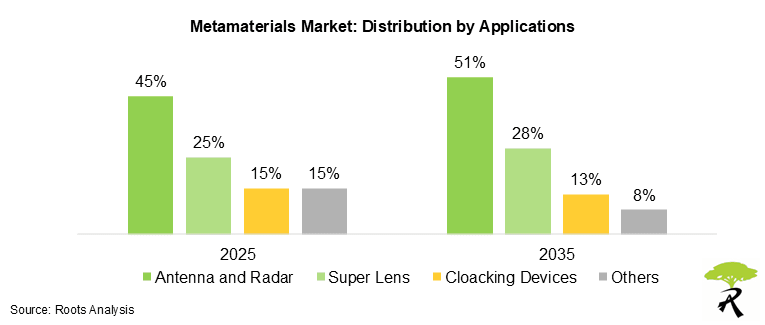
- This segment highlights the distribution of market for metamaterials across various sub-segments based on applications, such as antenna and radar, super lens, clocking devices, other applications. In 2025, the antenna and radar sub-segment holds the largest (45.41%) metamaterials market share. This is likely due to the due to
- The antenna and radar sub-segment is anticipated to be the fastest growing segment in this industry, with annualized rate (CAGR) of 28.81% during the forecast period.
Market Share by Type of Enterprise: Small and Medium Enterprises Dominate the Overall Market
- In terms of type of enterprise, the global market is segmented into small and medium enterprises, and large enterprises. Among these, in 2025, the small and medium enterprises sub-segment occupies the highest share of the metamaterials market size.
- In the long run, large enterprises sub-segment is likely to grow at a higher CAGR during the forecast period, attributing to their agility, innovation, focus on niche markets and ability to adapt to changing customer preferences and market conditions.
Market Share by End-use Industry: Metamaterials Market Growth Driven by Aerospace and Defense and Consumer Electronics
- Currently, the consumer electronics sub-segment captures the majority (32.26%) of the global metamaterials market, this is followed by aerospace and defense sub-segment (29.67%) and are expected to maintain this dominance during the forecast period. This dominance of metamaterials for consumer electronics sub-segment stems from the ability of metamaterials to enhance device miniaturization, signal efficiency, and energy harvesting, which meets the increasing demand for smarter, lightweight gadgets due to the growing interest in consumer electronics.
- The market for energy and power sub-segment is expected to grow at a high CAGR of 28.81%, driven by the broad applications of metamaterial in improving solar cell performance through advanced light-trapping structures, boosting energy conversion rates.
Market Share by Key Geographical Regions: Asia-Pacific to Propel in the Metamaterials Sector in the Coming Years
- The overall market highlights the distribution across North America, Europe, Asia, Latin America, and Middle East and North Africa and rest of the world. North America dominated the metamaterials market and is likely to capture the largest revenue share of 39.96% in 2025. This can be attributed to robust innovation ecosystem, supported by government funding and advanced technological infrastructure.
- Further, in Asia, the metamaterials market is likely to demonstrate lucrative growth during the forecast period, growing at an annualized growth rate of 28.85%.
Want Information on Specific Region/Segment?
Metamaterials Market: Report Deliverables
| Report Deliverables | Details | |
| Excel Data Packs (Complimentary) |
|
|
| Key Metamaterials Companies Profiled |
|
|
| PowerPoint Presentation (Complimentary) | Available | |
| Customization Scope | 15% Free Customization | |
Metamaterials Market Key Takeaways
The “Metamaterials Market: Industry Trends and Global Forecasts, till 2035” market report features an extensive study of the current market landscape, company competitiveness, recent developments, patents, and market size and future opportunities within the metamaterials industry, during the forecast period.
Competitive Landscape of Leading Metamaterials / Metamaterial-based Product Manufacturers
The current market landscape features close to 30 players, including large, mid-sized, and small companies. The market for leading players manufacturing metamaterials remains fragmented, with both new entrants and established players actively participating.
Notably, over 70% of leading manufacturers provide metamaterial-based products, and about 50% of these manufacturers supply products for the aerospace and defense industry. Additionally, nearly 40% of manufacturers provide metamaterial-based antennas and radars for various end-use industries, such as consumer electronics and aerospace and defense.
Market Size Analysis: Metamaterials Market Size and Forecast 2025-2035?
The global Metamaterials market is likely to be worth $ 1.55 billion in 2025 and will reach $ 17.44 billion by 2035. In terms of the type of metamaterial, electromagnetic metamaterials segment holds the largest share of the market due to its extensive applications in telecommunications, aerospace, and defense, driven by the ability to manipulate electromagnetic waves for advanced antenna systems, radar sensor / technologies, and stealth applications. The market size for electromagnetic metamaterials is likely to grow at a relatively higher CAGR of 29.0% during the forecast period.
Regional Analysis: Which Region Holds the Largest Share of the Metamaterials Market?
North America is Leading the Market
North American companies will likely dominate the global Metamaterials market in 2035, driven by its robust research ecosystem, substantial investments in defense and aerospace, and advanced telecommunications infrastructure. The region's dominance is further driven by the presence of established companies entering the metamaterials domain and significant government funding and investment.
Asia: An Emerging Growth Spot
The global metamaterials market in Asia-Pacific will grow at a high CAGR (28.9%) during the forecast period through 2035. This is due to several factors, including rapid industrialization, substantial R&D investments, and widespread 5G adoption in countries like China, Japan, and South Korea. Additionally, escalating use of metamaterials for defense, rising defense budgets and the expanding consumer electronics sector drive innovation in metamaterial applications across aerospace, healthcare, and renewable energy, further bolstering market growth.
What are the Key Drivers of Metamaterials Market?
Metamaterial-based miniaturized electronic components like antennas and optical lenses deliver optimum performance while meeting key requirements, including compact design, energy efficiency, and cost-effectiveness. These features are accelerating their adoption in the consumer electronics industry. Further, increased funding in defense and aerospace sectors, particularly for stealth and next-generation radar technologies, is also driving the growth in this market.
In addition, the rapid advancements in the field of super lenses, optical and photonics, is accelerating the adoption of metamaterials across several applications. Their distinctive capability to reflect / refract visible light beyond natural limits enables novel imaging and data transmission applications, which further drive the demand for these advanced materials in the telecommunication and defense industry.
Your Business is Unique–Why Shouldn’t Your Report Be?
Key Market Trends in Metamaterials Market
Rising Partnerships and Collaborations Amongst the Manufacturer to Foster Progress and Innovation in Expanding their Capabilities
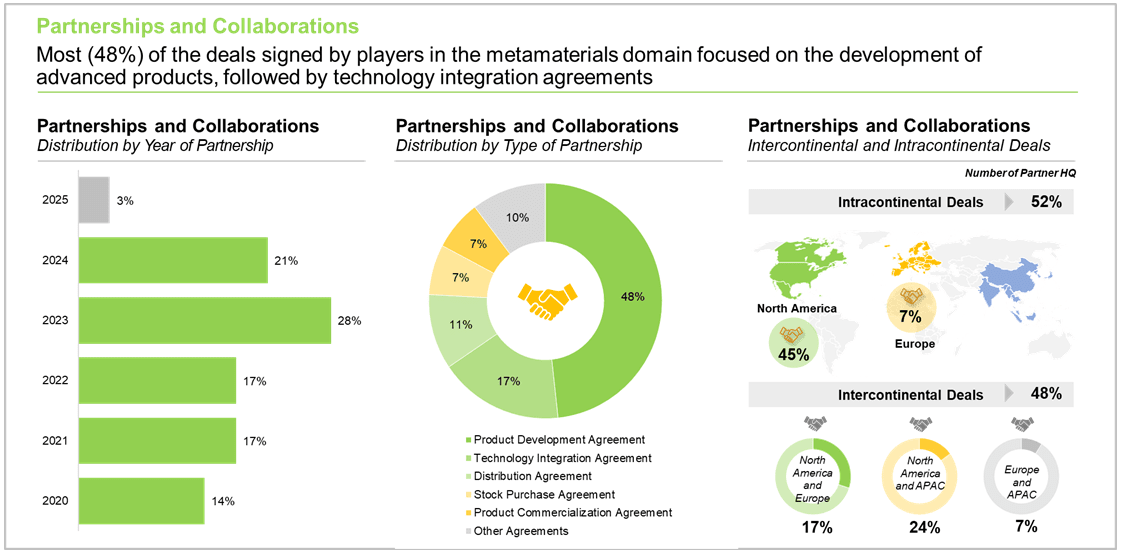
Metamaterials manufacturers have forged several partnerships with other stakeholders to enhance their portfolios. Notably, in the last five years, close to 50% of the deals signed by players in the metamaterial’s domain focused on the development of advanced products, followed by technology integration agreements.
It is worth highlighting that both international and domestic stakeholders have signed multiple agreements focused on metamaterials across various regions, with notable activity concentrated in North America, particularly in the US.
 |
Metamaterials Market Report Coverage
The market report presents an in-depth analysis, highlighting the capabilities of various stakeholders in the metamaterials industry, across different geographies. Amongst other elements, the market report includes:
- An Infographic Executive Summary
- Leading Metamaterial Manufacturers Landscape
- Company Competitiveness Analysis
- Startup Ecosystem Analysis
- Value Chain Analysis
- Company Profiles
- Key Winning Strategies
- In-depth View of Recent Developments
- Mega Trends
- Unmet Needs Analysis
- Market Forecast Analysis
- Porter’s Five Forces Analysis
- SWOT Analysis
Glossary
- Super Lenses: Optical devices designed to achieve exceptionally high-resolution imaging beyond the limitations of conventional lenses, often by manipulating light in innovative ways to focus it with greater precision, used in fields like microscopy, photography, and medical imaging.
- Cloaking: A technique or technology that renders an object or entity undetectable or invisible to certain detection methods, such as light, sound, or radar, often employed in military, surveillance, or privacy applications.
- Stealth Technology: A set of methods and technologies used to minimize the detectability of objects, such as vehicles or aircraft, by reducing their visibility to radar, infrared, sonar, or other detection systems, primarily used in military and defense applications.
- Nanofabrication Technology: Manufacturing processes that create structures or devices at the nanometer scale (typically 1–100 nanometers), used in industries like electronics, medicine, and materials science to produce components with high precision and unique properties.
- Computational Design Technology: The use of computer-based tools, algorithms, and simulations to design, model, and optimize complex systems, structures, or products, widely applied in engineering, architecture, product design, and software development to enhance efficiency and innovation.
From the Author’s Desk
Author’s View on Metamaterials Market
The metamaterials market represents a cutting-edge, technology-driven sector that is transforming industries such as telecommunications, aerospace, and healthcare. It offers significant advantages by enabling unprecedented control over electromagnetic waves, enhancing performance, and reducing system costs. Notably, the adoption of advanced nanofabrication and computational design technologies is poised to revolutionize metamaterial applications, creating substantial opportunities for industry players. Owing to the rising demand for innovative solutions in high-tech applications, the metamaterials market is expected to experience robust growth in the coming years.
About Authors
Lead Author: Hardik Patel
Lead Reviewer: Yash Tyagi
Chief Editor: Ronit Sharma
Customization Opportunities
At Roots Analysis, we genuinely care about your success and understand that your business requirements are unique. While our market research reports provide valuable insights, we recognize that they might not cover every aspect you need to make well-informed strategic decisions. To account for that, we offer 15% free report customization tailored to your specific needs. Whether you require additional quantitative analysis, qualitative insights, or any other information related to the market report, reach out us today at: support@rootsanalysis.com


