
Lowest Price Guaranteed
Slides
183
Last Updated
March 2025
View Count
14013
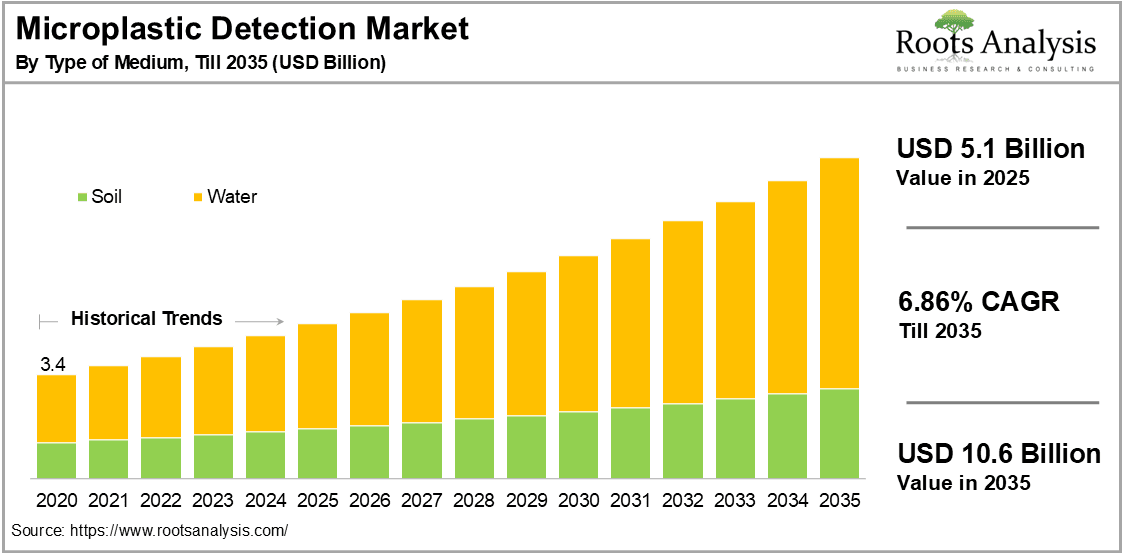
The global microplastic detection market size is projected to grow from USD 5.1 billion in 2025 to USD 10.6 billion by 2035, representing a CAGR of 6.86%, during the forecast period till 2035.
 |
To learn more about this report, request a free sample copy
The new research study consists of microplastic detection industry analysis, detailed market forecast analysis and providing actionable strategic recommendations.
According to the UN Environment Programme, around 400 million tons of plastic waste is produced each year. Microplastic detection is the process of identifying and analyzing microplastic particles, defined as plastic debris less than 5 mm in size. These particles originate from the breakdown of larger plastics through various processes, including physical degradation and chemical reactions. It is worth highlighting that the functioning of microplastic detection technologies typically involves advanced methods such as Fourier-transform infrared (FT-IR) spectroscopy, which enables precise identification of microplastic types by infrared absorption patterns. Notably, advantages of microplastic detection include high reliability, rapid analysis, and the ability to automate data evaluation through machine learning algorithms, which enhance the accuracy of results while minimizing human error.
The global microplastic detection market is expected to grow significantly over the forecast period due to the rapid industrialization in emerging economies like China and India. Fourier-transform infrared (FTIR) and Raman spectroscopy, have emerged as leading methods due to their ability to determine the chemical composition of microplastics with high sensitivity. Notably, microscopy methods, including fluorescence staining and electron microscopy, have been refined to improve the identification of microplastics based on their size and shape. Additionally, innovative approaches utilizing nanotechnology are being explored for efficient removal of microplastics from water sources, showcasing a promising intersection of material science and environmental remediation.
The impact of climate change, which increases plastic runoff into ecosystems, and ongoing research initiatives that enhance understanding of microplastic pollution. Additionally, global initiatives aimed at reducing plastic pollution foster collaboration in developing detection solutions would be governing factors for the market growth.
The microplastic detection market research report presents an in-depth analysis of the various companies that are involved in offering microplastic detection , across different segments, as defined in the table below:
| Key Report Attributes | Details | |
| Historical Trend | Since 2020 | |
| Forecast Period | Till 2035 | |
| Current Market Size | $ 5.1 Billion | |
| Market Size Value by 2035 | $ 10.6 Billion | |
| CAGR (Till 2035) | 6.86% | |
| Type of Detection |
|
|
| Type of Medium |
|
|
| Type of Size |
|
|
| End User |
|
|
| Geographical Regions |
|
|
| Leading Market Players |
|
|
| PowerPoint Presentation (Complimentary) |
Available | |
| Customization Scope | 15% Free Customization | |
| Excel Data Packs (Complimentary) |
|
|
Based on the type of detection, the global microplastic detection market is split into electron microscopy, optical microscopy, Raman spectroscopy, thermal desorption and others. According to our analysis the Raman spectroscopy segment will augment the segment's growth with over 45% of the microplastic detection market share during this forecast period. Further, this segment is expected to grow with a relatively higher (7.34%) CAGR in the near future. This can be ascribed to its high spatial resolution, allowing for the analysis of particles as small as 1 µm, which is crucial for assessing microplastics that can impact human health and the environment.
On the basis of the type of medium, the microplastic detection market is bifurcated into soil and water. The water segment is anticipated to dominate the segment with more than 60% of microplastic detection market size in 2025. Further, this segment is also expected to witness a relatively faster microplastic detection market growth rate of (7.87%) until 2035. This can be ascribed to escalating public awareness and regulatory scrutiny surrounding the impact of microplastics on human health and aquatic ecosystems.
On the basis of the type of size, the microplastic detection market is bifurcated into < 1mm and 1-3mm. The < 1mm segment is anticipated to dominate the segment with more than 65% of microplastic detection market size in 2025. Further, the segment is expected to witness a relatively faster microplastic detection market growth rate of (7.57%) until 2035. This can be attributed to increasing public awareness of microplastic pollution and regulatory pressures surrounding the health and environmental impacts of microplastics.
On the basis of the end user, the microplastic detection market is bifurcated into industrial facilities, regulatory bodies, research laboratories and others. The regulatory bodies segment is anticipated to dominate the segment with more than 40% of market share in 2025. Additionally, this segment is expected to witness a relatively faster microplastic detection market growth rate until 2035. This can be ascribed to their critical role in enforcing environmental standards and public health regulations. As concerns over plastic pollution escalate, these agencies are mandated to monitor and control microplastic levels in various ecosystems, including water sources and food supplies.
This segment highlights the distribution of the microplastic detection market across various geographical regions such as North America, Europe, Asia, Latin America, Middle East, North Africa, and the rest of the world. According to our microplastic detection market analysis, Asia exhibits dominance in the market with over 43% of the microplastic detection market share in the global marketplace. However, North America is projected to grow with a relatively higher CAGR in the forecasted period. Primary reasons for this dominance include regions robust regulatory frameworks, heightened public awareness, and significant research and development activities.
The “Microplastic Detection Market, Till-2035: Industry Trends and Global Forecasts” report features an extensive study of the current market landscape, market size and future opportunity within microplastic detection market, during the given forecast period. The market report highlights the efforts of several stakeholders involved in this rapidly emerging segment of the service providers industry. Key takeaways of the global microplastic detection market report are briefly discussed below.
The microplastic detection market is driven by various drivers including increasing environmental concerns over plastic pollution, regulatory pressures for monitoring and compliance. Moreover, advancements in detection technologies like Raman spectroscopy and FTIR, and rising industrial applications of microplastic detection across sectors such as demand for microplastic detection in water treatment and food safety. Additionally, public awareness and consumer demand for transparency regarding microplastics further drive the need for effective detection solutions.
With the presence of several small and large microplastic detection companies, the market is experiencing intense competition and changing dynamics. From large multinational companies to microplastic detection manufacturers players, companies are striving to enhance their competitive edge. In terms of market share, large enterprises and multinational companies are dominating the market. While small microplastic detection players are continuously improving their products to cater to niche markets, or they are offering specialized services. These industry players are focusing on adopting competitive strategies, such as developing innovative solution techniques, forming strategic alliances and partnerships to expand their portfolios and global footprint, investing in recent developments and new feature launches to enhance their microplastic detection offerings.
Despite strong market growth projection, the microplastic detection market faces numerous challenges. The most common challenges include the variability in microplastic sizes and chemical diversity, which complicate detection methods, that can lead to inaccurate results. Therefore, the lack of standardization in quantification methods results in inconsistent data across studies, while conventional wastewater treatment systems often fail to effectively remove microplastics. Additionally, existing analytical techniques involve multiple steps that can yield variable results.
Asia currently holds a substantial share of approximately 43% in the microplastic detection market opportunities. This dominance can be attributed to their increasing focus on environmental protection and public health. Further, as awareness of microplastic pollution escalates, governments and regulatory agencies are implementing stricter monitoring and reporting requirements to assess and mitigate the impact of microplastics on ecosystems and human health. Notably, heightened regulatory impact on microplastic detection demand for advanced detection technologies, is one of the major governing reasons for growth in this region.
Examples of key player involved in the microplastic detection market (which have also been captured in this market report, arranged in alphabetical order) include Agilent Technologies, Bruker, Danaher, Endress+Hauser Group Services, JASCO, JEOL, METTLER TOLEDO, Oxford Instruments, PerkinElmer, Renishaw, Shimadzu, Thermo Fisher Scientific and ZEISS. This market report includes an easily searchable excel database of all the companies who have adopted the microplastic detection market.
The market report presents an in-depth analysis, highlighting the capabilities of various companies engaged in this domain, across different segments. Amongst other elements, the market report includes: