Military Vehicle Electrification Market
Military Vehicle Electrification Market by Type of System, by Type of Technology, by Type of Platform, by Type of Mode of Operation, by Type of Vehicles, by Type of Product, by Types of Services, by Areas of Application, by Type of Installation, by Type of Equipment, by Type of Solutions, by Type of Enterprise, Geographical Regions, and Leading Players – Trends and Forecasts 2026-2040
-
Lowest Price Guaranteed
-
Slides
214 -
Last Updated
February 2026 -
View Count
11704 -
Military Vehicle Electrification Market Overview
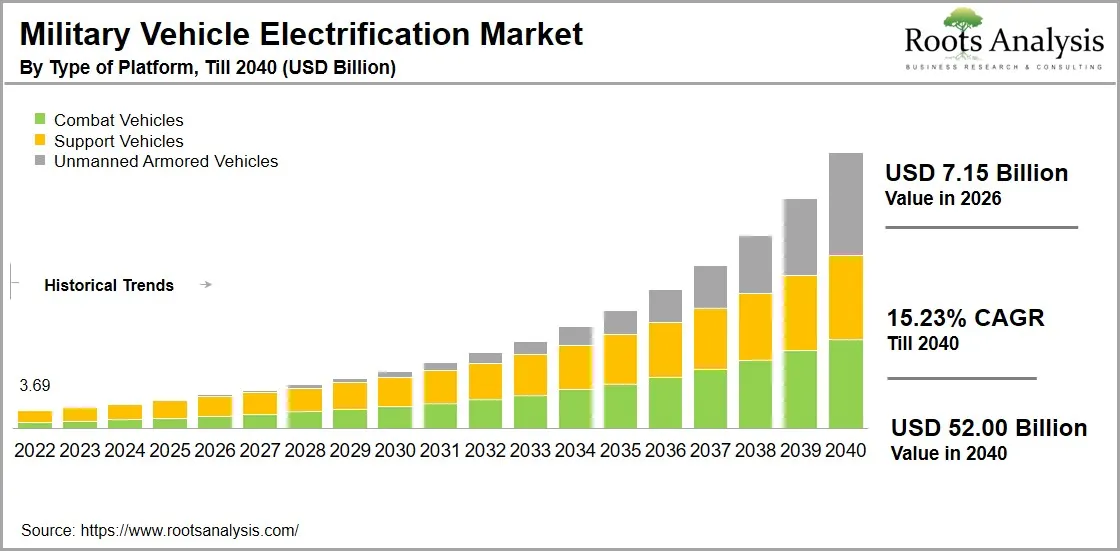
The global military vehicle electrification market, valued at USD 7.15 billion in 2026 is projected to reach USD 52.00 billion by 2040, representing a CAGR of 15.23% during the forecast period.
 |
To learn more about this report, request a free sample copy
The new research study consists of military vehicle electrification industry analysis, detailed military vehicle electrification market analysis, mega trends, patent analysis, porter five forces, SWOT analysis, value chain analysis and other strategic frameworks.
The electrification of military vehicles is a strategic move to use electric and hybrid-electric systems in military fleets. This change is driven by the need for military fleet modernization, better operational efficiency, less dependence on fossil fuels, and a smaller environmental impact, which aligns with global sustainability goals. Electric vehicles offer advantages like quieter operations and lower costs over time. They are used in various military vehicles for combat, logistics, and reconnaissance missions, enhancing military capabilities and readiness in defense and peacekeeping operations worldwide.
The market is influenced by improvements in battery technology, supportive defense policies, and increased spending on modernization. Partnerships between defense companies and tech firms focusing on energy solutions provide opportunities for growth, especially in developing better batteries and faster charging systems. New opportunities include using renewable energy to charge vehicles, creating more reliable batteries, and developing autonomous electric vehicles for unmanned missions.
Growth is expected to occur through partnerships that combine expertise in advanced technologies, focusing on improving battery life, creating adaptable power systems, and enhancing charging capabilities. The market emphasizes sustainability, modular design, and integrating new technologies, requiring collaborative research, government support, and flexible development strategies to meet military and environmental standards in a changing world.
Military Vehicle Electrification Market Share Insights
The military vehicle electrification market report presents an in-depth analysis of the various companies that are involved in offering military vehicle electrification solutions, across different segments, as defined in the table below:
Military Vehicle Electrification Market: Report Attributes / Market Segmentations
| Key Report Attributes | Details | |
| Historical Trend | Since 2022-2025 | |
| Forecast Period | 2026-2040 | |
| Current Market Size | USD 7.15 Billion | |
| Market Size 2040 | USD 52.00 Billion | |
| CAGR (Till 2040) | 15.23% | |
| Type of System |
|
|
| Type of Technology |
|
|
| Types of Platforms |
|
|
| Type of Mode of Operation |
|
|
| Type of Vehicles |
|
|
| Type of Product |
|
|
| Type of Services |
|
|
| Areas of Application |
|
|
| Type of Installation |
|
|
| Type of Equipment |
|
|
| Type of Solutions |
|
|
| Type of Enterprise |
|
|
| Geographical Regions |
|
|
| Prominent Market Players |
|
|
| PowerPoint Presentation (Complimentary) |
Available | |
| Customization Scope | 15% Free Customization | |
| Excel Data Packs (Complimentary) |
|
|
Military Vehicle Electrification Market Segmentation
Market Share by Type of System
Based on the type of system, the market is split into cooling system, energy storage, power conversion, power generation, traction drive system and transmission system. Among these categories, the energy storage segment growth is expected to dominate the market with a share of 35.86%. This growth is attributed to the critical role energy storage systems play in enabling the efficient operation of electric and hybrid-electric military vehicles. Energy storage, primarily through advanced battery technologies like lithium-ion and emerging solid-state batteries, is essential for providing the necessary power and range for military operations.
On the other hand, it is worth highlighting that the power generation segment is expected to witness one of the fastest CAGRs, at approximately 23.8%. This rapid growth is driven by advancements in technologies that enhance power output and efficiency, such as advanced generators and renewable energy integration systems. As military forces increasingly adopt electric and hybrid vehicles, there is a growing need for reliable and efficient power generation systems to support both vehicle operation and auxiliary power requirements in the field.
Market Share by Type of Technology
The global military vehicle electrification market is segmented into various types of technology, such as fully electric and hybrid. According to our global military vehicle electrification analysis, the hybrid segment will augment the segment's growth with the largest market share of over 85.56% by the next decade. Hybrid vehicles offer a balance between the efficiency of electric propulsion systems and the range and reliability of traditional combustion engines, making them highly suitable for military operations where flexibility and reliability are crucial.
On the other hand, it is worth highlighting that the fully electric segment is expected to witness the fastest CAGR of around 23.78% during the forecasted period. This growth can be attributed to technological advancements and increasing environmental concerns. Fully electric vehicles offer advantages such as reduced noise, lower thermal signatures, and zero emissions, which are particularly beneficial for stealth operations and align with global sustainability goals.
Market Share by Types of Platforms
The market is segmented into various types of platforms such as combat vehicles, support vehicles and unmanned armored vehicles. According to our industry forecast, the support vehicles segment will augment the segment's growth with the largest market share of over 30.2% by the next decade. Support vehicles are crucial for military operations, and their electrification enhances operational capabilities by providing improved stealth, agility, and adaptability. The dominance of combat vehicles in this market is driven by their strategic importance and the need for advanced technologies that support tactical missions.
Furthermore, the unmanned armored vehicles segment is expected to witness a growth of CAGR of 23.8% during the forecast period. This growth is fueled by the increasing use of remotely operated vehicles in military operations as well as the advantages offered by unmanned armored vehicles such as reduced risk to personnel and enhanced operational flexibility.
Market Share by Mode of Operation
The market is segmented into various types of modes of operations, such as autonomous/semi-autonomous and manned. According to our military vehicle electrification statistics, the manned vehicles segment will augment the market's growth with a market share of 75.8% during the forecasted period. This dominance is attributed to the longstanding use of manned vehicles in military operations, the trust in human control for mission-critical tasks, and the complexity of military operations that often require real-time human judgment and intervention.
Furthermore, the autonomous/semi-autonomous segment is expected to witness the fastest CAGR of around 23.64% during the forecasted period. This growth can be attributed to the technological advancements and operational benefits such as reduced crew requirements and improved maneuverability. Autonomous vehicles offer enhanced operational capabilities, including increased efficiency and reduced human error, which are critical for future military operations.
Market Share by Types of Vehicles
The market is segmented into various types of vehicles, such as battery electric vehicles, fuel cell electric vehicles, hybrid electric vehicles, and plug-in hybrid electric vehicles. According to our military vehicle electrification analysis, the hybrid electric vehicles segment will augment the market's growth with a market share of 37.65% during the forecasted period.
This growth can be attributed to their ability to balance the benefits of electric propulsion with the reliability and range of traditional combustion engines, making them highly suitable for military operations where flexibility and reliability are crucial. Hybrid systems offer improved fuel efficiency, reduced emissions, and enhanced operational capabilities, which are key factors driving their adoption in military fleets.
Market Share by Types of Products
The market is segmented into various types of products, such as armored personnel carriers, infantry fighting vehicles, light utility vehicles, main battle tanks, military trucks, unmanned ground vehicles. According to our market trends, the infantry fighting vehicles segment will augment the market's growth with a share of 37.65% during the forecasted period. They account for the largest market share due to their vital role in modern combat operations, providing mobility, protection, and firepower on the battlefield. IFVs are versatile and can be used in various combat situations, making them a crucial asset for military forces.
Furthermore, the unmanned ground vehicles segment is expected to witness the fastest CAGR of around 24.89% during the forecasted period. This growth is driven by the advancements in autonomous technologies and their increasing use in military operations. Unmanned vehicles offer advantages such as reduced risk to personnel and enhanced operational flexibility, which are driving their adoption.
Market Share by Types of Services
The market is segmented into various types of services, such as consulting services, maintenance and support, retrofit services and training and simulation. According to our military vehicle electrification analysis, the maintenance and support segment will augment the market's growth with a market share of 47.65% during the forecasted period.
This growth can be owed to the continuous need for maintenance, repairs, and upgrades to ensure operational readiness of military vehicles. The extensive use of military vehicles for both combat and logistical support creates a constant demand for maintenance services, which are crucial for extending the lifespan of vehicles and ensuring they remain operational in diverse environments.
Furthermore, the consulting services segment is expected to witness the fastest CAGR of around 23.8% during the forecasted period. This growth can be attributed to the increasing complexity of military operations and the need for strategic advice on vehicle modernization, technology integration, and operational efficiency.
Market Share by Areas of Application
The market is segmented into various areas of application, such as combat operations, logistics and transportation, reconnaissance, search and rescue, and surveillance. According to our military vehicle electrification analysis, the combat operations segment will augment the market's growth with a market share of 57.65% during the forecasted period.
This growth can be owed to the critical role these vehicles play in supporting military strategies and national security. Vehicles used in combat operations are essential for protecting troops, enduring hostile conditions, and delivering combat-ready firepower, making them indispensable in modern warfare.
Furthermore, the surveillance segment is expected to witness the fastest CAGR of around 23.8% during the forecasted period. This growth can be attributed to advancements in technology and the increasing need for real-time intelligence gathering. Surveillance vehicles equipped with advanced sensors and communication systems are crucial for providing situational awareness and supporting multi-domain operations.
Market Share by Types of Installation
The market is segmented into various types of installation, such as new installations and retrofits. According to our military vehicle electrification analysis, the new installations segment will augment the market's growth with a market share of 77.65% during the forecasted period. This growth can be attributed to ongoing military modernization efforts and the need for advanced vehicles that meet current operational requirements. New installations typically involve the procurement of new vehicles equipped with the latest technologies, which are essential for maintaining military readiness and effectiveness.
Furthermore, the retrofits segment is expected to witness the fastest CAGR of 24.86% during the forecasted period. This growth can be attributed to the increasing need to upgrade existing military vehicles with advanced technologies, such as electrification, autonomous systems, and improved armor protection. Retrofits offer a cost-effective way to enhance the capabilities of existing fleets, making them more efficient and effective without the full cost of new vehicle procurement.
Market Share by Type of Equipment
The market is segmented into various types of equipment, such as charging stations, onboard chargers, and portable chargers. According to our military vehicle electrification analysis, the charging stations segment will augment the market's growth with a market share of 67.65% during the forecasted period.
This growth can be owed to their widespread use and necessity for supporting the electrification of military vehicles. Charging stations provide the infrastructure needed for both public and private charging, making them essential for maintaining operational readiness and supporting the deployment of electric military vehicles.
Furthermore, the portable chargers segment is expected to witness the fastest CAGR of 23.87% during the forecasted period. This growth can be attributed to their versatility and utility in military operations. Portable chargers offer flexibility and can be used in remote or tactical environments where fixed charging infrastructure may not be available. This adaptability aligns with the military's need for mobile and reliable power solutions, potentially leading to a higher growth rate compared to other segments.
Market Share by Type of Solutions
The market is segmented into various types of solutions, such as energy storage solutions, and vehicle-to-grid solutions. According to our military vehicle electrification analysis, the energy storage segment will augment the market's growth with a market share of 87.65% during the forecasted period.
This growth can be attributed to their critical role in enabling the efficient operation of electric and hybrid-electric military vehicles. Advanced battery technologies, such as high-density lithium-ion and emerging solid-state batteries, are essential for providing the necessary power and range for military operations. The emphasis on energy storage is driven by the need for reliable, high-capacity batteries that can support extended missions without frequent recharging.
Furthermore, the vehicle-to-grid (V2G) solutions segment is expected to witness the fastest CAGR of around 24.28% during the forecasted period. This growth can be attributed to their potential to enhance operational efficiency and sustainability. V2G technology allows electric vehicles to supply energy back to the grid when not in use, which can support military bases' energy needs and reduce reliance on external power sources.
Market Share by Type of Enterprises
The market is fragmented into multiple types of enterprises, namely large and small and medium enterprise. Currently, the large enterprise segment is anticipated to dominate the segment with 68.34% of the market share. However, small and medium enterprise segments are expected to witness a relatively higher (23.78%) growth rate. This is ascribable to their agility, innovation, focus on niche markets, and ability to adapt to changing customer preferences and market conditions.
Market Share by Geographical Regions
This segment highlights the distribution of military vehicle electrification market share by region, such as North America, Europe, Asia, Latin America, Middle East and North Africa, and the rest of the world. According to our regional analysis, North America currently exhibits dominance with 37.69% of overall market share. The North American growth is driven by the rising expenditures in military vehicle electrification technologies by countries in this region.
This growth is further driven by a combination of strategic efforts, technological knowledge, and an increased dedication to sustainability. The area’s strong commitment to decreasing carbon emissions and reducing dependence on fossil fuels has led to significant funding for electric vehicle technology, creating a favorable environment for military electrification.
Military Vehicle Electrification Market Key Insights
Military Vehicle Electrification Market Drivers
The military vehicle electrification market growth is expected to be driven by several key factors. Operational efficiency and environmental sustainability are primary drivers, as electrification enhances military capabilities while reducing fuel dependency and environmental impact. The integration of advanced battery technologies, such as high-energy-density lithium-ion and solid-state batteries, extends operational ranges and ensures rapid response capabilities.
Additionally, government policies and environmental regulations play a significant role, with many countries setting targets to reduce greenhouse gas emissions, influencing defense procurement strategies towards more sustainable options. Furthermore, technological advancements in hybrid and electric powertrains offer improved stealth, agility, and adaptability, making them crucial for modern military operations.
Military Vehicle Electrification Market Competitive Landscape
With the presence of several small and large companies, the market is experiencing intense competition and changing market dynamics. From large multinational companies to local players, companies are striving to enhance their competitive edge. In terms of market share, large enterprises and multinational companies are dominating the market.
The key players are using strategies such as partnerships, acquisitions, ventures, innovations, novel product launches, R&D and geographical expansions in an attempt to solidify their position in the industry. Additionally, the increasing emphasis on sustainability is driving companies to invest in biodegradable materials and technologies, further intensifying the competitive landscape.
Military Vehicle Electrification Market Challenges
Despite the strong market growth projection, there are several challenges in implementing military vehicle electrification solutions. One of the primary challenges is the high initial investment cost associated with transitioning to electric vehicles, including the development of advanced battery systems and charging infrastructure. Additionally, the power-to-weight ratio poses a significant engineering challenge, as military vehicles require substantial armor and specialized equipment, which can be difficult to balance with the weight limitations of energy storage systems like batteries.
The limited charging infrastructure, particularly in remote or combat zones, is another major obstacle, as it affects the operational readiness and deployment of electric military vehicles. Furthermore, the short range and limited endurance of electric vehicles compared to traditional combustion engine vehicles remain significant concerns, impacting their suitability for extended military operations.
Regional Analysis: North America is Expected to Dominate the Market with the Largest Military Vehicle Electrification Market Share
With respect to regional industry insights, North America is likely to dominate the market for the forecasted period. The dominance of this region is majorly influenced by substantial defense budgets and advanced technological capabilities. The United States, as a major player, invests heavily in research and development of electric and hybrid military vehicles to enhance operational efficiency and sustainability.
Additionally, supportive government policies and strategic initiatives, such as the U.S. army’s modernization programs, further bolster the region’s leadership in adopting and advancing military vehicle electrification technologies.
Leading Players in Military Vehicle Electrification Market
Examples of leading companies in the military vehicle electrification market (which have also been captured in this market report, arranged in alphabetical order) include Alke, AM General, AMETEK, Arquus, Aselsan, Aspen Systems, BAE Systems, Ballard Power, Bren-Tronics, Canoo Technologies, Crane Aerospace & Electronics, Denchi, EaglePicher, EnerSys, Epsilor-Electric Fuel, FFG Flensburger Fahrzeugbau, Galvion, General Dynamics, General Motors, GS Yuasa Lithium Power, Hanwha Defense, Highland Systems, Honeywell, Iveco Defence Vehicles, Kongsberg Defence & Aerospace, Krauss-Maffei Wegmann, Leonardo, Lithium Ion Technologies, Lockheed Martin, Mack Defense, Mahindra & Mahindra, MAHLE, Mega Engineering Vehicles, Milrem Robotics, Navistar International, Nexter, Nikola, Northrop Grumman, Oshkosh, Otokar Otomotiv ve Savunma Sanayi, Paramount, Patria, QinetiQ, Raytheon Technologies, Red Dot Europe, RENK, Rheinmetall, Ricardo, Saft Groupe, ST Engineering, Stryten Energy LLC, Textron, Thales Group, UKroboronprom, Volvo Defense.
Recent Developments in Military Vehicle Electrification Market
- In February 2026, The Indian Army formalized a time-bound roadmap to induct electric vehicles into its fleet, targeting the replacement of 25% of light vehicles, 38% of buses, and 48% of motorcycles at select peace-time units. A tender for 60 electric buses and 24 fast chargers was scheduled for immediate release.
- In January 2026, Rheinmetall finalized the development of new electrode technology for hydrogen electrolysis. The company initiated pilot-scale production to support the integration of hydrogen fuel cell systems into military vehicle platforms to address range and weight constraints of battery-only systems.
- In January 2026, Oshkosh Corporation showcased its "Striker Volterra" Electric Airport Rescue and Fire Fighting (ARFF) vehicle and advanced electrification technologies at CES 2026. The initiative highlighted zero-emission high-performance electric platforms designed for rigorous military and emergency response requirements.
- In December 2026, Belrise Industries and Plasan Sasa signed a strategic agreement on December 22, 2025, to jointly produce the All-Terrain Electric Mission Module (ATEMM) for the Indian military. The partnership includes technology transfer and the integration of Belrise into Plasan’s global supply chain for electric military platforms.