


 Download Free Sample
 Buy Now
Market Size
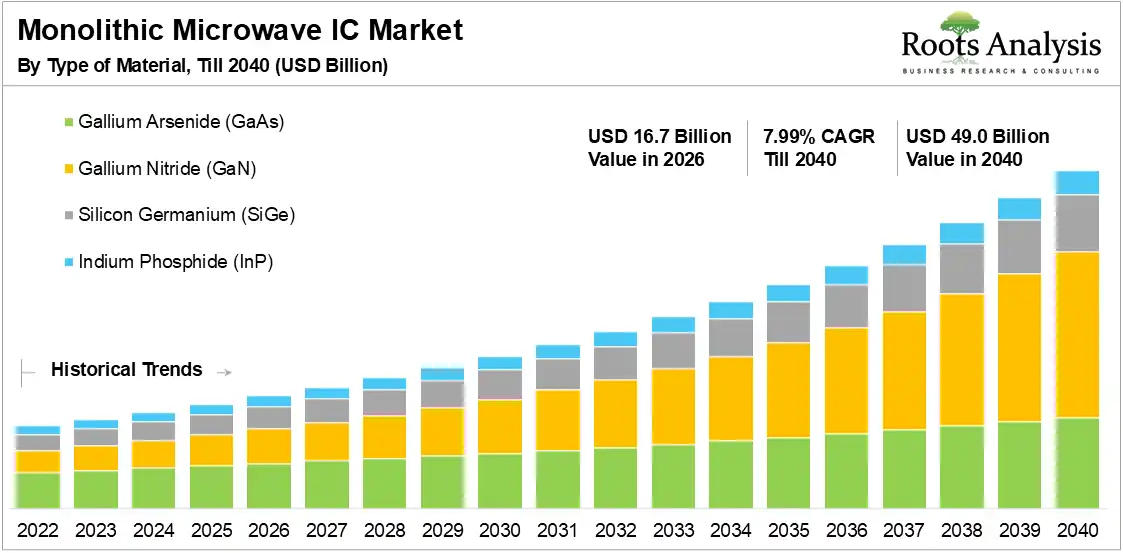
The global monolithic microwave IC market is projected to reach USD 16.7 billion in 2026 and USD 49.0 billion by 2040, representing a CAGR of 7.99% during the forecast period 2026 to 2040.
See What’s in the Full Report – Request Your Complimentary Insights!
Market Report: Key Takeaways
- Leading Players Competitive Footprint: Our monolithic microwave IC (MMIC) industry analysis shows that this industry features mix of tech giants and startup companies. Some notable players are Analog Devices, Bae Systems, Microchip Technology, Northrop Grumman, Infineon Technologies, and Texas Instruments.
- Innovation Hotspots: The shift toward sub-THz and D-band frequencies in 6G research is establishing a new frontier for MMIC innovation. Current capital allocation is pivoted toward integrated sensing and communication (ISAC) modules, which are projected to underpin the global connectivity infrastructure by 2030.
- Regional Insights: In 2026, the Asia-Pacific region maintains its global market dominance, underpinned by strategic 6G infrastructure investment. As the primary engine for growth, APAC also commands the highest CAGR, consistently outstripping mature markets through superior manufacturing and supply chain clustering.
- Market Growth Across Type of Component: Power amplifiers (PA) holds the largest share of the market, accounting for 36.0% market share, and is also projected to be the fastest-growing sub-segment with a 9.1% CAGR, reflecting sustained value concentration in transmit-chain performance.
Market Overview
Monolithic microwave integrated circuits (MMICs) form a critical technology segment focused on integrating complete radio frequency functions onto a single semiconductor substrate. The market covers solutions that support signal processing, amplification, frequency conversion, and control across microwave and millimeter-wave frequencies. These compact, high-efficiency components enable advanced communication, radar, and sensing systems in performance-intensive environments. Market value is largely driven by MMICs’ ability to reduce system size, weight, power consumption, and overall cost while maintaining high operational reliability.
Market trends show accelerating adoption as high-performance wireless infrastructure and advanced sensing applications expand globally. The rollout of 5G networks, particularly in millimeter-wave spectrum bands, increases demand for compact, high-power MMICs used in base stations and connected devices. Growth dynamics also reflect rising deployment of low-Earth-orbit satellite constellations and ongoing aerospace modernization programs requiring scalable phased array architectures. A notable recent development is the broader adoption of wide-band gallium nitride MMICs in next-generation defense platforms, improving performance consistency across radar and electronic warfare systems.
The industry outlook is shaped by continued innovation in compound semiconductor technologies aimed at higher frequency operation and improved efficiency. Investments in indium phosphide and silicon germanium designs target terahertz performance levels aligned with emerging 6G research directions. At the same time, manufacturers are advancing packaging methods and process standardization to lower production costs and support larger commercial deployments, including automotive radar and satellite communication, reinforcing long-term market expansion.
Get an Instant Quote in 10 Minutes. Lowest Price Guaranteed
Monolithic Microwave IC Market Size Estimation Methodology
Based on a hybrid methodology combining bottom-up demand modeling with top-down market validation, the following approach was used to derive market size estimates and projections for the monolithic microwave IC market.
- As a starting point, we identified identifying key components and application areas by defining the scope of monolithic microwave integrated circuits (MMICs) across key frequency bands (L-band to mmWave) and core functionalities (power amplifiers, low noise amplifiers, mixers, phase shifters).
- Then we examined the market demand-side approach as the primary forecasting model, prioritizing end-use application deployment schedules over macroeconomic factors, which are often less directly correlated with niche component adoption. We also analyzed demand drivers included core technology (e.g., Gallium Nitride (GaN), Gallium Arsenide (GaAs), Silicon Germanium (SiGe)), and geographic region to establish a structured framework for data collection and analysis.
- Thereafter, we collected historical MMIC shipment data, average selling prices (ASPs), and technology transitions (e.g., migration from GaAs to GaN in high-power applications) through secondary research sources, including industry association reports, financial statements of key market players, and technical white papers.
- Primary research, involving interviews with value chain stakeholders, including component manufacturers, foundry operators, system integrators, and end-users, to validate technology adoption curves, current pricing trends, and new program deployment timelines, to validate historical market size estimates and identify emerging shifts in pricing, competition, and technological requirements.
- Using these data and insights, we calculated the global monolithic microwave IC market size by multiplying the validated unit shipment forecasts for each application segment by the corresponding ASP, considering factors such as cost reduction pressures from volume production and technological maturity.
- The overall future projections were derived by analyzing the technology adoption lifecycle (S-curve model) for specific applications, accounting for factors such as the transition from legacy systems, new technology commercialization schedules (e.g., mmWave adoption in automotive radar), and regulatory policies (e.g., spectrum allocation).
- Finally, in order to assess the sensitivity of our assumptions, we conducted the impact of key uncertainties, including variations in 5G rollout speed, potential delays in major satellite constellation programs, and changes in defense spending budgets, providing high and low-growth scenarios for the forecast period.
Market Share Insights
Monolithic Microwave IC Market Share by Application: 5G vs. Defense
Based on global MMIC market report, aerospace and defense application segment currently holds the largest market share (28.5%) in 2026. This leadership remains anchored in advanced radar modernization programs and continued adoption of GaN-based power amplifiers. Furthermore, the higher share is supported by stable procurement cycles and stringent qualification requirements that sustain high-value MMIC deployments despite slower unit scaling. However, its share declines over time as growth follows government budget cycles rather than exponential device expansion.
Conversely, automotive is projected to be the fastest-growing application with a 10.6% CAGR through 2040, reflecting a structural shift in adoption trends toward high-volume sensing and connectivity use cases. This unprecedented growth is also due to the ongoing ADAS radar transitions from premium differentiation to regulatory necessity, supported by cost reductions in mmWave chips and integrated 60-GHz radar platforms introduced in early 2025. These radar platforms enable wider adoption across mid-range vehicles and autonomous sensing systems.
In contrast, telecommunications and communication applications expand their share to 29.5% by 2040, driven by 5G to 6G infrastructure scaling, mmWave front-end upgrades, and satellite communications growth, where MMIC integration delivers clear advantages in power efficiency, thermal performance, and bandwidth density. Demonstrations of 6G-ready RF front ends and GaN amplifier innovation by MACOM Technology Solutions, at industry technology showcases in 2025 illustrate how infrastructure vendors are accelerating high-frequency deployments across massive-MIMO and satellite links, reinforcing long-term demand.
Geographical Regions Insight: Asia-Pacific Leads the Market
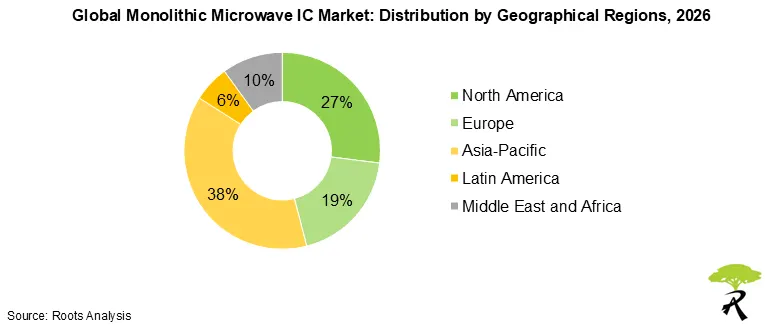
According to the monolithic microwave integrated circuit market forecast, Asia-Pacific dominates the market by holding 38.0% of the overall revenue share in 2026. This highest share reflects strong adoption trends anchored in manufacturing scale and infrastructure expansion. The region’s dominance is also due to the concentration of RF fabrication facilities and OSAT ecosystems, combined with emerging 6G infrastructure and the presence of major handset and satellite manufacturing hubs.
Vertically integrated semiconductor clusters across Taiwan, South Korea, and mainland China reduce RF front-end production costs. This cluster has accelerated commercialization timelines across these countries, reinforcing competitive advantages across the value chain. In addition, Government-backed semiconductor incentive programs and continued telecom investment further strengthen demand momentum.
For instance, advanced RF process capacity expansion initiatives announced by TSMC in April 2025 reinforced regional leadership in high-frequency nodes used for 5G and satellite communications. Owing to these reasons, Asia-Pacific will continue to expand at a CAGR of 9.4% (2026–2040).
Conversely, North America holds the second-largest share at 27.0% in 2026. However, this region is expected to grow moderately at a 7.1% CAGR, leading to a gradual share decline as production remains globally distributed and smartphone-driven volume growth slows relative to infrastructure-led expansion elsewhere. The region maintains strong innovation leadership supported by defense RF demand and platform development, illustrated by RF front-end ecosystem advancements introduced by Qualcomm in February 2025, yet manufacturing localization remains limited.
Want Information on Specific Region / Segment?
.
Market Ecosystem Insights
Top 10 Market Leaders Shaping the Future of Monolithic Microwave IC Industry
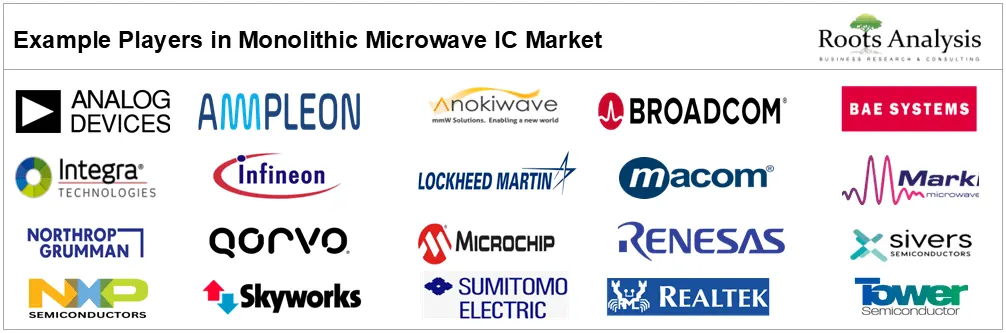
Our MMIC market analysis highlights that the industry is highly consolidated with the well-established players. Some of the notable examples of the market players include Analog Devices, NXP Semiconductors, Bae Systems, Texas Instruments, and Microchip Technology. undertaking strategic initiatives for global expansion and technological innovations. Some of the recent initiatives of the industrial players are as follows:
- Investments: Recently, Texas Instrument announced to invest over USD 60 billion to develop and expand semiconductor manufacturing facilities across the US. This facility will support the broader radiofrequency component, including monolithic microwave IC supply chain for both commercial and defense-grade applications.
- Partnerships: WIN Semiconductors recently welcomes Viper RF into its Alliance Partner Program, enabling custom MMIC services spanning 1–150 GHz using both GaN and GaAs platforms. This partnership directly targets telecom infrastructure, satellite, and aerospace buyers requiring broadband MMIC solutions.
- Product Launch: Keysight Technologies recently enhances its RF and microwave instrument portfolio with new signal generators, synthesizers, and analyzers, significantly improving test and validation environments for MMIC design houses and system integrators.
Top 5 Startups Driving Innovation in Monolithic Microwave IC Market
The startup ecosystem for MMICs and microelectronics is witnessing a surge in momentum. Investors are placing bigger bets on late-stage companies who are capable of addressing AI-driven hardware needs. Several initiatives has been taken to develop advanced wide-bandgap material alternatives (GaN-on-Si, InP) for cost reduction in high-volume telecom applications. One of the standout initiatives comes from Sonic Edge, an Israeli pioneer in micro-acoustic innovation.
At CES 2026, this company announced a partnership with a global semiconductor giant to integrate its modulated ultrasound IP into audio chipsets. This technology doubles sound output from tiny spaces every two years, leveraging reliable silicon technology to produce high-quality audio at scale.
Market Access Considerations
Regulatory Scenario
The regulatory environment plays a decisive role in determining market access and commercialization pathways for monolithic microwave integrated circuits (MMICs), particularly due to their strategic importance in defense, telecommunications, and automotive applications. In defense and aerospace markets, export control frameworks such as the International Traffic in Arms Regulations (ITAR) in the United States and the European Union’s Dual-Use regulation impose strict limitations on technology transfer and cross-border sales of high-power and high-frequency MMICs.
These regulatory requirements create significant commercialization challenges for companies operating outside key strategic regions and require rigorous compliance processes, influencing supply chain structures and extending product approval timelines.
In contrast, regulatory developments in commercial sectors often act as adoption drivers. Global spectrum allocation for millimeter-wave communications supporting 5G and future 6G deployments increases demand for high-frequency MMICs used in network infrastructure and connected devices, where compliance with 3GPP standards is essential.
Within the automotive industry, mandates related to advanced driver assistance systems (ADAS) and autonomous driving technologies require adherence to functional safety standards such as ISO 26262 and regulated frequency allocations, including 77 GHz radar bands. These requirements elevate quality assurance expectations and increase development costs, but they also establish clear technical benchmarks that support scalable commercialization.
Although compliance obligations can lengthen certification cycles, policies that standardize spectrum usage and safety frameworks ultimately facilitate broader market expansion. Regional differences in intellectual property protection and government support for domestic semiconductor manufacturing further shape competitive dynamics, often strengthening the position of local suppliers within their respective markets.
Cost Benefits and Value-Based Considerations
Market adoption of MMIC technology is primarily influenced by value-based purchasing decisions in which long-term operational advantages outweigh higher upfront costs. Although MMICs typically involve greater initial procurement expenses than discrete or hybrid alternatives, their integration capabilities deliver measurable performance improvements and operational efficiencies. A key benefit lies in reducing system size, weight, and power consumption (SWaP), which is especially important in space, airborne, and portable telecommunications environments.
For defense platforms, lower SWaP enables enhanced functionality within existing system architectures, improving mission effectiveness and operational flexibility. In telecommunications infrastructure, improved efficiency reduces energy consumption in base stations, supporting a lower total cost of ownership over the product lifecycle.
Pricing dynamics continue to improve as commercial adoption expands. Increasing production volumes in applications such as automotive radar and 5G infrastructure, combined with the maturation of manufacturing technologies including Gallium Nitride and Silicon Germanium processes, contribute to economies of scale that narrow the cost gap between MMICs and legacy solutions.
Procurement strategies for large deployments increasingly emphasize lifecycle value, reliability, and return on investment rather than initial component pricing. As a result, suppliers that demonstrate consistent performance and durability in demanding operating conditions gain a competitive advantage, particularly where maintenance costs and system downtime significantly affect overall economic outcomes.
Competitive Market Entry Barriers
The MMIC market presents substantial entry barriers that shape the competitive landscape and limit participation by new entrants. High capital requirements for specialized fabrication facilities designed for compound semiconductor materials such as gallium arsenide (GaAs) and gallium nitride (GaN) represent a major obstacle. These facilities require continuous investment in research and development to sustain manufacturing precision and process innovation, making cost competitiveness difficult to achieve without significant financial resources.
Technological complexity and intellectual property constraints further reinforce market concentration. Designing and producing high-frequency MMICs demands advanced expertise in RF engineering and material science, areas often protected by extensive patent portfolios held by established companies. New participants face challenges in developing proprietary processes capable of meeting the stringent performance and reliability standards required in mission-critical applications, particularly within defense and aerospace sectors.
In addition, lengthy qualification and design-in cycles create high switching costs for customers, who prioritize proven reliability and established supplier relationships to mitigate operational risk. Combined with strict regulatory compliance obligations, these factors make market entry highly challenging, with successful participation frequently dependent on strategic partnerships, collaborations, or acquisitions rather than purely organic expansion.
How Stakeholders Benefit from the Key Focus Areas of Our Monolithic Microwave IC Market Research Report
The monolithic microwave IC (MMIC) market is gaining strategic importance as high-frequency communication, radar modernization, satellite connectivity, and advanced defense electronics accelerate worldwide demand for high-performance RF solutions. This report enables stakeholders to make informed strategic, investment, and technology decisions by translating market trends, competitive movements, and innovation dynamics into actionable business insights that support commercialization and expansion planning.
- Unmet Needs and Market Gaps in Monolithic Microwave IC Market: The report identifies critical performance, integration, and cost-efficiency gaps across emerging applications such as 5G infrastructure, satellite communications, automotive radar, and aerospace systems. By highlighting underserved application segments and evolving customer requirements, stakeholders gain clarity on where innovation and differentiation opportunities exist. These insights help organizations prioritize product development pipelines and guide investors toward high-growth niches with limited competitive saturation.
- Funding and Investment Landscape in Monolithic Microwave IC Market: The study analyses investment activity, capital flow patterns, and funding momentum across semiconductor innovators and RF technology developers. Stakeholders gain visibility into which technology areas are attracting financing and where long-term growth confidence is strongest. This intelligence supports capital allocation decisions, partnership evaluations, and risk assessment for stakeholders seeking scalable opportunities aligned with future wireless and defense electronics demand.
- Player Landscape and Competitive Dynamics in Monolithic Microwave IC Market: The report provides a structured view of the competitive landscape, including positioning strategies, innovation focus areas, and market participation across established semiconductor leaders and emerging players. Stakeholders benefit from understanding competitive strengths, differentiation strategies, and evolving market entry barriers. These insights enable more effective competitive benchmarking, acquisition evaluation, and strategic positioning decisions.
- Technology Innovation and Adoption Trends in Monolithic Microwave IC Market: The analysis tracks technology evolution across compound semiconductor materials, integration architectures, and high-frequency performance enhancements driving next-generation MMIC adoption. Stakeholders gain clarity on adoption drivers influencing commercialization timelines and application expansion across telecommunications, defense, and space systems. This supports technology roadmapping, R&D prioritization, and faster alignment between innovation investments and market demand.
- Partnerships and Collaboration Trends in Monolithic Microwave IC Market: The report evaluates ecosystem partnerships spanning semiconductor manufacturers, system integrators, defense contractors, and telecom infrastructure providers. By identifying collaboration models accelerating product deployment and market penetration, stakeholders can better assess alliance opportunities that reduce development risk and shorten commercialization cycles. These insights guide partnership strategies that strengthen supply chains and expand market access.
- Market Segmentation and Geographic Coverage in Monolithic Microwave IC Market: Comprehensive segmentation analysis across product types, applications, end-use industries, and regional markets provides stakeholders with a clear view of growth outlook and demand concentration. Geographic insights reveal regional adoption patterns, regulatory influences, and expansion opportunities across mature and emerging markets. This enables informed market entry planning, regional investment prioritization, and targeted go-to-market strategies aligned with evolving global demand dynamics.
Your Business is Unique – Why Shouldn’t Your Report Be?
Monolithic Microwave IC Market: Scope of the Report
| Key Report Attributes | Details | |
| Historical Trend | Since 2022 | |
| Forecast Period | Till 2040 | |
| Market Size 2026 | $ 16.7 Billion | |
| Market Size 2040 | $ 49.0 Billion | |
| CAGR (Till 2040) | 7.99% | |
| Segments Covered |
|
|
| Geographical Regions Covered |
|
|
| Key Sections Covered |
|
|
Market Segmentation
Based on the research, we have segmented the monolithic microwave IC market into type of component, type of material, type of technology, type of frequency band, application, geographical regions, and leading players.
Market Share by Type of Component
- Power Amplifier (PA)
- Low Noise Amplifier (LNA)
- Mixer
- Switch
- Attenuator Standalone Physical Layer (PHY) Devices
Market Share by Type of Material
- Gallium Arsenide (GaAs)
- Gallium Nitride (GaN)
- Silicon Germanium (SiGe)
- Indium Phosphide (InP)10 Gbps
Market Share by Type of Technology
- Pseudo-morphic High Electron Mobility Transistor (pHEMT)
- Heterojunction Bipolar Transistor (HBT)
- Metal-Semiconductor Field-Effect Transistor (MESFET)
- High Electron Mobility Transistor (HEMT)
Market Share by Type of Frequency Band
- X-Band
- Ku-Band
- Ka-Band
- V-Band
- Q-Band
- W-Band
Market Share by Application
- Data Centers and Servers
- Enterprise Networking
- Industrial Automation
- Automotive
- Consumer Electronics
- Telecom Infrastructure
Market Share by Geographical Regions
- North America
- US
- Canada
- Mexico
- Rest of North America
- Europe
- Austria
- Belgium
- Denmark
- France
- Germany
- Ireland
- Italy
- Netherlands
- Norway
- Russia
- Spain
- Sweden
- Switzerland
- UK
- Rest of Europe
- Asia-Pacific
- Australia
- China
- India
- Japan
- New Zealand
- Singapore
- South Korea
- Rest of Asia-Pacific
- Latin America
- Brazil
- Chile
- Colombia
- Venezuela
- Rest of Latin America
- Middle East and Africa (MEA)
- Egypt
- Iran
- Iraq
- Israel
- Kuwait
- Saudi Arabia
- UAE
- Rest of MEA


