


 Download Free Sample
 Buy Now
Market Size
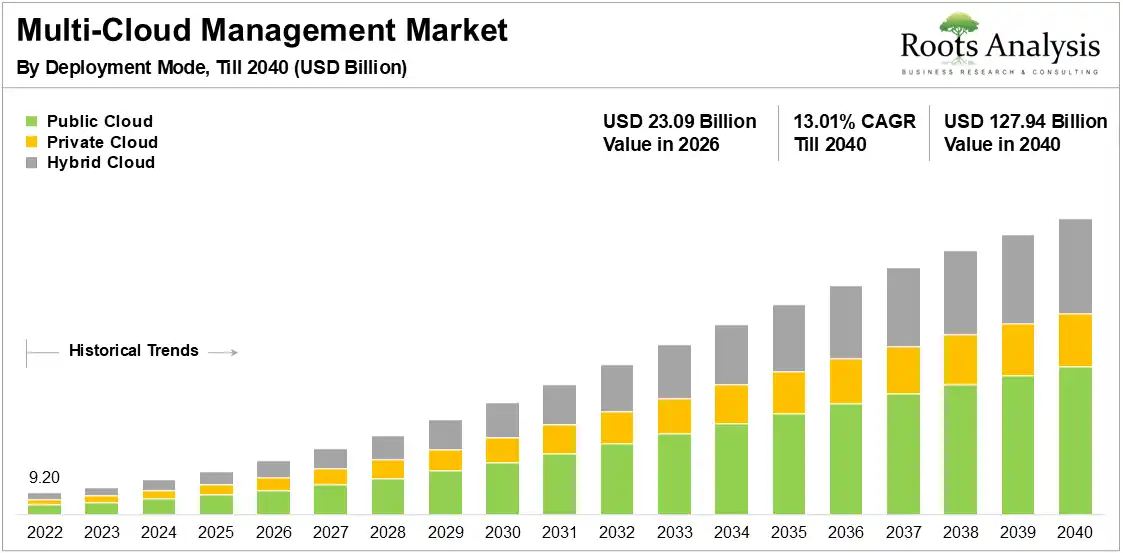
The global multi-cloud management market size is projected to grow from USD 23.09 billion in 2026 to USD 127.94 billion by 2040, representing a CAGR of 13.01% during the forecast period 2026 to 2040.
See What’s in the Full Report – Request Your Complimentary Insights!
Market Report: Key Takeaways
- Based on components, multi-cloud management software / platforms capture the largest share (76.9%) in 2026, whereas services experience faster growth (13.2% CAGR) through 2040 accelerating comprehensive digital transformation frameworks.
- In terms of deployment mode, public cloud dominates the market, capturing a 45.0% share in 2026, and is also projected to grow at a leading 14.1% CAGR through 2040 aggressively scaling global operational footprints.
- Among applications, infrastructure and resource management maintains a dominant 32.0% share in 2026, however financial management projects faster growth at a higher 15.9% CAGR till 2040 directly rationalizing fragmented enterprise computing expenditures.
- Based on distribution by enterprise size, large enterprises secure a 60.7% share in 2026. Conversely, small and medium enterprises (SMEs) are projected to grow at a 21.8% CAGR through 2040, systematically dismantling legacy architectural constraints.
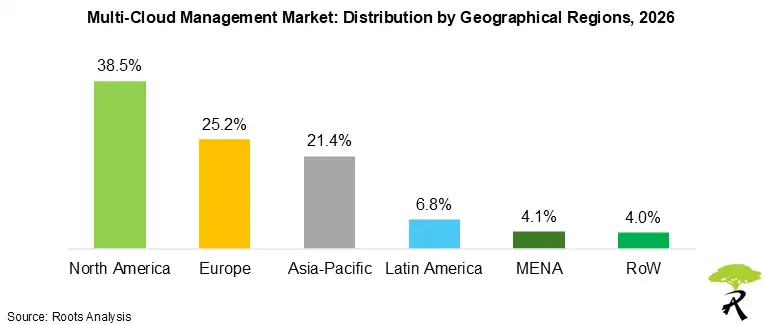
- Regionally, North America holds the largest share (38.5%) in 2026, while Asia-Pacific showcases faster growth at a 15.1% CAGR till 2040 rapidly expanding cross-border digital governance protocols.
- Focusing on industry verticals, multicloud management market size for BFSI sector dominates the industry (23.0%) in 2026, whereas healthcare and life sciences sector is poised to experience a higher 15.0% CAGR till 2040 securely accelerating strict compliance-bound data interoperability.
Multi-Cloud Management Market Outlook
Multi-cloud management platforms operate strictly within AI-driven governance frameworks prioritizing interoperability and centralized visibility. This structural evolution consistently compels enterprises to replace manual provisioning with automated orchestration. Aggressive FinOps integration directly rationalizes fragmented cloud spending and systematically reduces accumulated technical debt across vast heterogeneous server environments.
Strict regulatory compliance pressures, particularly the 2025 EU Data Act portability mandates, aggressively accelerate platform adoption across regulated sectors. Simultaneously, scaling generative AI workloads heavily demands seamless cross-platform data movement mechanisms. Broadcom’s VMware Cloud Foundation 9.0 deployment explicitly illustrates ecosystem convergence toward unified operations spanning sovereign and public infrastructures.
The market growth trajectory points toward autonomous cloud operations centered on supercloud architectures that dynamically abstract underlying infrastructure layers. Embedded AI agents systematically reallocate computing resources against real-time demand signals without requiring refactoring, reflecting a structural shift in how enterprises approach intelligent orchestration. Further, the April 2026 expansion of the Google-Oracle partnership exemplifies the cross-provider integration driving this trajectory, where standardized operations ultimately render cloud boundaries commercially and technically invisible.
Pay Only for What You Need – The Best Way to Optimize
Multi-Cloud Management Market Size Estimation Methodology
- As a starting point, we established the market scope by categorizing multi-cloud management solutions into core functional areas, such as cost management (FinOps), automation and orchestration, security and compliance, and IT service brokering, tailored to support complex enterprise cloud architectures.
- Following this, we analyzed enterprise cloud migration services demand patterns and technology adoption cycles, evaluating digital transformation priorities, and regulatory-driven data sovereignty requirements. By mapping historical enterprise IT spending against the accelerating transition rates from single-cloud to distributed multi-cloud environments, we were able to establish solid baseline adoption trajectories.
- Subsequently, we collected key data points regarding software-as-a-service (SaaS) subscription volumes, enterprise licensing agreements, and shifts toward consumption-based pricing models through primary research with CIOs, cloud architects, and IT operations executives. We rigorously cross-validated these enterprise insights against secondary sources, including cloud vendor financial filings, SEC reports, and technology consortium data.
- Using these data and insights, we calculated the global multi-cloud management market size and projected the long-term commercial opportunity. This was achieved through a robust dual-approach framework that combined bottom-up aggregated vendor revenue models with top-down estimates derived from total global enterprise public cloud and infrastructure-as-a-service (IaaS) expenditures, factoring in expected cloud workload growth rates and the anticipated integration of AI-driven cloud optimization tools.
- The total projected market value was then systematically distributed across distinct market segments, allocating revenue by deployment model, component, application and enterprise size. Geographic distribution was meticulously mapped by evaluating regional data center maturity and localized digital infrastructure investments across key global markets.
- Finally, in order to assess the sensitivity of our assumptions, we conducted a multivariate sensitivity and scenario analysis (base, optimistic, and conservative) on some of the most important parameters of our forecast methodology, evaluating the potential market impacts of macroeconomic IT budget tightening, evolving global data privacy regulations, and shifting vendor lock-in dynamics.
Multi-Cloud Management Market Share Insights
Market Share by Component: Multi-Cloud Management Software / Platforms Dominate the 2026 Market while Service to Grow Rapidly through 2040
- Software dominates with a 76.9% share, driven by aggressive macroeconomic regulatory mandates requiring centralized governance across complex hybrid environments. Deploying robust platform architecture directly offsets enterprise computational overhead. For instance, Datadog’s January 2026 integrations explicitly enhanced observability across distributed multicloud endpoints, providing essential visibility into scalable AI infrastructure workload deployments.
- Services project the fastest 13.2% CAGR as complex hardware and software integration constraints demand managed orchestration. Specialized providers establish strong market defensibility by securing proprietary multicloud deployment pipelines. This market growth trajectory is validated by Rackspace’s February 2026 partnership with Palantir, which strategically delivers governed AI operations into complex enterprise networks.
Which Applications Drive Demand in Multi-Cloud Management Market?
- Infrastructure and resource management commands a dominant 32.0% market share, driven by strict macroeconomic mandates requiring centralized governance over distributed capacity provisioning. This establishes an irreplaceable operational baseline before complex optimization occurs. For instance, Dynatrace’s April 2026 Alibaba Cloud extension integrates native multicloud observability, securing baseline visibility across massive enterprise workloads.
- Multi-cloud application in financial management projects the fastest 15.9% CAGR as sprawling hardware topologies compel automated cost enforcement. This trajectory is driven by vendors which secure market defensibility utilizing proprietary algorithmic forecasting pipelines. For instance, Flexera’s April 2026 State of the Cloud findings accelerate immediate enterprise demand for unified FinOps platforms managing volatile AI infrastructure expenditures.
Want Information on Specific Region / Segment?
Multi-Cloud Management Regional Market Outlook
North America Multi-Cloud Management Market Captures the Largest Share in 2026
- North America commands a dominant 38.5% share, driven by aggressive federal cybersecurity mandates demanding robust operational resilience across complex corporate perimeters. Established hyperscale ecosystems provide unmatched infrastructure maturity, empowering enterprises to seamlessly execute industrial-scale hybrid workload provisioning without facing stringent data localization hurdles that disrupt massive enterprise cloud commercialization pipelines.
- Complex hardware and software integration constraints consistently compel specialized regional vendors to secure defensive moats utilizing intelligent network orchestration. For instance, Equinix launched Fabric Intelligence in April 2026, strategically embedding automated agentic telemetry to autonomously optimize complex cross-cloud networking connectivity supporting massive and rapidly evolving artificial intelligence infrastructure scaling demands.
Asia-Pacific Region to Witness Accelerated Multi-Cloud Ecosystem Growth Through 2040
- Asia-Pacific region is projected to witness a rapid 15.1% CAGR during the period between 2026 to 2040, propelled by aggressive government-led digital transformation policies accelerating massive sovereign infrastructure deployments. Increasing urbanization directly fuels hyperscale data center builds, forcing emerging economies to completely bypass legacy architectures in favor of highly scalable cloud-native applications supporting robust e-commerce and smart city governance technology ecosystems.
- Diverse hardware integration requirements across localized Asian markets continuously demand centralized orchestration pipelines. For instance, in April 2026 Alibaba Cloud deployed LoongCollector, strategically integrating dynamic content delivery networks to execute low-cost, real-time observability data collection seamlessly across highly fragmented and heavily regulated cross-cloud Asian enterprise hardware.
Multi-Cloud Management Market Opportunity Analysis by Industry Vertical
- In terms of industry verticals, BFSI sector holds the largest share (23.0%), propelled by strict macroeconomic data sovereignty mandates requiring resilient, segregated workload orchestration. This necessity establishes an irreplaceable compliance foundation across global financial operations. For instance, ACI Worldwide’s March 2026 Connetic launch explicitly deployed unified multicloud architecture to manage massive, highly regulated instant payment pipelines.
- Healthcare and Life Sciences sector is poised to experience the fastest growth with 15.0% CAGR as severe interoperability constraints compel strict hardware abstraction across diverse clinical environments. Multi-cloud companies establish market defensibility by securing proprietary health compliance workflows. For instance, CoreStack’s late 2025 Neurealm partnership, actively integrating automated multicloud governance directly into complex healthcare digital transformation initiatives.
Market Ecosystem Analysis
Multi-Cloud Management Market Competitive Landscape and Strategic Consolidation
The competitive landscape for multi-cloud management highlights intense consolidation among established players advancing automated orchestration and unified infrastructure security. Concurrently, agile startups aggressively capture niche segments by pioneering agentic AI workflows, strict cost-observability tools, and high-performance cross-cloud compute automation to resolve accumulated operational debt.
Multi-Cloud Management Market Established Top-Tier Corporations Scaling Unified Cross-Cloud Orchestration
- Established hyperscale vendors aggressively expand core capabilities through strategic consolidation and deep architectural integrations. In February 2025, IBM successfully finalized its USD 6.4 billion acquisition of HashiCorp, systematically embedding industry-standard infrastructure automation directly into its enterprise hybrid portfolio.
- Microsoft subsequently advanced its centralized control plane in April 2026 by upgrading Azure Arc, deploying a unified migration workflow for SQL Server instances across diverse heterogeneous environments.
- Simultaneously, Nutanix launched its comprehensive Agentic AI platform and Cloud Manager 2.0 architecture in April 2026. This multitenant software stack securely governs distributed infrastructure, enabling enterprises to dynamically orchestrate massive generative AI workloads across sovereign endpoints without compromising strict regulatory compliance.
Multi-Cloud Management Market Startup Innovations and Investments Accelerating Autonomous Infrastructure
- Startups eliminate traditional operational bottlenecks by leveraging massive venture capital to scale specialized automation. For instance, in January 2026, Pacific Alliance Ventures injected strategic capital into Cast AI, elevating its valuation beyond USD 1 billion to globally scale OMNI Compute, which dynamically provisions cross-cloud GPU resources.
- Port accelerated its market footprint in December 2025 by securing a USD 100 million Series C funding round, transforming its enterprise developer portal into a centralized operational nervous system for AI-agent orchestration.
- Furthermore, Native emerged from stealth in March 2026 with a USD 31 million Series A to operationalize secure-by-design control planes directly translating security intent into multi-cloud enforcement.
Multi-Cloud Management Market Trends
Workload Modernization and Cloud Expenditure Rationalization
- Aggressive IT infrastructure modernization inherently requires securing sensitive enterprise data against future quantum decryption threats. Deploying advanced cloud cost optimization tools directly offsets the intense computational overhead associated with integrating cryptographic agility, thereby stabilizing long-term public cloud spend management initiatives.
- Decentralized infrastructure-as-a-service (IaaS) management frameworks aggressively accelerate the vast deployment of quantum-resistant algorithms across heterogeneous server networks. Furthermore, adopting comprehensive SaaS-based multi-cloud solutions securely accelerates cryptographic key distribution, fundamentally resolving complex enterprise architectural vulnerabilities without disrupting operations.
Automated Orchestration and Cross-Environment Interoperability
- Next-generation cloud automation eliminates manual provisioning bottlenecks while deploying complex multi-cloud management protocols natively. Simultaneously, scaling robust container management and Kubernetes architecture directly ensures seamless cryptographic agility, persistently defending distributed microservices against rapidly emerging unauthorized quantum computing access.
- Strict cloud governance and compliance mandates now heavily prioritize embedding new quantum-safe encryption standards across hybrid ecosystems. Consequently, achieving flawless interoperability and portability of these advanced cryptographic algorithms ensures resilient enterprise data sovereignty without experiencing severe operational vendor lock-in.
Your Business is Unique – Why Shouldn’t Your Report Be?
Market Access Considerations
Organizational Readiness: Human Capital Constraints and Skill Deficits
Severe shortages in cross-certified cloud architectural talent act as a critical market entry barrier. To successfully commercialize, new platforms must aggressively deploy low-code abstraction layers and intuitive interface paradigms. Enterprises systematically reject complex tools that exacerbate internal engineering deficits, strongly favoring vendors delivering immediate operational simplicity.
Brownfield Infrastructure: Legacy System Integration and Technical Debt
Accessing established corporate sectors heavily demands profound compatibility with legacy on-premises infrastructure. Emerging vendors often fail to penetrate mature markets due to an inability to manage deep-rooted technical debt. Commercial viability strictly requires platforms to seamlessly bridge modern hyperscale environments with decades-old proprietary systems without triggering operational downtime.
Liability Risk Profiling: Cyber-Insurance Telemetry Prerequisites
Aggressive corporate cyber-insurance underwriting mandates now systematically dictate enterprise software procurement. To secure market access, orchestration platforms must natively export granular risk telemetry that satisfies stringent insurer prerequisites. Vendors failing to automate these specific liability audits face immediate exclusion from critical, high-value enterprise vendor shortlists.
How Stakeholders Benefit from the Key Focus Areas of Our Multi-Cloud Management Industry Report
The multicloud management market is gaining momentum as enterprises increasingly adopt hybrid and distributed cloud environments to improve flexibility, resilience, and cost efficiency. This report equips stakeholders with actionable insights to make informed strategic, investment, and technology decisions, while enabling effective commercialization and market expansion in a rapidly evolving ecosystem.
- Unmet Needs and Market Gaps in Multi-Cloud Management: The report identifies critical gaps such as interoperability challenges, cost visibility limitations, and cloud security inconsistencies across software / platforms. These insights help organizations refine product strategies and prioritize high-impact innovation areas. Stakeholders can uncover underserved segments and align offerings with real enterprise pain points. This directly supports differentiated positioning and faster market entry.
- Funding and Venture Investment Opportunities in Multi-Cloud Management Industry: The study analyzes investment activity, funding trends, and capital allocation across emerging multicloud solutions. It highlights high-growth segments attracting venture and private equity interest, enabling investors to assess scalability and risk-return profiles. Decision-makers can identify promising startups and technologies with strong commercialization potential. This insight strengthens capital deployment strategies and long-term portfolio planning.
- Technology Innovation and Adoption Trends: The analysis highlights adoption drivers such as automation, AI-driven orchestration, and unified governance frameworks. It explains how emerging technologies are transforming cloud operations and improving efficiency across complex environments. Product and technology leaders can align development roadmaps with evolving enterprise demands. This accelerates innovation cycles and enhances commercialization opportunities.
- Multi-Cloud Management Market Competitive Landscape and Industry Analysis: The report maps key players, market share positioning, and competitive strategies shaping the landscape. It provides clarity on how leading vendors differentiate through platform capabilities, pricing models, and ecosystem integration. Organizations can benchmark against competitors and refine go-to-market strategies accordingly. This enables stronger competitive positioning and informed expansion decisions.
- Mapping Strategic Partnerships and Ecosystem Synergies: The report evaluates strategic alliances between cloud providers, software vendors, and system integrators. It reveals how partnerships are driving ecosystem expansion and enabling integrated multicloud solutions. Businesses can identify collaboration opportunities that enhance capabilities and market reach. This supports faster scaling and stronger value propositions through ecosystem participation.
- Multi-Cloud Management Revenue Forecast and Geographic Expansion Opportunities: The study provides detailed multi-cloud management market segmentation by deployment model, enterprise size, industry vertical, and region, along with a clear growth outlook. Further, it highlights high-potential markets and regions with strong adoption momentum across various applications. Stakeholders can prioritize target segments and optimize resource allocation for expansion. This enables data-driven market entry strategies and improved revenue planning.
Have Questions? Let’s Get Them Answered.
Multi-Cloud Management Market: Scope of the Report
| Key Report Attributes | Details | |
| Forecast Period | Till 2040 | |
| Market Size 2026 | USD 23.09 Billion | |
| Market Size 2040 | USD 127.94 Billion | |
| CAGR (Till 2040) | 13.01% | |
| Segments Covered |
|
|
| Geographical Regions Covered |
|
|
| Key Sections Covered |
|
|
Multi-Cloud Management Market Segmentation
The global multi-cloud management industry report presents an in-depth analysis, highlighting the capabilities of various stakeholders, based on different segments such as component, deployment mode, application, industry vertical, enterprise size, geographical regions, and key players.
Market Share by Component
- Software / Platforms
- Services
- Consulting / Professional / Training Services
- Managed Services
Market Share by Deployment Mode
- Public Cloud
- Private Cloud
- Hybrid Cloud
Market Share by Application
- Cloud Automation
- Cloud Security and Risk Management
- Financial Management
- Infrastructure and Resource Management
- Migration and Integration
- Reporting and Analytics
- Others
Market Share by Industry Vertical
- BFSI
- Energy and Utilities
- Government and Public Sector
- Healthcare and Life Sciences
- IT and Telecommunications
- Manufacturing
- Retail and Consumer Goods
Market Share by Enterprise Size
- Large Enterprises
- Small and Medium Enterprises (SMEs)
Market Share by Geographical Regions
- North America
- US
- Canada
- Mexico
- Rest of North America
- Europe
- Austria
- Belgium
- Denmark
- France
- Germany
- Ireland
- Italy
- Netherlands
- Norway
- Russia
- Spain
- Sweden
- Switzerland
- UK
- Rest of Europe
- Asia-Pacific
- Australia
- China
- India
- Japan
- New-Zealand
- Singapore
- South Korea
- Rest of Asia-Pacific
- Latin America
- Argentina
- Brazil
- Chile
- Colombia
- Venezuela
- Rest of Latin America
- Middle East and North Africa (MENA)
- Egypt
- Iran
- Iraq
- Israel
- Kuwait
- Saudi Arabia
- UAE
- Rest of MENA
- Rest of the World


