


 Download Free Sample
 Buy Now
Market Size
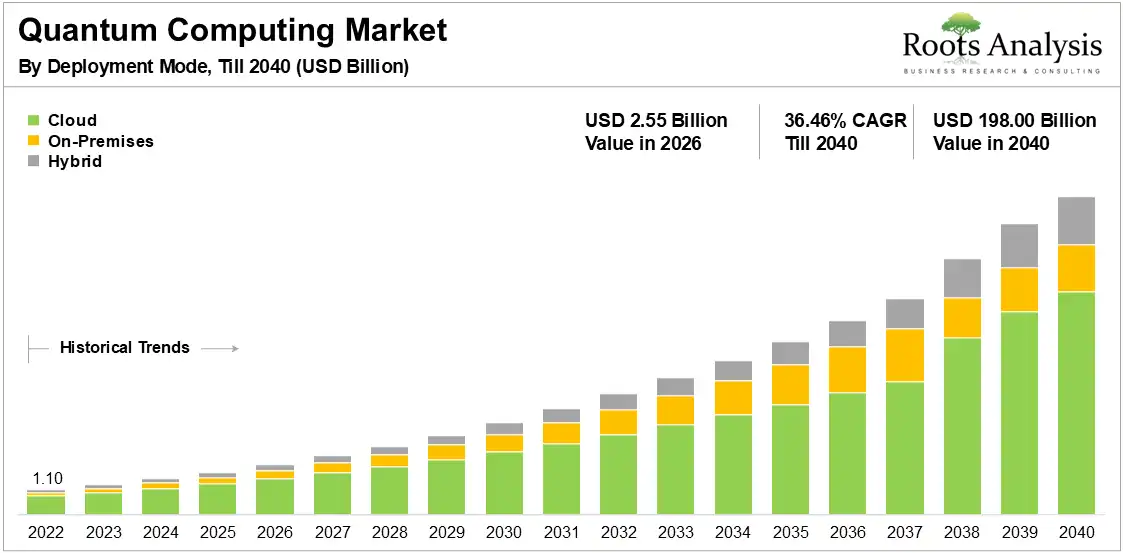
The global quantum computing market size is projected to grow from USD 2.55 billion in 2026 to USD 198.00 billion by 2040, representing a CAGR of 36.46% during the forecast period 2026 to 2040.
See What’s in the Full Report – Request Your Complimentary Insights!
Market Report: Key Takeaways
- In terms of offerings, services dominate the market, capturing a 40.0% share in 2026, and is also projected to grow at a leading 39.2% CAGR through 2040 for sustained integration support.
- With respect to deployment modes, cloud-based deployment architecture dominates the industry (65.0%) in 2026 and is poised to experience a higher CAGR of 37.3% till 2040 by abstracting hardware constraints.
- Based on technology, superconducting qubits capture a 32.5% share in 2026, whereas photonic platforms experience faster growth (43.5% CAGR) through 2040 resolving persistent scaling limitations.
- Among applications, optimization maintains a 40.5% share in 2026, however machine learning projects faster growth at a higher CAGR till 2040 driving advanced algorithmic training.
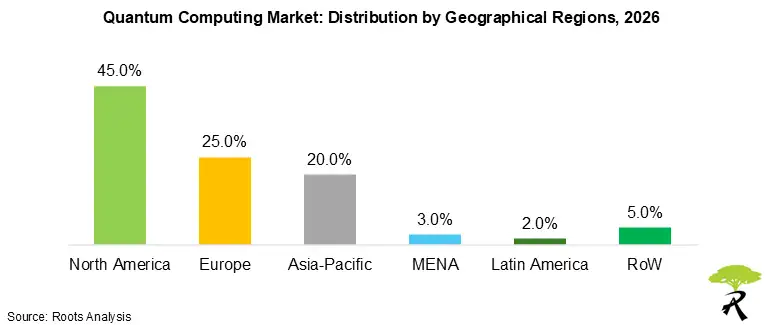
- Regionally, North America holds the largest share (45.0%) in 2026, while Asia-Pacific showcases faster growth at a 39.8% CAGR till 2040 expanding sovereign computational capabilities.
- Focusing on end use industry, BFSI secures a 25.0% share in 2026. Conversely, the healthcare & pharmaceutical sector is projected to grow at 38.5% CAGR through 2040, driven by systemic macro mega trends in digital sovereignty.
Quantum Computing Market Outlook
The quantum landscape is rapidly maturing from conceptual exploration into a utility-focused architecture prioritizing robust, high-fidelity operations over mere qubit volume. Enterprise strategies now center on specialized, cloud-based access models, seamlessly embedding advanced processing capabilities directly within existing high-performance computing frameworks.
Sovereign security mandates and imperative post-quantum cryptographic transitions heavily drive the current market growth and capital allocation. Further, multi-billion-dollar strategic investments by tier-1 enterprises, exemplified by JPMorgan Chase’s USD 10 billion strategic technology initiative in 2025, alongside localized research infrastructure expansion, are advancing workforce development and immediate commercial adoption trajectories.
Hardware manufacturers are actively scaling modular, fault-tolerant networks to resolve highly complex, distributed computational challenges. Following urgent World Economic Forum directives in January 2026 regarding compressed Q-Day timelines, immense global investment is aggressively mobilizing to secure digital ecosystems and expedite utility-scale deployments.
Quantum Computing Market Growth Drivers, Restraints, Challenges and Opportunities

The quantum computing market navigates a complex interplay of structural drivers, restraints, opportunities, and challenges defining its trajectory. Quantum AI (generative artificial intelligence convergence) accelerates enterprise adoption, while severe classical integration latency hinders processing. Strategically, renewable energy grid optimization represents the defining opportunity unlocking sustainable infrastructure.
Pay Only for What You Need – The Best Way to Optimize
Quantum Computing Market Size Estimation Methodology
- As a starting point, we categorized the quantum computing ecosystem into core segments, specifically quantum hardware (including superconducting, trapped ion, and photonic technologies), quantum software, and quantum-as-a-service (QaaS) deployment models. We also mapped vertical-specific adoption patterns across high-impact industries like pharmaceuticals, finance, and aerospace to establish distinct, industry-specific demand curves.
- Following this, we analyzed historical benchmarks from analogous deep-tech cycles, such as high-performance computing (HPC) and early-stage AI, to model technology diffusion timelines. We evaluated enterprise readiness and the transition from quantum-ready consulting to production-level execution, carefully narrowing the total addressable market (TAM) to the serviceable obtainable market (SOM) by accounting for technical bottlenecks like cryogenic infrastructure requirements and error correction limitations.
- Subsequently, we gathered critical data points on hardware unit shipments, QaaS subscription models, and compute-hour pricing trends through primary research with C-suite executives at hardware providers and lead researchers at Tier-1 technology firms. We triangulated these internal development milestones with secondary sources, synthesizing venture capital inflows, government R&D grants, patent filings, and corporate earnings reports to validate overall investment momentum.
- Integrating these triangulated insights, we calculated the global quantum computing market size and projected future commercial opportunities. This was achieved through a comprehensive hybrid forecasting framework that aligned supply-side hardware roadmaps and qubit scalability with demand-side R&D budgets and enterprise pilot programs, factoring in a projected quantum advantage inflection point where quantum systems outperform classical supercomputers for specific commercial use cases.
- The total projected market value was then systematically distributed across distinct market segments, allocating revenue by hardware technology, software algorithms, and service models, as well as across key geographic regions. This regional allocation was heavily influenced by the density of quantum startups, localized cloud infrastructure investments, and national strategic initiatives across North America, Europe, and the Asia-Pacific.
- Finally, in order to assess the sensitivity of our assumptions, we conducted a multivariate sensitivity and scenario analysis (base, optimistic, and conservative) on some of the most important parameters of our forecast methodology, evaluating the potential impact of technical volatility, global semiconductor supply chain stability, and shifts in sovereign technology protectionism on the overall market trajectory.
Quantum Computing Market Share Insights
Quantum Computing Services Offering Dominates the Market in 2026 and Beyond
- Services segment dominates the quantum computing market, capturing a 40.0% market share in 2026. This is because cloud-based quantum as a service (QaaS) platforms completely eliminate extreme hardware capital expenditures. Global enterprises utilize these flexible, pay-per-use ecosystems to scale complex algorithmic experimentation, directly aligning strategic procurement with strict corporate risk aversion mandates.
- Aggressive hybrid infrastructure investments definitively anchor this remote-access commercial model. For instance, Qilimanjaro’s SpeQtrum QaaS, launched in March 2026, provides global enterprises with immediate cloud integration across both analog and digital QPUs, driving sustained service revenues without localized physical hardware bottlenecks.
- Services also represent the fastest-growing sub-segment, driven by explosive commercial requirements for specialized simulation capabilities. By bypassing isolated laboratory environments, industries instantly integrate high-value machine learning directly into their core operational workflows without committing to rapidly depreciating, complex physical hardware infrastructure.
- Demonstrating this rapid trajectory, D-Wave officially upgraded its Stride hybrid solver at the January 2026 Qubits conference. This critical software advancement enables developers to directly embed predictive surrogate machine learning models into existing enterprise scheduling algorithms, driving sustained commercialization revenue.
By Deployment Mode: Cloud-based Quantum Computing Market Forecast
- Cloud-based infrastructures secure the dominant 2026 deployment market share, fundamentally eliminating cost-prohibitive physical hardware investments and extreme cryogenic maintenance requirements. Global enterprises leverage existing API ecosystems to seamlessly integrate remote quantum processing units (QPUs) into classical architectures, bypassing massive proprietary computing expenditures.
- Strategic vendor software upgrades aggressively accelerate this remote integration model. In April 2026, Quandela formally launched its Belenos quantum computer directly on the OVHcloud platform, successfully democratizing sovereign hybrid machine learning access across complex high-performance artificial intelligence pipelines.
Want Information on Specific Region / Segment?
Quantum Computing Market CAGR and Growth by Geographical Regions
North America Quantum Infrastructure Dominates the 2026 Market
- North America secures the dominant market share (45.0%) through aggressive federal funding mechanisms accelerating scalable commercialization. This mature supply chain environment provides definitive cost advantages, explicitly allowing regional hardware developers to execute rapid iteration cycles essential for achieving foundational fault-tolerant enterprise infrastructure deployments.
- Aggressive federal procurement contracts directly secure this dominant supply chain. In April 2026, the US Defense Advanced Research Projects Agency officially awarded Infleqtion a strategic development grant to advance heterogeneous quantum architectures, accelerating the deployment of error-corrected logic circuits.
Asia-Pacific Quantum Commercialization Growth and Superconducting QPU Expansion
- The Asia-Pacific region projects the fastest commercial growth (with 39.80% CAGR) through 2040, driven entirely by aggressive sovereign capital injections bridging early academic research directly into utility-scale deployment. Strategic government procurement frameworks definitively establish regional infrastructure hubs, drastically accelerating enterprise adoption across complex financial applications.
- Collaborative commercial consortiums bridging public research and private manufacturing definitively accelerate this scaling trajectory. In April 2025, Japanese hardware provider Fujitsu launched a 256-qubit superconducting quantum computer alongside RIKEN, actively preparing an unprecedented 1,000-qubit commercial system targeting widespread enterprise deployments throughout 2026.
Europe Quantum Computing Market Share Analysis: Factors Driving Growth in 2026
- In 2026, Europe regions hold the second largest share (25.0%) within the quantum computing industry. Notably, the European market growth accelerates through aggressive regional initiatives seamlessly integrating quantum processors directly into established high-performance computing centers. Coordinated transnational funding mandates effectively secure sovereign supply chains, empowering industrial sectors to transition complex optimization workflows away from critical foreign infrastructure dependencies.
- Government-backed supercomputing deployments support this sovereign technological ecosystem. In February 2026, European consortiums inaugurated the Euro-Q-Exa digital quantum computer in Munich, utilizing IQM's advanced superconducting qubits to provide direct hybrid computational access for massive regional industrial and academic enterprise sectors.
Market Ecosystem Analysis
Quantum Computing Market Competitive Landscape: Consolidating Hardware Leadership and QPU Orchestration
The competitive landscape for quantum computing is fragmented between established multinational infrastructure providers securing sovereign supply chains, and specialized innovators deploying critical sub-system enhancements. Market leadership now demands high-fidelity error mitigation, capital-intensive domestic manufacturing capabilities, and advanced software layers translating high-level business logic into optimized hardware execution. Quantum computing market share is dominated by leading players, including Google Quantum AI, IonQ, Maybell Quantum, PsiQuantum, QuEra Computing, and Riverlane.
Tier-1 Quantum Computing Market Players: Securing Utility-Scale Fault-Tolerant Architectures
- Leading infrastructure providers are aggressively transitioning toward industrialized hardware configurations prioritizing integrated processing. In March 2026, IBM accelerated this commercial trajectory by publishing the industry’s inaugural quantum-centric supercomputing reference architecture, an advanced blueprint physically linking quantum processors with conventional GPU clusters to solve massive scientific workloads.
- Concurrently, strategic sector consolidation is expanding sovereign capabilities. In January 2026, IonQ announced the acquisition of SkyWater Technology, effectively establishing a well-capitalized domestic merchant foundry intended to secure the US quantum manufacturing base. These definitive institutional actions reflect a broader pivot away from experimental proofs toward secured, high-fidelity deployment frameworks serving national economic interests.
Quantum Computing Startups and Innovator Companies: Optimizing Sub-System Orchestration and Algorithmic Simulations
- Specialized innovators are aggressively resolving deep systemic bottlenecks across discrete operational layers. Financial simulation scalability achieved a critical milestone in March 2025 when Classiq compressed enterprise quantum circuits by 95% during a joint Monte Carlo risk portfolio evaluation with Sumitomo Corporation, proving algorithmic viability for probabilistic banking models.
- Simultaneously, localized hardware constraints are being systematically dismantled. In September 2025, Maybell Quantum secured USD 40 million in Series B financing to scale the commercialization of its high-density cryogenic and radio-frequency systems. This capital influx directly commercializes the foundational cooling infrastructures fundamentally required to support massive utility-scale deployments without introducing crippling environmental noise.
Quantum Computing Market Trends
Quantum Infrastructure Procurement and QaaS Commercialization
- The immediate shift toward quantum-as-a-service fundamentally alters how corporate enterprises procure advanced processing power. By eliminating massive upfront hardware investments, this access model allows research divisions to validate complex algorithms without waiting for localized infrastructure installations.
- Meanwhile, the ongoing hardware competition between superconducting qubits vs. trapped ion architectures is rapidly maturing the broader quantum computing supply chain. This intense rivalry forces component manufacturers to standardize fabrication, thereby lowering unit production costs for emerging commercial data centers.
Enterprise Quantum Algorithms and Post-Quantum Cryptographic Agility
- Applying quantum computing in drug discovery helps pharmaceutical developers significantly reduce time spent simulating complex molecular interactions. Similarly, adopting sophisticated quantum financial modeling applications gives global banks distinct advantages when pricing exotic derivatives much faster than traditional banking computing systems.
- Beyond immediate algorithmic applications, international regulatory mandates requiring immediate transitions to post-quantum cryptography are currently creating massive revenue streams. Specialized software vendors now face intense pressure to overhaul enterprise cyber security networks, ensuring critical corporate data remains protected against future decryption.
Your Business is Unique – Why Shouldn’t Your Report Be?
Market Access Considerations
Quantum Hardware Trade Restrictions and Sovereign Geopolitical Localization
Strict national security export controls on high-qubit systems severely fragment global market access. Cross-border vendors face immense entry barriers, as geopolitical restrictions force them to establish entirely localized supply chains and domestic partnerships. This regulatory friction restricts international expansion, locking emerging hardware developers out of lucrative foreign enterprise contracts.
Quantum Cryogenic Procurement and QPU Physical Deployment Constraints
Severe supply chain bottlenecks for critical cryogenic components and scarce Helium-3 isotopes create formidable physical barriers to market entry. Because established incumbents monopolize existing supplier capacity through long-term contracts, new hardware manufacturers face prohibitive delays in securing necessary infrastructure, completely stalling their ability to commercialize and deploy competing QPU systems.
Quantum Architectural Fragmentation and Cross-Platform Middleware Standardization
The absence of unified quantum programming standards creates massive entry barriers for independent software vendors attempting to access the broader market. Because disparate QPU architecture requires highly specialized, non-transferable code, new entrants face cost-prohibitive R&D challenges. Interoperable middleware development remains an essential commercialization gateway to bypass rigid vendor lock-in ecosystems.
How Stakeholders Benefit from the Key Focus Areas of Our Quantum Computing Industry Report
The quantum computing market commands critical strategic focus as enterprise microservices and cloud-native architectures scale exponentially. This comprehensive quantum computing intelligence report equips decision-makers with rigorously validated market data, enabling precise investment forecasting, targeted product expansion, and confident navigation of complex regulatory and technological shifts across the digital ecosystem.
- Unmet Needs in Quantum Hardware and Commercial Market Gaps: This research isolates critical scaling bottlenecks within QPU fidelity and cross-platform error correction. By pinpointing these exact underserved segments, stakeholders can aggressively align targeted R&D strategies with validated enterprise demand, securing a distinct competitive advantage and accelerating quantum-as-a-service commercialization.
- Quantum Funding and Venture Investment Opportunities: The study maps sovereign funding mandates and venture capital flows, explicitly highlighting high-growth quantum infrastructure segments attracting strategic liquidity. Institutional investors leverage these financial baselines to assess risk-adjusted opportunities, validate operational business models, and confidently execute highly lucrative hardware consolidation strategies.
- Quantum Algorithmic Advancements and Technology Adoption Trends: Detailed coverage of competing QPU modalities and post-quantum cryptographic transitions clarifies exact technological trajectories. Technology officers evaluate proven commercial traction, ensuring enterprise hybrid-cloud integrations strictly align with validated adoption patterns to maximize operational resilience and bypass immense proprietary research costs.
- Quantum Computing Market Competitive Landscape and Industry Analysis: This section rigorously analyzes tier-one hyperscale incumbents and agile sub-system innovators, providing deep insights into proprietary hardware portfolios. Executives utilize this intelligence to benchmark full-stack capabilities, refine go-to-market execution, and orchestrate highly informed mergers, acquisitions, and competitive response frameworks.
- Funding and Investment Analysis of Quantum Computing Market: Comprehensive financial analysis highlights capital flow trends, venture hotspots, and high-growth segments within quantum-resilient infrastructure. Stakeholders gain absolute clarity regarding private equity concentration, empowering investors to strategically allocate capital toward scalable automation platforms and rapidly execute lucrative consolidation strategies across the trust ecosystem.
- Mapping Strategic Quantum Ecosystem Partnerships and Alliances: This analysis explicitly details commercial synergies forged between specialized QPU manufacturers, middleware developers, and hyperscale cloud vendors. Stakeholders extract actionable collaborative blueprints, utilizing these validated ecosystem maps to rapidly expand market reach, enhance native algorithmic integrations, and accelerate utility-scale innovation cycles.
- Quantum Market Revenue Forecast and Geographic Expansion Opportunities: Evaluating diverse QPU deployment modes and regulated end use industry verticals, this comprehensive quantum computing market segmentation analysis identifies maximum-yield commercial territories. Global strategists rely on these precise regional growth patterns to orchestrate targeted market penetration, allocate capital efficiently, and navigate localized sovereign trade complexities with absolute confidence.
Have Questions? Let’s Get Them Answered.
Quantum Computing Market: Scope of the Report
| Key Report Attributes | Details | |
| Forecast Period | Till 2040 | |
| Market Size 2026 | USD 2.55 Billion | |
| Market Size 2040 | USD 198.00 Billion | |
| CAGR (Till 2040) | 36.46% | |
| Segments Covered |
|
|
| Geographical Regions Covered |
|
|
| Key Sections Covered |
|
|
Source: Roots Analysis
Quantum Computing Market Segmentation
The global quantum computing industry report presents an in-depth analysis, highlighting the capabilities of various stakeholders, based on different segments such as offering, deployment mode, technology, application, end use industry, geographical regions, and key players.
Market Share by Offering
- Hardware
- Software
- Services
- Consulting
- Professional
Market Share by Deployment Mode
- Cloud
- On-Premises
- Hybrid
Market Share by Technology
- Photonic Qubits
- Quantum Annealing
- Spin-based Qubits
- Superconducting Qubits
- Topological Qubits
- Trapped Ion Qubits
- Others
Market Share by Application
- Cryptography and Security
- Machine Learning
- Optimization
- Simulation and Modeling
- Others
Market Share by End Use Industry
- Aerospace and Defense
- Automotive
- BFSI
- Chemicals and Materials
- Energy and Utilities
- Healthcare and Pharmaceuticals
- Others
Market Share by Geographical Regions
- North America
- US
- Canada
- Mexico
- Rest of North America
- Europe
- Austria
- Belgium
- Denmark
- France
- Germany
- Ireland
- Italy
- Netherlands
- Norway
- Russia
- Spain
- Sweden
- Switzerland
- UK
- Rest of Europe
- Asia-Pacific
- Australia
- China
- India
- Japan
- New-Zealand
- Singapore
- South Korea
- Rest of Asia-Pacific
- Latin America
- Argentina
- Brazil
- Chile
- Colombia
- Venezuela
- Rest of Latin America
- Middle East and North Africa (MENA)
- Egypt
- Iran
- Iraq
- Israel
- Kuwait
- Saudi Arabia
- UAE
- Rest of MENA
- Rest of the World


