
Lowest Price Guaranteed
Slides
181
Last Updated
May 2025
View Count
11608
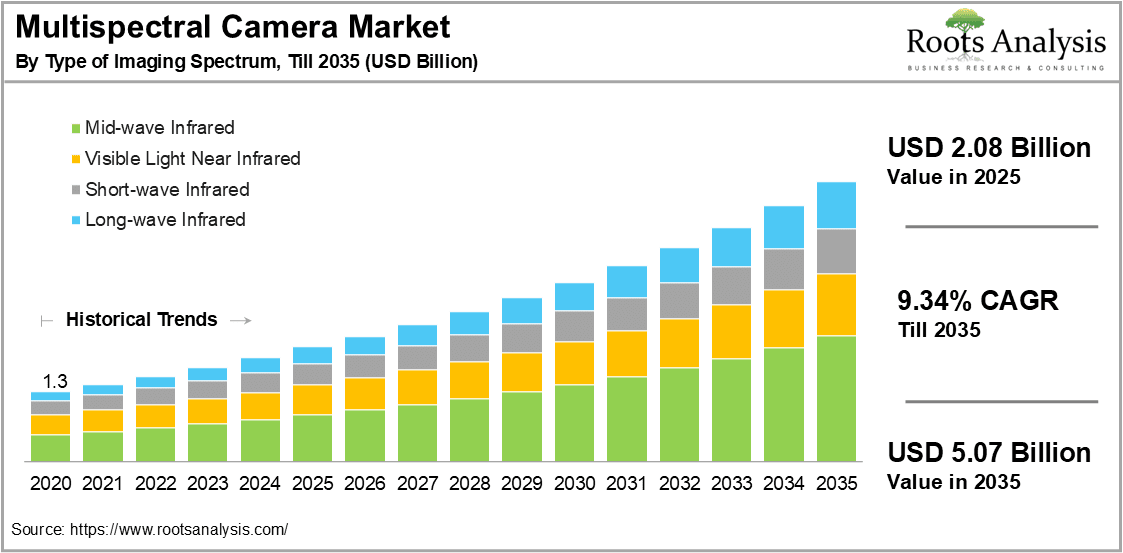
The multispectral camera market size is projected to grow from USD 2.08 billion in 2025 to USD 5.07 billion by 2035, representing a CAGR of 9.34% during the forecast period till 2035.
 |
The new research study consists of multispectral camera market and trends analysis, detailed market forecast analysis, and provide actionable strategic recommendations.
A multispectral camera is a type of imaging device that captures data across multiple wavelengths of light including both visible and non-visible parts of the electromagnetic spectrum. The sensor technology in multispectral cameras is capable of capturing numerous spectral bands that offer precision imaging of objects and non-destructive analysis. The core feature of data processing in multispectral imaging which extracts insights from spectral information for various applications enhances its importance among applications.
Thus, with the expanding use of multispectral imaging technology across different industries, the multispectral camera market is booming exponentially. Among the key industries, defense is the leading application sector in terms of revenue due to the widespread use of multispectral imaging technology for surveillance. Its remote sensing technologies have also broadened the applications in environmental monitoring. Additionally, the soaring adoption of multispectral cameras highlights the key trends in agricultural technology such as precision farming, crop health monitoring, and resource optimization, spurring the market demand.
With regard to regulatory impacts on imaging technologies, the market is experiencing positive growth, specifically, in agriculture and environmental monitoring where compliance with sustainability and safety is crucial.
Apart from this, the growing trend of hyperspectral vs. multispectral cameras is raising the technology demand for their most suitable applications where hyperspectral cameras provide detailed spectral data for research while multispectral cameras are used for wider applications. As a consequence, multispectral camera investment opportunities are bourgeoning as industries including environmental monitoring, agriculture, and healthcare seek advanced imaging solutions for improved decision-making and operational efficiency. Overall, emerging industry trends and key drivers are collectively poised to fuel the growth of the market during this forecast period.
The multispectral camera market report presents an in-depth analysis of the various companies that are involved in offering multispectral cameras, across different segments, as defined in the table below:
| Key Report Attributes | Details | |
| Historical Trend | Since 2020 | |
| Forecast Period | Till 2035 | |
| Current Market Size | $ 2.08 Billion | |
| Market Size Value by 2035 | $ 5.07 Billion | |
| CAGR (Till 2035) | 9.34% | |
| Type of Cooling Technology |
|
|
| Type of Imaging Spectrum |
|
|
| Type of Application |
|
|
| Type of End User |
|
|
| Geographical Regions |
|
|
| Leading Market Players |
|
|
| PowerPoint Presentation (Complimentary) |
Available | |
| Customization Scope | 15% Free Customization | |
| Excel Data Packs (Complimentary) |
|
|
The global multispectral camera market is categorized into multiple cooling technologies wherein the cooled segment is projected to foster market growth with (~63%) of the market share by 2035. Cooled multispectral cameras have higher sensitivity and better signal-to-noise ratio which allow them to detect even the smallest temperature difference. Therefore, this capability makes them essential for applications requiring high precision. Whereas, the uncooled segment is anticipated to experience a significant (10.58%) growth rate during this projection timeframe driven by cost-effectiveness, compact and lightweight design, and ease of maintenance. Also, uncooled multispectral cameras are increasingly being integrated into advanced driver systems and smartphones which will magnify the segment growth.
Based on the type of imaging spectrum, the mid-wave segment is poised to lead the market with (~41%) of the market share by 2035. The segment will accelerate the market owing to its ability to penetrate fog, haze, smoke, and thin foliage, enabling clear target visualization, which is beneficial for defense and surveillance applications. While the visible near-infrared segment is likely to rise at a substantial (11.02%) CAGR during this projection timeframe. This can be ascribed to the wide range of applications such as agriculture and environmental monitoring supported by the availability of high-quality, cost-effective sensors that are capable of capturing visible light data.
The distribution of the global market for multispectral cameras is segmented into various applications where the defense applications have been leading the segment. Defense applications are expected to continue to drive the market growth with the largest (~44%) of the market share by 2035. The key driving factors behind this growth are the increasing demand for border security, counterterrorism efforts, and maritime surveillance. These cameras provide enhanced situational awareness and operational effectiveness in surveillance, thus, significantly contributing to the market's expansion.
Moreover, the environmental monitoring segment is expected to expand at an incredible (12.44%) CAGR throughout this forecast period. Multispectral cameras are used to track environmental changes, such as deforestation, land degradation, and changes in water bodies that help in the global fight against climate change, thereby, bolstering the market prospects.
This segmentation of the market describes the type of end-users such as man-portable and payloads. According to our multispectral camera industry analysis, the payload segment exhibits a strong position by occupying (~62%) of the current market share. This trend is expected to continue due to soaring demand for multispectral cameras integrated into unmanned aerial vehicles (UAVs), satellites, and other platforms. UAVS with multispectral cameras is revolutionizing various industries by providing high-resolution, real-time data for better decision-making.
Furthermore, the man-portable is anticipated to register a noteworthy (11.7%) growth rate during this forecast period. This can be attributed to the widespread applications in military and security where these cameras allow troops and field operators to perform surveillance, reconnaissance, and target detection in various environments.
This segment highlights the distribution of the multispectral camera market across various geographical regions, such as North America, Europe, Asia, Latin America, the Middle East and North Africa, and the rest of the world. Based on revenue, North America leads the market with (~46%) of the current market share due to the early adoption of advanced technology.
Additionally, Asia is facilitating the emergence of new opportunities for the multispectral imaging market owing to its large agricultural base where precision farming advances the technology demand. Rapid industrialization and a surge in the use of drones for surveillance, mapping, and environmental monitoring have broadened the applications of multispectral cameras, spurring the market growth. Furthermore, growing government initiatives to promote advanced technology for urban planning and environmental protection is an additional factor augmenting the market scope in Asia.
The “Multispectral Camera Market, Till-2035: Industry Trends and Global Forecasts” report features an extensive study of the current market landscape, market size and future opportunities within the multispectral camera market, during the given forecast period. The market report highlights the efforts of several stakeholders involved in this rapidly emerging segment of the service providers industry. Key takeaways of the multispectral camera market report are briefly discussed below.
The rising adoption of the multispectral camera across various industries including healthcare, agriculture, and defense is the major key driver to advance the market development. Particularly, the heightening demand for multispectral cameras in agriculture is augmenting the market growth. In agriculture, precision agriculture tools are used for crop health monitoring, irrigation management, and yield optimization that help farmers to make data-driven decisions. Along with this, the significant benefits of multispectral imaging in healthcare have boosted the implementation of the technology for non-invasive diagnostics, tissue analysis, and surgical assistance, inflating the market demand in the medical sector.
Apart from this, the expanding application of environmental monitoring using multispectral cameras is notably supplementing the market progress due to their critical role in monitoring in climate change, forestry, and biodiversity. Moreover, the rising integration of AI in imaging solutions driven by ongoing advancements in imaging technology is anticipated to amplify the market potential during this forecast period.
The competitive landscape of the market is changing dynamically with the presence of large and small-sized companies operating in the market. Prominent companies such as Teledyne FLIR, Headwall Photonic, Unispectral, and others dominate the industry by holding a substantial market share of multispectral cameras. These companies are focusing on R&D investment, technological advancements, and partnerships and collaboration that aid them boost their competitive edge. Meanwhile, emerging startups and smaller companies are emphasizing niche applications such as UAV-based multispectral imaging for crop health and forestry analysis that help them enter the market.
The high cost can be a leading challenge as these cameras and their associated systems are expensive which can limit their adoption, especially, among small and medium-sized enterprises. Furthermore, incorporating multispectral imaging technology into existing systems and applications can be technically challenging. Therefore, the high-cost complexity of technology integration is the key market challenge for multispectral cameras that can halt the growth of the market.
North America remains at the pinnacle in the global market for multispectral cameras due to its early adoption of advanced technology. The region is projected to continue to lead the market with (~46%) of the current market share during this forecast period as North America leads in adopting innovative technologies such as multispectral imaging across industries from agriculture to healthcare. The robust defense and security system is a major contributor to fueling the demand for multispectral cameras as it is commonly used for surveillance and target detection. Additionally, the key players established in the region fortify the market position with their technological advancements in multispectral imaging technology. For instance, in October 2024, Teledyne FLIR introduced TrafiBot Dual AI multispectral camera which is designed for interurban traffic safety. This system enhances tunnel and bridge safety by detecting unseen objects and vehicle fire risks.
Examples of key players involved in the market for multispectral camera (which have also been captured in this market report, arranged in alphabetical order) include Collins Aerospace (US), Cuber, DJI (China), Headwall Photonics (US), Hensoldt (Germany), HGH Group (France) JAI (Denmark), Leonardo DRS (US), Ocean Insight (US), Opgal Optronics Industries (Israel), Paras Aerospace (India), Silos Technology, Spectral Devices (Canada), Teledyne FLIR (US), Telops (Canada), TetraCam (US), Unispectral (Israel), and Wingtra (Switzerland). This market report includes an easily searchable excel database of all the companies who have adopted the multispectral camera market.
The market report presents an in-depth analysis, highlighting the capabilities of various companies engaged in this domain, across different segments. Amongst other elements, the market report includes:
At Roots Analysis, we genuinely care about your success and understand that your business requirements are unique. While our market research reports provide valuable insights, we recognize that they might not cover every aspect you need to make well-informed strategic decisions. To account for that, we offer 15% free report customization tailored to your specific needs. Whether you require additional quantitative analysis, qualitative insights, or any other information related to the multispectral camera market, reach out us today at: support@rootsanalysis.com